 27
27
 27
27
 27
27
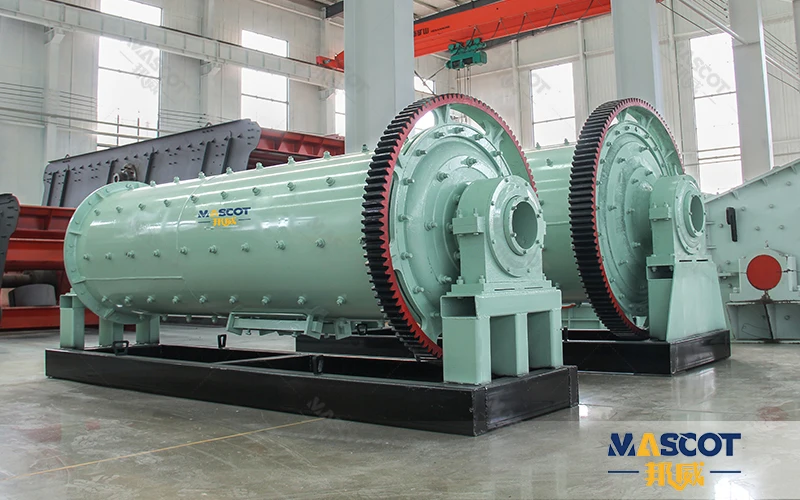
Silica sand is one of the most abrasive feeds a grinding circuit will ever handle, and in mineral processing it is almost always ground wet. The wet ball mill from Zhengzhou Mascot Industry is built for that duty: a horizontal rotating cylinder that reduces material by impact and attrition while the feed moves through it as a slurry, not as dust. Three decisions decide whether a silica sand line performs as designed — the grinding media, the liners, and the output settings. This guide covers all three, with the published specifications of the models most often specified for silica sand.
Silica sand is processed wet for reasons that are partly process-driven and partly practical. A wet mill discharges a slurry rather than a dry powder, and the water carries the ground product to classification while keeping the working area free of airborne dust. Downstream operations — flotation, leaching, washing or dewatering — then take the material in the form they need it, instead of requiring a separate conditioning step first.
The trade-off is that everything inside a wet mill has to survive water. The shell, the trunnions and the liners all sit in a corrosive, abrasive slurry environment, so material selection is not a finishing detail. It is the difference between a mill that runs for years and one that is rebuilt every season. That is why a wet ball mill intended for hard minerals is specified around its wear parts as much as around its motor.

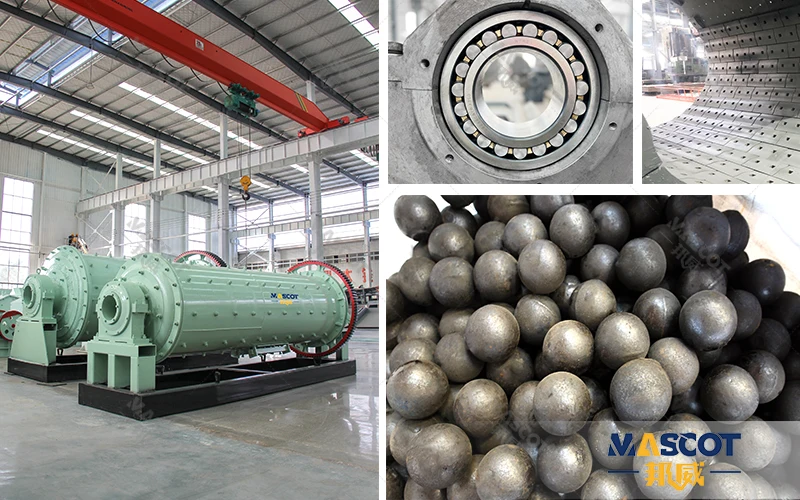
The media do the grinding, and two parameters decide how well they do it: how much of the cylinder the charge fills, and how the ball sizes are mixed. Mascot wet ball mills are designed to run with a media charge of roughly 30-40% of the mill volume, loaded as a graded mix rather than a single ball size.
The principle behind a graded charge is straightforward. The largest balls in the mix carry the mass that delivers the impact needed to break the coarsest particles in the feed, which runs up to about 25 mm. The smaller balls contribute surface area, and it is that surface area which performs the attrition that refines the product as the slurry travels down the cylinder. A charge built from one ball size can only do one of those jobs well.
Because the media are the main consumable in the circuit, they are also the easiest place to lose efficiency without noticing. A charge that has worn below its design size distribution loses impact capacity, and the plant sees tonnage fall while power draw stays flat. Top up the charge on a schedule and track ball size distribution, not just total ball weight — the two numbers tell different stories.

Liners do two jobs at once: they protect the shell from the charge, and they shape the motion of the charge so the balls lift and cascade instead of sliding. On a hard, abrasive feed such as silica sand, both jobs are demanding, and liner wear becomes the event that schedules the mill's downtime.
Mascot builds the wet ball mill with a heavy-duty, corrosion-protected shell and wear-resistant liners, and specifies the liner material to the application. For hard, abrasive duty the standard choice is high-manganese steel — the same liner type used on the Mascot wet mill running at a gold operation in Ghana, described in the field note below, which has operated without a rebuild. Two design details make that specification practical: modular components, which shorten the work of a liner change once it is due, and a centralized lubrication system, which keeps the trunnion and bearing points serviced between changes. A mill that is quick to reline is a mill that stays on its maintenance schedule.

Output on a wet line means two numbers at once: how many tons per hour leave the mill, and how fine the slurry is when it leaves. Both are controlled by the same set of variables — retention time, slurry density and media selection.
In normal operation, feed material of up to about 25 mm is mixed with water to form a slurry of roughly 60-75% solids and fed into the mill continuously. A thicker slurry stays in the cylinder longer and leaves finer; a thinner slurry travels through faster and leaves coarser, at higher tonnage. Product exits either by overflow or through a grate discharge, and the discharge arrangement the mill is ordered with, together with the retention time it creates, is the operator's main lever for holding a target fineness.
Across the wet ball mill range, the published output size band runs from 0.074 mm to 0.4 mm, depending on model. Where the product specification is tight, the mill is run in closed circuit with a classifier, which returns oversize material to the mill for regrinding instead of allowing it into the finished product. That is also the arrangement that isolates output from fineness: the classifier, not the mill alone, holds the cut.
The table below lists published specifications for the models most often specified on silica sand and other wet mineral circuits. Small units serve pilot and low-tonnage lines; the larger models carry the tonnage.
| Model | Cylinder Rotating Speed (r/min) | Loading Ball Weight (t) | Output Size (mm) | Capacity (t/h) | Power (kW) |
|---|---|---|---|---|---|
| 1200x2400 | 35 | 4.6 | 0.075-0.6 | 1.6-5.8 | 37 |
| 1500x3000 | 29 | 9 | 0.074-0.4 | 2-7 | 75 |
| 1500x4500 | 27 | 11 | 0.074-0.4 | 3-6 | 110 |
| 1830x4500 | 25.4 | 15 | 0.074-0.4 | 4.5-12 | 155 |
| 1830x7000 | 24.1 | 23 | 0.074-0.4 | 7.5-17 | 245 |
| 2100x4500 | 23.7 | 24 | 0.074-0.4 | 8-43 | 245 |
| 2400x4500 | 21 | 30 | 0.074-0.4 | 40-60 | 320 |
| 3200x4500 | 18 | 65 | 0.074-0.4 | 50-90 | 800 |
Capacity is not a fixed property of the model: it moves with the hardness of the feed, the feed size and the target fineness, as well as with the slurry density the plant runs. Treat the table as the starting envelope, not as a quotation. Mascot engineers size the mill against the actual feed and the required product specification before an order is placed, and confirm the configuration in a project design.
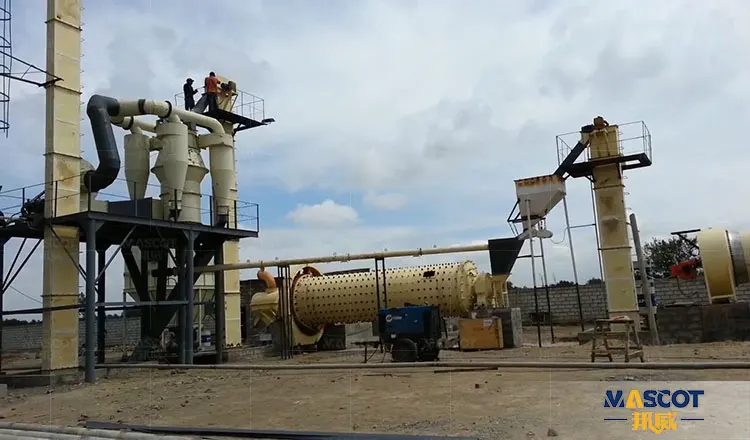
The clearest evidence for a wet mill is a mill that has already run. At a 200 TPD carbon-in-pulp plant in the Ashanti gold belt, a Mascot 1500x3000 wet ball mill fitted with high-manganese steel liners and matched with a spiral classifier for closed-circuit grinding was set the task of grinding gold ore to 80% passing 200 mesh (0.074 mm) for cyanide leaching.
The unit settled at a stable 5-6 t/h and exceeded the plant's original throughput target by 15%. The finer, more consistent grind then lifted leaching recovery from 88% to 92%. Two Mascot engineers carried out a 21-day on-site installation and commissioning, including full operator training and maintenance protocol setup. The arrangement that made the difference — wet mill in closed circuit with a classifier — is exactly the pattern a silica sand line uses to hold a fine product specification.
Q1: What grinding media should a silica sand wet ball mill use?
A: A graded steel ball charge filling roughly 30-40% of the mill volume, with the largest balls sized to the top feed size (about 25 mm) and smaller sizes providing the attrition that refines the product. Monitor ball size distribution as well as total ball weight, and top up on a schedule.
Q2: How often do the liners have to be replaced?
A: Liner life depends on how abrasive the feed is and how many hours the mill runs. Mascot specifies the liner material to the application and supplies high-manganese steel for hard, abrasive duty. Modular construction and centralized lubrication keep liner changes short when they fall due.
Q3: What output size can be reached on silica sand?
A: The published band across the range is 0.074 mm to 0.4 mm depending on model. For a tight specification, run the mill in closed circuit with a classifier so oversize is returned for regrinding rather than passing into the product.
Q4: What are the delivery time and warranty terms?
A: Stock models ship in 7-10 days; customized production takes 15-30 days. Mascot provides a 12-month warranty on the whole machine and a 12-month warranty on core components such as bearings, motors and liners, with 24/7 online consultation and engineers available for on-site installation and commissioning.
Q5: Can Mascot supply the complete processing line, not only the mill?
A: Yes. Mascot delivers turnkey circuits covering crushing, grinding, classification and the downstream flotation or leaching stage, and has delivered complete mineral processing projects in Africa, Southeast Asia and South America.
On a silica sand circuit, the wet ball mill is asked to do two things at once: hold tonnage and hold fineness, in a slurry that wears everything it touches. The media decide whether the charge can still break the coarse feed and refine the fines; the liners decide how often the mill stops; and retention time, slurry density and the discharge arrangement decide the output number the plant actually gets. Published capacities across the range run from 1.6 t/h on the 1200x2400 to 50-90 t/h on the 3200x4500, with product sizes from 0.074 mm to 0.4 mm, and a closed circuit with a classifier is what holds a tight specification. Share your feed size, target product size and required tonnage with the Mascot engineering team and the line can be sized against your material rather than against a table.

About of Mascot
Zhengzhou Mascot Industry is a high-tech mining equipment company integrating R&D, manufacturing, sales, and after-sales service. Focusing on crushing, grinding, and mineral processing equipment, we provide professional solutions to our customers. We are ISO9001:2015 certified, and our products include mobile crushing plants, crawler crushing plant, construction waste crushing plants, jaw crushers, sand making machines, cone crushers, fine crushers, grinding mills, ball mills, etc., all with reliable performance to meet diverse project needs.
• Professional pre-sales support: Free project design and comprehensive solutions to help you accurately select the right equipment;
• Comprehensive on-site service: Providing installation guidance and worker training to ensure smooth equipment commissioning;
• Reliable after-sales guarantee: A complete after-sales system, timely response to technical inquiries and equipment maintenance, ensuring long-term stable operation.
To protect your rights, please contact us through the following official channels for professional service:
WhatsApp: 0086-16650273865
Email: mascot@mascotenv.com
We are committed to providing high-quality equipment and full-cycle services to deliver comprehensive intelligent solutions for the global mining industry!

The MTW series European grinding mill production line includes high-efficiency crushers, elevators, electromagnetic vibration feeders, milling machines, classifiers, and collectors. These pieces of equipment work together to achieve efficient crushing, grinding, and classification of various non-metallic ores, coal powder, slag, and other materials. It can meet the diverse needs of various industries for powder particle size, uniformity, shape, etc., and offer enterprises high-quality grinding products.

The gypsum grinding production line is an efficient, stable, and environmentally friendly production solution, which is widely used in construction, decoration, the chemical industry, and other fields. In addition, the grinding process is particularly critical, which directly affects the quality and particle size of the final product. With the continuous development of science and technology, the technical level and production efficiency of gypsum grinding production lines will be further improved, providing strong support for the development of the gypsum processing industry.

This production line utilizes a three-ring medium-speed micro-grinding mill as the central equipment, complemented by other auxiliary equipment like hammer crushers, bucket elevators, and storage silos to establish a comprehensive grinding operation system. It has demonstrated strong potential for application and market competitiveness in industries such as construction, chemical industry, and new materials.

The Raymond mill production line is a highly efficient system designed for grinding operations, with a focus on energy efficiency, durability, and productivity. It caters to the needs of users by offering fine powder products in non-metallic ores, coal powder, and slag processing, aiding enterprises in achieving sustainable growth.

YGMX Enhanced High-Pressure Mill is a new type of high-performance grinding equipment, and the biggest improvement of this milling equipment lies in the increase of the high-pressure spring system in the grinding roller part. Compared with the traditional high-pressure roller mill, it has a wider scope of application and excellent performance to meet the production needs of a variety of powder fineness. It is widely used in non-metallic minerals, chemicals, building materials, metallurgy, environmental protection, etc. Multiple areas.
Green and Intelligent Mining Machinery
Manufacturing and Export Base
Based on high quality and perfect after-sales service, our products have been
exported to more than 120 countries and regions.
Copyright © 2023 Zhengzhou Mascot Environmental Technology Co., Ltd Record number: Yu ICP No. 13021523-4





 WhatsApp