
Two grinding technologies dominate the calcium carbonate industry: the ball mill, an old and proven workhorse, and the MTW Trapezium Grinding Mill, the European-type generation. For a plant producing 250-mesh calcium carbonate for concrete admixtures, paint fillers or desulfurization, the choice between them decides the particle size distribution of the product, the energy bill and the cost per ton. This article compares them on the lines that matter — fineness consistency, output, energy, maintenance and line complexity — and gives an honest verdict for the 250-mesh application.
The ball mill grinds by tumbling steel balls against the material: impact and attrition inside a rotating drum. The process is simple and robust, but it produces a relatively wide particle size distribution — a mix of fine and coarse fractions around the target size — because the grinding action in the drum is statistical rather than controlled. To hold a specification such as 250 mesh, a ball mill line needs an external classifier to remove the coarse fraction and send it back for another pass.

The MTW mill works on a different principle: trapezoidal rollers press material against a grinding ring, squeezing it into powder with a controlled gap, while a frequency-conversion classifier on top cuts the product precisely at the target size. The result is a narrower particle size distribution — fewer oversize particles, more consistent powder — which is exactly what 250-mesh calcium carbonate buyers test for when they receive a shipment.

At 250 mesh — particles of about 0.058-0.063mm — consistency decides whether the powder is saleable to demanding customers. A concrete admixture producer cannot accept batches with an over-coarse tail, because coarse particles weaken the mix and clog dosing equipment. The MTW's classifier holds the cut point automatically: in the Southeast Asia reference project, an MTW175 line grinding limestone to 250 mesh maintained a 99.6% finished powder pass rate over more than ten months.
A ball mill at the same fineness depends on its external classifier and its media charge condition. As the balls wear, the grinding efficiency drifts, the distribution widens, and the operator must adjust feed and classifier settings to hold the spec. The MTW's classifier speed is set on the PLC panel and holds the cut precisely — the difference between a product that passes inspection every time and one that occasionally does not.

Fine grinding is energy-hungry in any technology, but the two machines spend energy differently. The ball mill lifts and tumbles the entire media charge — tens of tons of steel balls — whether the material is coarse or fine, and a large share of that energy goes into moving the media, not into grinding. As the target gets finer, the ball mill's energy per ton rises sharply.
The MTW's energy picture is different. The trapezoidal roller and ring enlarge the effective grinding area, lifting efficiency 20%-30% at the same power, and the integral bevel gear recovers about 15% of the energy split drives waste. The series reaches about 0.18-0.23 t/h per kilowatt at maximum output. The field result: the MTW175 line at 250 mesh delivered 31 t/h against a 28-32 t/h design target with 22% lower energy per ton than the traditional mills it replaced — the same energy advantage applies in a ball-mill comparison at fine-mesh duty.
Ball mill maintenance is a steady stream of work: steel media must be topped up as it wears, liners replaced on a cycle, and the mill stopped for each intervention. The media charge itself is a consumable cost that never stops, and a large-diameter ball mill is loud enough to require hearing protection everywhere around it.

The MTW line's maintenance is concentrated in fewer, scheduled events: grinding rollers and ring last 8-12 months on limestone and calcite, the dilute oil system runs four months between changes instead of constant grease service, and the curved air duct eliminates blockage stops. In the reference project, annual maintenance cost came in about 20% lower than the previous traditional equipment, with wear parts beyond ten months. Fewer interventions also mean more uptime — and uptime is output.

A 250-mesh ball mill line is a multi-machine system: the mill drum, the external air classifier, bucket elevators, the dust collector and multiple conveying stages arranged over a larger footprint, with more motors and more control points. The MTW line is a single integrated train — the main mill with its classifier on top, matched with the GZ2 feeder, TH400 elevator, LQM72-7 pulse dust collector and LSY273 screw conveyor under one PLC. Smaller footprint, fewer components, one control panel.
Line simplicity matters beyond space. Every additional machine is a potential failure point, a maintenance item and a control interface. For a plant building a 250-mesh calcium carbonate line today, the MTW's integrated design is not a convenience — it is a shorter project, a smaller team and fewer things to go wrong.
Honesty requires the counter-case. The ball mill remains a strong choice where the plant already operates ball mill infrastructure, where very large daily volumes justify its scale, or where the target is coarse powder for bulk markets. It is proven technology with a wide service base, and for some operators the familiarity alone is worth something.
For 250-mesh calcium carbonate with a controlled particle size distribution, the MTW wins on the lines that matter: narrower and more consistent fineness, lower energy per ton, fewer maintenance events and a simpler line. The field benchmark — 31 t/h, 99.6% pass rate, 22% lower energy — is the answer to the title question in production terms, not in theory. Send Mascot your material and target output for a project design, and let the numbers confirm the verdict for your plant.

Q1: Can a ball mill produce 250 mesh calcium carbonate?
A: Yes, with an external classifier — but the particle size distribution is wider and energy per ton is higher at fine-mesh duty. The MTW produces a narrower distribution with integrated classification.
Q2: Which has lower energy consumption?
A: At 250 mesh, the MTW's trapezoidal geometry and bevel gear drive deliver up to 22% lower energy per ton than traditional equipment — the ball mill's media charge consumes energy moving itself rather than grinding.
Q3: What about very large outputs above 50 t/h?
A: Beyond the MTW series' 50 t/h top end, very large ball mill lines remain relevant for bulk production. Within the MTW range (3-50 t/h), the trapezium mill offers better consistency per ton.
Q4: Is the MTW line more complex to operate?
A: No — the integrated line runs under one PLC with one-key start and stop, fewer motors and fewer control points than a ball mill plus external classifier system.
For 250-mesh calcium carbonate, the ball mill and the MTW mill deliver the same product category through different economics. The MTW Trapezium Grinding Mill brings a narrower particle size distribution, up to 22% lower energy per ton, fewer maintenance events and a simpler line — the combination that showed 31 t/h at 250 mesh in the field. The ball mill keeps its place for coarse bulk duty and very large scale. For a new 250-mesh calcium carbonate line, the MTW series is the economical answer, and Mascot's free project design will confirm it with your own numbers.

About of Mascot
Zhengzhou Mascot Industry is a high-tech mining equipment company integrating R&D, manufacturing, sales, and after-sales service. Focusing on crushing, grinding, and mineral processing equipment, we provide professional solutions to our customers. We are ISO9001:2015 certified, and our products include mobile crushing plants, crawler crushing plant, construction waste crushing plants, jaw crushers, sand making machines, cone crushers, fine crushers, grinding mills, ball mills, etc., all with reliable performance to meet diverse project needs.
• Professional pre-sales support: Free project design and comprehensive solutions to help you accurately select the right equipment;
• Comprehensive on-site service: Providing installation guidance and worker training to ensure smooth equipment commissioning;
• Reliable after-sales guarantee: A complete after-sales system, timely response to technical inquiries and equipment maintenance, ensuring long-term stable operation.
To protect your rights, please contact us through the following official channels for professional service:
WhatsApp: 0086-16650273865
Email: mascot@mascotenv.com
We are committed to providing high-quality equipment and full-cycle services to deliver comprehensive intelligent solutions for the global mining industry!
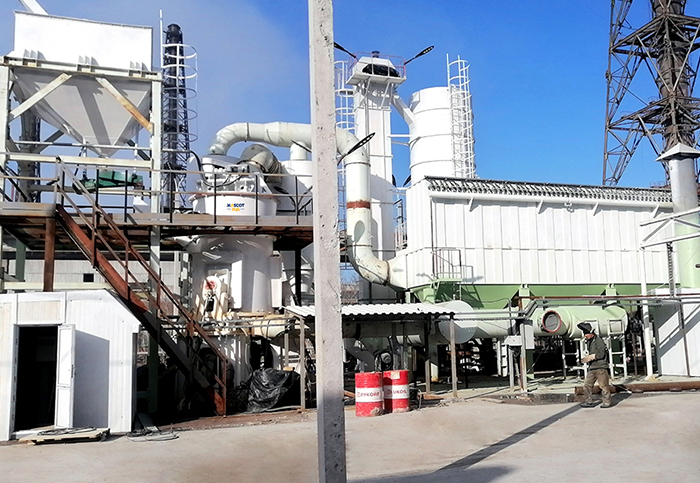
The production line of the vertical roller mill is a cost-effective and energy-efficient solution for processing powder, which is widely used in many industries, such as metallurgy, building materials, industrial solid waste treatment, thermal power plants, cement plants, and environmental protection fields. The primary purpose of this project is to finely grind raw materials through a vertical roller mill to meet the requirements of different industries for particle size, purity, and output of powder products.

This production line utilizes a three-ring medium-speed micro-grinding mill as the central equipment, complemented by other auxiliary equipment like hammer crushers, bucket elevators, and storage silos to establish a comprehensive grinding operation system. It has demonstrated strong potential for application and market competitiveness in industries such as construction, chemical industry, and new materials.

The gypsum grinding production line is an efficient, stable, and environmentally friendly production solution, which is widely used in construction, decoration, the chemical industry, and other fields. In addition, the grinding process is particularly critical, which directly affects the quality and particle size of the final product. With the continuous development of science and technology, the technical level and production efficiency of gypsum grinding production lines will be further improved, providing strong support for the development of the gypsum processing industry.

The high-pressure grinding mill production line is a project specially designed for efficient grinding operations. It is widely used in metallurgy, building materials, the chemical industry, highways, water conservancy hydropower, and other industries. It is a suspended roller mill that uses springs to increase pressure. It can achieve efficient grinding processing of various non-metallic raw materials. It has high efficiency, stability, and environmental protection characteristics.

YGMX Enhanced High-Pressure Mill is a new type of high-performance grinding equipment, and the biggest improvement of this milling equipment lies in the increase of the high-pressure spring system in the grinding roller part. Compared with the traditional high-pressure roller mill, it has a wider scope of application and excellent performance to meet the production needs of a variety of powder fineness. It is widely used in non-metallic minerals, chemicals, building materials, metallurgy, environmental protection, etc. Multiple areas.
Green and Intelligent Mining Machinery
Manufacturing and Export Base
Based on high quality and perfect after-sales service, our products have been
exported to more than 120 countries and regions.
Copyright © 2023 Zhengzhou Mascot Environmental Technology Co., Ltd Record number: Yu ICP No. 13021523-4





 WhatsApp