 27
27
 25
25
 27
27

Ground calcium carbonate is the workhorse pigment of the paper industry: it coats, fills and brightens the sheets that carry print, packaging and image quality. But paper-coating grade is not ordinary GCC. It is a specification product defined by two properties above all — fineness and whiteness — and both are decided in the grinding mill. The HGM Series Micro-Powder Grinding Mill from Zhengzhou Mascot Industry is engineered for this grade, and this article explains what paper coating asks of calcium carbonate and how the HGM delivers it.
Paper coating is applied as a thin layer of pigment slurry that must dry to a smooth, bright, uniform surface — the surface the printer and the reader actually see. Calcium carbonate earns its place in that layer because it is white, inexpensive relative to other pigments, and chemically stable. But the coating formula tolerates no surprises: if the pigment's particle size drifts, the coating gloss changes; if the powder carries color or contamination, the sheet brightness falls.
That is why coating-grade GCC is specified tightly, and why the industry buys it as a controlled product rather than a bulk commodity. The specification lives at the fine end of the grinding range — in the 600-2500 mesh band for paints and coatings applications — and the plant that holds the specification reliably is the one that keeps the coating contract.

Coating smoothness and gloss come from fine, uniform particles. A coating-grade calcium carbonate is typically ground to the fine-mesh band such as 1250 mesh at D97 — the size below which 97% of the powder falls — and the mill must hold that cut batch after batch. The HGM's variable-speed turbo classifier does exactly this: it screens qualified particles from coarse ones continuously, with a D97 pass rate above 98% and fineness stability of about ±2%.
The contrast with less precise systems is measurable. Where a conventional line's D97 drifts around ±5%, the HGM holds the narrow band that coating formulas assume — and stability is what protects both the paper's surface quality and the powder producer's reputation with the coating plant. Fineness consistency is not a mill specification-sheet nicety for coating grade; it is the product.

Whiteness is the second specification, and it is fragile. Any contamination in the powder path — iron fines from steel wear, scale from unlined ducts, residue from a previous dark mineral — tints the product and drops its brightness below the coating plant's acceptance level. Protecting whiteness is therefore a design discipline, not an operating afterthought.
The HGM answers with a ceramic-lined powder path that keeps the product free of metal contamination, and with changeover procedures that let one machine switch between calcite and other minerals in 30-60 minutes without carrying color from one product into the next. In the Jakarta case, a single HGM1036 line supplies calcite and talc at 1250 mesh and kaolin at 800 mesh to paint, plastics and paper customers — with all three products holding stable whiteness, because the powder path never lets steel touch the product.

Producing coating-grade calcium carbonate needs a mill that grinds fine without contaminating and classifies precisely without losing output. The HGM integrates the whole process — crushing the feed, grinding it between multi-layer rollers and the ring, classifying it in the turbo classifier, and collecting it through a cyclone and pulse-jet bag filter — in one system. Calcite, at Mohs 3, is well inside the machine's design envelope for minerals below Mohs 7 and 6% humidity.
Against a traditional ball mill classification line at the same fineness, the HGM delivers 30-40% higher output and 40%+ lower energy consumption. For a coating-grade producer, that combination matters twice: higher output spreads fixed costs over more saleable tons, and lower energy protects the margin on a product whose price is set by spec, not by volume.

Coating-grade output is usually modest in tonnage but exacting in spec. The four HGM models cover the range from pilot to industrial duty:
| Model | Capacity (t/h) | Main Motor (kw) | Typical Coating-Grade Duty |
|---|---|---|---|
| HGM80 | 0.35-2.5 | 37 | Small coating-grade lines |
| HGM1028 | 0.6-4 | 75 | Medium GCC supply |
| HGM1036 | 0.9-6 | 110 | Case-proven at 2 t/h of 1250-mesh calcite |
| HGM1250 | 1.2-10 | 132 | Larger coating and filler supply |
All models produce the full 5-47 micron band; at the fine 1250-mesh duty typical of coating grade, size with a margin below the top of the range, and confirm the exact output with a project design on your calcite.
A coating-grade calcium carbonate line is a full process train: a jaw crusher reduces the raw lumps to feed size, a bucket elevator lifts the crushed stone, an electromagnetic vibrating feeder meters it uniformly into the HGM main unit, the turbo classifier cuts the product, and a cyclone collector with a pulse-jet bag filter captures the powder into the product silo — delivered by Mascot as a complete turnkey package with control panel, drawings and on-site commissioning guidance.
Every stage protects the two specifications. Uniform feeding protects D97 stability; the bag filter and clean powder path protect whiteness; and the sealed system keeps the coating plant's material clean from crusher to silo. Mascot engineers commission the line on site and train the operators, so the first batch shipped to a coating customer is on spec, not a test.

Q1: What fineness does paper-coating calcium carbonate need?
A: Coating-grade GCC typically sits in the fine-mesh band such as 1250 mesh at D97. The HGM produces 325-2500 mesh with a D97 pass rate above 98%, holding the cut with about ±2% stability.
Q2: How does the HGM protect whiteness?
A: The ceramic-lined powder path keeps steel from contacting the product, and quick changeover between minerals prevents color carry-over between grades.
Q3: Can one HGM line supply multiple grades?
A: Yes — the Jakarta case runs 1250-mesh calcite, 1250-mesh talc and 800-mesh kaolin on one HGM1036, switching in 40-60 minutes.
Q4: What warranty applies to the mill?
A: Twelve months on the whole machine and on core components — rollers, rings and classifier — with around-the-clock online support.
Paper-coating calcium carbonate is a specification product defined by fineness and whiteness, and both are decided in the grinding line. The HGM Series Micro-Powder Grinding Mill delivers the fine 1250-mesh D97 cut with above-98% pass rate and ±2% stability, protects whiteness with a ceramic-lined powder path, and supports multi-grade production on one machine — the Jakarta case proves it at 2 t/h of coating-grade calcite with 40%+ lower power than a ball mill line. For a producer supplying the paper and coating industries, Mascot's free project design will configure the line for your calcite and your target grade.

About of Mascot
Zhengzhou Mascot Industry is a high-tech mining equipment company integrating R&D, manufacturing, sales, and after-sales service. Focusing on crushing, grinding, and mineral processing equipment, we provide professional solutions to our customers. We are ISO9001:2015 certified, and our products include mobile crushing plants, crawler crushing plant, construction waste crushing plants, jaw crushers, sand making machines, cone crushers, fine crushers, grinding mills, ball mills, etc., all with reliable performance to meet diverse project needs.
• Professional pre-sales support: Free project design and comprehensive solutions to help you accurately select the right equipment;
• Comprehensive on-site service: Providing installation guidance and worker training to ensure smooth equipment commissioning;
• Reliable after-sales guarantee: A complete after-sales system, timely response to technical inquiries and equipment maintenance, ensuring long-term stable operation.
To protect your rights, please contact us through the following official channels for professional service:
WhatsApp: 0086-16650273865
Email: mascot@mascotenv.com
We are committed to providing high-quality equipment and full-cycle services to deliver comprehensive intelligent solutions for the global mining industry!

The high-pressure grinding mill production line is a project specially designed for efficient grinding operations. It is widely used in metallurgy, building materials, the chemical industry, highways, water conservancy hydropower, and other industries. It is a suspended roller mill that uses springs to increase pressure. It can achieve efficient grinding processing of various non-metallic raw materials. It has high efficiency, stability, and environmental protection characteristics.

YGMX Enhanced High-Pressure Mill is a new type of high-performance grinding equipment, and the biggest improvement of this milling equipment lies in the increase of the high-pressure spring system in the grinding roller part. Compared with the traditional high-pressure roller mill, it has a wider scope of application and excellent performance to meet the production needs of a variety of powder fineness. It is widely used in non-metallic minerals, chemicals, building materials, metallurgy, environmental protection, etc. Multiple areas.

The gypsum grinding production line is an efficient, stable, and environmentally friendly production solution, which is widely used in construction, decoration, the chemical industry, and other fields. In addition, the grinding process is particularly critical, which directly affects the quality and particle size of the final product. With the continuous development of science and technology, the technical level and production efficiency of gypsum grinding production lines will be further improved, providing strong support for the development of the gypsum processing industry.

The Raymond mill production line is a highly efficient system designed for grinding operations, with a focus on energy efficiency, durability, and productivity. It caters to the needs of users by offering fine powder products in non-metallic ores, coal powder, and slag processing, aiding enterprises in achieving sustainable growth.
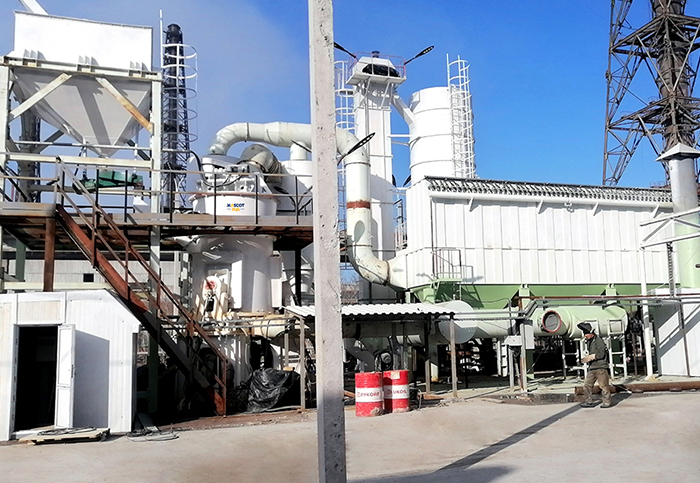
The production line of the vertical roller mill is a cost-effective and energy-efficient solution for processing powder, which is widely used in many industries, such as metallurgy, building materials, industrial solid waste treatment, thermal power plants, cement plants, and environmental protection fields. The primary purpose of this project is to finely grind raw materials through a vertical roller mill to meet the requirements of different industries for particle size, purity, and output of powder products.
Green and Intelligent Mining Machinery
Manufacturing and Export Base
Based on high quality and perfect after-sales service, our products have been
exported to more than 120 countries and regions.
Copyright © 2023 Zhengzhou Mascot Environmental Technology Co., Ltd Record number: Yu ICP No. 13021523-4





 WhatsApp