
How to Decide Between YGM High Pressure Grinding Mill and Raymond Mill
Plant operators evaluating grinding equipment for non-metallic mineral processing frequently face a single decision: stick with the proven, lower-cost Raymond Mill, or invest in the higher-performance YGM High-pressure Grinding Mill. Both machines share a common design lineage — YGM is Mascot Heavy Industry's evolution of the Raymond platform — but the differences in grinding mechanism, output stability, wear-part longevity, and total cost of ownership are significant enough that the wrong call can lock a plant into years of suboptimal performance.
This comparison breaks down the five dimensions that determine which mill delivers a better return for your specific operation. The YGM High-pressure Grinding Mill is not universally the right answer — and below we identify exactly when a Raymond Mill remains the smarter choice.
Side-by-Side Comparison: YGM vs. Raymond Mill
| Dimension | Raymond Mill | YGM High-pressure Mill |
|---|---|---|
| Grinding Mechanism | Centrifugal force; grinding pressure decreases as rollers wear | High-pressure spring system; 1,000–1,500 kg constant pressure per roller, independent of wear state |
| Output vs. Equivalent Power | Baseline | 20%–30% higher throughput at matched motor power |
| Finished Fineness | 80–325 mesh (typical); pass rate varies | 80–425 mesh stepless adjustment; pass rate ≥99% |
| Wear-Part Life | Standard alloy; uneven wear common | High-chromium alloy; service life 2–3× longer; constant pressure reduces uneven wear |
| Energy Consumption per Ton | Higher; centrifugal mechanism loses efficiency under load fluctuation | 28% lower in documented field comparisons (limestone, 200 mesh) |
| Control System | Conventional electrical control; manual adjustment | PLC intelligent control; one-key start-stop, automatic monitoring, fault alarm |
| Dust Emission | Typically 50–100 mg/m³ without upgrade | ≤30 mg/m³ with sealed negative-pressure system and pulse-jet baghouse |
| Initial Capital Cost | Lower; economical for start-up projects | Higher; price premium recovered within 12–18 months via energy and maintenance savings |
| Material Compatibility | Non-metallic minerals; Mohs hardness typically <7 | Non-metallic minerals; Mohs hardness up to 9.3; moisture <6% |

Core Parameters of YGM High-pressure Grinding Mill
| Model | YGM65 | YGM95 | YGM130 | YGM160 |
|---|---|---|---|---|
| Grinding Rollers | 3 pcs | 4 pcs | 5 pcs | 6 pcs |
| Max Feed Size | <15 mm | <25 mm | <30 mm | <35 mm |
| Capacity | 0.3-2.0 t/h | 1.1-5.6 t/h | 2.2-9.5 t/h | 8.0-22.0 t/h |
| Main Motor Power | 18.5 kw | 37 kw | 75 kw | 132 kw |
| Finished Fineness | 80-425 mesh | 80-425 mesh | 80-425 mesh | 80-425 mesh |

Core Advantages of YGM Over Traditional Raymond Mill
1. Constant Grinding Pressure — The Defining Difference
Raymond mills generate grinding force through centrifugal rotation: as rollers wear and lose mass, pressure declines, and output drops. YGM replaces this with an active high-pressure spring system delivering 800–1,200 kg of additional constant pressure. Output remains flat across the wear-part lifecycle rather than following a descending curve. For operations where throughput consistency directly affects downstream contract fulfillment, this alone justifies the upgrade.
2. 20%–30% Higher Throughput at Equivalent Power
In side-by-side comparisons with same-power Raymond mills, YGM consistently delivers 20%–30% more finished product per shift. This is not a theoretical estimate — it is a measured result of the combined effect of constant pressure, optimized shovel blade geometry, and higher grinding-roller contact efficiency.
3. Finer, More Consistent Powder
The frequency-conversion classifier enables stepless fineness adjustment from 80 to 425 mesh without hardware changes. Finished powder pass rate exceeds 99%, compared with the variable pass rates typical of mechanically classified Raymond systems. For industries where off-spec powder must be re-ground at additional cost (coatings, fillers, high-grade construction materials), this near-zero rejection rate directly improves margin.
4. Extended Wear-Part Intervals
High-chromium alloy grinding rollers and rings last 2–3 times longer than standard Raymond wear parts. The constant-pressure mechanism distributes wear uniformly across the roller surface, preventing the localized grooving that forces premature replacement in centrifugal mills. Fewer shutdowns for part swaps translate into higher annual operating hours.
5. Lower Per-Ton Energy Cost
High-efficiency gear transmission and the sealed negative-pressure system together reduce energy consumption per ton of finished powder. A documented limestone operation achieved a 28% reduction in kWh per ton after switching from a Raymond mill to YGM130. At typical industrial electricity rates, this saving recovers the YGM price premium within 12–18 months.

Scenarios Where Raymond Mill Is Still the Right Choice
YGM is not always the answer. Raymond Mill remains the more appropriate choice under these conditions:
1. Capital-constrained start-ups — When initial equipment budget is the binding constraint and the operation cannot finance the higher upfront cost of YGM, a Raymond Mill gets production started. The trade-off is accepted: higher per-ton operating cost in exchange for lower entry barrier.
2. Low-utilization or intermittent operation — If the mill runs fewer than 1,500 hours per year, the energy savings from YGM may not compound fast enough to recover the price premium within a reasonable payback period. In this scenario, the lower capital cost of Raymond Mill dominates the TCO equation.
3. Coarse powder only (80–150 mesh), no fineness tolerance sensitivity — Applications such as basic construction fillers or low-grade agricultural minerals, where output consistency and ultra-fine capability carry no commercial premium, do not benefit from YGM's classifier precision.
4. Temporary or mobile operations — Where the equipment may be relocated after 2–3 years, the extended wear-part life of YGM is unlikely to be fully realized before the move, reducing the value of that investment.
Detailed Customer Case: Central Asia Limestone Grinding Project
Project Location: Central Asia
Processing Material: Limestone
Required Fineness: 200 mesh
Capacity Demand: 8 t/h
Original Problem: The plant operated a traditional Raymond mill. Output was inconsistent, declining as rollers wore. Energy consumption per ton was high, dust emissions exceeded local environmental limits, and unplanned maintenance stops disrupted downstream batching schedules.
After comparing multiple international brands, the customer chose Mascot YGM130 High-pressure Grinding Mill as the replacement. Our technical team customized a complete production line including vibrating feeder, bucket elevator, dust collector and screw conveyor.
Our engineers provided on-site installation guidance and professional operator training, completing commissioning within 30 days. After stable operation, the project achieved:
- Stable output: 8.5 t/h, exceeding customer demand
- Fineness effect: 200 mesh pass rate up to 99.2%
- Energy saving: Energy consumption per ton reduced by 28% versus the replaced Raymond mill
- Environmental protection: Dust emission ≤20mg/m³, meeting local standards
- Cost reduction: Annual maintenance cost reduced by 22%
The transition from reactive maintenance (frequent emergency stops on the old Raymond mill) to planned preventive maintenance (scheduled part swaps on YGM) stabilized production scheduling. The customer signed a long-term cooperation agreement, becoming our loyal partner in Central Asia.

Auxiliary Equipment Configuration for YGM Grinding System
| Equipment Name | Model | Power | Function |
|---|---|---|---|
| Bucket Elevator | TH315 | 4 kw | Material lifting |
| Belt Scale Feeder | B400x6m | 2.2 kw | Precise & stable feeding |
| Dust Collector | LQM64-6 | -- | High-efficiency dust removal |
| High-pressure Blower | 9-26 series | 18.5-132 kw | Air supply & conveying |
Related Recommended Equipment
1. MTW Trapezium Grinding Mill: Larger output, higher efficiency, matching large-scale mineral processing lines above 25 t/h.
2. Ball Mill: For wet/dry grinding of high-hardness ores beyond the Mohs 9.3 ceiling of YGM and Raymond mills.
3. Ball Press Machine: Briquetting mineral powder and waste, improving resource utilization from both YGM and Raymond mill byproducts.

Frequently Asked Questions (FAQs)
Q1: What is the fundamental difference between YGM and Raymond Mill?
A: The grinding mechanism. Raymond Mill uses centrifugal force; grinding pressure weakens as rollers wear. YGM uses an active high-pressure spring system providing 1,000–1,500 kg constant pressure per roller, independent of wear. This difference drives all downstream advantages: higher throughput, more consistent fineness, longer wear-part life, and lower per-ton energy cost.
Q2: Can YGM process the same materials as a Raymond Mill?
A: Yes — and a wider range. YGM handles limestone, calcite, dolomite, gypsum, barite, talc, quartz and other non-metallic minerals with Mohs hardness up to 9.3 and moisture below 6%. Standard Raymond mills are typically limited to Mohs hardness below 7 for sustained operation.
Q3: How long does it take to recover the higher cost of YGM over Raymond?
A: Based on field data from limestone operations, the energy savings alone recover the price premium within 12–18 months. When reduced maintenance costs and higher throughput are included, total payback is typically achieved within the first year of continuous operation.
Q4: Is YGM more difficult to operate and maintain than Raymond Mill?
A: No. YGM's PLC intelligent control system makes operation simpler — one-key start-stop, automatic monitoring, and fault alarm reduce operator workload compared with the manual adjustments required on conventional Raymond mills. Maintenance is less frequent due to extended wear-part life and the shift from reactive to planned preventive maintenance scheduling.
Q5: If I already have a Raymond Mill, can I retrofit it to YGM performance?
A: No. The high-pressure spring system, optimized shovel blade geometry, frequency-conversion classifier, and sealed negative-pressure dust system are integrated into the YGM structural design and cannot be retrofitted onto a Raymond mill chassis. The upgrade path is a full equipment replacement — which is why evaluating total cost of ownership over a 5-year horizon is critical before making the decision.
Mascot Heavy Industry is a high-tech enterprise integrating R&D, manufacturing, sales and service of mining and grinding equipment. We provide customized YGM High-pressure Grinding Mill solutions, including project design, equipment manufacturing, installation guidance and after-sales support. Welcome global customers to contact us for cooperation.

About of Mascot
Zhengzhou Mascot Industry is a high-tech mining equipment company integrating R&D, manufacturing, sales, and after-sales service. Focusing on crushing, grinding, and mineral processing equipment, we provide professional solutions to our customers. We are ISO9001:2015、certified, and our products include mobile crushing plants, crawler crushing plant, construction waste crushing plants, jaw crushers, sand making machines, cone crushers, fine crushers, grinding mills, ball mills, etc., all with reliable performance to meet diverse project needs.
• Professional pre-sales support: Free project design and comprehensive solutions to help you accurately select the right equipment;
• Comprehensive on-site service: Providing installation guidance and worker training to ensure smooth equipment commissioning;
• Reliable after-sales guarantee: A complete after-sales system, timely response to technical inquiries and equipment maintenance, ensuring long-term stable operation.
To protect your rights, please contact us through the following official channels for professional service:
WhatsApp: 0086-18737119558
Email: mascot@mascotenv.com
We are committed to providing high-quality equipment and full-cycle services to deliver comprehensive intelligent solutions for the global mining industry!

YGMX Enhanced High-Pressure Mill is a new type of high-performance grinding equipment, and the biggest improvement of this milling equipment lies in the increase of the high-pressure spring system in the grinding roller part. Compared with the traditional high-pressure roller mill, it has a wider scope of application and excellent performance to meet the production needs of a variety of powder fineness. It is widely used in non-metallic minerals, chemicals, building materials, metallurgy, environmental protection, etc. Multiple areas.

The MTW series European grinding mill production line includes high-efficiency crushers, elevators, electromagnetic vibration feeders, milling machines, classifiers, and collectors. These pieces of equipment work together to achieve efficient crushing, grinding, and classification of various non-metallic ores, coal powder, slag, and other materials. It can meet the diverse needs of various industries for powder particle size, uniformity, shape, etc., and offer enterprises high-quality grinding products.

The gypsum grinding production line is an efficient, stable, and environmentally friendly production solution, which is widely used in construction, decoration, the chemical industry, and other fields. In addition, the grinding process is particularly critical, which directly affects the quality and particle size of the final product. With the continuous development of science and technology, the technical level and production efficiency of gypsum grinding production lines will be further improved, providing strong support for the development of the gypsum processing industry.

The ball mill production line is a comprehensive production line that integrates material crushing, grinding, grading, and collection. This production line is mainly used to process various materials, including sand and gravel, cement, new building materials, silicates, refractory materials, fertilizers, ferrous metal beneficiation, non-ferrous metals, glass ceramics, etc.
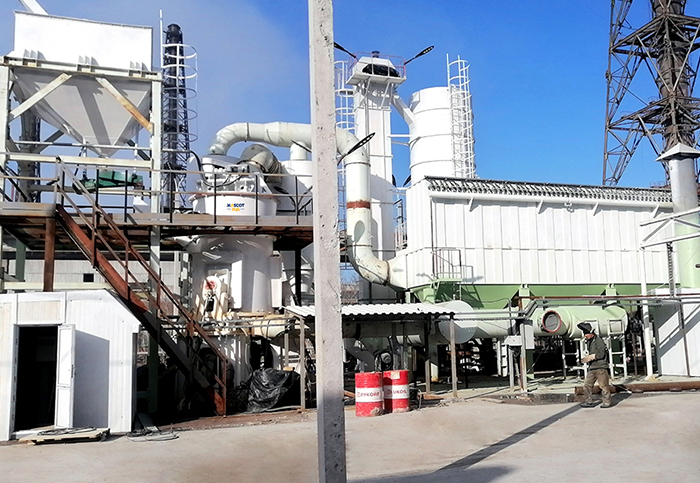
The production line of the vertical roller mill is a cost-effective and energy-efficient solution for processing powder, which is widely used in many industries, such as metallurgy, building materials, industrial solid waste treatment, thermal power plants, cement plants, and environmental protection fields. The primary purpose of this project is to finely grind raw materials through a vertical roller mill to meet the requirements of different industries for particle size, purity, and output of powder products.
Green and Intelligent Mining Machinery
Manufacturing and Export Base
Based on high quality and perfect after-sales service, our products have been
exported to more than 120 countries and regions.
Copyright © 2023 Zhengzhou Mascot Environmental Technology Co., Ltd Record number: Yu ICP No. 13021523-4





 WhatsApp