
325-mesh limestone powder — particles of about 0.043mm — feeds paint fillers, plastics, rubber, paper coating and desulfurization. Every MTW Trapezium Grinding Mill model can produce it, because the whole MTW series adjusts fineness across 80-425 mesh. So the real question is not "can it" but "which model fits my output" — which this article answers.
Choosing for 325-mesh limestone is a four-part decision: target tonnage, crusher discharge, site power and your three-year plan. This guide walks through the four models one by one and ends with a decision table you can use directly.
The MTW lineup offers four sizes. For 325-mesh limestone work, the deciding columns are capacity, feed acceptance and installed power:
| Model | Capacity (t/h) | Max Feed (mm) | Main Motor (kw) | Installed Power (kw) | Fineness |
|---|---|---|---|---|---|
| MTW110 | 3-10 | ≤30 | 55 | 128.5 | 80-425 mesh |
| MTW138 | 6-20 | ≤35 | 90 | 244 | 80-425 mesh |
| MTW175 | 10-35 | ≤40 | 160 | 397 | 80-425 mesh |
| MTW215 | 20-50 | ≤45 | 220 | 507 | 80-425 mesh |
Installed power is the sum of main motor, classifier and blower. It matters twice: it sets the site's electrical requirement, and it is the best indicator of where the equipment price sits.
One fact before sizing: rated capacities are published at coarser fineness. At 325 mesh, actual throughput runs below the rated range because finer classification means more recirculation. The field benchmark shows the scale: an MTW175 — rated 10-35 t/h — produced a stable 31 t/h at 250 mesh. At 325 mesh it produces a lower figure; the exact number depends on your limestone's hardness and moisture.
The rule: size with a margin, and treat the rated range as the ceiling at fine-mesh duty, not the expectation. A plant needing 12 t/h of 325-mesh powder should plan around the MTW175, not the top of the MTW138 range — running near the ceiling overworks the machine and raises energy cost per ton.

The MTW110 (55 kw main motor, about 128 kw installed) is the entry point for small lines and pilot projects producing below roughly 5 t/h of 325-mesh powder. Its footprint, price and power requirement are the lowest in the series, and its 30mm feed limit suits small crushers. It is right when the market is small and the budget tight — and wrong the moment demand grows past its ceiling, so check your three-year plan before settling on it.
The MTW138 (90 kw main motor, 244 kw installed) is the best-selling model of the series and the default answer for medium limestone powder plants targeting roughly 6-15 t/h at 325 mesh. It delivers the best capacity-to-power ratio in the lineup — about 0.22 t/h per kilowatt — and its 35mm feed acceptance covers most jaw-crusher discharges. For most buyers, capacity and price intersect correctly here, and payback is quick.
The MTW175 (160 kw main motor, 397 kw installed) serves large lines targeting roughly 15-30 t/h of 325-mesh powder. Its 40mm feed limit matches a standard jaw crusher's discharge directly, and it is the model behind the documented case — 31 t/h at 250 mesh, 99.6% pass rate, 22% lower energy. It demands a heavier electrical installation and a larger investment than the MTW138, and earns both back when the order book fills its hours.
The MTW215 (220 kw main motor, about 507 kw installed) is the largest model, built for centralized powder bases producing 20-50 t/h — at 325-mesh duty, realistically the upper part of that band. With 45mm feed acceptance and the series' best tons-per-kilowatt ratio (about 0.23), it minimizes unit cost when throughput is large and continuous. It is a scale decision: it pays near capacity, and overpays when it does not.

| Your 325-Mesh Target | Model | Typical Line Scope |
|---|---|---|
| Under ~5 t/h (small plant, pilot) | MTW110 | Mill + feeder + small dust collector |
| ~6-15 t/h (medium plant) | MTW138 | Complete line: GZ2 feeder, TH400 elevator, LQM72-7 collector, LSY273 conveyor, PLC |
| ~15-30 t/h (large plant) | MTW175 | Same complete line, sized up; case-proven at 31 t/h (250 mesh) |
| ~20-50 t/h (production base) | MTW215 | Ultra-large line; verify site power for ~507 kw installed |
On the borderline between rows, choose by the three-year plan: expect growth, take the larger model now; stable market, take the smaller and keep the capital. Either is defensible — ignoring the margin rule from Section 2 is not.

The model's feed limit must match your crusher's real discharge, not its nominal setting: MTW110 ≤30mm, MTW138 ≤35mm, MTW175 ≤40mm, MTW215 ≤45mm. If your jaw crusher discharges 40mm material, the MTW175 accepts it directly and saves a screening or secondary crushing stage; a smaller model adds that stage's cost — which can exceed the price difference between models. Measure your actual discharge before choosing.
Energy economics follow the same pattern: about 0.18 t/h per kilowatt for the MTW110, 0.22 for the MTW138 and MTW175, and 0.23 for the MTW215 at maximum output. The MTW138 and MTW175 are the value benchmarks — the same efficiency per kilowatt at different scale. At fine-mesh duty the ratios narrow proportionally, but the ranking holds. For 325-mesh limestone: the MTW138 is the efficiency sweet spot for medium output, the MTW215 the lowest unit cost at scale.

Q1: Can every MTW model really produce 325 mesh?
A: Yes. All four models adjust fineness steplessly across 80-425 mesh through the frequency-conversion classifier. The model choice affects output and investment, not the achievable mesh.
Q2: Why is output at 325 mesh lower than the rated range?
A: Because finer classification increases recirculation through the grinding zone. Size with a margin — the field case shows the effect clearly: 31 t/h at 250 mesh on an MTW175 rated up to 35 t/h.
Q3: What if my crusher discharges larger than the model's feed limit?
A: Choose the next model up, or add a screening or secondary crushing stage — and price that stage before deciding, because it may cost more than the model upgrade.
Q4: Can I start smaller and expand?
A: Yes, but plan it. Starting with the MTW138 and adding a second line later is a common path; buying the largest model for a small market is the expensive one.
For 325-mesh limestone, the MTW question is a sizing question. Define your target tonnage, check your crusher's discharge, confirm your site's power, and match the model with a margin: MTW110 for small plants, MTW138 for medium — the series' benchmark — MTW175 for large lines with a proven case behind it, and MTW215 for production bases. Mascot's free project design will confirm the fit with your material data, so the choice is based on your numbers.

About of Mascot
Zhengzhou Mascot Industry is a high-tech mining equipment company integrating R&D, manufacturing, sales, and after-sales service. Focusing on crushing, grinding, and mineral processing equipment, we provide professional solutions to our customers. We are ISO9001:2015 certified, and our products include mobile crushing plants, crawler crushing plant, construction waste crushing plants, jaw crushers, sand making machines, cone crushers, fine crushers, grinding mills, ball mills, etc., all with reliable performance to meet diverse project needs.
• Professional pre-sales support: Free project design and comprehensive solutions to help you accurately select the right equipment;
• Comprehensive on-site service: Providing installation guidance and worker training to ensure smooth equipment commissioning;
• Reliable after-sales guarantee: A complete after-sales system, timely response to technical inquiries and equipment maintenance, ensuring long-term stable operation.
To protect your rights, please contact us through the following official channels for professional service:
WhatsApp: 0086-16650273865
Email: mascot@mascotenv.com
We are committed to providing high-quality equipment and full-cycle services to deliver comprehensive intelligent solutions for the global mining industry!

YGMX Enhanced High-Pressure Mill is a new type of high-performance grinding equipment, and the biggest improvement of this milling equipment lies in the increase of the high-pressure spring system in the grinding roller part. Compared with the traditional high-pressure roller mill, it has a wider scope of application and excellent performance to meet the production needs of a variety of powder fineness. It is widely used in non-metallic minerals, chemicals, building materials, metallurgy, environmental protection, etc. Multiple areas.

This production line utilizes a three-ring medium-speed micro-grinding mill as the central equipment, complemented by other auxiliary equipment like hammer crushers, bucket elevators, and storage silos to establish a comprehensive grinding operation system. It has demonstrated strong potential for application and market competitiveness in industries such as construction, chemical industry, and new materials.

The high-pressure grinding mill production line is a project specially designed for efficient grinding operations. It is widely used in metallurgy, building materials, the chemical industry, highways, water conservancy hydropower, and other industries. It is a suspended roller mill that uses springs to increase pressure. It can achieve efficient grinding processing of various non-metallic raw materials. It has high efficiency, stability, and environmental protection characteristics.
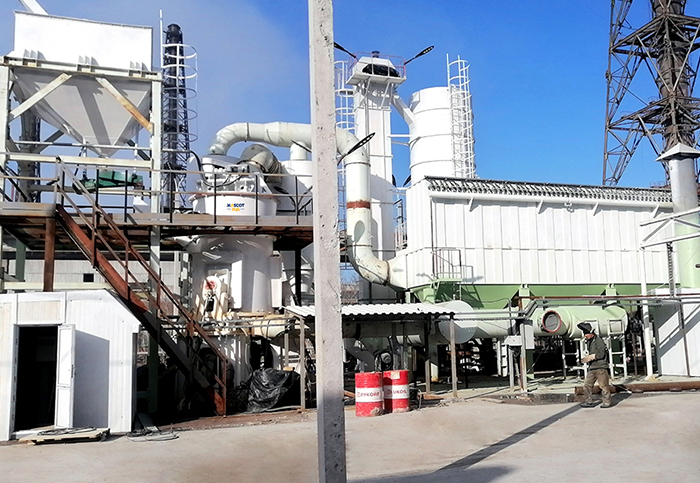
The production line of the vertical roller mill is a cost-effective and energy-efficient solution for processing powder, which is widely used in many industries, such as metallurgy, building materials, industrial solid waste treatment, thermal power plants, cement plants, and environmental protection fields. The primary purpose of this project is to finely grind raw materials through a vertical roller mill to meet the requirements of different industries for particle size, purity, and output of powder products.

The gypsum grinding production line is an efficient, stable, and environmentally friendly production solution, which is widely used in construction, decoration, the chemical industry, and other fields. In addition, the grinding process is particularly critical, which directly affects the quality and particle size of the final product. With the continuous development of science and technology, the technical level and production efficiency of gypsum grinding production lines will be further improved, providing strong support for the development of the gypsum processing industry.
Green and Intelligent Mining Machinery
Manufacturing and Export Base
Based on high quality and perfect after-sales service, our products have been
exported to more than 120 countries and regions.
Copyright © 2023 Zhengzhou Mascot Environmental Technology Co., Ltd Record number: Yu ICP No. 13021523-4





 WhatsApp