 25
25
 25
25
 25
25

"How much does it cost?" is the first question every buyer asks, and it is the hardest question to answer with a single number. A grinding mill is not a commodity with a sticker price; the MTW Trapezium Grinding Mill is configured to a production line, and the price moves with the configuration. Asking "how much is an MTW mill" is like asking "how much is a truck" — the honest answer depends on the model, the load it carries and the distance it travels.
This guide answers the price question the way a serious buyer should ask it. It explains why the price varies, what exactly you are paying for at each model level, which cost factors move the number most, and — most importantly — why the purchase price is the smallest part of what a mill really costs over its working life. By the end, you will know what a realistic price range looks like, what questions to ask before requesting a quote, and how to compare offers on a basis that will not mislead you.
Industrial grinding equipment is quoted per project, and the variance comes from four legitimate sources. The first is the model itself: the MTW series spans four machines, from the compact MTW110 with a 55kW main motor to the MTW215 flagship with a 220kW main motor and a grinding chamber nearly twice the size. Larger machines carry larger castings, stronger drivetrains, bigger classifiers and blowers, and all of that is reflected in the equipment price.
The second source of variance is the scope of supply. A quotation can cover the main mill alone, or a complete production line including the vibrating feeder, bucket elevator, pulse dust collector, screw conveyor and PLC control system. The difference between these two scopes can be substantial — and the price difference is legitimate, because the complete line is what actually produces powder. Comparing a mill-only quote from one supplier against a complete-line quote from another is comparing two different products.
The third and fourth sources are logistics and service. Freight to your port, import duties and local taxes vary by region, and the installation package — engineer-guided installation, commissioning and operator training — is priced differently by different suppliers. Finally, exchange rates and payment terms (T/T, L/C or PayPal) influence the final figure. None of this is a reason for suspicion; it is the reason why any responsible supplier will quote you after understanding your project, not before.
To understand the price, understand the machine. The four MTW models share the same trapezoidal grinding design, integral bevel gear drive and dilute oil lubrication, but they differ in scale, and the scale is what drives the price. The full parameter picture:
| Model | Roller Size (mm) | Grind Ring Inner Dia./Height & Length (mm) | Feed Size (mm) | Output Size (mm) | Capacity (t/h) | Main Motor (kw) |
|---|---|---|---|---|---|---|
| MTW110 | 360x210 | 1100x210 | ≤30 | 0.038-0.2 | 3-10 | 55 |
| MTW138 | 460x260 | 1380x260 | ≤35 | 0.038-0.2 | 6-20 | 90 |
| MTW175 | 520x300 | 1750x300 | ≤40 | 0.038-0.2 | 10-35 | 160 |
| MTW215 | 640x340 | 2150x340 | ≤45 | 0.038-0.2 | 20-50 | 220 |
Three observations from this table matter for the price discussion. First, every step up the model range buys real capability: a larger grinding chamber, a bigger drivetrain and higher output. Second, the step is not linear — MTW138 nearly doubles the MTW110's maximum output (20 t/h vs 10 t/h) while raising main motor power by only 64% (90kW vs 55kW), which is why it is the best-selling model. Third, the most efficient value sits in the middle of the range: at maximum output, MTW110 delivers about 0.18 t/h per kilowatt, while MTW138 and MTW175 deliver about 0.22 and MTW215 about 0.23.
What this means in price terms: you are not paying for size alone, you are paying for capacity per dollar. A plant that needs 15 t/h does not need an MTW215; an MTW138 running near its design point will produce that output at a lower equipment cost and with better power economy than an oversized machine running far below its rating. The most expensive mistake in mill buying is not paying too much for a machine — it is paying for a machine that is the wrong size for the job.
One more point deserves emphasis: all four models share the same adjustable fineness range of 80-425 mesh (0.038-0.2mm), so you are never paying extra for finer powder capability as you move up the range — the classifier technology is identical across the series. What the larger models add is scale: more capacity, a larger feed acceptance and a bigger installed power base. Choose the model for the tons, not for the mesh.

The single biggest decision in a quotation is scope. A main-mill-only quote covers the mill body with its trapezoidal roller and ring, the frequency-conversion classifier, the blower and the PLC panel. A complete-line quote adds the feeding, conveying, dust collection and discharge equipment that turns the mill into a working production system. Buyers who compare prices across suppliers must compare the same scope, item by item.
For a production plant, the complete line is the rational purchase. A mill without matched auxiliary equipment cannot reach its rated output in practice: feeding must be uniform, product must be conveyed, and dust must be controlled. Mascot's standard line configuration — a GZ2 vibrating feeder, a TH400 bucket elevator, an LQM72-7 pulse dust collector and an LSY273 screw conveyor, coordinated by the PLC — is matched to the main mill model so the system works as one machine. When you receive a quote, ask for it itemized: main mill, each auxiliary component with model and power, and installation.
Your raw material changes the machine that must be quoted. If your crusher discharges 40mm material, the MTW175 accepts it directly; if your material is coarser than the model's feed limit, the quote must include pre-crushing or screening equipment. If your material moisture exceeds 6%, a pre-drying stage enters the picture. If you require a specific fineness at high output, the classifier configuration and possibly the model selection change. These are not add-ons to be discovered later — they are part of a properly quoted project, and a supplier who asks about your material before quoting is doing their job.
The delivered price includes getting the equipment to your site. Freight to Southeast Asia, Central Asia, South America, North America and Africa differs by route and container configuration; the MTW series ships in standard containers with nude packing or wooden boxes, and the packing choice affects both protection and freight cost. Import duties and local taxes vary by country and are usually quoted separately. Installation is a service with a real cost: Mascot dispatches engineers for on-site guidance, commissioning and operator training, and in the reference case the complete line was produced in 18 working days and commissioned 28 days after arrival on site. Confirm in writing whether engineer visits and training are included in the quoted price before you compare offers.

The purchase price is paid once. Energy, wear parts, maintenance and labor are paid every month, and over a ten-year equipment life they dwarf the initial invoice. This is the difference between a cheap mill and an economical one, and it is where the MTW series' engineering shows up as money.
Consider the operating data from Mascot's Southeast Asia case plant, which replaced traditional mills with an MTW175 line processing limestone at ≤40mm and ≤5% moisture into 250-mesh powder. Over more than ten months of operation, the measured results were: 31 t/h average output (roughly 220,000 tons per year on a 24-hour, 300-day schedule), 99.6% finished powder pass rate, 22% lower energy consumption per ton than the previous equipment, and 20% lower annual maintenance cost, with grinding rollers and ring lasting more than ten months.
| Cost Dimension | Traditional Mill | MTW Trapezium Mill |
|---|---|---|
| Energy per ton of powder | Baseline | Up to 22% lower |
| Annual maintenance cost | Baseline | About 20% lower |
| Wear part replacement | Frequent | 8-12 months on medium-hard materials |
| Lubricant service | Constant grease service | Oil change every 4 months |
| Operation labor | Multi-operator | PLC one-key operation |
Translate those percentages into your plant's numbers. If your grinding line's electricity bill is a significant annual cost, a 22% reduction is not a rounding error — it recurs every month, every year, for the life of the machine. Maintenance interventions that happen quarterly instead of monthly, wear parts that survive a full production season instead of failing mid-contract, and a line that runs with fewer operators all reduce the cost per ton of finished powder. When you compare two quotations, compare this second column, not the first line of the invoice.
You can run this calculation for your own plant in five minutes. Take your annual tonnage, multiply by your current energy cost per ton, and apply a 22% reduction: that is the annual energy saving the trapezium design delivered in the field case. Multiply your current annual maintenance spend by 20%: that is the maintenance saving. Add the value of higher output and fewer stops. The sum, repeated over ten years, is the number that should stand next to the purchase price when you evaluate any quotation.

A meaningful quotation requires three pieces of information from you: your raw material (type, hardness, moisture, maximum feed size), your target fineness, and your target output. With those numbers, Mascot's engineers can recommend the correct model, configure the complete line, and prepare an itemized quotation — equipment, auxiliary components, packing, freight estimate and installation service. This free project design step is not a sales formality; it is the mechanism that turns a range into a real number.
What you should receive in a professional quotation: the recommended model with its capacity range; a list of every component in the line with model and power; the payment terms (T/T, L/C or PayPal as agreed); the packing and shipping basis; and the installation and training scope. What you should treat with caution: a quote that names a price without a model, a line configuration or a delivery scope — because without those, the number is not comparable to anything.
When you receive multiple quotations, align them before comparing. Use a table like this one to put every offer on the same basis:
| Comparison Item | Supplier A | Supplier B | Supplier C |
|---|---|---|---|
| Recommended model | |||
| Capacity range | |||
| Scope: main mill or complete line | |||
| Auxiliary equipment, itemized | |||
| Fineness range covered | |||
| Packing and freight basis | |||
| Installation and training | |||
| Payment terms | |||
| Delivery time | |||
| Reference operating data |
Any quote that leaves cells empty — no model, no itemized scope, no delivery time, no reference data — is an incomplete comparison. The supplier who can fill the whole table is the supplier who understands your project; the price that supplier quotes is the one you can trust.
Q1: How much does an MTW138 or MTW175 cost?
A: The price depends on configuration, scope (mill only vs complete line), shipping destination and current exchange rates. Instead of asking for a fixed figure, send your material, target fineness and target output to Mascot for a free project design and an itemized quotation for your specific case.
Q2: Why do quotes from different suppliers vary so much?
A: Compare the scope first. One quote may cover the main mill only, another a complete line; one may include installation and training, another not. Align the scope item by item, then compare — and compare the operating cost data, not just the equipment price.
Q3: Is the cheaper model more economical if my output is small?
A: Not necessarily. A mill running far below its design point wastes both capital and energy. Match the model to your target output: MTW110 for 3-10 t/h, MTW138 for 6-20 t/h, MTW175 for 10-35 t/h, MTW215 for 20-50 t/h, and consider your expansion plan before deciding.
Q4: Are shipping and installation included in the price?
A: They are quoted separately and transparently: packing and freight to your port, and engineer-guided installation with operator training. In the reference case, equipment was produced in 18 working days and the line was commissioned 28 days after arrival on site.
The honest answer to "how much does an MTW mill cost" is: it depends on the model, the scope, the logistics and the operating life you plan for. The useful answer is: the models span 3-50 t/h across four sizes; the price varies with the complete-line configuration; and the real cost is measured in energy per ton, maintenance per year and tons per day — where the trapezium design delivers 22% lower energy, 20% lower maintenance and a higher output that no purchase price can match.
To get your number, give Mascot your numbers. Send your raw material characteristics, target fineness and target output, receive the recommended model and an itemized quotation, and compare it on the basis that matters — cost per ton over the life of the line.

About of Mascot
Zhengzhou Mascot Industry is a high-tech mining equipment company integrating R&D, manufacturing, sales, and after-sales service. Focusing on crushing, grinding, and mineral processing equipment, we provide professional solutions to our customers. We are ISO9001:2015、certified, and our products include mobile crushing palnts, crawler crushing plant,construction waste crushing plants, jaw crushers, sand making machines, cone crushers, fine crushers,grinding mills, ball mills, etc., all with reliable performance to meet diverse project needs.
• Professional pre-sales support: Free project design and comprehensive solutions to help you accurately select the right equipment;
• Comprehensive on-site service: Providing installation guidance and worker training to ensure smooth equipment commissioning;
• Reliable after-sales guarantee: A complete after-sales system, timely response to technical inquiries and equipment maintenance, ensuring long-term stable operation.
To protect your rights, please contact us through the following official channels for professional service:
WhatsApp: 0086-16650273865
Email: mascot@mascotenv.com
We are committed to providing high-quality equipment and full-cycle services to deliver comprehensive intelligent solutions for the global mining industry!

The MTW series European grinding mill production line includes high-efficiency crushers, elevators, electromagnetic vibration feeders, milling machines, classifiers, and collectors. These pieces of equipment work together to achieve efficient crushing, grinding, and classification of various non-metallic ores, coal powder, slag, and other materials. It can meet the diverse needs of various industries for powder particle size, uniformity, shape, etc., and offer enterprises high-quality grinding products.

The ball mill production line is a comprehensive production line that integrates material crushing, grinding, grading, and collection. This production line is mainly used to process various materials, including sand and gravel, cement, new building materials, silicates, refractory materials, fertilizers, ferrous metal beneficiation, non-ferrous metals, glass ceramics, etc.
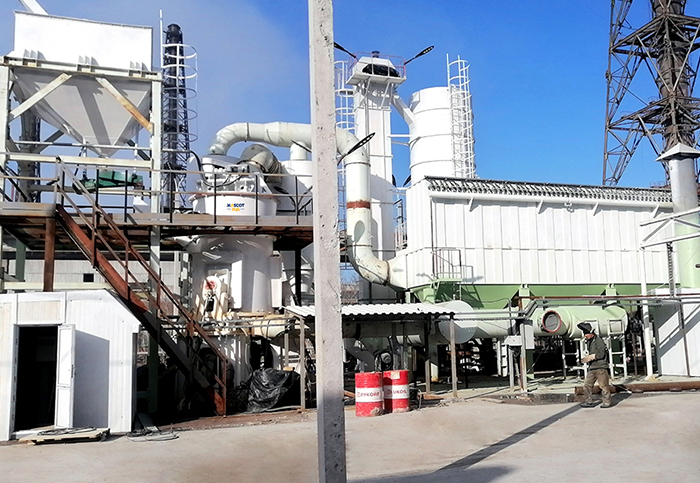
The production line of the vertical roller mill is a cost-effective and energy-efficient solution for processing powder, which is widely used in many industries, such as metallurgy, building materials, industrial solid waste treatment, thermal power plants, cement plants, and environmental protection fields. The primary purpose of this project is to finely grind raw materials through a vertical roller mill to meet the requirements of different industries for particle size, purity, and output of powder products.

The high-pressure grinding mill production line is a project specially designed for efficient grinding operations. It is widely used in metallurgy, building materials, the chemical industry, highways, water conservancy hydropower, and other industries. It is a suspended roller mill that uses springs to increase pressure. It can achieve efficient grinding processing of various non-metallic raw materials. It has high efficiency, stability, and environmental protection characteristics.

The gypsum grinding production line is an efficient, stable, and environmentally friendly production solution, which is widely used in construction, decoration, the chemical industry, and other fields. In addition, the grinding process is particularly critical, which directly affects the quality and particle size of the final product. With the continuous development of science and technology, the technical level and production efficiency of gypsum grinding production lines will be further improved, providing strong support for the development of the gypsum processing industry.
Green and Intelligent Mining Machinery
Manufacturing and Export Base
Based on high quality and perfect after-sales service, our products have been
exported to more than 120 countries and regions.
Copyright © 2023 Zhengzhou Mascot Environmental Technology Co., Ltd Record number: Yu ICP No. 13021523-4





 WhatsApp