 25
25
 25
25
 27
27

Ultra-fine powder is not the same product as the coarse powder it is ground from, and in 2026 the gap between the two is one of the clearest value stories in mineral processing. The same calcite that moves as a commodity at 325 mesh can be upgraded into a specification-grade functional powder at 1250 or 2500 mesh — and the price per ton follows the specification, not the mineral. The machine behind that upgrade is the HGM Series Micro-powder Grinding Mill. This article explains why ultra-fine powder earns a premium in 2026, where the cost of producing it actually goes, and how the right grinding line keeps that premium on the producer's side of the ledger.
Powder prices do not rise smoothly with mesh number — they step. At 325 mesh, calcium carbonate and similar minerals are bought as bulk fillers, priced on volume and logistics. As the target moves toward 800, 1250 and 2500 mesh, the buyer's intention changes: the powder stops being cheap volume and starts being a functional ingredient that determines gloss, coverage, tensile strength or surface finish in a finished product worth far more than the powder itself.
That is the structural reason the premium exists. A coating, film or rubber compound containing the powder sells for a multiple of the powder's own value, so the formulator is not buying mineral mass — they are buying specification reliability. The tighter the specification, the fewer mills can hold it day after day, and the fewer mills there are, the more the reliable producer can ask. In 2026 this ladder is firming up, because downstream industries are substituting finer, better-controlled grades into higher-value products rather than simply buying more tonnage.

The premium is earned in the properties that only fine, well-classified particles can deliver. In paper coating, finer particles pack more evenly and give the coverage and gloss that printing grades demand. In plastics and rubber, fine fillers disperse into the polymer matrix instead of acting as stress points, so mechanical properties survive the addition of mineral content. In paints and inks, particle size controls finish and settling. In each case, the buyer pays for what the powder does inside their product.
Two numbers dominate those buying decisions: D97 and the top cut. D97 tells the formulator where 97% of the volume sits; the top cut tells them the largest particle that will ever enter their product. One oversized grain is enough to scratch a film, weaken a seal or spoil a coating surface — so the ability to guarantee an upper limit is where much of the premium is actually paid for. A line that produces a beautiful average but an uncontrolled tail cannot command the same price as one that holds both the distribution and the ceiling.

The premium exists because the production is genuinely harder. Energy per ton rises sharply as the target moves below the coarse range: every micron shaved off the D97 means more grinding passes, more classification work and more air handling for the same output. Yield and stability become the real battlegrounds — a line that over-grinds wastes energy and generates unwanted fines, while a line with a loose classifier contaminates the premium grade with coarse particles. Wear also accelerates with fineness, because finer grinding means more contact surface and more passes over the grinding elements.
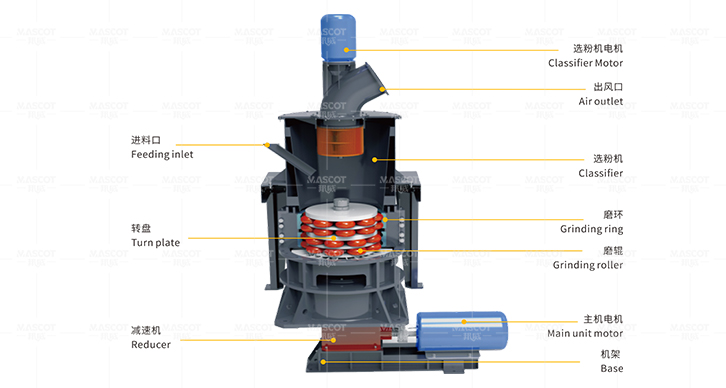
The comparison that matters is against the alternative routes to ultra-fineness. Jet mills reach very fine sizes by grinding particle against particle in high-speed air streams — effective, but expensive in compressed energy and capital. At equal output and fineness, Mascot's published figures put an HGM line at more than 80% lower cost than jet mill installations, because the ring-roller principle does the size reduction mechanically and the classifier does the selection. The HGM design attacks the cost items directly: rollers and ring do the grinding with a 15-20% higher grinding force per pass, an internal thin-oil lubrication system extends service intervals, and the working life of the mill is rated at 3-5 times that of conventional grinding mills — which is to say the wear cost and downtime cost per ton fall with it.
The economics only close if one machine can produce specification powder without constant intervention. The HGM micro-powder mill pairs the ring-roller grinding chamber with a variable-frequency turbo classifier: fineness is adjusted by changing the classifier speed, so a producer can move from an 800 mesh run to a 2500 mesh run without stopping the line to swap parts. That single feature turns premium grades from a separate project into a production mode.
For planning purposes, the HGM series offers three workhorse models. The HGM80 takes feed up to 10 mm and produces roughly 0.6-4 t/h with a 75 kW main motor and a 22 kW classifier. The HGM100 takes feed up to 20 mm, produces roughly 0.9-6 t/h with a 110 kW main motor and a 30 kW classifier. The HGM1036, the largest of the three, produces roughly 1.2-10 t/h with a 132 kW main motor and a 37 kW classifier. Across the series the finished product range is published at 325-2500 mesh (approximately 5-47 microns), with feed moisture handled by upstream drying where needed. Output depends on the material and its feed size, which is exactly why the engineering stage — matching model to mineral and target spec — decides whether the premium is real or theoretical.

Owning the mill is only half of the premium story; the other half is proving the specification. Producers who command premium prices run the same discipline every day: the contract quotes D97 and a top cut, not a vague mesh name; every lot is checked by sieve residue and particle-size testing before it ships; whiteness and iron contamination are monitored, because a discolored batch destroys a premium grade in one delivery; and moisture is controlled from feed to packing so the powder arrives free-flowing.
The HGM line supports that discipline structurally. Wear parts are selected for the mineral — including ceramic composite options for whiteness-sensitive and iron-sensitive products — so the mill does not add contamination that QC would later reject. The pulse dust collector recovers finished product while keeping the workshop clean. And because grade changes are a control-room adjustment rather than a mechanical rebuild, a plant can run a base grade for volume and fill premium spot orders on the same line, capturing the price ladder instead of being locked to one rung of it.
Q1: Is the ultra-fine premium a real 2026 trend or a short-term spike?
A: The premium reflects a structural shift, not a price spike. Downstream industries are specifying finer, better-controlled powders for functional use in coatings, plastics, rubber and paper. Demand driven by specification is more stable than demand driven by commodity cycles, because it is tied to product performance rather than to inventory buying.
Q2: At what fineness does the premium start?
A: There is no universal boundary, but the shift is visible in the contract language: when buyers start quoting D97 and a maximum particle size instead of a mesh name, the product has moved from filler to functional ingredient. In practice this usually appears from the 800 mesh range upward, where D97 control and top-cut control start to differentiate suppliers.
Q3: Why not just use a jet mill for ultra-fine powder?
A: Jet mills can reach very fine sizes, but they consume large amounts of compressed energy to do it. For medium-hard minerals such as calcite, marble and barite, the HGM ring-roller mill reaches the same specification at a fraction of the energy and capital cost — Mascot's published comparison puts HGM more than 80% below jet mill cost at equal output and fineness.
Q4: Can one HGM line serve several premium grades?
A: Yes. The variable-frequency turbo classifier changes the finished fineness by adjusting rotor speed, without stopping the line or changing parts. A producer can schedule base-grade and premium-grade runs on one machine, which is how the price ladder becomes a margin strategy rather than a separate investment.
Ultra-fine powder commands premium prices in 2026 for a structural reason: at 800 mesh and above, powder stops being bulk filler and becomes a functional specification that determines the value of downstream products. Producing it costs more per ton — in energy, classification discipline, wear and quality control — which is exactly why suppliers who hold the specification can charge for it. The HGM Series Micro-powder Grinding Mill attacks both sides of that equation: mechanical ring-roller grinding and a variable-frequency turbo classifier deliver 325-2500 mesh powder at a cost far below jet milling, while wear-material selection, dust-free operation and fast grade changes protect the margin on every ton. The premium is available to any plant that can hold the spec — the HGM line is how the spec is held.

About of Mascot
Zhengzhou Mascot Industry is a high-tech mining equipment company integrating R&D, manufacturing, sales, and after-sales service. Focusing on crushing, grinding, and mineral processing equipment, we provide professional solutions to our customers. We are ISO9001:2015 certified, and our products include mobile crushing plants, crawler crushing plant, construction waste crushing plants, jaw crushers, sand making machines, cone crushers, fine crushers, grinding mills, ball mills, etc., all with reliable performance to meet diverse project needs.
• Professional pre-sales support: Free project design and comprehensive solutions to help you accurately select the right equipment;
• Comprehensive on-site service: Providing installation guidance and worker training to ensure smooth equipment commissioning;
• Reliable after-sales guarantee: A complete after-sales system, timely response to technical inquiries and equipment maintenance, ensuring long-term stable operation.
To protect your rights, please contact us through the following official channels for professional service:
WhatsApp: 0086-16650273865
Email: mascot@mascotenv.com
We are committed to providing high-quality equipment and full-cycle services to deliver comprehensive intelligent solutions for the global mining industry!

This production line utilizes a three-ring medium-speed micro-grinding mill as the central equipment, complemented by other auxiliary equipment like hammer crushers, bucket elevators, and storage silos to establish a comprehensive grinding operation system. It has demonstrated strong potential for application and market competitiveness in industries such as construction, chemical industry, and new materials.
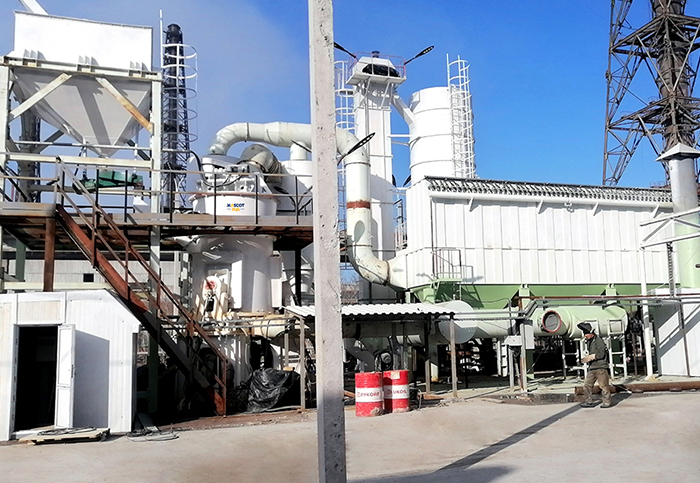
The production line of the vertical roller mill is a cost-effective and energy-efficient solution for processing powder, which is widely used in many industries, such as metallurgy, building materials, industrial solid waste treatment, thermal power plants, cement plants, and environmental protection fields. The primary purpose of this project is to finely grind raw materials through a vertical roller mill to meet the requirements of different industries for particle size, purity, and output of powder products.

The Raymond mill production line is a highly efficient system designed for grinding operations, with a focus on energy efficiency, durability, and productivity. It caters to the needs of users by offering fine powder products in non-metallic ores, coal powder, and slag processing, aiding enterprises in achieving sustainable growth.

YGMX Enhanced High-Pressure Mill is a new type of high-performance grinding equipment, and the biggest improvement of this milling equipment lies in the increase of the high-pressure spring system in the grinding roller part. Compared with the traditional high-pressure roller mill, it has a wider scope of application and excellent performance to meet the production needs of a variety of powder fineness. It is widely used in non-metallic minerals, chemicals, building materials, metallurgy, environmental protection, etc. Multiple areas.

The MTW series European grinding mill production line includes high-efficiency crushers, elevators, electromagnetic vibration feeders, milling machines, classifiers, and collectors. These pieces of equipment work together to achieve efficient crushing, grinding, and classification of various non-metallic ores, coal powder, slag, and other materials. It can meet the diverse needs of various industries for powder particle size, uniformity, shape, etc., and offer enterprises high-quality grinding products.
Green and Intelligent Mining Machinery
Manufacturing and Export Base
Based on high quality and perfect after-sales service, our products have been
exported to more than 120 countries and regions.
Copyright © 2023 Zhengzhou Mascot Environmental Technology Co., Ltd Record number: Yu ICP No. 13021523-4





 WhatsApp