
Flue-gas desulfurization (FGD) is one of the largest and steadiest consumers of fine limestone powder in the world. As emission regulations tighten across Southeast Asia, South America and other industrializing regions, power plants, steel mills and industrial boilers must remove sulfur dioxide from their flue gas — and the reagent they buy by the thousands of tons is ground limestone. For powder producers, this demand is a business opportunity; for the equipment behind it, the requirement is clear: high output, consistent fineness and reliable supply. The MTW Trapezium Grinding Mill is built for exactly that duty.
The driver is regulation, and regulation moves in one direction. Emission standards for sulfur dioxide are being adopted and enforced across industrializing economies, pushing coal-fired power plants, steel sinter plants, cement kilns and industrial boilers to install or upgrade FGD systems. Each system needs a continuous reagent supply — not a one-time order, but a permanent monthly tonnage.
The result is a structural demand shift for limestone powder: plants that once produced for building materials now hold desulfurization contracts on top, and regional powder producers who secure those contracts gain a stable, recurring revenue base. The trend is qualitative but unmistakable — FGD limestone demand follows emissions enforcement, and emissions enforcement is not reversing. For a powder plant with spare capacity or a new line in the plan, the desulfurization market is the growth segment of 2026.

FGD systems are picky customers. The reagent limestone powder must meet a defined fineness — commonly 250 mesh, with 325 mesh specified in some systems — because the desulfurization reaction rate depends on particle surface area. The powder must be consistent batch after batch, since the plant's dosing and reaction control assume a stable product. And the supply must be continuous, because a power plant cannot stop burning when the reagent warehouse is empty.
Three requirements follow for the grinding equipment. First, output: the line must produce the contracted tonnage every day, with no seasonal surprises. Second, consistency: a high pass rate at the specified mesh, held shift after shift. Third, reliability: minimal unplanned downtime, because every stopped hour is a contract risk. These are exactly the properties the MTW series was designed to deliver.
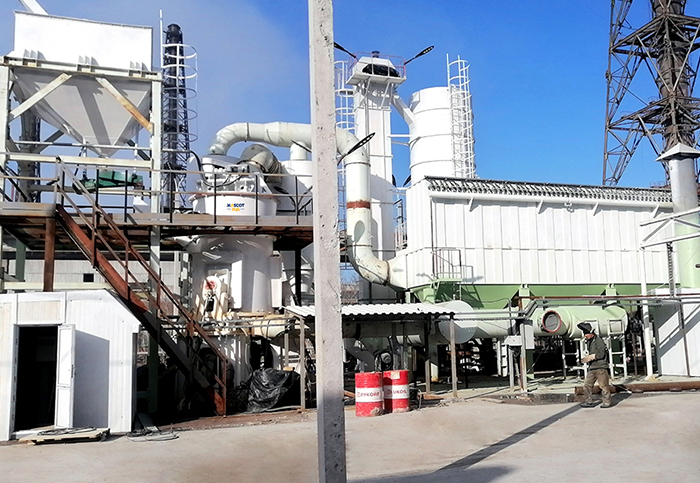
The field evidence for desulfurization duty is direct. A Southeast Asian plant runs an MTW175 line grinding limestone at ≤40mm and ≤5% moisture into 250-mesh powder — the FGD specification — and has held a stable 31 t/h against a 28-32 t/h design target for more than ten months, with a 99.6% finished powder pass rate. The same machine class that supplies concrete-admixture markets is the one FGD reagent producers rely on: high output at the exact mesh, consistently.
Energy and maintenance support the economics. The trapezoidal geometry lifts efficiency 20%-30%, the bevel gear recovers about 15% of drivetrain loss, and the line measured 22% lower energy per ton and 20% lower maintenance than the traditional equipment it replaced — numbers that matter when the contract price per ton is set by competition. A desulfurization contract won at a competitive price still needs a profitable cost per ton to be a real win.

Model selection follows the contract tonnage, with a margin for the 250-325 mesh duty:
| FGD Powder Target | Model | Capacity (t/h) |
|---|---|---|
| Small regional supply | MTW110 | 3-10 |
| Medium plant contract | MTW138 | 6-20 |
| Large power-plant supply | MTW175 | 10-35 (case-proven at 31 t/h @ 250 mesh) |
| Multi-contract production base | MTW215 | 20-50 |
At 250-325 mesh, size with a margin: the rated ranges are stated at coarser fineness, so a plant contracted for 25 t/h of 250-mesh FGD powder should plan around the MTW175, not the top of a smaller model's range. Feed size (30-45mm by model) and moisture below 6% are the other two inputs to confirm before the line is designed.
A desulfurization powder line is more than the mill: it must feed, lift, collect dust and discharge continuously, because the contract does not pause. Mascot configures the complete line — the main mill with its classifier, a GZ2 vibrating feeder for uniform feed, a TH400 bucket elevator, an LQM72-7 pulse dust collector holding emissions below 20mg/m³, an LSY273 screw conveyor for finished powder, and a PLC system with one-key start and stop coordinating the whole sequence.
Execution speed matters for contract starts. In the reference project, the complete line was produced in 18 working days and commissioned 28 days after arrival on site, with engineer-guided installation and operator training included. A producer who wins an FGD contract needs the line running before the first delivery date — and the MTW project timeline is built around that need.

Q1: What fineness do FGD limestone contracts typically require?
A: Commonly 250 mesh, with 325 mesh in some systems. The MTW classifier adjusts across 80-425 mesh, so one line can serve both specifications and other powder markets.
Q2: Can I supply multiple FGD customers from one line?
A: Yes — the MTW175 case plant produced 31 t/h of 250-mesh powder stably for over ten months. Multi-contract supply is a matter of contracted tonnage, not line count.
Q3: How reliable is the MTW line for continuous operation?
A: The reference line ran beyond ten months with wear parts intact, 22% lower energy and 20% lower maintenance — reliability designed for the continuous duty FGD supply requires.
Q4: How quickly can an FGD powder line be commissioned?
A: Equipment is produced in 18 working days and the line commissioned 28 days after arrival, with engineer-guided installation and operator training included.
The 2026 desulfurization market rewards the same things the MTW Trapezium Grinding Mill delivers: high sustained output at the 250-325 mesh FGD specification, batch-to-batch consistency, and the reliability to hold a supply contract. The field case — 31 t/h, 99.6% pass rate, 22% lower energy, a second line ordered — is the evidence, and the complete-line package with 18-working-day production and 28-day commissioning is the execution. For a powder producer looking at the desulfurization opportunity, Mascot's free project design will size the line for your contract tonnage and confirm the numbers before you commit.

About of Mascot
Zhengzhou Mascot Industry is a high-tech mining equipment company integrating R&D, manufacturing, sales, and after-sales service. Focusing on crushing, grinding, and mineral processing equipment, we provide professional solutions to our customers. We are ISO9001:2015 certified, and our products include mobile crushing plants, crawler crushing plant, construction waste crushing plants, jaw crushers, sand making machines, cone crushers, fine crushers, grinding mills, ball mills, etc., all with reliable performance to meet diverse project needs.
• Professional pre-sales support: Free project design and comprehensive solutions to help you accurately select the right equipment;
• Comprehensive on-site service: Providing installation guidance and worker training to ensure smooth equipment commissioning;
• Reliable after-sales guarantee: A complete after-sales system, timely response to technical inquiries and equipment maintenance, ensuring long-term stable operation.
To protect your rights, please contact us through the following official channels for professional service:
WhatsApp: 0086-16650273865
Email: mascot@mascotenv.com
We are committed to providing high-quality equipment and full-cycle services to deliver comprehensive intelligent solutions for the global mining industry!

YGMX Enhanced High-Pressure Mill is a new type of high-performance grinding equipment, and the biggest improvement of this milling equipment lies in the increase of the high-pressure spring system in the grinding roller part. Compared with the traditional high-pressure roller mill, it has a wider scope of application and excellent performance to meet the production needs of a variety of powder fineness. It is widely used in non-metallic minerals, chemicals, building materials, metallurgy, environmental protection, etc. Multiple areas.

The high-pressure grinding mill production line is a project specially designed for efficient grinding operations. It is widely used in metallurgy, building materials, the chemical industry, highways, water conservancy hydropower, and other industries. It is a suspended roller mill that uses springs to increase pressure. It can achieve efficient grinding processing of various non-metallic raw materials. It has high efficiency, stability, and environmental protection characteristics.

The MTW series European grinding mill production line includes high-efficiency crushers, elevators, electromagnetic vibration feeders, milling machines, classifiers, and collectors. These pieces of equipment work together to achieve efficient crushing, grinding, and classification of various non-metallic ores, coal powder, slag, and other materials. It can meet the diverse needs of various industries for powder particle size, uniformity, shape, etc., and offer enterprises high-quality grinding products.

The Raymond mill production line is a highly efficient system designed for grinding operations, with a focus on energy efficiency, durability, and productivity. It caters to the needs of users by offering fine powder products in non-metallic ores, coal powder, and slag processing, aiding enterprises in achieving sustainable growth.
The production line of the vertical roller mill is a cost-effective and energy-efficient solution for processing powder, which is widely used in many industries, such as metallurgy, building materials, industrial solid waste treatment, thermal power plants, cement plants, and environmental protection fields. The primary purpose of this project is to finely grind raw materials through a vertical roller mill to meet the requirements of different industries for particle size, purity, and output of powder products.
Green and Intelligent Mining Machinery
Manufacturing and Export Base
Based on high quality and perfect after-sales service, our products have been
exported to more than 120 countries and regions.
Copyright © 2023 Zhengzhou Mascot Environmental Technology Co., Ltd Record number: Yu ICP No. 13021523-4





 WhatsApp