 27
27
 27
27
 25
25

Buyers of mineral powder equipment hear mesh numbers every day — 200 mesh, 325 mesh, 400 mesh — yet few stop to translate them. The MTW Trapezium Grinding Mill produces powder across 80-425 mesh (0.038-0.2mm), and choosing the right fineness for your product is as important as choosing the right machine. This guide explains what mesh actually means, how 325 and 400 mesh differ in practice, which fineness each market needs, and how fineness choice affects mill capacity and cost.
Mesh is a sieve-based measure: a 325-mesh powder passes a screen with 325 openings per inch. The number is not a particle size directly — it is a screen count — but the standard conversion table turns it into microns. The practical translation, with typical values:
| Mesh | Opening (approx.) | Typical Use |
|---|---|---|
| 80 mesh | 0.177mm (177 µm) | Coarse powder, building materials |
| 100 mesh | 0.149mm (149 µm) | Coarse industrial powder |
| 200 mesh | 0.074mm (74 µm) | General industrial powder |
| 250 mesh | 0.058-0.063mm (58-63 µm) | Concrete admixture, desulfurization |
| 325 mesh | 0.043-0.044mm (43-44 µm) | Paint, plastics, rubber fillers |
| 400 mesh | 0.037-0.038mm (37-38 µm) | Fine fillers, coating grade |
The numbers vary slightly between sieve standards, so always quote the standard (or the micron value) with the mesh number in your specification. What matters commercially is the micron size and the uniformity around it — which brings us to the real difference between 325 and 400.
At first glance the gap looks small — 43 microns against 38 microns. In practice it is significant in three ways. First, the particle size distribution shifts finer overall: a 400-mesh product has fewer coarse particles in the tail, which is what coating and filler buyers actually pay for. Second, the grinding cost rises: finer targets mean more recirculation through the grinding zone, so 400-mesh output per hour is lower than 325-mesh output on the same mill — the trade-off is real and must be priced.
Third, the applications differ. 325-mesh calcium carbonate serves paint, plastics, rubber and general filler duty, where consistency at 43 microns satisfies most formulations. 400-mesh powder is specified where surface smoothness and fineness of the tail matter more — higher-grade coatings, paper coating and premium filler formulations. For limestone in concrete admixtures and desulfurization, 250-mesh is typically the standard; buyers should specify what their downstream customer actually requires, not the finest number available, because finer costs more per ton to produce.

Fineness selection starts from the end product, not from the mill. The common market requirements, as a working reference:
Match the fineness to the contract, then choose the mill class. For grades within 80-425 mesh, the MTW series covers the requirement with stepless adjustment; for finer grades beyond 425 mesh, a different mill class applies.
Producing 325 or 400 mesh consistently is a classifier job, and this is where the MTW series' frequency-conversion classifier earns its keep. The classifier spins at a speed tuned to the exact cut point: particles finer than the target pass through with the airflow, coarser particles return to the grinding chamber for another pass. Because the speed is frequency-controlled, the cut point adjusts steplessly across 80-425 mesh on the PLC panel — without stopping the mill.
The field result shows what precise classification means: the Southeast Asian limestone case plant reported a 99.6% finished powder pass rate at 250 mesh over more than ten months. The same classifier technology holds 325 and 400 mesh on-spec, and when the market asks for a coarser or finer grade, the operator changes the speed and the line adapts within minutes — one machine serving multiple grades.

Finer powder costs more per ton to make, and the difference is measurable. At 250 mesh, the field benchmark shows an MTW175 delivering 31 t/h. Moving to 325 mesh, the same machine produces less — the finer cut increases recirculation — and at 400 mesh less still. The exact drop depends on material and classifier setting, but the direction is constant, and it must be in your cost plan.
Two consequences follow. First, size the mill for your finest grade, not your most common one, so the line is never a bottleneck when a fine contract arrives. Second, price your product by grade: a plant that sells 400-mesh powder at 325-mesh prices is giving away the extra energy and time it takes to produce it. The MTW series' stepless adjustment makes multi-grade production easy — the pricing discipline is up to the plant.
For a quick reference, here is how typical materials map to fineness and MTW models:
| Material | Common Fineness | Typical MTW Class |
|---|---|---|
| Limestone (concrete admixture) | 250 mesh | MTW138 / MTW175 |
| Calcium carbonate (fillers) | 325-400 mesh | MTW138 / MTW175 |
| Barite (drilling fluids) | 200-325 mesh | MTW110 / MTW138 |
| Talc, gypsum, dolomite | 200-325 mesh | MTW110 / MTW138 |
| Quartz | 80-400 mesh | MTW138 / MTW175 (abrasive duty) |
These are typical market ranges, not fixed rules — the definitive selection is confirmed by a project design on your material.
Q1: Is 400 mesh always better than 325 mesh?
A: No — better means "fits the application." Finer powder costs more to produce and is only worth it where the downstream product demands it. Specify what your customer's formulation requires.
Q2: How much capacity do I lose going from 325 to 400 mesh?
A: Output falls as fineness rises, because of increased recirculation. The exact drop depends on your material; Mascot's project design gives the number for your case.
Q3: Can the MTW mill switch between mesh grades?
A: Yes. The frequency-conversion classifier adjusts across 80-425 mesh on the PLC panel without stopping the mill, and the field case held a 99.6% pass rate at 250 mesh.
Q4: What if my market needs finer than 425 mesh?
A: Grades beyond 425 mesh belong to a finer-mill class; within the 80-425 mesh range, the MTW series covers your requirement with one adjustable machine.
Mesh numbers translate into microns — 325 mesh is about 43 microns, 400 mesh about 38 — and the choice between them is an application decision, not a quality contest. 250 mesh serves concrete and desulfurization, 325 mesh fills paint, plastics and rubber, and 400 mesh serves premium filler and coating grades at a higher production cost per ton. The MTW Trapezium Grinding Mill covers the full 80-425 mesh range with one stepless classifier, so your fineness strategy can follow your market instead of your machine. Size for your finest grade, price by grade, and let a project design confirm the numbers for your material.

About of Mascot
Zhengzhou Mascot Industry is a high-tech mining equipment company integrating R&D, manufacturing, sales, and after-sales service. Focusing on crushing, grinding, and mineral processing equipment, we provide professional solutions to our customers. We are ISO9001:2015 certified, and our products include mobile crushing plants, crawler crushing plant, construction waste crushing plants, jaw crushers, sand making machines, cone crushers, fine crushers, grinding mills, ball mills, etc., all with reliable performance to meet diverse project needs.
• Professional pre-sales support: Free project design and comprehensive solutions to help you accurately select the right equipment;
• Comprehensive on-site service: Providing installation guidance and worker training to ensure smooth equipment commissioning;
• Reliable after-sales guarantee: A complete after-sales system, timely response to technical inquiries and equipment maintenance, ensuring long-term stable operation.
To protect your rights, please contact us through the following official channels for professional service:
WhatsApp: 0086-16650273865
Email: mascot@mascotenv.com
We are committed to providing high-quality equipment and full-cycle services to deliver comprehensive intelligent solutions for the global mining industry!
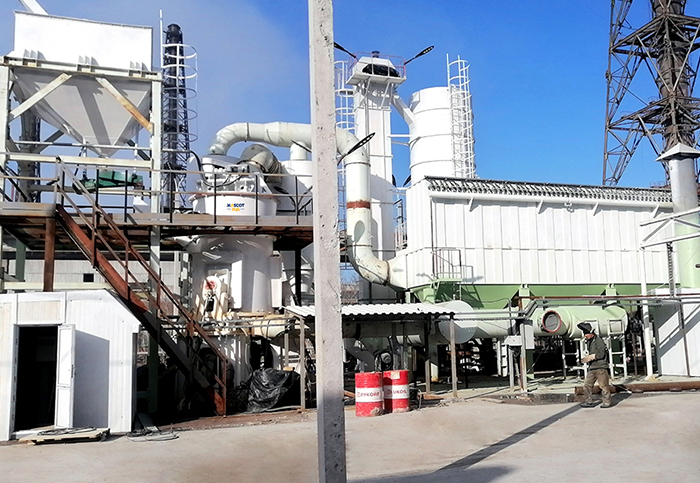
The production line of the vertical roller mill is a cost-effective and energy-efficient solution for processing powder, which is widely used in many industries, such as metallurgy, building materials, industrial solid waste treatment, thermal power plants, cement plants, and environmental protection fields. The primary purpose of this project is to finely grind raw materials through a vertical roller mill to meet the requirements of different industries for particle size, purity, and output of powder products.

The gypsum grinding production line is an efficient, stable, and environmentally friendly production solution, which is widely used in construction, decoration, the chemical industry, and other fields. In addition, the grinding process is particularly critical, which directly affects the quality and particle size of the final product. With the continuous development of science and technology, the technical level and production efficiency of gypsum grinding production lines will be further improved, providing strong support for the development of the gypsum processing industry.

YGMX Enhanced High-Pressure Mill is a new type of high-performance grinding equipment, and the biggest improvement of this milling equipment lies in the increase of the high-pressure spring system in the grinding roller part. Compared with the traditional high-pressure roller mill, it has a wider scope of application and excellent performance to meet the production needs of a variety of powder fineness. It is widely used in non-metallic minerals, chemicals, building materials, metallurgy, environmental protection, etc. Multiple areas.

The high-pressure grinding mill production line is a project specially designed for efficient grinding operations. It is widely used in metallurgy, building materials, the chemical industry, highways, water conservancy hydropower, and other industries. It is a suspended roller mill that uses springs to increase pressure. It can achieve efficient grinding processing of various non-metallic raw materials. It has high efficiency, stability, and environmental protection characteristics.

The MTW series European grinding mill production line includes high-efficiency crushers, elevators, electromagnetic vibration feeders, milling machines, classifiers, and collectors. These pieces of equipment work together to achieve efficient crushing, grinding, and classification of various non-metallic ores, coal powder, slag, and other materials. It can meet the diverse needs of various industries for powder particle size, uniformity, shape, etc., and offer enterprises high-quality grinding products.
Green and Intelligent Mining Machinery
Manufacturing and Export Base
Based on high quality and perfect after-sales service, our products have been
exported to more than 120 countries and regions.
Copyright © 2023 Zhengzhou Mascot Environmental Technology Co., Ltd Record number: Yu ICP No. 13021523-4





 WhatsApp