
Feldspar and quartz are the backbone of the ceramics, glass and refractory industries, and both are usually delivered to the plant as a dry, closely specified powder. Grinding them dry rules out the slurry circuits used on softer minerals, which means the mill has to hold fineness and tonnage while handling two of the harder feeds in the business. The Dry Ball Mill from Zhengzhou Mascot Industry is positioned for exactly this duty: after crushing, it reduces dry bulk material into uniform fine powder with a wide, adjustable fineness range. This guide covers the two questions buyers ask first — what output to expect, and which liners to run.
Feldspar and quartz are ground dry for reasons that come from the customer, not from the mill. Ceramic bodies, glass batches and refractory mixes are formulated as dry blends, so any water introduced during grinding has to be removed again before the powder can be batched — a drying step that costs fuel and adds a production stage. Dry grinding simply delivers the product in the form the next process expects.
The cost of that choice is a harder working environment for the equipment. There is no slurry to cushion the charge, no liquid to carry heat away, and the feed itself is abrasive. The Mascot dry ball mill answers with a reinforced shell and high-grade alloy liners, so the structure and the wear parts are specified for continuous industrial load rather than for intermittent duty. For materials that react with water, or processes that require a dry final powder, dry grinding is not a preference; it is the only workable route.

On a dry line, output is decided by four inputs: the hardness of the material, the feed size going in, the target fineness coming out, and whether the mill runs in open or closed circuit. The published capacity of a given model is a range for that reason — the same mill that delivers its upper tonnage on an easy feed will sit at the lower end on a hard one.
In operation, raw material of up to about 25 mm enters the cylinder through the hollow feed trunnion. As the cylinder rotates, the grinding media are lifted and cascade down, and the material is pulverised by the impact of the falling balls and by friction against the charge and the liner. The ground powder leaves through the discharge structure: carried out by continuous airflow, or by gravity in an open-circuit arrangement. Coarse particles that are not yet fine enough remain in the cylinder for further grinding, which is what holds the fineness band.
Where the specification is demanding, the mill is run in closed circuit with an air classifier. The classifier takes the mill discharge, returns oversize for regrinding, and passes only qualified powder to collection — a cyclone separator and pulse-jet bag filter system that recovers product and keeps the circuit under negative pressure. This is the configuration that lets one mill serve several product grades by changing the cut point rather than the machine.

The table below gives the published specifications for the models commonly specified on feldspar, quartz and other hard dry feeds. Feed size is up to 25 mm across the series, and the published output band is 0.074-0.4 mm except at the smallest size.
| Model | Feeding Size (mm) | Output Size (mm) | Capacity (t/h) | Power (kW) |
|---|---|---|---|---|
| 1200x2400 | ≤25 | 0.075-0.6 | 1.6-5.8 | 37 |
| 1500x3000 | ≤25 | 0.074-0.4 | 2-7 | 75 |
| 1830x4500 | ≤25 | 0.074-0.4 | 4.5-12 | 155 |
| 1830x6400 | ≤25 | 0.074-0.4 | 6.5-15 | 210 |
| 2100x7000 | ≤25 | 0.074-0.4 | 8-48 | 280 |
| 2200x7000 | ≤25 | 0.074-0.4 | 15-28 | 380 |
| 2400x4500 | ≤25 | 0.074-0.4 | 40-60 | 320 |
| 2700x4500 | ≤25 | 0.074-0.4 | 50-90 | 430 |
| 3200x4500 | ≤25 | 0.074-0.4 | 50-90 | 800 |
Because output moves with material hardness, feed size and target fineness, model selection needs three data points before it can be answered properly: the material type, the required capacity in tons per hour, and the required output fineness. Mascot application engineers work from those three numbers, and will also advise whether an air classifier is needed to hold the product specification.
On feldspar and quartz duty, the liner is the part that decides the maintenance calendar. It protects the shell from the charge and shapes the ball trajectory, and because the feed is abrasive, it wears by design rather than by accident. The engineering question is not whether it wears, but how long the interval between changes can be stretched.
Liner material is therefore a specification decision, not a spare-part default. High-manganese (Mn13) steel is the option for hard, abrasive duty, and the reported difference against standard manganese is substantial:
| Liner Option | Reported Service Life | Best Applied To |
|---|---|---|
| High-manganese (Mn13) steel | 12-18 months | Hard, abrasive dry feed such as quartz and feldspar |
| Standard manganese steel | 6-8 months | Lower-abrasion dry grinding duty |
Service life above is the interval reported in field operation, and it moves with feed hardness and running hours; the point of the comparison is the ratio, not the exact month. Doubling the interval between liner changes does more than save the liner cost. It removes a shutdown, a set of man-hours and a production interruption from the calendar — which is where the larger part of the saving sits.
Other wear items matter for the same reason. Grates, bearing assemblies and transmission belts are the parts that stop a mill when they fail unexpectedly, so Mascot keeps them in stock year-round and ships a recommended spare parts list with every order, letting the plant hold critical items from day one rather than waiting for a breakdown to place the order. Mascot also supplies the grinding media themselves — forged or cast steel balls — and calculates the initial ball size distribution to match the feed.

Grinding is an energy-intensive step, and on a dry line two design choices decide where that energy goes. The first is the bearing arrangement: the self-aligning roller bearing system is reported to save 10-20% on electricity against conventional sliding-bearing mills. The second is the motor, which is specified as a wide-voltage-tolerant IE3 unit able to operate within ±10% of rated voltage without losing performance — a specification written for sites with unstable supply. For installations where that is not enough, optional motor soft-starters and voltage stabilizers protect the winding from surge damage, and overload and phase-loss protection is fitted as standard rather than offered as an upgrade.
The numbers are worth putting in front of a buyer. Based on feedback from more than 30 operating customers, a medium-scale installation typically pays back in 12-18 months. On a 1500x4500 model running 20 hours a day, the bearing advantage alone translates into roughly US$3,000-5,000 in annual power savings, before the longer liner interval is counted.
Dust is the other operating cost that a dry line has to answer for, and increasingly it is an inspection question rather than a housekeeping one. The mill and classifier form a closed negative-pressure loop: material enters sealed, grinds sealed and discharges sealed. Dust-laden air is drawn into a high-capacity pulse-jet bag filter that captures 99.9% of particulate matter, with outlet emissions typically below 30 mg/m³. That is a clean workshop and a compliant stack from the same design.

The clearest way to judge a dry grinding line is by one that is already running. A regional cement manufacturer in Rajasthan expanded its clinker pulverising capacity with a Φ3200x13000 large-scale dry ball mill integrated with a Mascot air classifier system, targeting a fineness of 300-350 kg/m² Blaine.
The plant reported a 12% reduction in power consumption per ton of cement against its older units, and the combination of mill and air classifier allowed the precise production of multiple cement grades from the same installation. Mascot provided a 30-day on-site commissioning service, including 10 days of intensive operator training. The arrangement at the centre of that result — a dry ball mill held in closed circuit by an air classifier — is the same one a feldspar or quartz line uses when the product specification has to be held rather than approximated.

Q1: How do I choose the correct size of dry ball mill?
A: Three factors decide it — the required capacity in tons per hour, the hardness of the raw material, and the target final fineness. Send those three data points and the Mascot engineering team will return a calculated model recommendation, ball charge ratio and, where needed, a classifier specification.
Q2: What output should I expect on feldspar or quartz?
A: Use the published range as the envelope and expect the actual figure to move with hardness, feed size and target fineness. The series covers roughly 1.6-5.8 t/h on the 1200x2400 up to 50-90 t/h on the 3200x4500, at product sizes of 0.074-0.4 mm. A project design against your own material gives the reliable number.
Q3: Does Mascot supply the grinding media?
A: Yes. Mascot supplies high-quality forged or cast steel balls and calculates the optimal initial ball ratio, so the charge starts at the size distribution the mill was designed around.
Q4: How does a dry ball mill handle dust emissions?
A: The mill and classifier run as a closed negative-pressure system connected to a pulse-jet bag filter that captures 99.9% of particulate matter, with outlet emissions typically below 30 mg/m³.
Q5: What is the lead time and warranty?
A: Large customized mills such as the 3200 series are typically manufactured in 35-50 days; smaller standard models in 20-25 days. Mascot provides a 12-month warranty on the whole machine and a 12-month warranty on core components such as rollers, rings and classifiers, with 24/7 online consultation.
Feldspar and quartz are ground dry because their customers batch dry, and that choice puts the mill, its liners and its air circuit under the load of two hard, abrasive feeds. Output on a dry line is set by material hardness, feed size, target fineness and circuit configuration — which is why the published capacity of a model is a range from 1.6-5.8 t/h on the 1200x2400 to 50-90 t/h on the 3200x4500, at 0.074-0.4 mm, and why closed-circuit operation with an air classifier is what holds a specification. Liner selection is the maintenance decision that runs alongside it: high-manganese (Mn13) steel is reported at 12-18 months against 6-8 months for standard manganese on abrasive duty, and the saving is measured in shutdowns avoided, not only liners bought. For a mill matched to your material, the Mascot Dry Ball Mill is sized from three numbers: material, capacity and fineness.

About of Mascot
Zhengzhou Mascot Industry is a high-tech mining equipment company integrating R&D, manufacturing, sales, and after-sales service. Focusing on crushing, grinding, and mineral processing equipment, we provide professional solutions to our customers. We are ISO9001:2015 certified, and our products include mobile crushing plants, crawler crushing plant, construction waste crushing plants, jaw crushers, sand making machines, cone crushers, fine crushers, grinding mills, ball mills, etc., all with reliable performance to meet diverse project needs.
• Professional pre-sales support: Free project design and comprehensive solutions to help you accurately select the right equipment;
• Comprehensive on-site service: Providing installation guidance and worker training to ensure smooth equipment commissioning;
• Reliable after-sales guarantee: A complete after-sales system, timely response to technical inquiries and equipment maintenance, ensuring long-term stable operation.
To protect your rights, please contact us through the following official channels for professional service:
WhatsApp: 0086-16650273865
Email: mascot@mascotenv.com
We are committed to providing high-quality equipment and full-cycle services to deliver comprehensive intelligent solutions for the global mining industry!

YGMX Enhanced High-Pressure Mill is a new type of high-performance grinding equipment, and the biggest improvement of this milling equipment lies in the increase of the high-pressure spring system in the grinding roller part. Compared with the traditional high-pressure roller mill, it has a wider scope of application and excellent performance to meet the production needs of a variety of powder fineness. It is widely used in non-metallic minerals, chemicals, building materials, metallurgy, environmental protection, etc. Multiple areas.

The high-pressure grinding mill production line is a project specially designed for efficient grinding operations. It is widely used in metallurgy, building materials, the chemical industry, highways, water conservancy hydropower, and other industries. It is a suspended roller mill that uses springs to increase pressure. It can achieve efficient grinding processing of various non-metallic raw materials. It has high efficiency, stability, and environmental protection characteristics.

The Raymond mill production line is a highly efficient system designed for grinding operations, with a focus on energy efficiency, durability, and productivity. It caters to the needs of users by offering fine powder products in non-metallic ores, coal powder, and slag processing, aiding enterprises in achieving sustainable growth.

This production line utilizes a three-ring medium-speed micro-grinding mill as the central equipment, complemented by other auxiliary equipment like hammer crushers, bucket elevators, and storage silos to establish a comprehensive grinding operation system. It has demonstrated strong potential for application and market competitiveness in industries such as construction, chemical industry, and new materials.
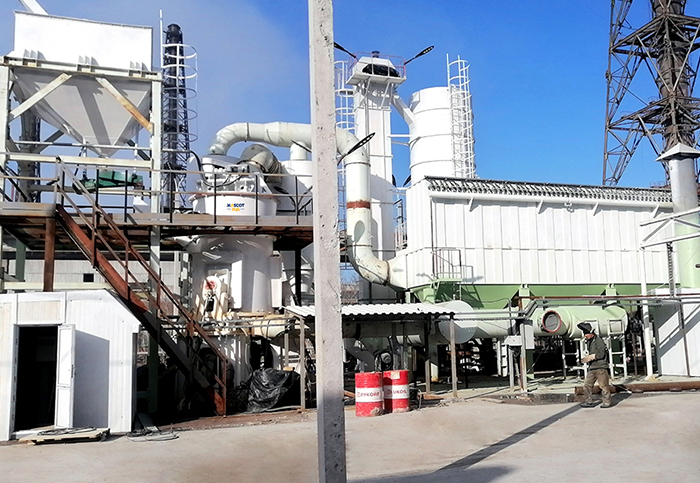
The production line of the vertical roller mill is a cost-effective and energy-efficient solution for processing powder, which is widely used in many industries, such as metallurgy, building materials, industrial solid waste treatment, thermal power plants, cement plants, and environmental protection fields. The primary purpose of this project is to finely grind raw materials through a vertical roller mill to meet the requirements of different industries for particle size, purity, and output of powder products.
Green and Intelligent Mining Machinery
Manufacturing and Export Base
Based on high quality and perfect after-sales service, our products have been
exported to more than 120 countries and regions.
Copyright © 2023 Zhengzhou Mascot Environmental Technology Co., Ltd Record number: Yu ICP No. 13021523-4





 WhatsApp