 27
 27
 25

A vertical roller mill is tuned in a fixed order, and most of the fineness problems blamed on the classifier are created two steps earlier. The machine grinds on a bed of material, holds that bed with hydraulic pressure, and carries the fines out with hot gas. Get the bed and the gas right and the cut follows the classifier almost by itself; get them wrong and no amount of classifier speed will hold a specification for a full shift.
The published frame for the vertical roller mill range is a 1,300-2,200 mm table, feed up to 38 mm, 10-135 t/h and 185-1,000 kW, with hot gas up to 350 °C at the inlet and 70-95 °C at the outlet. Those are the boundaries the tuning works inside.
An unstable mill cannot hold a cut, because the cut is a product of a steady bed. When the mill is vibrating, the operator typically reaches for the classifier first — the powder is coarse, so the wheel must be too slow. Ten minutes later the powder is fine and the mill is shaking harder, because the real problem was a bed that never formed.
The order that works is bed, then pressure, then air, then classifier. Each step assumes the previous one is holding. Tuning in that order also tells you which step failed: a mill that goes unstable when the classifier is raised was already marginal on the bed.
Material enters at the centre of the table, moves outward under centrifugal force, and is caught between the table and the rollers as a layer. That layer is the grinding zone. Too thin and the rollers run close to metal: noise rises, vibration spikes, and the table and roller sleeves begin to spall. Too thick and the rollers ride on top of the material instead of working it: the product coarsens, differential pressure climbs and the mill starts to feel sluggish.
Two settings hold the bed: how much material arrives, and how fast the table turns. Feed gradation matters as much as feed rate — the mill accepts up to 38 mm, but a feed with too many fines at the top and too little in the middle will build an uneven bed whatever the feeder does. Steady feed is worth more than a clever setpoint.

The hydraulic system presses the rollers down onto the bed, and it is the setting most often treated as a performance dial. It is not. Pressure converts table torque into grinding force, and up to a point that force buys fineness. Past that point it buys vibration, sleeve wear and specific power: the mill is pressing harder on a bed it can no longer grip.
The practical test is the pair of readings, not the pressure gauge alone. If more pressure produces more vibration and no change in residue, the mill is already at its working point and the answer lies upstream — in feed stability or in air. Pressure changes also have a wear cost that shows up months later, which is why they should be made deliberately rather than as a daily adjustment.
Hot gas does three jobs at once: it dries the feed, lifts the ground material to the classifier, and sets how much coarse material is dragged up with it. The published drying envelope is 4-15% input moisture down to 1% final, which is why outlet temperature is a tuning reading rather than a comfort reading.
Air that is too strong carries coarse particles past the wheel, and the product goes coarse at a classifier speed that previously worked. Air that is too weak leaves fines circulating: the bed thickens, differential pressure and main motor current rise, and outlet temperature falls because less hot gas is passing through the material. Neither condition is a classifier fault, and neither is fixed at the classifier.

A vertical mill answers a change slowly, because the bed has to re-form before the product reflects the new setting. Twenty to thirty minutes is the minimum before a sample means anything, and a mill still settling at that point is telling you the change was too large.
Move one setting, hold the rest, sample, record. Four readings carry the diagnosis: main motor current, differential pressure across the mill, vibration trend, and residue on the control sieve. The table below is what those four say when they move together.
| What you see | What it usually means | Where to act first |
|---|---|---|
| Vibration spikes, current steady | Bed too thin, or feed interrupted | Feeder stability and table speed, not pressure |
| Vibration with rising differential pressure | Bed too thick, air short of the load | Air volume and feed rate together |
| Product coarse at unchanged classifier speed | Carry-over too strong, or roller and table worn | Damper first, roller profile second |
| Fineness on target, output low | Classifier set faster than the air and feed can support | Rebalance the three, do not add pressure |
| Outlet temperature falling, product damp | Hot gas volume short for the moisture load | Inlet temperature and air volume |
Read the third row before raising pressure. Coarse powder is the symptom that most often leads to a pressure increase, and pressure is the one setting that will hide the problem for a week while it adds wear. How roller and table wear interact with output is covered in the slag powder output and wear life guide, and a line where these settings had to be held together is described in the 40 t/h vertical mill production line.
| Model | Table dia. (mm) | Capacity (t/h) | Power (kW) | Output (mesh) |
|---|---|---|---|---|
| SRM1300 | 1,300 | 10-35 | 185-250 | 70-325 |
| SRM1500 | 1,500 | 13-48 | 250-355 | 70-325 |
| SRM1700 | 1,700 | 18-68 | 355-600 | 70-325 |
| SRM1900 | 1,900 | 23-85 | 450-600 | 70-325 |
| SRM2200 | 2,200 | 36-135 | 710-1,000 | 70-325 |
How to read this table: capacity is quoted across the whole 70-325 mesh band, so a mill tuning toward the fine end of that window should expect the lower half of its capacity range and should not be diagnosed as underperforming. The table is the envelope; the four settings above are what decide where inside it the mill runs on a given day.

Q1: Should I raise classifier speed to fix a coarse product?
A: Only after the air and the bed are steady. If the damper is passing too much air, coarse particles are reaching the classifier faster than it can reject them, and raising speed increases the circulating load instead of fixing the cut.
Q2: What vibration level is normal?
A: The mill's own baseline, not a universal number. What matters is the trend against a recorded baseline at steady feed. A step change with unchanged feed points at the bed; a slow rise over weeks usually points at roller or table wear.
Q3: Does higher roller pressure always give a finer product?
A: Up to the working point of the bed. Beyond it, the extra force raises vibration and sleeve wear while the residue barely moves, and the specific power rises because the mill is doing the same work less efficiently.
Q4: Why does outlet temperature matter for fineness?
A: Because the gas that dries is the gas that carries. A falling outlet temperature means less hot gas is moving through the material, so fines recirculate and the bed thickens — fineness and output both drift without anything being changed at the classifier.

About of Mascot
Zhengzhou Mascot Industry is a high-tech mining equipment company integrating R&D, manufacturing, sales, and after-sales service. Focusing on crushing, grinding, and mineral processing equipment, we provide professional solutions to our customers. We are ISO9001:2015 certified, and our products include mobile crushing plants, crawler crushing plant, construction waste crushing plants, jaw crushers, sand making machines, cone crushers, fine crushers, grinding mills, ball mills, etc., all with reliable performance to meet diverse project needs.
• Professional pre-sales support: Free project design and comprehensive solutions to help you accurately select the right equipment;
• Comprehensive on-site service: Providing installation guidance and worker training to ensure smooth equipment commissioning;
• Reliable after-sales guarantee: A complete after-sales system, timely response to technical inquiries and equipment maintenance, ensuring long-term stable operation.
To protect your rights, please contact us through the following official channels for professional service:
WhatsApp: 0086-16650273865
Email: mascot@mascotenv.com
We are committed to providing high-quality equipment and full-cycle services to deliver comprehensive intelligent solutions for the global mining industry!

YGMX Enhanced High-Pressure Mill is a new type of high-performance grinding equipment, and the biggest improvement of this milling equipment lies in the increase of the high-pressure spring system in the grinding roller part. Compared with the traditional high-pressure roller mill, it has a wider scope of application and excellent performance to meet the production needs of a variety of powder fineness. It is widely used in non-metallic minerals, chemicals, building materials, metallurgy, environmental protection, etc. Multiple areas.

The high-pressure grinding mill production line is a project specially designed for efficient grinding operations. It is widely used in metallurgy, building materials, the chemical industry, highways, water conservancy hydropower, and other industries. It is a suspended roller mill that uses springs to increase pressure. It can achieve efficient grinding processing of various non-metallic raw materials. It has high efficiency, stability, and environmental protection characteristics.

This production line utilizes a three-ring medium-speed micro-grinding mill as the central equipment, complemented by other auxiliary equipment like hammer crushers, bucket elevators, and storage silos to establish a comprehensive grinding operation system. It has demonstrated strong potential for application and market competitiveness in industries such as construction, chemical industry, and new materials.
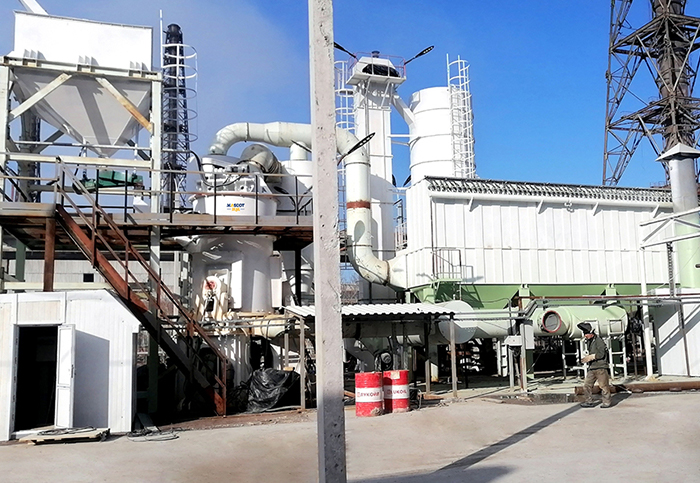
The production line of the vertical roller mill is a cost-effective and energy-efficient solution for processing powder, which is widely used in many industries, such as metallurgy, building materials, industrial solid waste treatment, thermal power plants, cement plants, and environmental protection fields. The primary purpose of this project is to finely grind raw materials through a vertical roller mill to meet the requirements of different industries for particle size, purity, and output of powder products.

The gypsum grinding production line is an efficient, stable, and environmentally friendly production solution, which is widely used in construction, decoration, the chemical industry, and other fields. In addition, the grinding process is particularly critical, which directly affects the quality and particle size of the final product. With the continuous development of science and technology, the technical level and production efficiency of gypsum grinding production lines will be further improved, providing strong support for the development of the gypsum processing industry.
Green and Intelligent Mining Machinery
Manufacturing and Export Base
Based on high quality and perfect after-sales service, our products have been
exported to more than 120 countries and regions.
Copyright © 2023 Zhengzhou Mascot Environmental Technology Co., Ltd Record number: Yu ICP No. 13021523-4





 WhatsApp
