 27
27
 25
25
 27
27
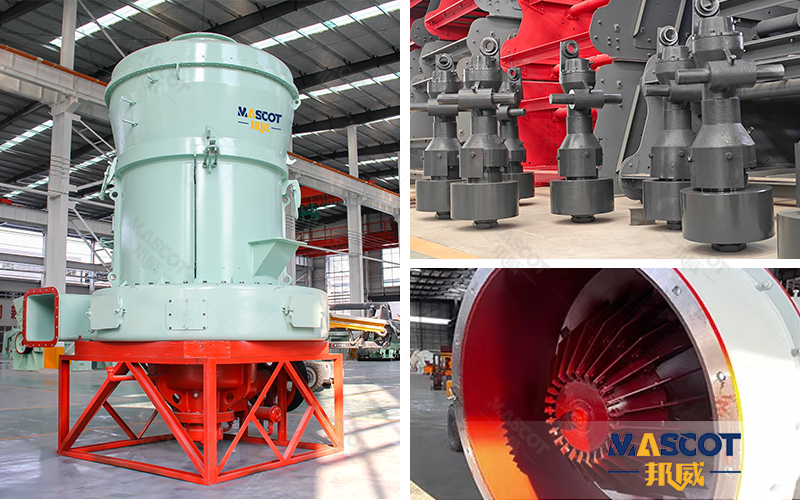
Put the MTW Trapezium Grinding Mill and the HGM Micro-powder Grinding Mill in one quotation and the first thing that happens is a mistake: both are Mascot roller mills, both are sold to non-metallic mineral plants, and both are therefore assumed to be interchangeable at two different prices. They are not. They are specified for two different powder bands, and where those bands meet there is a strip of less than ten microns of overlap. Almost every genuine comparison between them is really a question about where a plant's product mix sits, and this article sets out the published numbers that answer it — model by model, then side by side.
The MTW series is the European-type trapezium platform: curved rollers running against a trapezium ring, which holds the material in an even bed instead of working it by point contact. Airflow carries the powder to the classifier, fine particles pass while oversize ones fall back for regrinding, qualified powder is discharged from the cyclone collector, and the remaining air is cleaned by a pulse dust collector at over 99.9% efficiency before release. Four models cover 3-50 t/h across a published output band of 0.038-0.2 mm, or 80-400 mesh, for non-flammable, non-explosive minerals with Mohs hardness below 9.3 and feed moisture below 6%.
The HGM series takes a different architectural route. It integrates grinding, classification and collection in one system, with grinding rollers pressed against the ring by centrifugal force and a built-in high-precision turbo classifier as the control element. Four models cover 0.35-10 t/h across a published finished-product band of 325-2500 mesh, approximately 5-47 microns, for non-metallic minerals with Mohs hardness below 7 and moisture under 6%.
Read the two bands against each other and the structure of the comparison appears. The MTW's finest published cut is 0.038 mm; the HGM's coarsest published cut is 47 microns, or 0.047 mm. The two series therefore overlap across roughly 38-47 microns — the 325 to 400 mesh strip — and nowhere else. Below that strip, only the MTW is specified; above it, only the HGM is. Every buying decision between these two machines is made inside that narrow band, or it is not a comparison at all but a product-mix question.

Four models, one output band, and a power column split three ways — the last detail matters when the two series are quoted against each other, and it is dealt with in Section 4.
| Model | Roller Size (mm) | Grind Ring Inner Dia. (mm) | Feeding Size (mm) | Output Size (mm) | Capacity (t/h) | Main Mill (kW) | Powder Classifier (kW) | Blower (kW) |
|---|---|---|---|---|---|---|---|---|
| MTW110 | 360×210 | 1100×210 | 30 | 0.038-0.2 | 3-10 | 55 | 18.5 | 55 |
| MTW138 | 460×260 | 1380×260 | 35 | 0.038-0.2 | 6-20 | 90 | 22 | 132 |
| MTW175 | 520×300 | 1750×300 | 40 | 0.038-0.2 | 10-35 | 160 | 37 | 200 |
| MTW215 | 640×340 | 2150×340 | 45 | 0.038-0.2 | 20-50 | 220 | 37 | 250 |
Two features of this table decide what the MTW can and cannot be used for. The first is that the output band is identical across all four models, which means a plant can step up its tonnage later without changing the grade it sells. The second is that the cut is set by the powder classifier and adjusted through its speed while the mill keeps running, so a plant selling several mesh grades from one machine is making an operating adjustment rather than scheduling a shutdown.
Four models, one micron band, and a power column split four ways rather than three — a feeder drive is published on every HGM row as well as the main motor, the classifier and the blower.
| Model | Feeding Size (mm) | Output (Micron) | Main Motor (kW) | Classifier (kW) | Blower (kW) | Feeder (kW) | Capacity (t/h) |
|---|---|---|---|---|---|---|---|
| HGM80 | ≤10 | 5-47 | 37 | 11 | 30 | 0.06 | 0.35-2.5 |
| HGM1028 | ≤10 | 5-47 | 75 | 22 | 45 | 0.06 | 0.6-4 |
| HGM1036 | ≤20 | 5-47 | 110 | 30 | 75 | 0.15 | 0.9-6 |
| HGM1250 | ≤20 | 5-47 | 132 | 37 | 75 | 0.15 | 1.2-10 |
The parallel with the MTW table is exact in one respect and opposite in another. Exact: the published band is the same on every model, so the model ladder is a capacity ladder rather than a fineness ladder. Opposite: on the HGM the feed limit is 10 mm on the HGM80 and HGM1028 and 20 mm on the HGM1036 and HGM1250, against 30-45 mm on the MTW — a difference that pushes back into the crushing stage rather than the mill, and one that Section 4 takes up.
Fineness on the HGM is set by the speed of the turbo classifier through a variable-frequency drive rather than by mechanical clearances, and oversize particles fall back into the grinding zone for regrinding until they meet the cut. Because the selection is aerodynamic, a grade change moves the cut point electronically and is a matter of adjusting classifier speed and airflow, not of replacing parts. The grinding rollers and rings are cast from high-performance wear-resistant alloy, which is stated to last 2-5 times longer than standard steel — a durability question on a machine specified to run continuously. Feed moisture above 6% has to be dried before grinding, and materials harder than Mohs 7 fall outside the published feed envelope; both are project-design decisions rather than reasons to change the mill.

1. Where the band ends, and the strip where it does not. The MTW is published from 80 to 400 mesh; the HGM from 325 to 2500 mesh. Only the 325-400 mesh strip is served by both, and that strip is where a buyer must choose. Below 325 mesh there is nothing to compare: the MTW is the platform. Above 400 mesh there is nothing to compare either, because the MTW is not specified for that band and pushing a mill past its published range costs more than it earns — the HGM is the platform. The grader's conversion between the two ways of naming the same powder is set out in more detail in the site's guide to 325 mesh vs 400 mesh.
2. The shape of the capacity ladder. The MTW runs from 3 t/h to 50 t/h in four steps; the HGM runs from 0.35 t/h to 10 t/h in four. Below about 3 t/h, only the HGM applies. Above 10 t/h, only the MTW reaches the number. Between 3 and 10 t/h the two ladders cross, and inside that crossing a 325-400 mesh contract can be produced by either — which is precisely the case in which the tonnage a plant expects to sell, not the fineness it expects to sell, settles the question.
3. The material envelope is not the same width. The MTW publishes a ceiling of Mohs 9.3 with feed moisture below 6%; the HGM publishes Mohs below 7 with moisture under 6%. Moisture agrees, hardness does not, and the gap is operationally real: a mineral in the Mohs 7-9.3 range sits inside the MTW's envelope and outside the HGM's, so a plant grinding it cannot simply move to the finer mill to chase a higher-value grade. Both envelopes should be checked against a sample of the actual rock rather than against a group label.
4. Neither power column is a total. A quotation comparison fails here more often than anywhere else. The MTW table splits its power across the main mill, the powder classifier and the blower — 55 / 18.5 / 55 kW on the MTW110 up to 220 / 37 / 250 kW on the MTW215. The HGM table splits it across four drives — main motor, classifier, blower and feeder — 37 / 11 / 30 / 0.06 kW on the HGM80 up to 132 / 37 / 75 / 0.15 kW on the HGM1250. Put the two main-motor columns side by side and the HGM1250's 132 kW looks like less than half the MTW215's 220 kW, which tells a buyer nothing: the two figures describe different fractions of two different lines. The only comparable quantities are total installed power for the complete line and kilowatt-hours per ton at the target mesh, and both should be requested in writing.
5. The feed limit pushes back into the plant. The MTW accepts 30-45 mm depending on model, so a single-stage jaw crusher output can go straight into the mill. The HGM accepts 10 mm on the HGM80 and HGM1028 and 20 mm on the HGM1036 and HGM1250, and an HGM line is specified with a jaw crusher for pre-crushing to that limit, followed by bucket elevator, vibrating feeder, the mill, turbo classifier, cyclone collector, pulse-jet bag filter and finished-product silo. That is not a disadvantage; it is a scope item. It tells the buyer to price the crushing stage with the mill rather than discovering it later.

| Decision Point | MTW Trapezium Grinding Mill | HGM Micro-Powder Grinding Mill |
|---|---|---|
| Models / capacity | 4 models, 3-50 t/h | 4 models, 0.35-10 t/h |
| Fineness band | 80-400 mesh; output size 0.038-0.2 mm on every model | 325-2500 mesh; output 5-47 microns on every model |
| Overlap | 325-400 mesh (approximately 38-47 microns) — the only band served by both | 325-400 mesh (approximately 38-47 microns) — the only band served by both |
| Feed size | 30 mm on the MTW110 to 45 mm on the MTW215 | ≤10 mm on the HGM80 and HGM1028; ≤20 mm on the HGM1036 and HGM1250 |
| Material envelope | Mohs below 9.3, feed moisture below 6% | Mohs below 7, moisture under 6% |
| Published power | Split across main mill, powder classifier and blower | Split across main motor, classifier, blower and feeder |
| How fineness is set | Classifier speed adjusted while the mill runs | Turbo classifier speed through a variable-frequency drive; grade change by classifier speed and airflow, no parts replaced |
| Wear consumables / warranty | Grinding rollers and grinding ring; 12-month warranty on the machine and on core components | Grinding rollers and rings in cast wear-resistant alloy, stated at 2-5 times standard steel life; 12-month warranty on the machine and on core components |
| Typical fit | Medium to large tonnage in the 80-400 mesh band, frequent grade changes, growth plans | Low to moderate tonnage in the ultra-fine band, where the grade rather than the volume carries the margin |
The assumption worth testing is that the HGM is simply the machine you graduate to after an MTW — that the coarse mill feeds the fine mill. The published feed limits say otherwise. The MTW accepts 30-45 mm; the HGM accepts 10 mm or 20 mm depending on model. A mill's output at 325 mesh is powder measured in tens of microns, not the 10 mm or 20 mm feed the HGM is specified for, so a two-mill line is not a coarse-then-fine cascade on the same stream. An HGM line starts at a jaw crusher, exactly as an MTW line does.
What the two machines actually are, in commercial terms, is two producers of two different products from the same crushed feed. A plant grinding limestone, calcite or barite to 200-325 mesh for construction, coating or filler customers is buying the MTW's tonnage ladder. A plant selling 800-2500 mesh grades into masterbatch, coatings or high-end filler contracts is buying the HGM's micron band. A plant that sells both grades is buying both lines, fed from one crushing stage — and the crusher is then set to the HGM model's feed limit, which sits comfortably inside the MTW's window.
The practical consequence is that the 325-400 mesh strip is decided by something other than fineness. It is decided by how much of that grade the plant can sell, whether the ultra-fine grades are part of the product plan, and where the margin sits in the local market. A plant that will never ship a grade finer than 400 mesh has no reason to buy the micron band; a plant whose customers are already asking for 1250 mesh has no reason to buy it twice.

The clearest way to see the split is to look at two plants that bought the two platforms for two different reasons.
The coarse band. A major regional construction-material supplier in Surabaya, Indonesia needed high-volume limestone grinding at 325 mesh for high-strength cement, on a production schedule that could not afford midday stoppages. Mascot supplied two MTW trapezium mills operating in parallel as one matched set, with vibrating feeder, powder classifier, cyclone collector and pulse dust collector. Each mill achieved a stable 15 t/h at 325 mesh, the thin-oil lubrication system allowed three 8-hour shifts a day with zero stops for manual greasing, and total power per ton of powder fell by 22% against the older Raymond technology it replaced. The purchase was decided by tonnage in a band the MTW already covers.
The fine band. A manufacturer of industrial fillers and extenders in Ho Chi Minh City, Vietnam needed ultra-fine calcite at both 800 mesh and 1250 mesh (D97) for architectural coatings and polymer masterbatch, from white calcite lumps of Mohs hardness 3.0 and a feed of 20 mm and below, with whiteness that could not be compromised by iron pickup. The line supplied was an HGM1028 with a high-precision turbo classifier, a secondary pulse-jet bag filter and ceramic-lined piping along the powder path. The plant reports 1.5 t/h of 1250 mesh calcite at a consistent 94.5% ISO brightness, with D97 pass rates above 98%. That purchase was decided by grade, not by tonnage — and the same reasoning pattern has been covered in more depth in the site's explanation of how the HGM Series Micro-powder Grinding Mill holds a D97 target.
Neither number is transferable to another site. What transfers is the structure of the decision: one plant bought capacity inside a band it could already sell, and the other bought a band its competitors could not supply.


Q1: Can an MTW replace an HGM, or the other way round?
A: Only inside the 325-400 mesh strip, and only when the tonnage also matches. The MTW is published from 80 to 400 mesh at 3-50 t/h; the HGM from 325 to 2500 mesh at 0.35-10 t/h. Below 325 mesh the HGM is not specified; above 400 mesh the MTW is not.
Q2: Which one should a plant choose at 325 mesh?
A: The tonnage decides first. Above roughly 10 t/h only the MTW reaches the number; below about 3 t/h only the HGM does. Between 3 and 10 t/h both can hold 325-400 mesh, and the deciding factors become the plant's grade plan, the value of ultra-fine grades in its market, and the material's hardness.
Q3: My material is Mohs 8. Does the HGM apply?
A: No. The HGM's published envelope is Mohs hardness below 7 and moisture under 6%; the MTW's is Mohs below 9.3 and moisture below 6%. A mineral in the Mohs 7-9.3 range can be run on the MTW platform but falls outside the HGM's published envelope, so the finer band is not automatically available to it.
Q4: Can the two mills run in the same plant?
A: Yes, and this is common where a producer sells several grades. The two lines are independent, each fed from a crushing stage; because the HGM accepts 10 mm or 20 mm depending on model and the MTW accepts 30-45 mm, a shared crusher is set to the HGM's feed limit. One supplier, one service channel and one spare-parts relationship then cover both products.
Q5: How should the two quotations be compared?
A: On total installed power for the complete line and on kilowatt-hours per ton at your target mesh, not on the main-motor column. The MTW publishes its power across three drives and the HGM across four, so a main-motor-to-main-motor comparison measures two different fractions of two different lines.
Q6: Can I test my material before fixing the model?
A: Yes, and both series should be quoted that way. Send the mineral, its Mohs hardness, the target mesh or micron figure, the feed size and moisture, and the required tonnage; the model is then confirmed against your material rather than against a table.
The MTW and the HGM are not two prices for the same job. The MTW is a four-model trapezium platform published from 80 to 400 mesh at 3-50 t/h, with Mohs 9.3 and moisture 6% as its envelope, friction-adjusted fineness while running, and a power figure split across three drives. The HGM is a four-model micro-powder platform published from 325 to 2500 mesh (5-47 microns) at 0.35-10 t/h, with a Mohs 7 and moisture 6% envelope, a variable-frequency turbo classifier as its control element, a feed limit of 10 mm or 20 mm depending on model, which starts the line at a jaw crusher, and a power figure split across four drives. Outside the 325-400 mesh strip they do not compete at all; inside it, tonnage and product plan decide. Send your material, the grade you must sell and the tonnage you must ship, and the choice between the MTW Trapezium Grinding Mill and the HGM Micro-powder Grinding Mill will be settled on those three numbers rather than on a datasheet.

About of Mascot
Zhengzhou Mascot Industry is a high-tech mining equipment company integrating R&D, manufacturing, sales, and after-sales service. Focusing on crushing, grinding, and mineral processing equipment, we provide professional solutions to our customers. We are ISO9001:2015 certified, and our products include mobile crushing plants, crawler crushing plant, construction waste crushing plants, jaw crushers, sand making machines, cone crushers, fine crushers, grinding mills, ball mills, etc., all with reliable performance to meet diverse project needs.
• Professional pre-sales support: Free project design and comprehensive solutions to help you accurately select the right equipment;
• Comprehensive on-site service: Providing installation guidance and worker training to ensure smooth equipment commissioning;
• Reliable after-sales guarantee: A complete after-sales system, timely response to technical inquiries and equipment maintenance, ensuring long-term stable operation.
To protect your rights, please contact us through the following official channels for professional service:
WhatsApp: 0086-16650273865
Email: mascot@mascotenv.com
We are committed to providing high-quality equipment and full-cycle services to deliver comprehensive intelligent solutions for the global mining industry!

The high-pressure grinding mill production line is a project specially designed for efficient grinding operations. It is widely used in metallurgy, building materials, the chemical industry, highways, water conservancy hydropower, and other industries. It is a suspended roller mill that uses springs to increase pressure. It can achieve efficient grinding processing of various non-metallic raw materials. It has high efficiency, stability, and environmental protection characteristics.

YGMX Enhanced High-Pressure Mill is a new type of high-performance grinding equipment, and the biggest improvement of this milling equipment lies in the increase of the high-pressure spring system in the grinding roller part. Compared with the traditional high-pressure roller mill, it has a wider scope of application and excellent performance to meet the production needs of a variety of powder fineness. It is widely used in non-metallic minerals, chemicals, building materials, metallurgy, environmental protection, etc. Multiple areas.

The ball mill production line is a comprehensive production line that integrates material crushing, grinding, grading, and collection. This production line is mainly used to process various materials, including sand and gravel, cement, new building materials, silicates, refractory materials, fertilizers, ferrous metal beneficiation, non-ferrous metals, glass ceramics, etc.

This production line utilizes a three-ring medium-speed micro-grinding mill as the central equipment, complemented by other auxiliary equipment like hammer crushers, bucket elevators, and storage silos to establish a comprehensive grinding operation system. It has demonstrated strong potential for application and market competitiveness in industries such as construction, chemical industry, and new materials.

The Raymond mill production line is a highly efficient system designed for grinding operations, with a focus on energy efficiency, durability, and productivity. It caters to the needs of users by offering fine powder products in non-metallic ores, coal powder, and slag processing, aiding enterprises in achieving sustainable growth.
Green and Intelligent Mining Machinery
Manufacturing and Export Base
Based on high quality and perfect after-sales service, our products have been
exported to more than 120 countries and regions.
Copyright © 2023 Zhengzhou Mascot Environmental Technology Co., Ltd Record number: Yu ICP No. 13021523-4





 WhatsApp