
"How many tons per hour can it really do?" is the first question every buyer asks, and the honest answer has two parts: what the model is rated for, and what it delivers at your fineness on your material. The MTW Trapezium Grinding Mill series covers 3-50 t/h across four models, but rated capacity is only half the story — fineness, material hardness and feed condition move the real number. This guide gives the rated figures, the fine-mesh reality, and the field benchmark that connects them.
The rated ranges below are the official specifications, stated at coarser fineness in the series' standard operating band:
| Model | Rated Capacity (t/h) | Main Motor (kw) | Max Feed (mm) | Output Size (mm) |
|---|---|---|---|---|
| MTW110 | 3-10 | 55 | ≤30 | 0.038-0.2 |
| MTW138 | 6-20 | 90 | ≤35 | 0.038-0.2 |
| MTW175 | 10-35 | 160 | ≤40 | 0.038-0.2 |
| MTW215 | 20-50 | 220 | ≤45 | 0.038-0.2 |
Every model adjusts fineness steplessly across 80-425 mesh (0.038-0.2mm). The model number grows with the grinding chamber, the motor and the achievable output — and, at the top of each range, with the installed power that sustains it.

Rated capacities are stated at coarser fineness. At fine-mesh duty — 250 mesh or finer — actual throughput runs below the rated range, because finer classification means more material re-circulates through the grinding zone. Each re-circulation pass consumes grinding time and energy without producing finished powder, so the finer the target, the larger the gap between rated and real.
The field benchmark quantifies the effect. An MTW175 — rated 10-35 t/h — produced a stable 31 t/h at 250 mesh in a Southeast Asian limestone plant, near the top of its rated range even at fine duty. The same machine at 325 mesh produces a lower figure, and at 80-100 mesh a higher one. The exact number at your fineness depends on your material, which is why the guidance below is paired with the recommendation to run a project design for your exact case.

As a working guide, based on the series' design characteristics and the field benchmark, plan capacity expectations as follows — always subject to your material test:
| Fineness | Output vs Rated Range | Typical Duty |
|---|---|---|
| 80-120 mesh (0.177-0.125mm) | Near or above mid-range | Building materials, coarse fillers |
| 200 mesh (0.074mm) | Mid-range of rated band | General industrial powder |
| 250 mesh (0.058-0.063mm) | Below rated; field case: 31 t/h on MTW175 | Concrete admixture, desulfurization |
| 325-400 mesh (0.043-0.038mm) | Lower part of rated band; size with margin | Paint, plastics, rubber fillers |
The rule from the field: size with a margin, treating the rated range as the ceiling at fine-mesh duty rather than the expectation. A plant needing 12 t/h of 250-mesh powder should plan around the MTW175, not the top of the MTW138 range.
Material properties shift the number as much as fineness. Soft, medium-hard minerals such as limestone, calcite, talc and gypsum (Mohs hardness below 5) grind at the higher end of each model's capability. Barite and dolomite (Mohs 3.5-4) are similar. Quartz and other highly abrasive materials (Mohs 7) grind more slowly and wear the rollers and ring faster — expect lower output per hour and a wear-part life of 4-7 months against the 8-12 months typical for limestone and calcite.
Moisture is the second material lever. Below 6%, the MTW series handles the feed directly; above 6%, pre-drying is required because damp powder adheres to the grinding surfaces and drags output down. Feed size is the third: stay within the model's limit (30-45mm across the series) and match it to your crusher's real discharge to avoid an extra screening stage.

Beyond the specification sheet, five operating conditions decide whether a mill hits its capacity or misses it:
A mill operated on this discipline delivers its real capacity consistently — which is exactly what the field case demonstrated over more than ten months.

The most useful number in this guide is a field result, not a brochure figure. A Southeast Asian building materials plant installed an MTW175 complete line in August 2025, processing limestone at ≤40mm and ≤5% moisture into 250-mesh powder. The design target was 28-32 t/h. Ten months of operation delivered an average of 31 t/h, a 99.6% finished powder pass rate, 22% lower energy per ton and wear parts beyond ten months — and the customer ordered a second line in April 2026. That is what the MTW175's rated 10-35 t/h means in real production.
No guide can replace a test on your material. Mascot's free project design takes your raw material (type, hardness, moisture, feed size), your target fineness and your target output, and returns the recommended model with expected capacity and energy numbers for your specific case. A grinding test with a sample of your material removes the last uncertainty — the difference between one quarry's limestone and another's can be several tons per hour on the same machine.
Q1: Which MTW model produces 20 t/h at 250 mesh?
A: At 250 mesh, the MTW175 (rated 10-35 t/h) is the appropriate class — the field case delivered 31 t/h at that fineness. The MTW138 (rated 6-20) would operate at its ceiling.
Q2: Does capacity change when I switch fineness?
A: Yes. Finer powder means more recirculation, so output falls as mesh rises. The frequency-conversion classifier lets you adjust on the PLC panel, but plan capacity for your finest grade.
Q3: Why is my output lower than the rated range?
A: Check the five operating variables in Section 5 — feed uniformity, wear state, airflow, classifier and lubrication. Also confirm your material's hardness and moisture match the design.
Q4: Can one line run different fineness grades?
A: Yes. The classifier adjusts across 80-425 mesh without stopping the mill, so one MTW line can serve multiple powder grades — capacity simply follows the fineness you set.
MTW mill capacity is a two-part answer: the rated range by model — 3-10, 6-20, 10-35 and 20-50 t/h — and the real figure at your fineness on your material, which the field benchmark anchors at 31 t/h for the MTW175 at 250 mesh. Size with a margin for fine-mesh duty, keep the five operating variables in discipline, and confirm the number with a project design on your own material before you invest. That is how "tons per hour" stops being a brochure figure and becomes your production plan.

About of Mascot
Zhengzhou Mascot Industry is a high-tech mining equipment company integrating R&D, manufacturing, sales, and after-sales service. Focusing on crushing, grinding, and mineral processing equipment, we provide professional solutions to our customers. We are ISO9001:2015 certified, and our products include mobile crushing plants, crawler crushing plant, construction waste crushing plants, jaw crushers, sand making machines, cone crushers, fine crushers, grinding mills, ball mills, etc., all with reliable performance to meet diverse project needs.
• Professional pre-sales support: Free project design and comprehensive solutions to help you accurately select the right equipment;
• Comprehensive on-site service: Providing installation guidance and worker training to ensure smooth equipment commissioning;
• Reliable after-sales guarantee: A complete after-sales system, timely response to technical inquiries and equipment maintenance, ensuring long-term stable operation.
To protect your rights, please contact us through the following official channels for professional service:
WhatsApp: 0086-16650273865
Email: mascot@mascotenv.com
We are committed to providing high-quality equipment and full-cycle services to deliver comprehensive intelligent solutions for the global mining industry!

The high-pressure grinding mill production line is a project specially designed for efficient grinding operations. It is widely used in metallurgy, building materials, the chemical industry, highways, water conservancy hydropower, and other industries. It is a suspended roller mill that uses springs to increase pressure. It can achieve efficient grinding processing of various non-metallic raw materials. It has high efficiency, stability, and environmental protection characteristics.

YGMX Enhanced High-Pressure Mill is a new type of high-performance grinding equipment, and the biggest improvement of this milling equipment lies in the increase of the high-pressure spring system in the grinding roller part. Compared with the traditional high-pressure roller mill, it has a wider scope of application and excellent performance to meet the production needs of a variety of powder fineness. It is widely used in non-metallic minerals, chemicals, building materials, metallurgy, environmental protection, etc. Multiple areas.
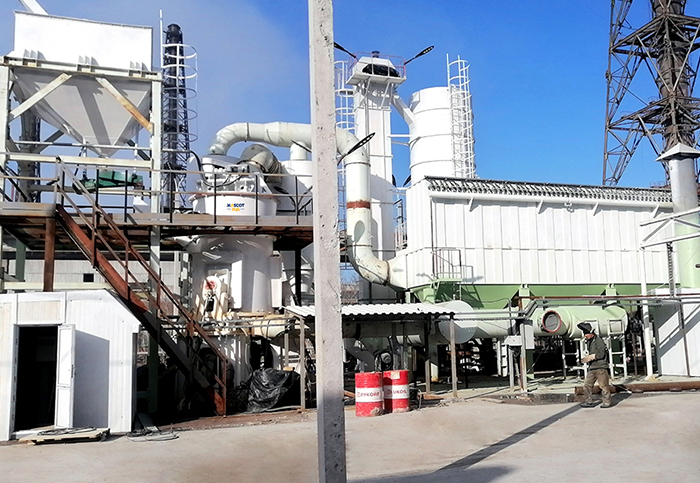
The production line of the vertical roller mill is a cost-effective and energy-efficient solution for processing powder, which is widely used in many industries, such as metallurgy, building materials, industrial solid waste treatment, thermal power plants, cement plants, and environmental protection fields. The primary purpose of this project is to finely grind raw materials through a vertical roller mill to meet the requirements of different industries for particle size, purity, and output of powder products.

The ball mill production line is a comprehensive production line that integrates material crushing, grinding, grading, and collection. This production line is mainly used to process various materials, including sand and gravel, cement, new building materials, silicates, refractory materials, fertilizers, ferrous metal beneficiation, non-ferrous metals, glass ceramics, etc.

This production line utilizes a three-ring medium-speed micro-grinding mill as the central equipment, complemented by other auxiliary equipment like hammer crushers, bucket elevators, and storage silos to establish a comprehensive grinding operation system. It has demonstrated strong potential for application and market competitiveness in industries such as construction, chemical industry, and new materials.
Green and Intelligent Mining Machinery
Manufacturing and Export Base
Based on high quality and perfect after-sales service, our products have been
exported to more than 120 countries and regions.
Copyright © 2023 Zhengzhou Mascot Environmental Technology Co., Ltd Record number: Yu ICP No. 13021523-4





 WhatsApp