 27
 27
 27

Four hundred mesh is 38 µm, and on an MTW Trapezium Grinding Mill that number sits at the top of the published range, not in the middle of it. Every mistake made on a calcined clay line starts with treating it as a mid-range duty: the mill is bought on a headline tonnage, the clay arrives wetter than the sample, and the commissioning week is spent chasing a residue figure with the roller pressure wound up.
Holding 400 mesh on clay is a control problem in four variables — classifier speed, airflow, drying and feed stability — and pressure is not one of them. What follows is the setting logic in the order it should be applied, using the published figures of the machine rather than a rule of thumb borrowed from limestone.
The series runs from MTW110 to MTW215, and the published numbers include three power figures per model, because the main unit, the classifier and the blower are separate loads. Adding them is the only way to compare one model against another honestly.
| Model | Max. feed (mm) | Capacity (t/h) | Main + classifier + blower (kW) | Installed kW per t/h |
|---|---|---|---|---|
| MTW110 | 30 | 3–10 | 75 + 7.5 + 75 | 15.8–52.5 |
| MTW138 | 35 | 6–20 | 90 + 11 + 90 | 9.6–31.8 |
| MTW175 | 40 | 10–35 | 185 + 30 + 185 | 11.4–40.0 |
| MTW215 | 50 | 20–50 | 280 + 45 + 280 | 12.1–30.3 |
How to read this table: the power column is the whole installation, not the mill alone — on MTW175 the blower is as large as the main unit, and on a wet clay duty that blower is doing drying work, not just transport. The last column is computed from the published figures and behaves the way it does on every mill: a model only reaches a competitive power per tonne near the top of its capacity band. Sizing at the bottom of a band means buying installed kilowatts you never use. The highlighted model is the usual fit for a clay line feeding a mid-size cement plant.
The published capacity figures are measured across the machine's working range, and a band quoted as 10–35 t/h does not deliver 35 t/h at 38 µm. It delivers its top tonnage at the coarse end of the range, in good feed conditions, with the circuit in balance. Working at 400 mesh puts you in the lower half of the band, and the honest way to size is to take the tonnage you must sell, divide it by the derating your supplier will commit to in writing at that fineness, and size the model on the result.
Two practical consequences follow. First, a clay line specified at 12 t/h of 400 mesh product is not an MTW138 job even though 12 t/h sits inside its 6–20 band; it is a discussion about MTW175 with margin, or about a different machine type entirely. Second, the derating factor is material-specific and is the single number worth arguing about before the order — a mill sized on limestone experience and commissioned on clay will meet a contract and miss the market.

On a roller mill, fineness is a classification decision. Material is scooped between roller and ring, carried upward by the air, and cut in the classifier; coarse particles fall back to the grinding ring for another pass. The classifier runs on a variable-frequency drive, and its speed is the fineness control that can be changed while the mill is running.
The setting logic is short. Fix the feed rate first, because a moving feed target makes every fineness reading meaningless. Raise classifier speed until the 38 µm residue sits where you want it, then watch the mill's differential pressure: if it climbs, the circuit is circulating more coarse material than the airflow can lift, and the answer is more air, not more speed. If the residue drifts coarse while the differential stays flat, the classifier is being overpowered and speed is the answer.
That coupling is why two adjustments made a week apart rarely hold. Classifier speed and airflow have to be trimmed as a pair, on the same feed rate, and logged, or the next shift inherits settings nobody can explain.
An air-swept mill dries as it grinds, and on clay that is the difference between a working line and a blocked one. Wet clay coats the roller face, packs between roller and ring, and blinds the classifier cage. Every one of those symptoms reads on the panel as falling output or rising residue, which is why operators reach for classifier speed when the real problem is water.
The published MTW sheet does not quote a moisture limit, so the limit is yours to establish rather than to assume. Two things belong in the specification instead: a drying test on your clay at the moisture it actually arrives with, and a stated inlet gas temperature that the quotation commits to. The outlet temperature matters just as much, because the bag filter has to stay above the dew point; a line that runs cold enough to condense will plug its bags and lose the airflow that carries the powder.
Where the clay comes out of the pit wet, pre-drying in a rotary dryer ahead of the mill is usually cheaper than buying a bigger mill to compensate. That is a sizing conversation, and it belongs before the order, not in the second month of operation.

This is the setting most often misapplied on soft material. On hard limestone, additional roller force can raise output, because the energy goes into breaking the particle. On calcined clay the particle is already weak; extra force compacts the bed, generates vibration, raises power and pushes wear — and the residue figure barely moves, because what limits the cut is the classifier, not the comminution.
The right approach is to set pressure to the level that holds a stable, full grinding bed and no more, then leave it. If output is short at the target fineness, the levers are airflow, classifier speed and feed stability, in that order. A mill run at maximum pressure on clay is a mill converting electricity into heat and roller wear.
Clay is cohesive: it bridges in hoppers, hangs on chute walls and arrives at the mill in slugs. A surging feed shows up as motor current swinging, residue drifting and the operator chasing settings that were correct ten minutes earlier.
Two fixes cost very little. Pre-crush the clay so the mill sees a consistent top size rather than lumps — the published feed limit is 30 to 50 mm depending on model, and running at that limit leaves nothing for the day the stockpile changes. And use a variable-speed feeder with a stable setpoint, so the mill is fed at a rate rather than in batches. On a 400 mesh duty the circuit has little tolerance for either problem, because the circulating load is already high.

Clay minerals are mild on rollers and rings. The free quartz carried inside the clay is not, and it is the fraction that decides whether a wear part lasts years or months. Two clays from neighbouring pits, both suitable for LC3 on kaolinite content, can differ substantially in quartz and therefore in maintenance cost.
Ask for the quartz or free-silica figure with the clay sample, and compare quotations on wear-part life rather than on price per set. On a line grinding 15 t/h, the difference between a two-year and a one-year roller life is a line item that dwarfs the purchase-order difference between two mills.
Three commitments belong in the order, and they are all measurable. A guaranteed tonnage at 400 mesh on your clay, not on limestone. A specific power figure in kWh per tonne at that fineness, so the electricity bill is part of the guarantee rather than a surprise. And the acceptance test: which method — sieve or laser — at which sample point, witnessed by whom, and what happens if the first run misses.
If the answers to those three questions point at a machine type other than a trapezium mill, the comparison of routes for calcined clay — roller mill, vertical mill, ball mill and micro-powder mill — is set out in which grinding mill handles calcined clay best. Where the clay has to go well beyond 400 mesh for a specialty product, the HGM micro-powder mill covers 325–2500 mesh at a fraction of the tonnage.
Q1: Can an MTW mill hold 400 mesh continuously on clay?
A: Yes, at a tonnage below the published band for the same model, with the classifier on its variable-frequency drive and a feed that does not surge. Continuous operation at the top of a capacity band and at the top of the fineness range at the same time is not a combination the published figures support.
Q2: What moisture can the mill take?
A: The published sheet does not quote a limit, and quoting one from another material would be guesswork. Establish it with a drying test on your clay, and require an inlet gas temperature and an outlet temperature above dew point in the quotation. Wet clay is the most common cause of a clay line that cannot hold fineness.
Q3: Output drops in the afternoon. Why?
A: Usually moisture and feed behaviour rather than the mill. Ambient humidity changes how the clay flows, warm clay bridges differently in the hopper, and a classifier cage with damp fines blinds progressively. Log residue, differential pressure and feed rate together for a week before changing any setting.
Q4: Should I buy the largest model for headroom?
A: No. Beyond the top of a band, extra tonnage is not available; below the bottom, installed kilowatts are paid for and not used. Size on the tonnage you can sell at 400 mesh, then put the margin into drying capacity and buffer storage, where it actually protects output.

About of Mascot
Zhengzhou Mascot Industry is a high-tech mining equipment company integrating R&D, manufacturing, sales, and after-sales service. Focusing on crushing, grinding, and mineral processing equipment, we provide professional solutions to our customers. We are ISO9001:2015 certified, and our products include mobile crushing plants, crawler crushing plant, construction waste crushing plants, jaw crushers, sand making machines, cone crushers, fine crushers, grinding mills, ball mills, etc., all with reliable performance to meet diverse project needs.
• Professional pre-sales support: Free project design and comprehensive solutions to help you accurately select the right equipment;
• Comprehensive on-site service: Providing installation guidance and worker training to ensure smooth equipment commissioning;
• Reliable after-sales guarantee: A complete after-sales system, timely response to technical inquiries and equipment maintenance, ensuring long-term stable operation.
To protect your rights, please contact us through the following official channels for professional service:
WhatsApp: 0086-16650273865
Email: mascot@mascotenv.com
We are committed to providing high-quality equipment and full-cycle services to deliver comprehensive intelligent solutions for the global mining industry!

This production line utilizes a three-ring medium-speed micro-grinding mill as the central equipment, complemented by other auxiliary equipment like hammer crushers, bucket elevators, and storage silos to establish a comprehensive grinding operation system. It has demonstrated strong potential for application and market competitiveness in industries such as construction, chemical industry, and new materials.

The ball mill production line is a comprehensive production line that integrates material crushing, grinding, grading, and collection. This production line is mainly used to process various materials, including sand and gravel, cement, new building materials, silicates, refractory materials, fertilizers, ferrous metal beneficiation, non-ferrous metals, glass ceramics, etc.
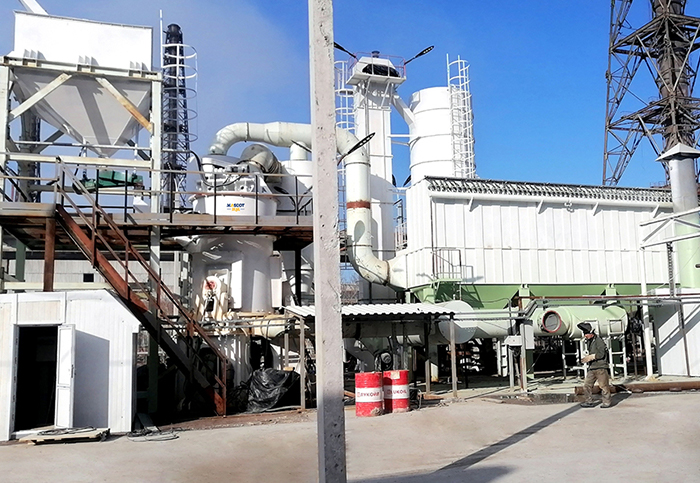
The production line of the vertical roller mill is a cost-effective and energy-efficient solution for processing powder, which is widely used in many industries, such as metallurgy, building materials, industrial solid waste treatment, thermal power plants, cement plants, and environmental protection fields. The primary purpose of this project is to finely grind raw materials through a vertical roller mill to meet the requirements of different industries for particle size, purity, and output of powder products.

YGMX Enhanced High-Pressure Mill is a new type of high-performance grinding equipment, and the biggest improvement of this milling equipment lies in the increase of the high-pressure spring system in the grinding roller part. Compared with the traditional high-pressure roller mill, it has a wider scope of application and excellent performance to meet the production needs of a variety of powder fineness. It is widely used in non-metallic minerals, chemicals, building materials, metallurgy, environmental protection, etc. Multiple areas.

The high-pressure grinding mill production line is a project specially designed for efficient grinding operations. It is widely used in metallurgy, building materials, the chemical industry, highways, water conservancy hydropower, and other industries. It is a suspended roller mill that uses springs to increase pressure. It can achieve efficient grinding processing of various non-metallic raw materials. It has high efficiency, stability, and environmental protection characteristics.
Green and Intelligent Mining Machinery
Manufacturing and Export Base
Based on high quality and perfect after-sales service, our products have been
exported to more than 120 countries and regions.
Copyright © 2023 Zhengzhou Mascot Environmental Technology Co., Ltd Record number: Yu ICP No. 13021523-4





 WhatsApp
