 25
25
 27
27
 25
25

The vertical roller mill (VRM) has become the standard in the cement industry, and the MTW Trapezium Grinding Mill is the reference for non-metallic mineral powder. Both are "roller" mills, and buyers comparing them for a limestone, calcium carbonate or similar powder line need to know where the technologies genuinely differ — and where each one is the better answer. This article compares them on fineness, capacity, energy, moisture handling and maintenance, with an honest decision table at the end.
The VRM grinds material on a rotating table under a set of rollers that press down on a material bed; the bed principle lets it handle large throughput and use waste heat from kilns for drying. It is a heavy, integrated machine, strongest in cement grinding and large mineral processing plants where its scale pays.

The MTW is a different architecture: trapezoidal rollers press material against a stationary grinding ring, and a frequency-conversion classifier sits on top of the mill. It is a compact, self-contained unit built for non-metallic minerals with Mohs hardness below 7 and moisture below 6% — limestone, calcite, barite, talc, dolomite, gypsum — producing powder across 80-425 mesh. The philosophies differ as much as the machines: the VRM scales up for enormous throughput, the MTW optimizes for fine, consistent powder at medium scale.

Fineness is where the two technologies answer different markets. The VRM in cement duty targets fineness expressed as specific surface (Blaine), with a wide particle size distribution that suits clinker grinding. The MTW targets a defined mesh band — 80-425 mesh, steplessly adjustable on the PLC panel — with a precise cut held by the frequency-conversion classifier.

For powder buyers who test by mesh and pass rate, the MTW's consistency is the differentiator: the reference line held a 99.6% finished powder pass rate at 250 mesh over more than ten months. A VRM configured for mineral powder can achieve fine products too, but its strength and its tuning are aimed at the cement process; for a plant whose contract says "250 mesh, uniform," the MTW's classifier is the direct answer.

Capacity defines the territories. The MTW series covers 3-50 t/h across four models — the right scale for regional powder plants and mineral processors. The VRM's economic territory starts where large daily volumes and integration with a cement or large mineral plant justify its capital and its footprint; below that scale, a VRM is over-built and under-utilized.
The practical rule: if your plant produces 3-50 t/h of fine mineral powder with a defined mesh specification, the MTW sits exactly in your territory. If your plant is a cement mill or a multi-hundred-tons-per-day mineral operation with existing VRM infrastructure and waste-heat drying, the VRM remains the incumbent answer. The two rarely compete for the same project — knowing which territory you are in decides the comparison.
Energy per ton favors the roller principle in both machines, but the numbers differ by duty. The MTW's trapezoidal geometry lifts grinding efficiency 20%-30% over traditional designs, the integral bevel gear recovers about 15% of drivetrain loss, and the series reaches about 0.18-0.23 t/h per kilowatt — with a field result of 22% lower energy per ton than the traditional equipment it replaced. At fine-mesh mineral duty, the MTW is an efficient answer.
Moisture is the VRM's genuine advantage. A VRM integrated with a kiln can use hot gas to dry material in the mill, handling feed moisture well above 6% without a separate dryer. The MTW requires feed below 6% moisture — above that, pre-drying is needed. For a cement plant grinding wet raw materials with available waste heat, the VRM earns its place; for a mineral powder plant feeding dry crushed stone, the MTW's requirement is already met.

Both machines wear where they grind. The VRM's table and rollers are large, heavy components; replacement is a major event with significant downtime and cost, and the hydraulic system adds a maintenance layer. The MTW's wear parts — grinding rollers and ring — last 8-12 months on limestone and calcite (4-7 months on quartz), and replacement is a scheduled, contained job. The dilute oil system runs four months between changes, and the curved air duct eliminates blockage stops.
Availability follows maintenance. In the reference project, the MTW175 line ran more than ten months with wear parts intact and about 20% lower annual maintenance cost than the traditional equipment it replaced. For a plant whose business is fine mineral powder, the MTW's maintenance structure is simpler and cheaper per ton than a VRM's heavy component regime.

| Application | Better Fit | Why |
|---|---|---|
| 250-425 mesh mineral powder, 3-50 t/h | MTW | Precise classifier, lower maintenance, right scale |
| Cement grinding / clinker | VRM | Proven cement duty, large capacity, bed grinding |
| High-moisture feed with waste heat | VRM | Hot-gas drying inside the mill |
| Dry mineral powder with mesh spec | MTW | Feed below 6% moisture, defined mesh band |
Read the table as territory, not as a beauty contest. The MTW wins where the product is defined by mesh and the scale is 3-50 t/h; the VRM wins where the product is cement or the scale and moisture justify a heavy integrated plant. Most mineral powder projects fall into the MTW's territory.
Q1: Is the VRM more efficient than the MTW?
A: Both use the efficient roller principle; the comparison depends on duty. At fine-mesh mineral powder, the MTW's field result is 22% lower energy per ton than traditional equipment — an efficient answer in its territory.
Q2: Can a VRM produce 250-mesh limestone powder?
A: Yes, configured with a classifier — but the MTW's frequency-conversion classifier holds the 250-mesh cut with a 99.6% pass rate in field operation, at the 3-50 t/h scale most powder plants need.
Q3: Which machine is cheaper to maintain?
A: At mineral powder scale, the MTW: 8-12 month wear parts, a four-month oil cycle and no hydraulic system, against the VRM's heavy table and roller components.
Q4: What if my project is very large, above 50 t/h?
A: Beyond the MTW's range, a VRM or large ball mill line is the appropriate scale. Within 3-50 t/h of fine mineral powder, the MTW is the economical fit.
The MTW Trapezium Grinding Mill and the vertical roller mill are both excellent machines — in different territories. The VRM owns cement grinding, very large scale and waste-heat drying; the MTW owns fine mineral powder at 3-50 t/h with a defined mesh specification, backed by a 99.6% pass rate, 22% lower energy and a simpler maintenance structure. Most mineral powder projects belong to the MTW's territory. Send Mascot your material and target output, and the project design will confirm which machine your project actually needs.

About of Mascot
Zhengzhou Mascot Industry is a high-tech mining equipment company integrating R&D, manufacturing, sales, and after-sales service. Focusing on crushing, grinding, and mineral processing equipment, we provide professional solutions to our customers. We are ISO9001:2015 certified, and our products include mobile crushing plants, crawler crushing plant, construction waste crushing plants, jaw crushers, sand making machines, cone crushers, fine crushers, grinding mills, ball mills, etc., all with reliable performance to meet diverse project needs.
• Professional pre-sales support: Free project design and comprehensive solutions to help you accurately select the right equipment;
• Comprehensive on-site service: Providing installation guidance and worker training to ensure smooth equipment commissioning;
• Reliable after-sales guarantee: A complete after-sales system, timely response to technical inquiries and equipment maintenance, ensuring long-term stable operation.
To protect your rights, please contact us through the following official channels for professional service:
WhatsApp: 0086-16650273865
Email: mascot@mascotenv.com
We are committed to providing high-quality equipment and full-cycle services to deliver comprehensive intelligent solutions for the global mining industry!

This production line utilizes a three-ring medium-speed micro-grinding mill as the central equipment, complemented by other auxiliary equipment like hammer crushers, bucket elevators, and storage silos to establish a comprehensive grinding operation system. It has demonstrated strong potential for application and market competitiveness in industries such as construction, chemical industry, and new materials.

The high-pressure grinding mill production line is a project specially designed for efficient grinding operations. It is widely used in metallurgy, building materials, the chemical industry, highways, water conservancy hydropower, and other industries. It is a suspended roller mill that uses springs to increase pressure. It can achieve efficient grinding processing of various non-metallic raw materials. It has high efficiency, stability, and environmental protection characteristics.

The gypsum grinding production line is an efficient, stable, and environmentally friendly production solution, which is widely used in construction, decoration, the chemical industry, and other fields. In addition, the grinding process is particularly critical, which directly affects the quality and particle size of the final product. With the continuous development of science and technology, the technical level and production efficiency of gypsum grinding production lines will be further improved, providing strong support for the development of the gypsum processing industry.
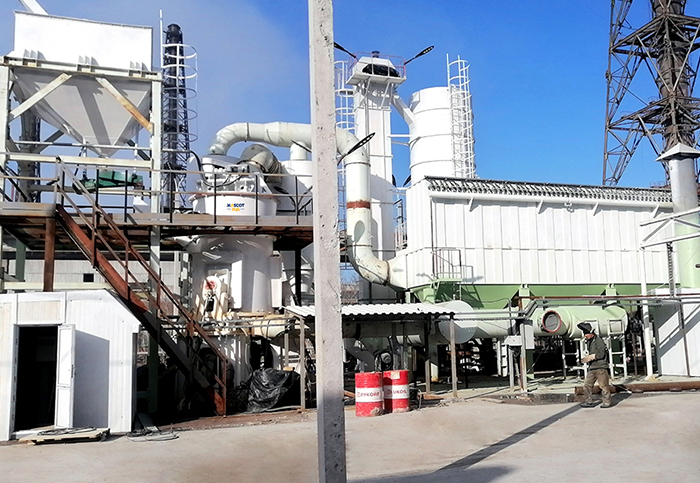
The production line of the vertical roller mill is a cost-effective and energy-efficient solution for processing powder, which is widely used in many industries, such as metallurgy, building materials, industrial solid waste treatment, thermal power plants, cement plants, and environmental protection fields. The primary purpose of this project is to finely grind raw materials through a vertical roller mill to meet the requirements of different industries for particle size, purity, and output of powder products.

The Raymond mill production line is a highly efficient system designed for grinding operations, with a focus on energy efficiency, durability, and productivity. It caters to the needs of users by offering fine powder products in non-metallic ores, coal powder, and slag processing, aiding enterprises in achieving sustainable growth.
Green and Intelligent Mining Machinery
Manufacturing and Export Base
Based on high quality and perfect after-sales service, our products have been
exported to more than 120 countries and regions.
Copyright © 2023 Zhengzhou Mascot Environmental Technology Co., Ltd Record number: Yu ICP No. 13021523-4





 WhatsApp