
Every dry grinding plant eventually faces the same commercial question: the mill can be pushed finer, but should it be? Selling 200 mesh, 325 mesh or 400 mesh is not simply a matter of choosing a number on a sieving chart — each grade has a different buyer base, a different production cost and a different price ceiling, and on the same machine they trade tonnage for fineness at a rate that is anything but linear. Using the published specifications of the Dry Ball Mill, this article sets out what each of the three grades actually costs to make, which market buys it, and how to decide where a dry grinding line should sit.
Mesh is a sieve count — the number of openings in one linear inch of screen — not a particle size, so the two are only related through a standard. On the American National Standard for Industrial Wire Cloth (ASTM E-11), the three grades in this comparison come out as follows.
| Grade | Sieve Opening (micron) | Sieve Opening (mm) | Typical Buyer Base |
|---|---|---|---|
| 200 mesh | 74 | 0.074 | Cement and clinker, dry-mix mortar, fly ash, general mineral filler |
| 325 mesh | 44 | 0.044 | Ceramic bodies and glazes, glass batch, refractory mixes, higher-grade filler |
| 400 mesh | 37 | 0.037 | Specialty filler, technical ceramics, high-end coatings |
Two things about that table matter commercially. The first is the boundary at the bottom of it: past roughly 325-400 mesh a screen has too little open area left between its wires to be a useful test, and standard industry practice is to stop describing particle size by mesh altogether and quote microns instead. The whole trade therefore shifts vocabulary somewhere between the second and third row, which is a useful signal that 400 mesh is the edge of what conventional dry sieving can even describe.
The second is the size interval involved. Moving from 200 mesh to 400 mesh halves the target particle size, from 74 microns to 37 microns, and in comminution the energy required per ton rises steeply as the target size falls. Grinding engineers have argued about the exact form of that relationship for a century; none of them have argued about its direction. The last few microns are always the expensive ones.
The three grades do not compete for the same customers, and understanding the buyer is the fastest way to understand the margin.
200 mesh (74 microns) is the volume grade. It is what cement and clinker circuits, dry-mix mortar plants, fly-ash processors and general mineral filler producers buy, and it is a specification that most buyers will accept from most suppliers. That is its strength and its weakness: the addressable market is the largest of the three, but the product is also the most commoditised, so price is set by the market rather than by the producer, and the winner is usually whoever runs the lowest cost per ton.
325 mesh (44 microns) is the value grade. It is the point at which the industry stops counting sieves and starts quoting microns, and the buyers behind it — ceramic bodies and glazes, glass batch, refractory mixes, higher-grade fillers and coatings — are specifying a powder that not every dry grinding plant can hold. Fewer competitors, a real premium over 200 mesh, and a market that is still wide enough to absorb tonnage: for most dry grinding operations this is where the best combination of volume and margin sits.
400 mesh (37 microns) is the premium grade. Unit prices are the highest of the three and the buyer base is the narrowest. Orders tend to be specification-driven and contracted in advance, because the applications — specialty fillers, technical ceramics, high-end coatings — are the ones where an oversized particle is least forgiving. It is a good business to be in, but it is a business you should not enter without a buyer already attached.

The mill does not know what the powder is called. It only knows how long the material has to stay in the cylinder and how much energy each ton consumes while it is there, and both of those move against the producer as the target gets finer.
Inputs that set fineness. On a dry ball mill, the output particle size is governed by the size and ratio of the steel ball charge — larger balls produce coarser output, smaller balls finer — and by grinding time. For tighter specifications, an optional air classifier can be added to the same mill, giving controllable output across the 0.074-0.89 mm range without stopping production. Set against those levers is one design principle worth more than any of them individually: material that has already reached the target should leave the circuit, not keep circulating. Over-grinding does not only waste energy, it flattens the particle-size distribution, so the plant ends up paying to manufacture fines the customer never ordered.
Three costs that move together. When a plant pushes from 200 mesh towards 325 or 400 mesh, three numbers change at once. Residence time rises, so tons per hour at that fineness falls. Energy per ton rises. And because media and liner wear is generated by the same grinding action but spread over fewer tons of finished product, wear cost per ton rises as well. The published capacity of any model is a range for exactly this reason: it describes what the machine can do at the coarse end of its output band, not what it will do when the specification tightens.
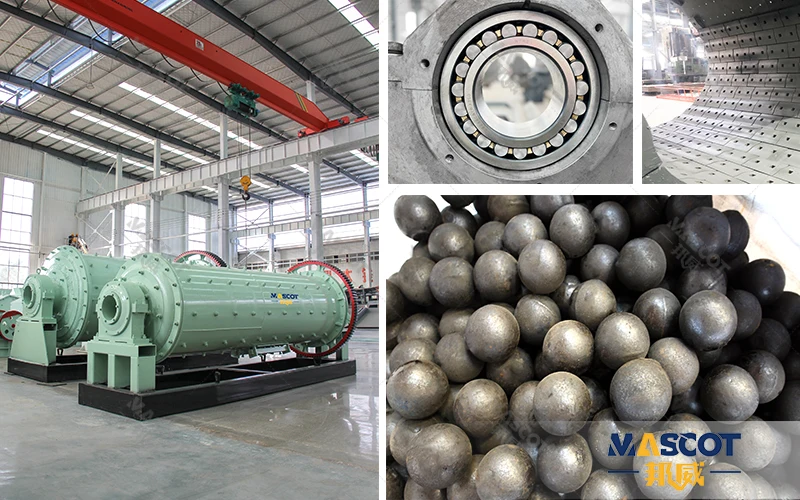
This is the point in the discussion where a supplier should be direct rather than persuasive. The Mascot dry ball mill series publishes an output size band of 0.074-0.4 mm across its standard models, with 0.074-0.6 mm on the 1200x2400 and 0.075-0.89 mm on the 900x1800 and 900x3000. In mesh terms, 0.074 mm is 200 mesh. That is the fine end of the published envelope, and it means 200 mesh is the grade this mill family is specified to deliver — with 325 mesh and 400 mesh sitting below that published band.
Plants do produce those finer grades on a dry circuit, and it is worth being clear about how. The mill is run in closed circuit with a fine classifier that returns oversize back to the cylinder and passes only qualifying powder to collection; the ball charge is re-balanced towards a smaller top size; and the operator accepts a reduced tonnage per hour in exchange for the fineness. The route works, but it has to be designed for rather than assumed. The classifier cut point, the ball size distribution and the expected yield all have to be modelled against the actual material before a plant commits to a 325 or 400 mesh product, because a mill sized for 200 mesh tonnage will not deliver that tonnage at 400 mesh.
There is also a second route that deserves to be stated plainly, because for many projects it is the cheaper one. When 325-400 mesh is a permanent part of the product range rather than an occasional order, the two grades belong on different machines. The HGM Micro-powder Grinding Mill is built for that band specifically, publishing 325-2500 mesh (approximately 5-47 microns) with a variable-frequency turbo classifier and four models covering 0.35-10 t/h, while the dry ball mill is left to do what it is specified for: 200 mesh at tonnage. Forcing one machine to be efficient at both ends usually means being inefficient at both ends.
The decision rule is therefore commercial, not technical. If your market needs 400 mesh occasionally, run the ball mill in closed circuit and price the extra energy into the order. If it needs 400 mesh as a standing product with a secured buyer, size that grade on a mill designed for it.

The table below is a selection from the published series. From the 1200x2400 upwards the output band settles at 0.074-0.4 mm with a 25 mm feed size limit, while the 900x1800 and 900x3000 cover a wider 0.075-0.89 mm band on a 20 mm feed — so in each case the choice between models is a capacity and power decision rather than a fineness one.
| Model | Feeding Size (mm) | Output Size (mm) | Capacity (t/h) | Power (kW) |
|---|---|---|---|---|
| 900x1800 | ≤20 | 0.075-0.89 | 0.65-2 | 18.5 |
| 1200x2400 | ≤25 | 0.075-0.6 | 1.6-5.8 | 37 |
| 1500x3000 | ≤25 | 0.074-0.4 | 2-7 | 75 |
| 1830x4500 | ≤25 | 0.074-0.4 | 4.5-12 | 155 |
| 2100x7000 | ≤25 | 0.074-0.4 | 8-48 | 280 |
| 2200x7000 | ≤25 | 0.074-0.4 | 15-28 | 380 |
| 2400x3000 | ≤25 | 0.074-0.4 | 30-50 | 245 |
| 2700x4500 | ≤25 | 0.074-0.4 | 50-90 | 430 |
| 3200x4500 | ≤25 | 0.074-0.4 | 50-90 | 800 |
Because output moves with material hardness, feed size and target fineness, model selection needs three data points before it can be answered properly: the material, the required capacity in tons per hour, and the required output size. Mascot application engineers work from those three numbers and will also advise whether an air classifier is required to hold the product specification.

The most useful evidence for where a dry grinding line should sit comes from one already running. A regional cement manufacturer in Rajasthan, India, expanded its clinker pulverising capacity with a Φ3200x13000 large-scale dry ball mill integrated with a Mascot air classifier system, targeting a fineness of 300-350 m²/kg Blaine to meet local construction standards.
The plant reported a 12% reduction in power consumption per ton of cement against its older units, and the combination of mill and air classifier allowed the precise production of multiple cement grades from the same installation — the practical version of the argument in Section 2: one grinding line, several specifications, and a classifier that decides which one is being made. Mascot provided a 30-day on-site commissioning service including 10 days of intensive operator training.
The energy side of that result is worth unpacking, because on a finer-grinding project it is the number that decides the margin. The mill's self-aligning double-row roller bearings are reported to cut rotational friction by approximately 30%, delivering a 10-20% reduction in overall power consumption against conventional sliding-bearing designs, and the drive uses IE3 high-efficiency motors. On a mid-sized mill in the 1500 series, that difference alone is worth thousands of dollars a year in electricity — and it is the same saving whether the plant is selling 200 mesh or 400 mesh, which means a plant grinding to a finer, higher-priced grade keeps more of the premium.

Q1: What do 200, 325 and 400 mesh mean in microns?
A: On the ASTM E-11 sieve series, 200 mesh is 74 microns (0.074 mm), 325 mesh is 44 microns (0.044 mm) and 400 mesh is 37 microns (0.037 mm). Past roughly 325-400 mesh, sieving becomes impractical and the industry quotes particle size in microns only.
Q2: So which grade sells best?
A: It depends which question you are asking. 200 mesh sells the most tons, because the buyer base is widest and the production cost is lowest — but it is also the most commoditised grade, so price is set by the market. 400 mesh earns the highest price per ton from the fewest customers, and only pays if the buyer and the specification are secured in advance. For most dry grinding plants, 325 mesh offers the best combination of the two: a real premium over 200 mesh, a still-wide buyer base in ceramics, glass and refractory, and a product that a well-designed dry circuit can hold.
Q3: Can a dry ball mill produce 325 or 400 mesh?
A: The published output band for the standard models is 0.074-0.4 mm, and 0.074 mm is 200 mesh — so 200 mesh is the fine end of the published specification, and 325 and 400 mesh sit below it. Finer grades are produced by running the mill in closed circuit with a fine classifier and re-balancing the ball charge, which reduces tonnage per hour. Where a fine grade is a permanent part of the product range, sizing it on a mill designed for the ultra-fine band is normally the lower-cost route.
Q4: How is fineness adjusted on a dry ball mill?
A: By changing the steel ball size and ratio — larger balls give coarser output, smaller balls finer — or by adjusting grinding time. For precision requirements an optional air classifier can be added to the same mill to give controllable output across 0.074-0.89 mm without stopping production.
Q5: What drives liner life on fine dry grinding duty?
A: The cylinder is lined with high-manganese steel (Mn13) or wear-resistant alloy steel, both proven in continuous mining operations, with a typical liner service life of 12-18 months under normal loads. Because wear per ton rises as the target fineness tightens, the modular segmented liner design matters on fine grades: individual plates can be swapped without removing the entire set, which keeps downtime to hours rather than days.
200, 325 and 400 mesh are three different businesses, not three settings on one dial. In microns they are 74, 44 and 37 — and because comminution energy per ton rises steeply as the target size falls, the interval between the first and last is far more expensive than the numbers suggest. The 200 mesh grade sells the most tons at the lowest cost but competes on price alone; 400 mesh earns the most per ton from the narrowest buyer base and needs a secured contract before the equipment is ordered; 325 mesh is where most dry grinding plants find the better balance of volume and margin. On the Mascot Dry Ball Mill, the published output band of 0.074-0.4 mm places 200 mesh at the fine end of the standard specification, with an optional air classifier extending controllable output across 0.074-0.89 mm, and 325 or 400 mesh reached through closed-circuit classification at reduced tonnage. Decide the grade from the market, then size the machine for it — and if the fine grade is what you sell, size it on a mill built for the fine band.

About of Mascot
Zhengzhou Mascot Industry is a high-tech mining equipment company integrating R&D, manufacturing, sales, and after-sales service. Focusing on crushing, grinding, and mineral processing equipment, we provide professional solutions to our customers. We are ISO9001:2015 certified, and our products include mobile crushing plants, crawler crushing plant, construction waste crushing plants, jaw crushers, sand making machines, cone crushers, fine crushers, grinding mills, ball mills, etc., all with reliable performance to meet diverse project needs.
• Professional pre-sales support: Free project design and comprehensive solutions to help you accurately select the right equipment;
• Comprehensive on-site service: Providing installation guidance and worker training to ensure smooth equipment commissioning;
• Reliable after-sales guarantee: A complete after-sales system, timely response to technical inquiries and equipment maintenance, ensuring long-term stable operation.
To protect your rights, please contact us through the following official channels for professional service:
WhatsApp: 0086-16650273865
Email: mascot@mascotenv.com
We are committed to providing high-quality equipment and full-cycle services to deliver comprehensive intelligent solutions for the global mining industry!
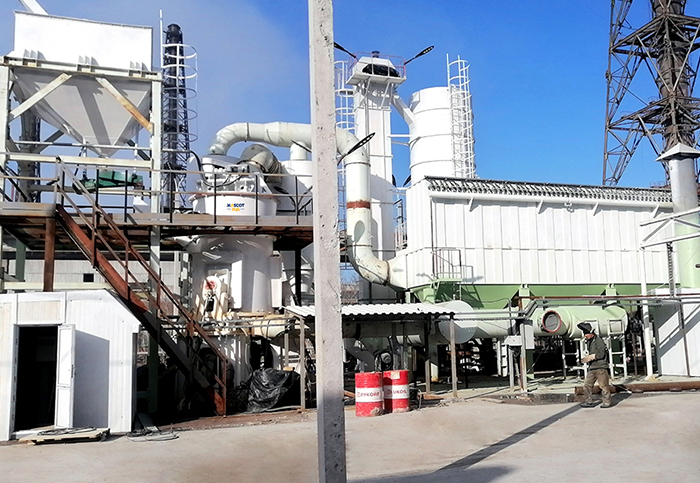
The production line of the vertical roller mill is a cost-effective and energy-efficient solution for processing powder, which is widely used in many industries, such as metallurgy, building materials, industrial solid waste treatment, thermal power plants, cement plants, and environmental protection fields. The primary purpose of this project is to finely grind raw materials through a vertical roller mill to meet the requirements of different industries for particle size, purity, and output of powder products.

The ball mill production line is a comprehensive production line that integrates material crushing, grinding, grading, and collection. This production line is mainly used to process various materials, including sand and gravel, cement, new building materials, silicates, refractory materials, fertilizers, ferrous metal beneficiation, non-ferrous metals, glass ceramics, etc.

The gypsum grinding production line is an efficient, stable, and environmentally friendly production solution, which is widely used in construction, decoration, the chemical industry, and other fields. In addition, the grinding process is particularly critical, which directly affects the quality and particle size of the final product. With the continuous development of science and technology, the technical level and production efficiency of gypsum grinding production lines will be further improved, providing strong support for the development of the gypsum processing industry.

The MTW series European grinding mill production line includes high-efficiency crushers, elevators, electromagnetic vibration feeders, milling machines, classifiers, and collectors. These pieces of equipment work together to achieve efficient crushing, grinding, and classification of various non-metallic ores, coal powder, slag, and other materials. It can meet the diverse needs of various industries for powder particle size, uniformity, shape, etc., and offer enterprises high-quality grinding products.

The high-pressure grinding mill production line is a project specially designed for efficient grinding operations. It is widely used in metallurgy, building materials, the chemical industry, highways, water conservancy hydropower, and other industries. It is a suspended roller mill that uses springs to increase pressure. It can achieve efficient grinding processing of various non-metallic raw materials. It has high efficiency, stability, and environmental protection characteristics.
Green and Intelligent Mining Machinery
Manufacturing and Export Base
Based on high quality and perfect after-sales service, our products have been
exported to more than 120 countries and regions.
Copyright © 2023 Zhengzhou Mascot Environmental Technology Co., Ltd Record number: Yu ICP No. 13021523-4





 WhatsApp