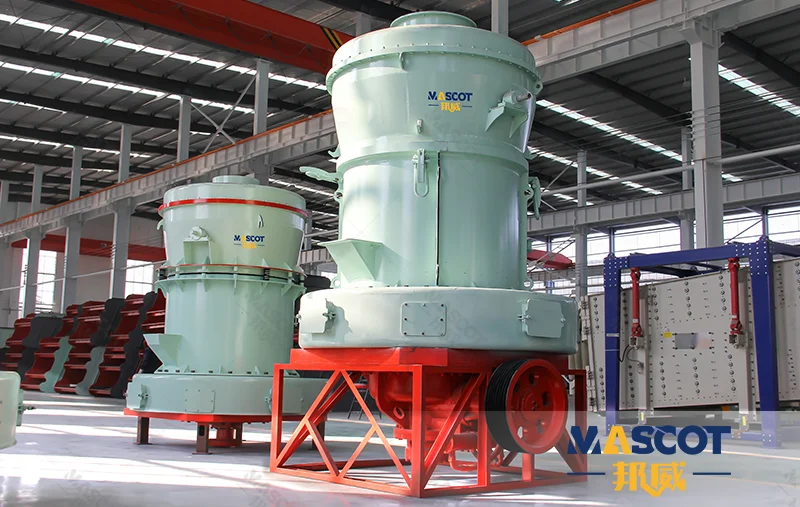
Gypsum is one of the few industrial minerals where the machine is rarely limited by hardness and almost always limited by two other things: fineness consistency and the cost of the parts that wear. Board and plaster producers buy powder on a residue specification, and they pay for it twice — once at the mill purchase and again every time a roller or ring set is replaced. This guide looks at both halves of that equation on the MTW Trapezium Grinding Mill: how the working fineness window is set, what each model delivers, and how the wear parts behave in service.
The MTW trapezium mill — also described as the European version trapezium mill — is a mill type designed on the basis of the high-pressure suspension roller mill. It is used across mining, building materials, the chemical industry, metallurgy and coal processing to grind non-flammable and non-explosive mineral materials with a Mohs hardness below 9.3 and a humidity below 6%.
Gypsum sits comfortably inside that envelope. The manufacturer lists it alongside limestone and calcite, marble and granite, potassium feldspar and quartz, barite and bentonite, and dolomite and talc — with gypsum specified for gypsum board and plaster. What makes gypsum distinctive in a specification meeting is not the grinding force required but the moisture clause: the mill is rated for feed humidity below 6%, so a feedstock that arrives wetter than that has to be dried upstream before it reaches the grinding chamber. That single number decides whether your project needs a dryer in the flow sheet.

Across the series the published output-size range is 0.038-0.2 mm, and the working fineness is adjustable from 80 to 400 mesh. The important operational detail for a gypsum plant is how that adjustment is made: the electrical control system is designed for one-button startup and for fineness changes made without shutting the mill down, so a producer moving between grades — a coarser plaster specification and a finer one for board core — does not schedule a production stop around every change-over.
That flexibility has commercial value beyond convenience. In a plant serving several downstream products, the mill setting becomes a scheduling decision rather than a mechanical one, and a grade that used to be quoted with a batch lead time can be produced against the order. Where the target specification is fixed for months at a time, the same control system simply holds it — which is the more common pattern in high-volume board production.
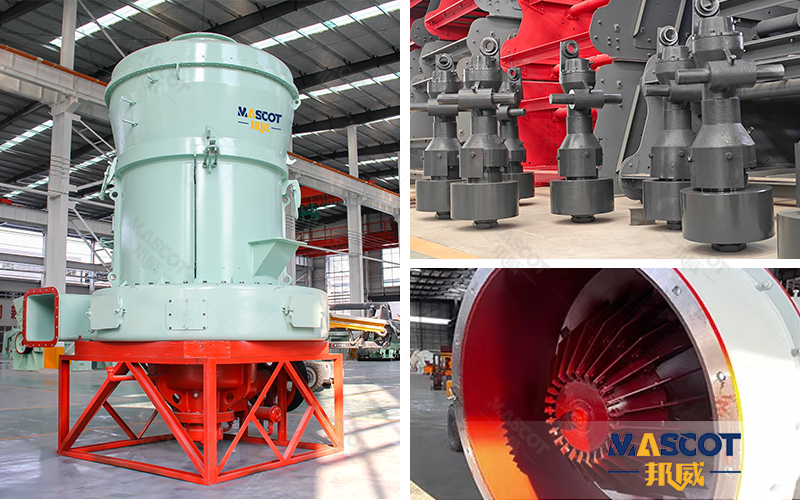
The table below is the published specification for the four models. Two columns deserve attention before the capacity figure: the feed size rises with the model (30 mm on the MTW110 to 45 mm on the MTW215), and the power is split across three drives — main mill, powder classifier and blower — which is where the efficiency case for a larger model usually rests.
| Model | Roller Size (mm) | Grind Ring Inner Dia. (mm) | Feeding Size (mm) | Output Size (mm) | Capacity (t/h) | Main Mill (kW) | Powder Classifier (kW) | Blower (kW) |
| MTW110 | 360×210 | 1100×210 | 30 | 0.038-0.2 | 3-10 | 55 | 18.5 | 55 |
| MTW138 | 460×260 | 1380×260 | 35 | 0.038-0.2 | 6-20 | 90 | 22 | 132 |
| MTW175 | 520×300 | 1750×300 | 40 | 0.038-0.2 | 10-35 | 160 | 37 | 200 |
| MTW215 | 640×340 | 2150×340 | 45 | 0.038-0.2 | 20-50 | 220 | 37 | 250 |
Read as a sizing ladder, the series spans 3-10 t/h on the MTW110, 6-20 t/h on the MTW138, 10-35 t/h on the MTW175 and 20-50 t/h on the MTW215. The practical question for a gypsum project is not which model is largest but which model holds your specification with margin: a mill running at the top of its range has no headroom left for a harder-than-expected feedstock or a finer grade, and the MTW175 and MTW215 columns exist precisely so that a plant planning to grow is not forced to replace the mill when it does.
The grinding roller and grinding ring are the components that convert motor power into powder, and in a gypsum plant they are also the largest recurring maintenance cost. The MTW design uses wear-resistant grinding roller and ring with a specific contour profile; the purpose of that contour is twofold — extended service life and a more uniform finished product. Uniformity matters commercially because a plant selling on a residue clause is paid for consistency, not for average particle size.
Three specification points are worth confirming when you compare suppliers. First, the wear-material grade of the roller and ring, since the same contour in a different alloy gives a very different replacement interval. Second, the warranty terms covering those components: the MTW mills are supplied with a 12-month warranty on the whole machine and a further 12-month warranty on core components including rollers, rings and classifiers. Third, the availability of spare parts, which are supplied at the lowest cost from factory stock.
Two operating habits extend the wear interval more than any specification change. Keeping the feed inside the moisture limit protects the grinding zone from caking and uneven loading, and recording product fineness and main-motor power draw every shift turns wear into a trend you can see. Wear almost always shows up first as a slow drift in fineness at constant power — catching it at that point means planning a replacement, not reacting to a failed one.

Beyond gypsum, the series covers the material groups below. The list is useful in two directions: for a gypsum producer it shows what else the same mill can process if the product mix changes, and for a multi-material plant it shows where one investment can serve several product lines.
| Material | Typical End Use |
| Limestone & Calcite | Construction materials, desulfurization in power plants, fillers |
| Marble & Granite | Powder for artificial stone, coatings and plastics |
| Potassium Feldspar & Quartz | Essential raw materials for the glass and ceramic industries |
| Barite & Bentonite | Weighting agent in drilling mud and other industrial applications |
| Dolomite & Talc | Paints, rubber, pharmaceuticals and cosmetics |
| Gypsum | Gypsum board and plaster |
| Clinker & Active Carbon | Cement production and purification processes |
Three design features decide how a gypsum line feels in daily operation. The airflow duct is optimized to reduce resistance and increase throughput, which shows up as output at a given power rather than as a specification on a sheet. The machine uses a robust modular design with vibration-damping devices for smooth, continuous operation with minimal maintenance — the difference between a mill that runs to the next planned stop and one that announces itself through the floor. And the advanced dust removal system centres on a high-efficiency pulse dust collector that achieves over 99.9% efficiency, meeting international environmental standards and keeping the working area clean.
For a board or plaster plant, that last point is not only an environmental compliance matter. Gypsum dust is the product; every kilogram that leaves through the stack is margin lost, and a collector efficiency stated at over 99.9% is the mechanism by which the mill's output and the plant's yield stay aligned.

1. Feeding. Crushed raw material is elevated to the storage hopper.
2. Grinding. A vibrating feeder supplies material uniformly into the grinding chamber, where the rollers grind it against the ring.
3. Classification. An air stream carries the powder to the classifier; fine particles pass through while oversized ones fall back for regrinding.
4. Collection. The fine powder is separated and collected in a cyclone collector.
5. Dust removal. The remaining air is purified by a pulse dust collector before being released, ensuring clean operation.
The classification step is where the fineness window is actually held, and the re-circulation of oversize material is what allows a single setting to produce a consistent residue rather than a spread. In a gypsum line, that closed loop also means the mill reaches steady state quickly after a start-up or a grade change — usually within the first few minutes of stable feed.
Q1: How do I match an MTW model to my gypsum tonnage?
A: Start from the capacity band and the feed size together. The MTW110 covers 3-10 t/h with feed up to 30 mm, the MTW138 covers 6-20 t/h at 35 mm, the MTW175 covers 10-35 t/h at 40 mm and the MTW215 covers 20-50 t/h at 45 mm. Choose the model that holds your target with margin rather than the smallest one that can reach it.
Q2: What moisture content can the mill handle?
A: The series is specified for materials with a humidity below 6%. Feedstock that arrives wetter than that should be dried upstream before grinding, because moisture in the grinding zone costs you throughput and product consistency rather than merely adding handling difficulty.
Q3: Can fineness be changed without stopping production?
A: Yes. The control system provides one-button startup and adjustable fineness from 80 to 400 mesh without shutdown, so grade changes are made from the control panel. The mill holds the chosen setting through the classifier, with oversize material returned automatically for regrinding.
Q4: What are the delivery time, payment terms and warranty?
A: Delivery is 7-10 days for stock models and 15-30 days for mass production. Payment is 30% deposit by T/T in advance with the 70% balance before shipment. Every machine carries a one-year warranty, with spare parts supplied at the lowest cost, and the rollers, rings and classifiers additionally covered by a 12-month core-component warranty.
Q5: Can you supply the complete production line, not only the mill?
A: Yes. The plant can be engineered as a complete crushing and grinding line with the related professional advice, covering feeding, grinding, classification, collection and dust removal — Mascot has built these lines in China and overseas.
Gypsum rewards a straightforward approach: confirm the moisture clause first, because a feed above the mill's humidity limit changes the flow sheet; then fix the fineness needed for your board or plaster specification inside the 80-400 mesh window; then choose the model from the capacity table with enough margin to absorb a harder feed or a finer grade. On the cost side, the two variables that matter are the alloy grade of the roller and ring and the habit of tracking fineness and power draw every shift, because that is how wear is caught as a plan rather than an outage.
The MTW Trapezium Grinding Mill covers gypsum board and plaster duty with capacities from 3 to 50 t/h across four models, wear-resistant roller and ring assemblies, fineness adjustment without shutdown and a pulse dust collector above 99.9% efficiency. For products that have to go finer than the trapezium mill's band, the HGM Series Micro-powder Grinding Mill takes over at the ultra-fine end. Send your material, target fineness and tonnage — or your gypsum sample for a test grind — and the model and wear configuration can be specified against your specification.

About of Mascot
Zhengzhou Mascot Industry is a high-tech mining equipment company integrating R&D, manufacturing, sales, and after-sales service. Focusing on crushing, grinding, and mineral processing equipment, we provide professional solutions to our customers. We are ISO9001:2015 certified, and our products include mobile crushing plants, crawler crushing plant, construction waste crushing plants, jaw crushers, sand making machines, cone crushers, fine crushers, grinding mills, ball mills, etc., all with reliable performance to meet diverse project needs.
• Professional pre-sales support: Free project design and comprehensive solutions to help you accurately select the right equipment;
• Comprehensive on-site service: Providing installation guidance and worker training to ensure smooth equipment commissioning;
• Reliable after-sales guarantee: A complete after-sales system, timely response to technical inquiries and equipment maintenance, ensuring long-term stable operation.
To protect your rights, please contact us through the following official channels for professional service:
WhatsApp: 0086-16650273865
Email: mascot@mascotenv.com
We are committed to providing high-quality equipment and full-cycle services to deliver comprehensive intelligent solutions for the global mining industry!

The ball mill production line is a comprehensive production line that integrates material crushing, grinding, grading, and collection. This production line is mainly used to process various materials, including sand and gravel, cement, new building materials, silicates, refractory materials, fertilizers, ferrous metal beneficiation, non-ferrous metals, glass ceramics, etc.

The Raymond mill production line is a highly efficient system designed for grinding operations, with a focus on energy efficiency, durability, and productivity. It caters to the needs of users by offering fine powder products in non-metallic ores, coal powder, and slag processing, aiding enterprises in achieving sustainable growth.

This production line utilizes a three-ring medium-speed micro-grinding mill as the central equipment, complemented by other auxiliary equipment like hammer crushers, bucket elevators, and storage silos to establish a comprehensive grinding operation system. It has demonstrated strong potential for application and market competitiveness in industries such as construction, chemical industry, and new materials.

YGMX Enhanced High-Pressure Mill is a new type of high-performance grinding equipment, and the biggest improvement of this milling equipment lies in the increase of the high-pressure spring system in the grinding roller part. Compared with the traditional high-pressure roller mill, it has a wider scope of application and excellent performance to meet the production needs of a variety of powder fineness. It is widely used in non-metallic minerals, chemicals, building materials, metallurgy, environmental protection, etc. Multiple areas.

The high-pressure grinding mill production line is a project specially designed for efficient grinding operations. It is widely used in metallurgy, building materials, the chemical industry, highways, water conservancy hydropower, and other industries. It is a suspended roller mill that uses springs to increase pressure. It can achieve efficient grinding processing of various non-metallic raw materials. It has high efficiency, stability, and environmental protection characteristics.
Green and Intelligent Mining Machinery
Manufacturing and Export Base
Based on high quality and perfect after-sales service, our products have been
exported to more than 120 countries and regions.
Copyright © 2023 Zhengzhou Mascot Environmental Technology Co., Ltd Record number: Yu ICP No. 13021523-4





 WhatsApp