
The two models most often compared in the MTW series are the MTW138 and the MTW175 Trapezium Grinding Mill. They sit side by side in the middle of the MTW range, they share the same technology, and their prices are close enough to make the choice genuinely difficult — while their outputs differ enough to make the wrong choice genuinely expensive.
This article compares them the way a plant manager should: what each delivers, what the larger model costs, where the payback advantage sits, and which plant profile each serves. The numbers are the models' published specifications and field operating data — no marketing multipliers.
Both share the same series technology: trapezoidal roller and ring, integral bevel gear drive, dilute oil lubrication. The differences are of scale — and scale is what matters here:
| Specification | MTW138 | MTW175 |
|---|---|---|
| Roller size | 460x260 mm | 520x300 mm |
| Grinding ring | 1380x260 mm | 1750x300 mm |
| Max feed size | ≤35 mm | ≤40 mm |
| Output size | 0.038-0.2 mm | 0.038-0.2 mm |
| Capacity | 6-20 t/h | 10-35 t/h |
| Main motor | 90 kw | 160 kw |
| Classifier / Blower | 22 / 132 kw | 37 / 200 kw |
| Total installed power | 244 kw | 397 kw |
Three differences drive everything else: a 13% larger roller, a 27% larger ring, feed up to 40mm instead of 35mm, and 63% more installed power. Each is a cost and a capability at the same time.

No supplier quotes a fixed price for either model — configuration, scope and logistics set the number — but the relationship between the two prices is predictable. The MTW175 carries a larger motor (160 vs 90 kw), a heavier grinding assembly, a bigger classifier and blower, and larger auxiliary equipment. Its price is therefore higher, in proportion to its size.
What the extra investment buys: more tons per hour, larger feed acceptance and headroom for growth. What it does not buy: better fineness — both adjust identically across 80-425 mesh — or better efficiency per kilowatt, which is identical too. The price difference is a purchase of scale, and scale pays only if your market can absorb the extra tons.
Compare prices properly: request itemized quotations for the same scope — main mill, classifier, blower, auxiliary line and installation — and compare the payback calculation, not the invoice. A price difference without a throughput plan is not a decision.
The rated ranges tell the story in one line: 6-20 t/h against 10-35 t/h. In annual terms, at rated maximum on a 24-hour, 300-day schedule, the MTW138 can produce about 144,000 tons per year and the MTW175 about 252,000. At 70% utilization: roughly 100,000 against 176,000 tons — a gap of about 76,000 tons of saleable powder.
Real plants do not run at rated maximum, and finer fineness narrows the gap proportionally. The field benchmark is instructive: a Southeast Asian limestone plant ran the MTW175 at a stable 31 t/h at 250 mesh — near the top of its rated range even at fine duty. An MTW138 on the same duty delivers a meaningful output, but a smaller one.

Efficiency is where the two models turn out to be twins. At maximum output, both deliver about 0.22 t/h per kilowatt of main motor power — the MTW138 producing 20 t/h on 90 kw, the MTW175 producing 35 t/h on 160 kw. The technology is identical; the ratio is identical; only the scale differs.
Consequence for payback: energy cost per ton is similar for both — the MTW175 simply moves more tons. The payback difference is decided not by efficiency, which is a wash, but by utilization: whether the plant can sell the extra output. A plant that cannot fill the larger machine's hours pays for capacity it never uses.
The answer to the title question depends on your target output, and the decision rule is simple:
| Your Target Output | Recommended Model | Payback Logic |
|---|---|---|
| 6-15 t/h | MTW138 | Lower investment, sufficient capacity, fastest return — the value benchmark |
| 15-25 t/h | Borderline | MTW138 at its limit vs MTW175 underused; decide on the 3-year plan |
| 25-35 t/h | MTW175 | Only the larger machine delivers the tons; payback driven by output value |
For a medium plant targeting 6-15 t/h, the MTW138 is the payback champion: the lower equipment price and lower installed power (244 vs 397 kw) return on a smaller base, and the machine runs near its design point — the condition where efficiency is best. For a large plant targeting 25-35 t/h, the MTW175 is the only rational choice, and its payback is driven by the value of the extra 76,000 tons a year — a volume advantage no efficiency ratio can replace.
The danger zone is the middle. Buying an MTW175 to produce 12 t/h pays the larger price, power bill and maintenance for output the MTW138 handles at a fraction of the cost. Buying an MTW138 to chase 30 t/h hits the ceiling, overworks the machine, and leads to the MTW175 purchase two years later anyway. Both cases pay worse than correct sizing — the sizing decision deserves real numbers, not hopes.

The MTW138 is the best-selling model of the series worldwide — evidence that for the largest group of buyers its capacity and price intersect correctly. The MTW175 carries the documented case: a Southeast Asian plant running 250-mesh powder at 31 t/h, with 22% lower energy, 20% lower maintenance, a 99.6% pass rate and a second line ordered within eight months. Both models have their proof — the question is which matches your plant's target.
Neither machine has a universal payback advantage. The MTW138 pays back faster for medium producers who fill its hours; the MTW175 for large producers whose orders demand the extra tonnage. Mascot's free project design will run the numbers for your material, fineness and output target — so the comparison is based on your plant, not a brochure.
Q1: Which model is right for 250-mesh limestone powder?
A: For medium-scale output, the MTW138; for large output, the MTW175 — which produced 31 t/h at 250 mesh in the Southeast Asia case. Send your target tonnage for a confirmed recommendation.
Q2: What are the electrical requirements of each model?
A: Total installed power: 244 kw for the MTW138 (90 + 22 classifier + 132 blower) and 397 kw for the MTW175 (160 + 37 + 200). Confirm your site's power supply before choosing.
Q3: Is the price difference large?
A: The MTW175 carries a larger motor, grinding assembly, classifier and blower, so its price is higher in proportion to its size. Compare itemized quotes for the same scope to see the real difference.
Q4: Can I start with an MTW138 and expand later?
A: Yes, and many plants do. If your three-year plan stays below the MTW138's capacity, it is the faster-payback start; if it approaches 20 t/h, moving straight to the MTW175 avoids a second purchase.
MTW138 and MTW175 are the same technology at different scale. Both deliver about 0.22 t/h per kilowatt, both adjust across 80-425 mesh, and both carry the trapezium design's efficiency and reliability advantages. They differ in capacity — 6-20 against 10-35 t/h — and in the investment, power and maintenance that scale requires. The MTW138 pays back faster for medium plants; the MTW175 pays back faster for large plants whose market absorbs its output. Match the model to your three-year tonnage target, and let Mascot's free project design put your numbers into the payback calculation.

About of Mascot
Zhengzhou Mascot Industry is a high-tech mining equipment company integrating R&D, manufacturing, sales, and after-sales service. Focusing on crushing, grinding, and mineral processing equipment, we provide professional solutions to our customers. We are ISO9001:2015 certified, and our products include mobile crushing plants, crawler crushing plant, construction waste crushing plants, jaw crushers, sand making machines, cone crushers, fine crushers, grinding mills, ball mills, etc., all with reliable performance to meet diverse project needs.
• Professional pre-sales support: Free project design and comprehensive solutions to help you accurately select the right equipment;
• Comprehensive on-site service: Providing installation guidance and worker training to ensure smooth equipment commissioning;
• Reliable after-sales guarantee: A complete after-sales system, timely response to technical inquiries and equipment maintenance, ensuring long-term stable operation.
To protect your rights, please contact us through the following official channels for professional service:
WhatsApp: 0086-16650273865
Email: mascot@mascotenv.com
We are committed to providing high-quality equipment and full-cycle services to deliver comprehensive intelligent solutions for the global mining industry!

This production line utilizes a three-ring medium-speed micro-grinding mill as the central equipment, complemented by other auxiliary equipment like hammer crushers, bucket elevators, and storage silos to establish a comprehensive grinding operation system. It has demonstrated strong potential for application and market competitiveness in industries such as construction, chemical industry, and new materials.
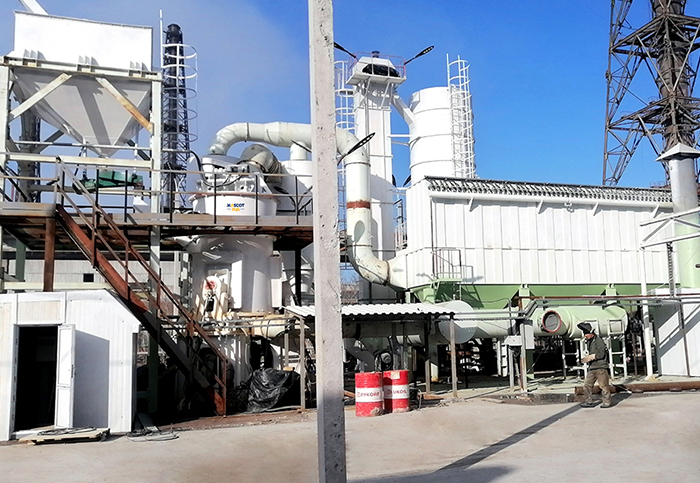
The production line of the vertical roller mill is a cost-effective and energy-efficient solution for processing powder, which is widely used in many industries, such as metallurgy, building materials, industrial solid waste treatment, thermal power plants, cement plants, and environmental protection fields. The primary purpose of this project is to finely grind raw materials through a vertical roller mill to meet the requirements of different industries for particle size, purity, and output of powder products.

The ball mill production line is a comprehensive production line that integrates material crushing, grinding, grading, and collection. This production line is mainly used to process various materials, including sand and gravel, cement, new building materials, silicates, refractory materials, fertilizers, ferrous metal beneficiation, non-ferrous metals, glass ceramics, etc.

YGMX Enhanced High-Pressure Mill is a new type of high-performance grinding equipment, and the biggest improvement of this milling equipment lies in the increase of the high-pressure spring system in the grinding roller part. Compared with the traditional high-pressure roller mill, it has a wider scope of application and excellent performance to meet the production needs of a variety of powder fineness. It is widely used in non-metallic minerals, chemicals, building materials, metallurgy, environmental protection, etc. Multiple areas.

The Raymond mill production line is a highly efficient system designed for grinding operations, with a focus on energy efficiency, durability, and productivity. It caters to the needs of users by offering fine powder products in non-metallic ores, coal powder, and slag processing, aiding enterprises in achieving sustainable growth.
Green and Intelligent Mining Machinery
Manufacturing and Export Base
Based on high quality and perfect after-sales service, our products have been
exported to more than 120 countries and regions.
Copyright © 2023 Zhengzhou Mascot Environmental Technology Co., Ltd Record number: Yu ICP No. 13021523-4





 WhatsApp