
Dryer quotations are argued in tonnes per hour. The bill is paid in water. "20 t/h" and "25 t/h" only mean something once the moisture in and the moisture out are attached to them, and the machine that looks cheaper per tonne of product is often the one evaporating more water per tonne of product.
Water is the only honest unit for the running cost, because the heat it takes to evaporate a tonne of it is fixed by physics and the fuel that supplies that heat is priced per gigajoule in every market. This is what one tonne of water costs on a Three-Cylinder Dryer, where the money goes, and which three figures belong in the order.
Take the ordinary case: mineral powder arriving at 25% moisture, leaving at 3%. Per tonne of dried product, the machine has to remove about 0.29 t of water. That is the number the fuel bill is built on. Change the target to 1% for a bagged product and the water per tonne product rises to roughly 0.32 t — an extra 10% of evaporation for a product that is only marginally drier.
Run the calculation in the other direction and the same machine sizes very differently. Feed at 20% instead of 25% and the water to remove falls to about 0.21 t per tonne of product, a saving of nearly a third on the drying bill before any equipment change. Feed at 30% and it climbs to 0.36 t. This is why a dryer specification written without a stated feed moisture is not a specification.
The published positioning for this machine family is a final moisture of 3–15% adjustable, on material arriving at up to 25% initial moisture. Those two figures bound the problem. Everything inside that box is a trade between throughput and how dry the product goes.
Nine models run from an outer cylinder of 2.0 m by 4 m to 4.0 m by 10 m, with drum volumes from 12.56 to 125.6 m³, published capacities of 8–100 t/h and drive power of 11–88 kW. Hot gas enters at 700–750 °C.
| Model | Drum volume (m³) | Speed (r/min) | Max. gas temp. (°C) | Capacity (t/h) | Drive power (kW) | kW per t/h |
|---|---|---|---|---|---|---|
| Ф2.0×4m | 12.56 | 4–10 | 700–750 | 8–15 | 5.5×2 | 0.73–1.38 |
| Ф2.2×5m | 18.99 | 4–10 | 700–750 | 12–20 | 5.5×2 | 0.55–0.92 |
| Ф2.5×6m | 29.43 | 4–10 | 700–750 | 18–28 | 7.5×2 | 0.54–0.83 |
| Ф2.8×6m | 36.92 | 4–10 | 700–750 | 25–35 | 11×2 | 0.63–0.88 |
| Ф3.0×6m | 42.39 | 4–10 | 700–750 | 30–40 | 7.5×4 | 0.75–1.00 |
| Ф3.0×7m | 49.45 | 4–10 | 700–750 | 30–45 | 7.5×4 | 0.67–1.00 |
| Ф3.2×7m | 56.27 | 4–10 | 700–750 | 35–55 | 11×4 | 0.80–1.26 |
| Ф3.6×8m | 81.39 | 4–10 | 700–750 | 55–75 | 18.5×4 | 0.99–1.35 |
| Ф4.0×10m | 125.60 | 4–10 | 700–750 | 70–100 | 22×4 | 0.88–1.26 |
How to read this table: the last column is computed from the published figures, drive power divided by capacity band, and it is a measure of how hard the drum is being turned per tonne — not of drying cost. The published sheet does not state an evaporation rate in tonnes of water per hour, a fuel consumption figure, or the moisture basis of the capacity band. Those three gaps are where quotations differ, and all three are answerable in writing. The highlighted model is the usual fit for a mineral powder line in the 40 t/h class.

Water entering at 20 °C has to be heated to its boiling point and then vaporised. Heating takes about 4.19 kJ per kilogram per degree, so 80 degrees costs roughly 335 kJ/kg. Vaporisation takes 2,257 kJ/kg at atmospheric pressure. Together, about 2.59 GJ per tonne of water, and that is before the solids are heated or a single kilojoule is lost up the stack.
Add the material: on the 25%-to-3% case, one tonne of water is carried in by about 3.4 t of dry solids, and lifting those solids to an outlet temperature of roughly 80 °C adds about 0.17 GJ. Call it 2.76 GJ per tonne of water as the theoretical minimum, on those stated assumptions. No dryer achieves it; the gap between that figure and what the burner delivers is thermal efficiency, and it is the single most useful number a supplier can be asked to commit to.
The calculation below holds the 2.76 GJ minimum constant and varies efficiency. Coal is taken at 5,500 kcal/kg, about 23 MJ/kg, burned at 85% combustion efficiency; natural gas at 35.8 MJ per normal cubic metre, burned at 98%. Both are stated so the arithmetic can be checked against local fuel.
| Dryer thermal efficiency | Heat input (GJ per t water) | Coal (kg per t water) | Natural gas (m³ per t water) |
|---|---|---|---|
| 55% | 5.02 | 257 | 143 |
| 65% | 4.25 | 217 | 121 |
| 75% | 3.68 | 188 | 105 |
How to read this table: these are calculated figures on the assumptions above, not published consumption data, and they exist to show the size of the efficiency effect rather than to predict your plant. Moving from 55% to 75% removes roughly a quarter of the fuel per tonne of water — on a line evaporating 8 t of water per hour, that is the difference between about 2.1 t and 1.5 t of coal an hour.
The three-stage cascading structure is where a three-cylinder machine earns its place: material is lifted and dropped through the inner, middle and outer drums in sequence, so it meets fresh hot gas repeatedly instead of travelling once along a single shell. The published claim for this design against a conventional single-drum machine is an energy reduction of about 20–25%, which sits in the same territory as the efficiency gap in the table.

Four habits account for most of the avoidable fuel on a mineral powder line.
Drying past the requirement. Product at 1% instead of 3% costs about a tenth more evaporation per tonne and buys nothing the next process step asked for. Set outlet moisture to what the customer actually requires, then control to it.
Running the outlet gas hotter than necessary. Every 10 °C of unnecessary outlet temperature is heat that left through the stack without evaporating water. The bag filter has to stay above the dew point, but the correct margin is a measured one, not a comfortable guess.
Air leakage. Inleakage at the seals and the discharge drops gas temperature and raises the volume the fan must move, so the burner works to heat air that never touched the material. Multi-channel labyrinth sealing at both cylinder ends is the design answer; worn seals are a cheap maintenance item.
Feeding wetter than the design case. A dryer sized at 20% inlet and fed at 27% will meet its tonnage by drying less, or meet its moisture by drying less tonnage. Neither shows up as a fault; both show up as a bigger fuel bill.
The 700–750 °C gas temperature in the table is an inlet limit, not an operating target, and how you reach it shapes the capital cost. Coal needs a combustion chamber or hot gas generator, ash handling and a dust collector rated for the added load; gas needs a burner and a reliable supply but far less ancillary equipment. Waste heat — kiln exit gas, cooler exhaust, engine exhaust — is the cheapest heat available once the ductwork exists, and the reason drying is often bolted onto a plant that already has a hot stack.
The collector downstream is part of the drying system, not an accessory: a pulse dust collector sized on gas volume at the outlet temperature, rather than at the burner, is the difference between a clean stack and an eroded fan. And where tonnage is small enough that a three-drum machine is hard to justify, the comparison with a single cylinder dryer comes down to water per hour, not tonnes of product.

Q1: How much fuel does it take to evaporate one tonne of water?
A: The theoretical minimum is about 2.76 GJ on a 25%-to-3% duty, counting water heated from 20 °C and solids raised to roughly 80 °C. At 65% thermal efficiency that becomes about 4.25 GJ, equivalent to some 217 kg of 5,500 kcal coal or 121 m³ of natural gas. Treat these as calculated figures from stated assumptions and require the supplier's measured consumption per tonne of water.
Q2: What capacity do I need for 30 t/h of product at 25% down to 3%?
A: That duty removes roughly 8.8 t of water per hour, which puts it in the Ф3.2×7m class on the published band. Confirm the moisture basis of the capacity figure first: a band quoted on feed rate and a band quoted on dried product describe different machines for the same job.
Q3: Is a three-cylinder dryer always cheaper to run than a single drum?
A: It uses the same physics but recovers heat better, and the published claim against a conventional single-drum design is a 20–25% energy reduction. That advantage has to be weighed against capital cost at small tonnage, where a single drum can still be the sensible buy.
Q4: Can I dry mineral powder with waste heat instead of a burner?
A: Yes, if the source delivers the gas volume at a usable temperature and the duct run is short enough to keep it there. Waste heat removes the fuel line from the bill, not the fan power, the dust collection, or the need to hold outlet temperature above dew point.

About of Mascot
Zhengzhou Mascot Industry is a high-tech mining equipment company integrating R&D, manufacturing, sales, and after-sales service. Focusing on crushing, grinding, and mineral processing equipment, we provide professional solutions to our customers. We are ISO9001:2015 certified, and our products include mobile crushing plants, crawler crushing plant, construction waste crushing plants, jaw crushers, sand making machines, cone crushers, fine crushers, grinding mills, ball mills, etc., all with reliable performance to meet diverse project needs.
• Professional pre-sales support: Free project design and comprehensive solutions to help you accurately select the right equipment;
• Comprehensive on-site service: Providing installation guidance and worker training to ensure smooth equipment commissioning;
• Reliable after-sales guarantee: A complete after-sales system, timely response to technical inquiries and equipment maintenance, ensuring long-term stable operation.
To protect your rights, please contact us through the following official channels for professional service:
WhatsApp: 0086-16650273865
Email: mascot@mascotenv.com
We are committed to providing high-quality equipment and full-cycle services to deliver comprehensive intelligent solutions for the global mining industry!

YGMX Enhanced High-Pressure Mill is a new type of high-performance grinding equipment, and the biggest improvement of this milling equipment lies in the increase of the high-pressure spring system in the grinding roller part. Compared with the traditional high-pressure roller mill, it has a wider scope of application and excellent performance to meet the production needs of a variety of powder fineness. It is widely used in non-metallic minerals, chemicals, building materials, metallurgy, environmental protection, etc. Multiple areas.

This production line utilizes a three-ring medium-speed micro-grinding mill as the central equipment, complemented by other auxiliary equipment like hammer crushers, bucket elevators, and storage silos to establish a comprehensive grinding operation system. It has demonstrated strong potential for application and market competitiveness in industries such as construction, chemical industry, and new materials.

The MTW series European grinding mill production line includes high-efficiency crushers, elevators, electromagnetic vibration feeders, milling machines, classifiers, and collectors. These pieces of equipment work together to achieve efficient crushing, grinding, and classification of various non-metallic ores, coal powder, slag, and other materials. It can meet the diverse needs of various industries for powder particle size, uniformity, shape, etc., and offer enterprises high-quality grinding products.
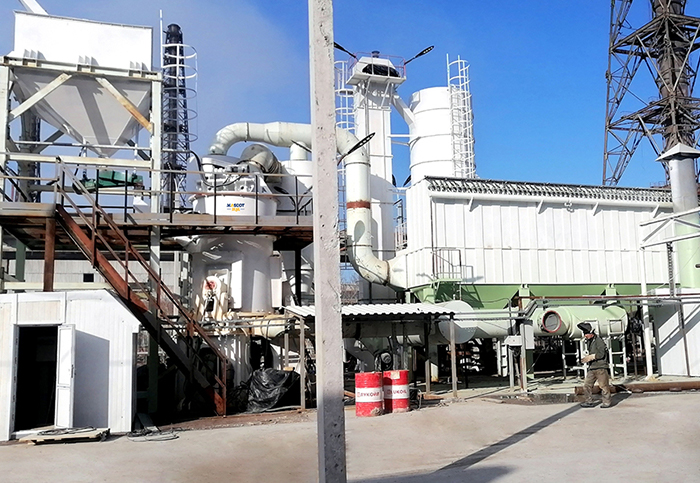
The production line of the vertical roller mill is a cost-effective and energy-efficient solution for processing powder, which is widely used in many industries, such as metallurgy, building materials, industrial solid waste treatment, thermal power plants, cement plants, and environmental protection fields. The primary purpose of this project is to finely grind raw materials through a vertical roller mill to meet the requirements of different industries for particle size, purity, and output of powder products.

The ball mill production line is a comprehensive production line that integrates material crushing, grinding, grading, and collection. This production line is mainly used to process various materials, including sand and gravel, cement, new building materials, silicates, refractory materials, fertilizers, ferrous metal beneficiation, non-ferrous metals, glass ceramics, etc.
Green and Intelligent Mining Machinery
Manufacturing and Export Base
Based on high quality and perfect after-sales service, our products have been
exported to more than 120 countries and regions.
Copyright © 2023 Zhengzhou Mascot Environmental Technology Co., Ltd Record number: Yu ICP No. 13021523-4





 WhatsApp
