 25
25
 27
27
 27
27

Ask any limestone powder plant for the number it tracks most closely, and the answer is the same: cost per ton. The Raymond mill has been the industry's workhorse for decades, and the MTW Trapezium Grinding Mill is its modern replacement — so the comparison is not between an old machine and a new machine, but between two cost structures. This article compares them on the lines that decide cost per ton: output, energy, maintenance and wear, with field data where it exists.
The cost difference begins in the grinding geometry. The Raymond mill uses flat, cylindrical rollers that contact the ring along a narrow band; each revolution grinds only a thin strip of material. The MTW series shapes its rollers and ring in a trapezoidal profile, widening the effective grinding area so more material is ground per revolution at the same power. This single difference — more work per pass — ripples through every cost line that follows.
The drivetrain difference matters as much. Raymond mills use split transmission, which loses roughly 15% of input energy through intermediate gears and couplings. The MTW series uses an integral bevel gear, recovering most of that loss. Add the lubrication systems — grease on a Raymond, an internal dilute oil circuit with a four-month change cycle on the MTW — and the two machines have genuinely different operating ledgers before the first ton is ground.

Cost per ton has two parts: cost, and tons. A mill that produces more tons spreads its fixed costs — labor, overhead, financing — over more output, so the output difference alone can decide the comparison. The trapezoidal geometry lifts MTW efficiency 20%-30% over traditional mills at the same power, and the difference grows at fine fineness, where Raymond-type narrow-band grinding loses output fastest.
The field number is concrete: an MTW175 line processing limestone produced a stable 31 t/h at 250 mesh in a Southeast Asian plant. The plant's previous traditional mills could not hold that output at that fineness — the reason it replaced them. At roughly 220,000 tons a year, that output spreads every fixed cost across nearly twice the tonnage of a typical Raymond-class line at fine-mesh duty.

Electricity is the biggest line on a grinding plant's ledger. The MTW's three energy advantages — 20%-30% more grinding efficiency from the trapezoidal geometry, roughly 15% recovered from the bevel gear drive, and low-friction dilute oil lubrication — combine into the field result: 22% lower energy per ton than the traditional mills the MTW175 replaced, measured on the same material and fineness.
Put that into your own numbers. If your Raymond mill spends a significant sum on electricity every month, 22% is not a rounding error; it recurs monthly for the life of the machine. Over a ten-year equipment life, the energy saving alone typically dwarfs the difference in purchase price between the two machines — which is why the cost-per-ton comparison is won in the operating ledger, not on the invoice.

Wear parts are the second stream, and the geometry decides them too. The Raymond's narrow contact band concentrates wear in one groove, forcing frequent roller replacement; the MTW's trapezoidal surface spreads the load, giving 8-12 months of life on limestone and calcite. Lubrication follows: grease service on a Raymond demands constant attention, while the MTW's dilute oil system runs four months between changes.
The field result: 20% lower annual maintenance cost on the MTW175 line, with wear parts lasting over ten months. Add the curved air duct that eliminates blockage stops and the sealed design with pulse dust collection that keeps the site clean, and the maintenance comparison is decided before the first scheduled service — the MTW structure simply costs less to keep running.

| Dimension | Raymond Mill | MTW Trapezium Mill |
|---|---|---|
| Grinding contact | Narrow band, flat roller | Wide trapezoidal zone |
| Grinding efficiency | Baseline | +20-30% |
| Transmission loss | ~15% wasted (split drive) | Recovered (bevel gear) |
| Energy per ton | Baseline | Up to 22% lower (field) |
| Wear-part life | Frequent replacement | 8-12 months on limestone |
| Annual maintenance | Baseline | About 20% lower (field) |
| Lubrication | Constant grease service | Oil change every 4 months |
| Dust emission | Leakage typical | Below 20mg/m³ |
| Operation | Multi-operator manual | PLC one-key |
Read the table as a cost structure, not a feature list. Every row in the right column either raises the tonnage in the denominator or lowers the cost in the numerator — and several do both. That is the definition of a lower cost per ton.
Honesty requires the counter-case. For small operations producing coarse powder — say 80-120 mesh at a few tons per hour — an existing, already-paid-for Raymond mill can remain economical, because the purchase price is sunk and the volumes are low. The MTW's advantages grow with fineness and volume: the finer the target and the more tons per year, the more the output, energy and maintenance differences matter.
The decision rule for a plant considering replacement: run the cost-per-ton calculation on your own numbers, and if your Raymond line operates at fine mesh, high volume or high energy prices, the MTW series will win on every operating line. If the line is small, coarse and running, the existing machine may be fine for now — but the next expansion should be MTW.

Q1: Is the MTW more expensive to buy than a Raymond mill?
A: Its purchase price is higher, in proportion to its larger capacity and better technology. The comparison that matters is cost per ton, where the MTW's output, energy and maintenance advantages repay the difference.
Q2: Can I replace my Raymond mill with an MTW on the same site?
A: Yes — Mascot designs the line to your site, including foundation, feed and discharge integration. The Raymond line's existing building and utilities are typically reusable.
Q3: How is the 22% energy figure measured?
A: By comparing line electricity consumption against tons of finished powder on the same material and fineness, before and after the replacement. It is a plant-level measurement, not a laboratory figure.
Q4: What about spare parts for the old Raymond?
A: Many plants keep their Raymond as a standby while the MTW takes the main load — a common transition that protects production during the changeover.
MTW vs Raymond on limestone is not a debate about which machine is "better" — it is a cost-per-ton calculation, and the MTW wins it on every operating line: 20-30% higher efficiency, 22% lower energy, 20% lower maintenance, 8-12 month wear parts and PLC automation, all against a higher output that spreads fixed costs thinner. The Raymond mill keeps its role at small scale and coarse fineness; for fine-mesh, high-volume limestone production, the MTW series is the cheaper ton, month after month. Mascot will run the comparison on your numbers with a free project design — your material, your fineness, your electricity price — before you decide.

About of Mascot
Zhengzhou Mascot Industry is a high-tech mining equipment company integrating R&D, manufacturing, sales, and after-sales service. Focusing on crushing, grinding, and mineral processing equipment, we provide professional solutions to our customers. We are ISO9001:2015 certified, and our products include mobile crushing plants, crawler crushing plant, construction waste crushing plants, jaw crushers, sand making machines, cone crushers, fine crushers, grinding mills, ball mills, etc., all with reliable performance to meet diverse project needs.
• Professional pre-sales support: Free project design and comprehensive solutions to help you accurately select the right equipment;
• Comprehensive on-site service: Providing installation guidance and worker training to ensure smooth equipment commissioning;
• Reliable after-sales guarantee: A complete after-sales system, timely response to technical inquiries and equipment maintenance, ensuring long-term stable operation.
To protect your rights, please contact us through the following official channels for professional service:
WhatsApp: 0086-16650273865
Email: mascot@mascotenv.com
We are committed to providing high-quality equipment and full-cycle services to deliver comprehensive intelligent solutions for the global mining industry!
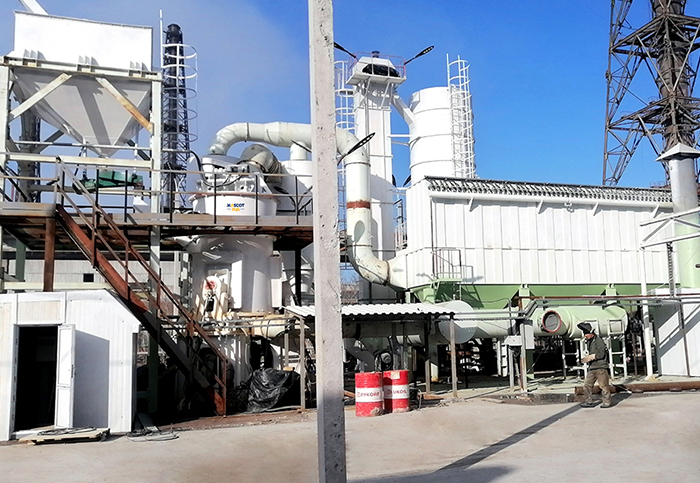
The production line of the vertical roller mill is a cost-effective and energy-efficient solution for processing powder, which is widely used in many industries, such as metallurgy, building materials, industrial solid waste treatment, thermal power plants, cement plants, and environmental protection fields. The primary purpose of this project is to finely grind raw materials through a vertical roller mill to meet the requirements of different industries for particle size, purity, and output of powder products.

The ball mill production line is a comprehensive production line that integrates material crushing, grinding, grading, and collection. This production line is mainly used to process various materials, including sand and gravel, cement, new building materials, silicates, refractory materials, fertilizers, ferrous metal beneficiation, non-ferrous metals, glass ceramics, etc.

The Raymond mill production line is a highly efficient system designed for grinding operations, with a focus on energy efficiency, durability, and productivity. It caters to the needs of users by offering fine powder products in non-metallic ores, coal powder, and slag processing, aiding enterprises in achieving sustainable growth.

The high-pressure grinding mill production line is a project specially designed for efficient grinding operations. It is widely used in metallurgy, building materials, the chemical industry, highways, water conservancy hydropower, and other industries. It is a suspended roller mill that uses springs to increase pressure. It can achieve efficient grinding processing of various non-metallic raw materials. It has high efficiency, stability, and environmental protection characteristics.

The MTW series European grinding mill production line includes high-efficiency crushers, elevators, electromagnetic vibration feeders, milling machines, classifiers, and collectors. These pieces of equipment work together to achieve efficient crushing, grinding, and classification of various non-metallic ores, coal powder, slag, and other materials. It can meet the diverse needs of various industries for powder particle size, uniformity, shape, etc., and offer enterprises high-quality grinding products.
Green and Intelligent Mining Machinery
Manufacturing and Export Base
Based on high quality and perfect after-sales service, our products have been
exported to more than 120 countries and regions.
Copyright © 2023 Zhengzhou Mascot Environmental Technology Co., Ltd Record number: Yu ICP No. 13021523-4





 WhatsApp