 25
25
 27
27
 23
23
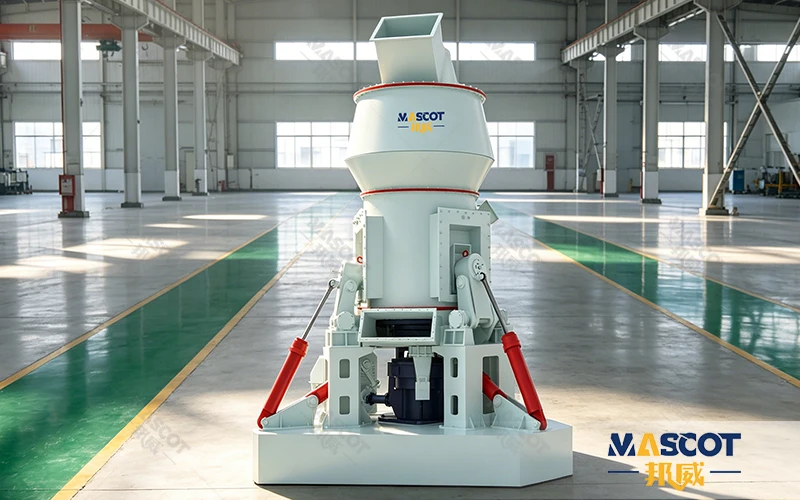
Every cement producer evaluating a vertical roller mill is handed the same headline: 30-50% less power than a ball mill. The number is real, but on its own it is not an ROI case — it is one input to one line of one calculation. A payback period is built from the power line, the drying line, the wear line and the availability line together, and it moves faster than most buyers expect when two of those four are stated in the wrong units. This article sets out how to build the calculation, what the machine actually contributes to it, and how to verify a supplier's claim before an order is placed.
In a cement plant, the grinding stage is where the electricity goes, and clinker is the hardest thing in the circuit. That single fact is what makes a vertical roller mill a payback conversation rather than a purchase conversation: material-bed compression grinding, in which a hydraulically loaded roller crushes a bed of material on a rotating table, uses 30-50% less power than a ball mill circuit for the same finished powder, with less over-grinding and a more uniform particle size distribution.
The commercial weight of that figure depends entirely on the plant it lands in. At a grinding station that imports clinker — a business model where every ton carries freight, handling and a purchased raw material before it is ground at all — the power line is the largest controllable item in the cost per ton, and it is the one a mill decision changes permanently. At a plant running a single production line with no excess demand, the same percentage saves proportionally less, because the tonnage moving through it is smaller.

The comparison is quoted per ton of finished powder, at matched fineness, against a ball mill circuit. Three qualifications have to be attached before it is used in a spreadsheet.
It is a range, not a point. The lower end and the upper end differ by a factor large enough to change a payback from comfortable to marginal, so the only usable version is a figure for your material and your product.
It is a circuit comparison. Ball mill grinding is usually quoted as a closed-circuit system, and a vertical mill integrates crushing, drying, grinding, classification and dust collection in one machine. If the comparison puts a mill-only figure on one side and a complete line on the other, the percentages stop being comparable. Both sides must be stated at the same boundary.
It has to survive the material. Clinker, gypsum and limestone are ground together in a cement plant, and the mix, the feed size and the target fineness all move the number. That is why the honest version of this figure arrives as kilowatt-hours per ton on your own clinker rather than as a percentage on a brochure — and why Mascot offers a lab grinding test that returns kWh/t and fineness data on the sample you send, as the basis of the quotation.

A payback period is not a property of a mill; it is a property of a project. Written out, the calculation has one dominant line and three that decide whether it holds:
Annual power saving = (kWh per ton on the existing circuit − kWh per ton on the vertical mill) × tons ground per year × your electricity tariff.
Everything that follows is about the four numbers inside that expression and the three adjustments around it.
The tonnage term is the one that gets over-estimated. A mill sized for a peak figure but operated at half of it does not halve its saving — it loses more than half, because a grinding line carries standing loads whatever the throughput. Size the model to the tonnage the plant will realistically run, then confirm it at the target fineness, since the capacity band of every model narrows as the powder gets finer.
The tariff term belongs to the plant, not to the supplier. Power price and annual operating hours are local facts, and a payback calculated on a supplier's assumed tariff is a marketing figure rather than a project figure.
The three adjustments around the power line are where a vertical mill earns more than the electricity it saves: the drying function, the wear structure, and availability. Each is treated in the sections below.
1. Utilisation and operating hours. The saving is per ton ground, so it scales with the tonnage actually produced. A mill running three shifts on a contracted product pays back on a completely different schedule from the same mill running one shift on spot orders.
2. Target fineness and the tonnage paired with it. Fineness and tonnage pull in opposite directions on any grinding machine, and a vertical mill is no exception: rated capacity is published as a band across the whole working range (SRM1300 at 10-35 t/h through to SRM2200 at 36-135 t/h), and the tonnage at 325 mesh is not the tonnage at 70 mesh. A payback built on the top of the t/h column and the finest grade in the order book is built on two numbers that do not occur together.
3. The moisture going in. This is the variable most often left out of a first-pass ROI. A vertical mill dries as it grinds, so a wetter feed is not a problem to be solved with separate equipment — it is a job the mill absorbs. The published working range is 4-15% input moisture against a final powder moisture of ≤1%, with a hot-air circuit running up to 350°C at the inlet and 70-95°C at the outlet. Feed well above that band should be drained or blended first, and the ROI should be calculated on the moisture profile the plant will actually receive, season by season.
4. The product mix. A mill that holds one grade earns one margin. A mill that can move its cut point on the classifier without stopping can hold additive powder, supplementary cementitious material and blended-cement recipes on the same machine — which raises the hours the plant can bill against the same capital.

Four features of an SRM vertical roller mill appear directly in the payback calculation rather than in the specification column.
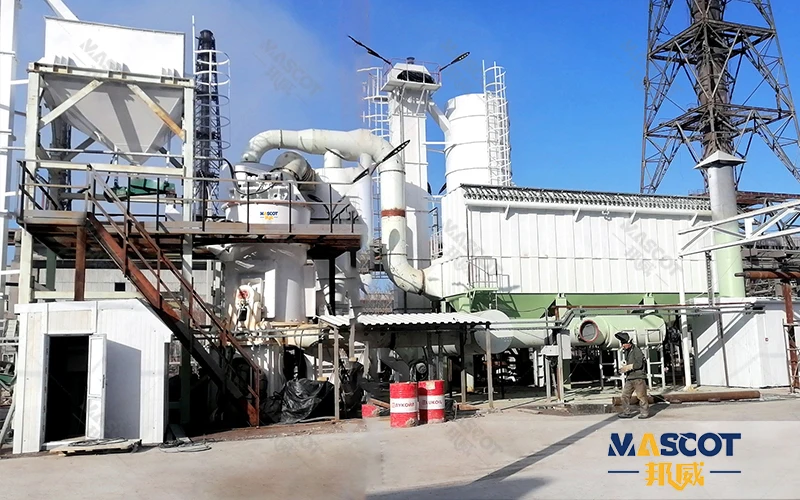
One machine instead of three. Crushing, drying, grinding and classification are integrated, so a project does not buy a separate dryer or an external classifier, and the civil and electrical works that would have served them disappear from the capital estimate. The standard packaged line Mascot publishes for this duty is rated 40-80 t/h with a 220-450 kW main motor and occupies 80-120 m² of floor space, running at 85 dB or less. The full circuit is visible in the reference installation at the 40 TPH vertical mill production line in Xinjiang, China, where jaw crusher, vertical roller mill, bucket elevator, vibrating feeder, classifier, cyclone collector, dust collector and blower are delivered as one matched set with PLC intelligent control.
Wear structured as segments, not assemblies. Rollers and table liners are high-chrome alloy built as modular segments, so a wearing-part change consumes the worn piece instead of a whole component, and the cost per ton of wear is a scheduled number rather than a shock. Automatic discharge of ungrindable metal — and slag and steel slag both carry scrap — is what keeps a potential breakdown out of the production plan.
Availability. Material-bed grinding avoids metal-to-metal contact, which is why wear stays low on abrasive feed; a stable, centred feed keeps vibration low and protects the hydraulic system. Every unplanned stop avoided is a cost per ton that never appears on the power bill at all.
Compliance without a renovation. The circuit runs under negative pressure with a bag filter at up to 99.9% dust removal efficiency, so the plant meets emission requirements on the same equipment it grinds with.

Five models carry the platform. All five publish the same fineness band and the same feed limit, so the model is chosen on tonnage and moisture rather than on feed size or product size.
| Model | Grinding Table Dia. (mm) | Max Feed Size (mm) | Discharge Size (μm / mesh) | Input Moisture | Final Moisture | Capacity (t/h) | Motor Power (kW) |
|---|---|---|---|---|---|---|---|
| SRM1300 | 1300 | ≤38 | 212-45 (µm) / 70-325 | 4-15% | ≤1% | 10-35 | 185-250 |
| SRM1500 | 1500 | ≤38 | 212-45 (µm) / 70-325 | 4-15% | ≤1% | 13-48 | 250-355 |
| SRM1700 | 1700 | ≤38 | 212-45 (µm) / 70-325 | 4-15% | ≤1% | 18-68 | 355-600 |
| SRM1900 | 1900 | ≤38 | 212-45 (µm) / 70-325 | 4-15% | ≤1% | 23-85 | 450-600 |
| SRM2200 | 2200 | ≤38 | 212-45 (µm) / 70-325 | 4-15% | ≤1% | 36-135 | 710-1000 |
Reading the table for a payback: the two rows that matter most are the capacity band and the moisture pair. Capacity is published across the whole working range, so the model has to be fixed on the fineness the plant sells, and the moisture rows tell you which feed the drying function can absorb without a pre-drying investment. Air conditions are published at ≤350°C in and 70-95°C out across the series.
The clearest published example of the model in use is a coastal cement grinding station in Lagos, Nigeria, which imports clinker and supplies cement additive powder, supplementary cementitious material and blended cement to the local concrete market. Its requirement was to intergrind clinker with gypsum and limestone filler in one mill, with fineness adjustable across the 70-325 mesh band and a stable output above 45 TPH at additive fineness (150-200 mesh).
Mascot supplied an SRM1700 vertical roller mill system with proportioning feeders for clinker, gypsum and limestone and a high-efficiency classifier for the additive and SCM grades. Three results were reported by the plant.
Drying inside the mill. The clinker-gypsum-limestone mix, carrying up to 8% moisture mainly from the gypsum, was dried to ≤1% during grinding, so no separate drying stage was needed and the additive powder stayed dry and free-flowing.
Specific power. Measured against a ball mill finish-grinding line of the same output, the specific power of the installation is about 40% lower — the item that shortens the payback of an imported-clinker business model, where the raw material has already been paid for before it reaches the mill.
Product flexibility. The complete layout was supplied with installation supervision and operator training covering recipe changeover between cement additive, SCM and blended cement, and the plant's own summary of the outcome was that one mill now produces three products, with grade switches taking minutes and the power saving showing directly in the landed cost.
The following six questions convert a percentage into a project number. Any supplier with a genuine case will answer all six.
1. What is the kWh/t figure, and on which material? Ask for it on your clinker, from a grinding test, not from a table. Mascot provides kWh/t and fineness data from a lab grinding test of the customer's own sample as the basis of the quotation.
2. What boundary does the comparison use? Vertical mill line against ball mill line, or mill against mill. The two answers are not comparable, and the difference is exactly the drying and classification equipment the vertical mill integrates.
3. At what tonnage and what fineness was that figure measured? One number without the other two is not evidence.
4. What moisture profile was assumed? The published working range is 4-15% input against a final ≤1%; if the plant sees wetter feed at any point in the year, the assumption needs to be written down.
5. What is the wear cost per ton, and how is it consumed? Modular high-chrome roller and table-liner segments mean the replacement unit is a segment; the rate at which those segments are consumed on your material is the second-largest controllable line after power.
6. Who is accountable for throughput and fineness after commissioning? A matched set — mill, classifier, hot-air circuit and dust collector sized together and delivered by one supplier, with layout design, installation and commissioning guidance, operator training, a 12-month warranty on the machine and on core components such as rollers, table liners and classifiers, and spare parts held as standard stock — is what keeps the payback from being renegotiated in year one. Stock models ship in 7-10 days and customized production in 15-30 days.
One more comparison is worth making before the model is fixed: the same platform is used for slag and steel slag at S95 fineness, which is covered in the vertical roller mill or ball mill comparison for cement and slag, and the platform's wider advantages are summarised in the site's overview of the SRM vertical roller mill.
Q1: What payback period should I expect from a vertical roller mill in a cement plant?
A: It depends on four local numbers — the kWh/t difference on your material, the tons you actually grind per year, your electricity tariff, and how much of the drying and handling equipment the mill replaces. Build the annual saving as (kWh/t saved × annual tons × tariff) and add the capital and fuel avoided on drying; the answer for a grinding station importing clinker is structurally better than for a plant with spare capacity, because more of its cost per ton is power and purchased material.
Q2: Is the 30-50% power saving guaranteed?
A: It is a published range for material-bed grinding against ball mill circuits, per ton of finished powder and at matched fineness. The guaranteed version of the number is a kWh/t figure measured on your own clinker in a lab grinding test, and that is the figure Mascot uses as the basis of a quotation.
Q3: Do I still need a separate dryer for wet clinker or gypsum?
A: No. Grinding and drying happen in the same hot-air circuit, with a published working range of 4-15% input moisture and a final powder moisture of ≤1%; in the Nigerian case a mix carrying up to 8% moisture, mainly from gypsum, was dried to ≤1% inside the mill. Feed well above the published band should be drained or blended first so throughput stays steady.
Q4: Which model fits a 25-30 t/h clinker additive line?
A: The SRM1700, published at 18-68 t/h across the 70-325 mesh band, covers that range at typical additive fineness; the final choice is confirmed by a grinding test of your clinker. The smallest model, the SRM1300, starts at 10-35 t/h and the range runs to the SRM2200 at 36-135 t/h.
Q5: Can one mill produce additive powder, SCM and blended cement?
A: Yes. Clinker, gypsum and limestone are proportioned and interground by recipe, and the dynamic classifier changes fineness while the mill runs, so one installation can hold additive powder at 150-200 mesh and finer SCM grades, or Portland-slag mixes, without a separate mill for each product.
Q6: How is wear handled on abrasive clinker and slag?
A: Rollers and table liners are high-chrome alloy in modular segments, so only the worn piece is replaced, and ungrindable metal that reaches the grinding bed is discharged automatically rather than forced through — which is what keeps a potential breakdown out of the production plan.
A vertical roller mill's ROI in a cement plant is decided by the power line, because clinker grinding is where the plant's electricity goes — but the payback itself is a project number, not a mill number. Build it as (kWh/t on the existing circuit minus kWh/t on the vertical mill) × annual tons × tariff, then add the capital and fuel that the integrated drying stage removes, the wear cost per ton of modular high-chrome roller and table-liner segments, and the tonnage that is not lost to unplanned stops. Check every input at the same boundary, at the fineness and tonnage the plant will actually sell, and with the moisture profile it will actually receive. The published SRM range is five models from 10 t/h to 135 t/h across 212-45 µm (70-325 mesh), accepting feed up to 38 mm and 4-15% moisture in one pass, and the reference installation of SRM vertical roller mills at a Nigerian grinding station reduced specific power by about 40% against a ball mill finish-grinding line of the same output while running three products from one machine. Send your clinker, your target fineness and your annual tonnage, and the mill can be quoted on a measured kWh/t figure rather than on a percentage.

About of Mascot
Zhengzhou Mascot Industry is a high-tech mining equipment company integrating R&D, manufacturing, sales, and after-sales service. Focusing on crushing, grinding, and mineral processing equipment, we provide professional solutions to our customers. We are ISO9001:2015 certified, and our products include mobile crushing plants, crawler crushing plant, construction waste crushing plants, jaw crushers, sand making machines, cone crushers, fine crushers, grinding mills, ball mills, etc., all with reliable performance to meet diverse project needs.
• Professional pre-sales support: Free project design and comprehensive solutions to help you accurately select the right equipment;
• Comprehensive on-site service: Providing installation guidance and worker training to ensure smooth equipment commissioning;
• Reliable after-sales guarantee: A complete after-sales system, timely response to technical inquiries and equipment maintenance, ensuring long-term stable operation.
To protect your rights, please contact us through the following official channels for professional service:
WhatsApp: 0086-16650273865
Email: mascot@mascotenv.com
We are committed to providing high-quality equipment and full-cycle services to deliver comprehensive intelligent solutions for the global mining industry!

YGMX Enhanced High-Pressure Mill is a new type of high-performance grinding equipment, and the biggest improvement of this milling equipment lies in the increase of the high-pressure spring system in the grinding roller part. Compared with the traditional high-pressure roller mill, it has a wider scope of application and excellent performance to meet the production needs of a variety of powder fineness. It is widely used in non-metallic minerals, chemicals, building materials, metallurgy, environmental protection, etc. Multiple areas.

The ball mill production line is a comprehensive production line that integrates material crushing, grinding, grading, and collection. This production line is mainly used to process various materials, including sand and gravel, cement, new building materials, silicates, refractory materials, fertilizers, ferrous metal beneficiation, non-ferrous metals, glass ceramics, etc.

The high-pressure grinding mill production line is a project specially designed for efficient grinding operations. It is widely used in metallurgy, building materials, the chemical industry, highways, water conservancy hydropower, and other industries. It is a suspended roller mill that uses springs to increase pressure. It can achieve efficient grinding processing of various non-metallic raw materials. It has high efficiency, stability, and environmental protection characteristics.

The MTW series European grinding mill production line includes high-efficiency crushers, elevators, electromagnetic vibration feeders, milling machines, classifiers, and collectors. These pieces of equipment work together to achieve efficient crushing, grinding, and classification of various non-metallic ores, coal powder, slag, and other materials. It can meet the diverse needs of various industries for powder particle size, uniformity, shape, etc., and offer enterprises high-quality grinding products.

The gypsum grinding production line is an efficient, stable, and environmentally friendly production solution, which is widely used in construction, decoration, the chemical industry, and other fields. In addition, the grinding process is particularly critical, which directly affects the quality and particle size of the final product. With the continuous development of science and technology, the technical level and production efficiency of gypsum grinding production lines will be further improved, providing strong support for the development of the gypsum processing industry.
Green and Intelligent Mining Machinery
Manufacturing and Export Base
Based on high quality and perfect after-sales service, our products have been
exported to more than 120 countries and regions.
Copyright © 2023 Zhengzhou Mascot Environmental Technology Co., Ltd Record number: Yu ICP No. 13021523-4





 WhatsApp