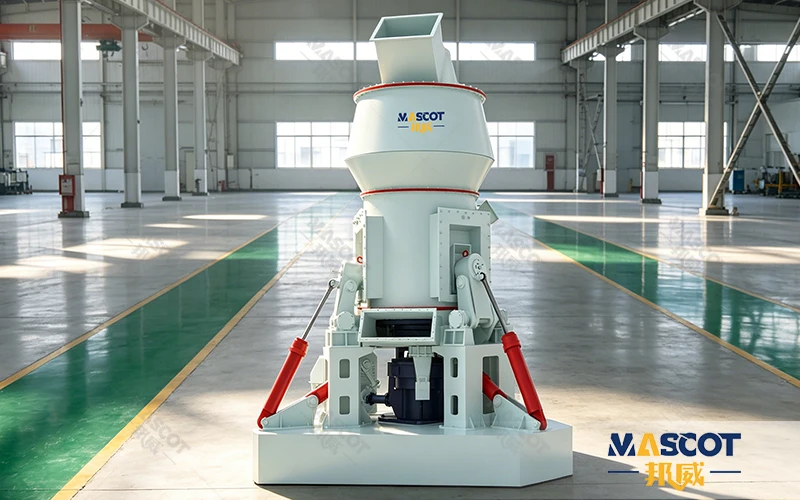
Cement and slag are the two duties where the vertical roller mill and the ball mill are most often put side by side in a quotation, and they are also the two duties where the wrong choice is hardest to correct afterwards. The two machines break rock by different mechanisms, they dry material differently, they quote fineness in different units, and they put the maintenance burden in different places. Using the published specifications of the Vertical Roller Mill and the Cement Ball Mill, this article sets out what actually differs, what the published numbers do and do not include, and how to decide between them on a clinker or slag duty.
A ball mill grinds by impact and abrasion. The cylinder lifts a steel ball charge, the charge cascades, and the clinker is progressively broken between balls and between balls and the shell liners. Because the work is done by individual contacts, the energy has to be carried into every collision whether or not that collision lands on a particle, and the finished powder leaves the mill as one stream that a separator then has to sort.
A vertical roller mill grinds on a material bed. Material is fed to the centre of a rotating grinding table, centrifugal force carries it outwards under hydraulically pressurised rollers, and the particles are crushed against each other in the bed rather than against loose media. A dynamic classifier then separates the finished powder from the coarse particles, which fall back to the table for regrinding; hard, ungrindable material is discharged automatically to protect the system. That single difference in principle is what produces every other difference in the comparison that follows.
The published position is straightforward: because a vertical roller mill uses the material bed grinding principle rather than loose media, it consumes 30-50% less energy than a ball mill. That is the headline number, and on a cement or slag duty, where electricity is the largest recurring cost, it is the number that usually decides the purchase.
It is also the number most often compared unfairly, in both directions. The honest way to read it is to check what each figure includes. On the vertical mill side, the installed power is not only the mill motor: the hot-air circuit, the classifier drive and the system fan all draw power, and they are doing work that on a ball mill circuit is either absent or done by separate equipment. On the ball mill side, the mill itself is only part of the circuit — as a published benchmark, a closed-circuit ball mill system typically consumes 25-32 kWh per ton of OPC at 350 m²/kg depending on clinker grindability, feed moisture and target fineness, and that figure is quoted for the closed-circuit system rather than for the mill alone. A comparison of motor nameplates between the two technologies is therefore not a comparison of cost per ton.
The practical instruction is to ask each supplier for the same thing: kilowatt-hours per ton of finished powder at your target fineness, on your material, with the whole system boundary declared. Everything in this section is an explanation of why that request works and a nameplate comparison does not.

Grinding generates heat, and both machines have to manage it, but only one of them is designed to use it.
On a vertical roller mill, hot air flows through the grinding bed, drying the material and lifting the fine powder upwards in the same pass. The published feature specification puts the moisture tolerance of the hot-air system at up to 15-20%, while the per-model tables list a working input-moisture range of 4-15% with a final product moisture of ≤1%. Air enters the system at up to 350 °C and leaves it at 70-95 °C, which is the temperature budget the drying is calculated against.
On a ball mill, the feed has to be dry before it goes in: a cement mill circuit manages temperature with a water-spray system at the inlet and outlet and adjustable ventilation, holding the material below 110 °C to protect gypsum dehydration, liner life and cement quality. That is a temperature-control system, not a drying system, and it works in the opposite direction.
So the moisture question is usually decisive rather than marginal. A plant grinding dry clinker can use either technology and should decide on energy and cost per ton. A plant dealing with granulated slag that arrives damp, or with a rainy-season feedstock, is comparing a machine that dries while it grinds against a circuit that needs a separate dryer upstream and its own fuel bill. In that case the vertical mill is not simply more efficient; it removes a piece of equipment from the flow sheet.

This is a trap worth naming explicitly, because it causes more wasted comparison work than any technical point on this page.
The vertical roller mill specification describes product size as a particle size cut: 212-45 µm, published as 70-325 mesh, and adjusted through the classifier while the mill runs. The ball mill specification describes cement fineness as surface area: 280-450 m²/kg Blaine, set by separator speed, ball charge and diaphragm setting.
These are not two ways of quoting the same measurement. Mesh and micron describe how large the particles are; Blaine describes how much surface the powder presents per unit mass, which is the number that correlates with early strength. A plant that buys a mill against one metric and commissions it against the other will be renegotiating the specification during commissioning.
The resolution is procedural rather than technical: decide which metric your customers and your local cement standard actually enforce, and ask the mill supplier to confirm the model against that metric on your material. Where a slag duty is sold on its own specification rather than as a cement constituent, the mesh-and-micron vocabulary of the vertical mill table is usually the one the buyer already uses.

The SRM series covers five models from 10 t/h to 135 t/h, all accepting feed up to 38 mm and all publishing the same discharge band, so the choice between them is a capacity and drive-power decision rather than a fineness one.
| Model | Max Feeding Size (mm) | Discharge Size (µm) | Discharge Size (mesh) | Air-in Temp (°C) | Air-out Temp (°C) | Input Moisture | Final Moisture | Capacity (t/h) | Motor Power (kW) |
|---|---|---|---|---|---|---|---|---|---|
| SRM1300 | ≤38 | 212-45 | 70-325 | ≤350 | 70-95 | 4-15% | ≤1% | 10-35 | 185-250 |
| SRM1500 | ≤38 | 212-45 | 70-325 | ≤350 | 70-95 | 4-15% | ≤1% | 13-48 | 250-355 |
| SRM1700 | ≤38 | 212-45 | 70-325 | ≤350 | 70-95 | 4-15% | ≤1% | 18-68 | 355-600 |
| SRM1900 | ≤38 | 212-45 | 70-325 | ≤350 | 70-95 | 4-15% | ≤1% | 23-85 | 450-600 |
| SRM2200 | ≤38 | 212-45 | 70-325 | ≤350 | 70-95 | 4-15% | ≤1% | 36-135 | 710-1000 |
Set out on the points that decide a cement or slag project, the two technologies read as follows. The table is deliberately built around the questions a buyer asks in the last meeting before signing, not around a feature list.
| Decision Point | Vertical Roller Mill | Ball Mill |
|---|---|---|
| Grinding mechanism | Material bed between hydraulically pressurised rollers and a rotating table | Impact and abrasion from a cascading steel ball charge |
| Energy per ton | Published at 30-50% less than a ball mill on the material bed principle | Closed-circuit benchmark of 25-32 kWh/t of OPC at 350 m²/kg, separator and fans included |
| Damp feed | Ground and dried in one pass; hot air system, final moisture ≤1% | Requires dry feed; mill temperature controlled by water spray and ventilation, below 110 °C |
| Fineness metric | Particle size cut: 212-45 µm (70-325 mesh), set by classifier | Surface area: 280-450 m²/kg Blaine, set by separator, charge and diaphragm |
| Capacity band | 10-135 t/h across five models, feed up to 38 mm | 1.6-210 t/h across the published series, two-chamber design |
| Fineness change | Adjusted through classifier speed while the mill runs | Adjusted through separator speed, ball charge and diaphragm setting |
| Layout and building | Vertical integrated structure: less floor area, fewer auxiliary machines | Horizontal cylinder and drive train, with the separator and dust circuit alongside |
| Wear parts | Wear-resistant rollers and table discs, modular design for part replacement | High-chrome liners at 8,000-12,000 operating hours, plus the grinding ball charge |
| Where it usually wins | Damp or high-moisture slag, combined drying, tight plot, rising electricity cost | Very high tonnage on dry clinker, sharp finish on a Blaine specification, mixed duties on one mill |
Two entries in that table deserve a second reading. The first is the maintenance structure. A ball mill consumes grinding balls continuously and relines the shell periodically; a vertical mill consumes rollers and table discs and is built to have them replaced individually. Both are consumable costs, but they behave differently against a budget: one is a steady feed, the other is a scheduled event. The second is layout. The vertical arrangement is often the reason a plant with an existing building and no spare footprint ends up on a roller mill at all, before energy per ton enters the discussion.
The evidence for the ball mill side of this comparison is well documented. A regional building-materials group serving the Moscow construction market runs two MQG2400×7000 closed-circuit cement ball mills with high-efficiency dynamic separators, water-spray temperature control and full PLC automation, producing CEM I 42.5N and CEM II/A-S 42.5N at 380 m²/kg Blaine from OPC clinker at roughly Mohs 6.5 together with granulated blast-furnace slag, at a feed size of 25 mm and below.

Each mill delivers 22-25 t/h of CEM I 42.5N at that fineness with a D97 pass rate above 96%, and closed-circuit operation with the dynamic separator cut specific power consumption by 18% against the customer's former open-circuit line — roughly 6 kWh saved per ton of cement, with the energy saving alone paying back the upgrade within 14 months. That is what a well-specified ball mill circuit looks like on a mixed clinker-and-slag duty, and it is the benchmark a vertical mill proposal has to beat on your tonnage, not on a datasheet.
On the vertical mill side, a documented reference installation is the 40 TPH Vertical Mill Production Line In Xinjiang, China, where raw material is finely ground to meet the particle size, purity and output requirements of the downstream product. Read the two case pages together rather than either one alone: they are the same duty answered by two different mechanisms, and the useful question is which set of numbers resembles your own site.
Work through these six questions in order and the technology usually selects itself:
1. Is the feed dry? If the slag or the raw material arrives damp and a separate dryer would be needed, the vertical mill's combined grinding and drying pass is normally the cheaper answer.
2. Is the product specified in Blaine or in mesh and microns? Cement sold to a local standard is specified in Blaine, and a ball mill circuit quotes directly against that number; a slag product sold on its own grade is usually specified in mesh or microns, which is what the vertical mill table publishes.
3. What is the required tonnage? Below roughly the 10 t/h floor of the vertical mill range, or above the 135 t/h top of it, the ball mill series covers ground the roller mill does not: 1.6 t/h to 210 t/h.
4. How many grades will the mill make, and how often will it change? If grades change during a shift, the classifier adjustment the vertical mill performs while running is worth more than a small difference in energy per ton. If the mill runs one grade continuously, it is worth less.
5. What is the plot and the building? A vertical mill is a smaller footprint and fewer auxiliary machines; a ball mill circuit needs the horizontal length, the drive train and the space around the separator and dust collection.
6. Then compare cost per ton, with both boundaries declared. Only at this point does the energy comparison become meaningful, and only if the vertical mill figure includes its fan and hot-air circuit and the ball mill figure includes its separator circuit.

Q1: Is a vertical roller mill always cheaper to run than a ball mill?
A: The published figure for the SRM series is 30-50% less energy than a ball mill, based on the material bed grinding principle. Whether that converts into a lower cost per ton on your site depends on what each number includes: the vertical mill's figure has to carry its fan, classifier and hot-air circuit, and the ball mill's has to carry its separator and fans. Ask both suppliers for kWh per ton at your target fineness on your material, with the system boundary stated, and compare those.
Q2: Which one handles slag better?
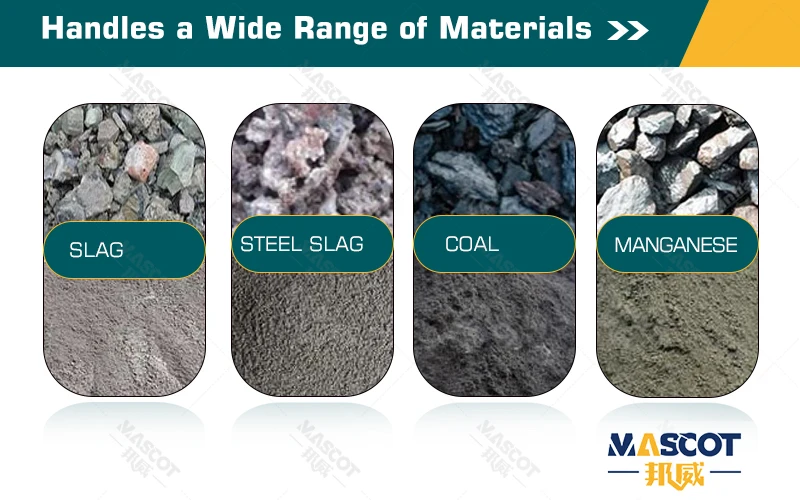
A: Both series handle granulated slag — it is a listed material for both the vertical mill and the cement ball mill series. The difference is moisture and drying. A vertical mill dries and grinds in the same pass, with hot air entering at up to 350 °C and product moisture specified at ≤1%; a ball mill circuit manages mill temperature with water spray and ventilation and needs the feed dry beforehand. Where damp slag would otherwise require a separate dryer, that is usually the deciding factor.
Q3: Can a vertical mill hit a cement Blaine specification?
A: The two series publish fineness in different vocabularies, and that is the point to settle first. The vertical roller mill publishes a particle size cut of 212-45 µm (70-325 mesh); the cement ball mill publishes 280-450 m²/kg Blaine. Blaine is a surface-area metric that correlates with early strength, so a plant selling cement to a local standard should confirm the model against that metric on its own material rather than translating one figure into the other by rule of thumb.
Q4: What tonnage does each cover?
A: The SRM vertical roller mill runs 10-135 t/h across five models, all accepting feed up to 38 mm and all publishing the same 212-45 µm discharge band, so within the series the choice is capacity and drive power. The cement ball mill series covers 1.6-210 t/h, with ball loads from 5 t to 278 t depending on model, so it extends both below and above the roller mill range.
Q5: How do I find out which is right for my material?
A: Send the material, the required tonnage and the fineness specification your customer enforces, and have both options quoted on the same three numbers. A vertical mill and a ball mill can also be combined in one flow sheet — roller mill for the drying-sensitive or high-volume stream, ball mill for the blended cement or the mixed-duty service — so the question is not always which one to exclude.
The vertical roller mill and the ball mill differ first in mechanism and then in everything else. A material bed crushed between rollers and a table produces the published 30-50% energy advantage and lets the same pass dry the feed, with hot air entering at up to 350 °C and product moisture specified at ≤1%. A cascading ball charge produces the closed-circuit benchmark of 25-32 kWh per ton of OPC at 350 m²/kg, the widest capacity band at 1.6-210 t/h, and the Blaine figures that cement standards are written in.
Decide on four things before comparing price: whether the feed is dry, whether the product is specified in Blaine or in mesh, how much tonnage you need, and how often the grade changes. The Vertical Roller Mill covers 10-135 t/h with combined grinding and drying and classifier adjustment while running; the Cement Ball Mill covers 1.6-210 t/h with the two-chamber circuit and Blaine control that cement plants commission against. Send your material, tonnage and the fineness metric your customer enforces, and both options can be quoted against the same three numbers.

About of Mascot
Zhengzhou Mascot Industry is a high-tech mining equipment company integrating R&D, manufacturing, sales, and after-sales service. Focusing on crushing, grinding, and mineral processing equipment, we provide professional solutions to our customers. We are ISO9001:2015 certified, and our products include mobile crushing plants, crawler crushing plant, construction waste crushing plants, jaw crushers, sand making machines, cone crushers, fine crushers, grinding mills, ball mills, etc., all with reliable performance to meet diverse project needs.
• Professional pre-sales support: Free project design and comprehensive solutions to help you accurately select the right equipment;
• Comprehensive on-site service: Providing installation guidance and worker training to ensure smooth equipment commissioning;
• Reliable after-sales guarantee: A complete after-sales system, timely response to technical inquiries and equipment maintenance, ensuring long-term stable operation.
To protect your rights, please contact us through the following official channels for professional service:
WhatsApp: 0086-16650273865
Email: mascot@mascotenv.com
We are committed to providing high-quality equipment and full-cycle services to deliver comprehensive intelligent solutions for the global mining industry!

The gypsum grinding production line is an efficient, stable, and environmentally friendly production solution, which is widely used in construction, decoration, the chemical industry, and other fields. In addition, the grinding process is particularly critical, which directly affects the quality and particle size of the final product. With the continuous development of science and technology, the technical level and production efficiency of gypsum grinding production lines will be further improved, providing strong support for the development of the gypsum processing industry.

This production line utilizes a three-ring medium-speed micro-grinding mill as the central equipment, complemented by other auxiliary equipment like hammer crushers, bucket elevators, and storage silos to establish a comprehensive grinding operation system. It has demonstrated strong potential for application and market competitiveness in industries such as construction, chemical industry, and new materials.

YGMX Enhanced High-Pressure Mill is a new type of high-performance grinding equipment, and the biggest improvement of this milling equipment lies in the increase of the high-pressure spring system in the grinding roller part. Compared with the traditional high-pressure roller mill, it has a wider scope of application and excellent performance to meet the production needs of a variety of powder fineness. It is widely used in non-metallic minerals, chemicals, building materials, metallurgy, environmental protection, etc. Multiple areas.

The high-pressure grinding mill production line is a project specially designed for efficient grinding operations. It is widely used in metallurgy, building materials, the chemical industry, highways, water conservancy hydropower, and other industries. It is a suspended roller mill that uses springs to increase pressure. It can achieve efficient grinding processing of various non-metallic raw materials. It has high efficiency, stability, and environmental protection characteristics.

The ball mill production line is a comprehensive production line that integrates material crushing, grinding, grading, and collection. This production line is mainly used to process various materials, including sand and gravel, cement, new building materials, silicates, refractory materials, fertilizers, ferrous metal beneficiation, non-ferrous metals, glass ceramics, etc.
Green and Intelligent Mining Machinery
Manufacturing and Export Base
Based on high quality and perfect after-sales service, our products have been
exported to more than 120 countries and regions.
Copyright © 2023 Zhengzhou Mascot Environmental Technology Co., Ltd Record number: Yu ICP No. 13021523-4





 WhatsApp