 27
27
 25
25
 27
27

| Product Focus | YGM High Pressure Grinding Mill |
|---|---|
| Competitors Analyzed | Traditional Raymond Mill (R-Series), Ball Mill, Vertical Roller Mill (VRM), Conventional High-Pressure Mill |
| Comparison Dimensions | Grinding force, capacity, energy consumption, investment cost, fineness control, maintenance, installation time, material compatibility |
| YGM Model Range | YGM65 / YGM75 / YGM85 / YGM85B / YGM95 / YGM130 / YGM160 / YGM190 (0.4-36 t/h) |
| Brand | Mascot Heavy Industry |
| Certification | ISO 9001:2015 |
| Note: All comparison data based on processing limestone (Mohs 3-4) at 200 mesh under standard operating conditions. Actual performance varies by material properties and site conditions. | |
1. Executive Summary: Where YGM Stands in the Grinding Mill Landscape
The global grinding mill market, valued at approximately USD 15.8 billion in 2026, presents buyers with a diverse range of technologies — from traditional Raymond mills and ball mills to modern vertical roller mills (VRMs) and high-pressure grinding systems. For non-metallic mineral processing operations targeting 30-425 mesh output at 0.4 to 36 t/h, the YGM High Pressure Grinding Mill series occupies a strategically distinct position: it delivers high-pressure grinding performance typically associated with premium equipment at a price point accessible to mid-market buyers in developing economies.
This analysis compares the YGM series against its four primary competitor categories across eight operational and commercial dimensions. The findings demonstrate that the YGM series holds measurable advantages in grinding force (40-60% higher than traditional Raymond mills at equivalent power), energy efficiency (25-30% lower consumption than open-circuit systems), and total cost of ownership (30-50% lower investment than comparable VRM installations) — while acknowledging the specific application scenarios where alternative technologies remain more suitable.

2. YGM vs Traditional Raymond Mill (R-Series): The Core Upgrade
The most direct competitive comparison is between the YGM series and traditional Raymond mills (R-series: 3R, 4R, 5R, 6R). The YGM series is built on Raymond mill architecture but incorporates a defining technological upgrade: a high-pressure spring loading system that fundamentally alters the grinding performance equation.
2.1 The Grinding Force Differential
The critical distinction lies in the grinding mechanism. A traditional Raymond mill relies on centrifugal force generated by the rotation of the main shaft to press grinding rollers against the grinding ring. In contrast, the YGM series adds a high-pressure spring assembly at each roller mounting point, applying an additional 800-1500kg of static pressure independent of rotational speed. This dual-force system —centrifugal force plus spring pressure —increases total grinding force on the material bed by approximately 40-60% compared to a traditional Raymond mill at equivalent motor power.
| Comparison Parameter | Traditional Raymond Mill (R-Series) | YGM High Pressure Grinding Mill | YGM Advantage |
|---|---|---|---|
| Grinding Force Mechanism | Centrifugal force only | Centrifugal force + 800-1500kg spring pressure | 40-60% higher total grinding force |
| Capacity at Equivalent Power | Baseline | 20-35% higher | Higher throughput without larger motor |
| Energy per Ton of Output | Baseline | 15-25% lower | Reduced operating cost per ton |
| Wear-Part Service Life | 4-8 months (standard materials) | 6-12 months (same materials) | 50% longer wear-part life |
| Fineness Range | 80-400 mesh (0.18-0.038mm) | 30-425 mesh (0.613-0.033mm) | Wider range; finer output ceiling |
| Vibration Control | Moderate; increases with wear | Reduced; spring system dampens vibration | Smoother operation; less structural stress |
| Noise Level | Higher at equivalent throughput | 5-8 dB lower | Improved workplace conditions |
Table 1: Head-to-head comparison between traditional Raymond mill (R-series) and YGM High Pressure Grinding Mill. Data based on processing limestone at 200 mesh.
2.2 Why the Spring System Matters: A Practical Example
Consider a mid-scale calcite powder producer targeting 4 t/h at 200 mesh. A traditional 4R Raymond mill with a 45kW motor might deliver 3.0-3.5 t/h under optimal conditions. The equivalent YGM95 —also 4 rollers, 45kW motor —achieves 3.5-5.6 t/h under identical conditions. The 20-35% capacity gain comes entirely from the high-pressure spring system converting motor power into grinding work more efficiently. Over a 300-day operating year at 8 hours per day, this difference translates to approximately 1,200-5,000 additional tons of finished product from the same power consumption —representing pure margin improvement.
The spring system also extends wear-part life. Because grinding is accomplished with a higher proportion of pressure-based crushing (rather than friction-dependent grinding), the rollers and ring experience less abrasive wear per ton of output. Under standard limestone processing conditions, YGM wear components typically achieve 6-12 months of service life versus 4-8 months on traditional Raymond mills of equivalent capacity.

2.3 When the Traditional Raymond Mill Remains a Valid Choice
The traditional Raymond mill is not obsolete. It remains a cost-effective option for operations where:
For all other non-metallic mineral processing scenarios, the YGM series represents a demonstrably superior platform with a payback period that typically justifies the incremental investment within 12-18 months.
3. YGM vs Ball Mill: Energy, Contamination, and Maintenance
Ball mills have been the workhorse of mineral grinding for over a century, but their dominance in the non-metallic mineral powder segment has steadily eroded as high-pressure grinding technologies mature. The comparison between YGM and ball mills is not about raw throughput —large ball mills can process hundreds of tons per hour —but about suitability, efficiency, and product quality for the 30-425 mesh fine powder market.
3.1 Grinding Mechanism and Energy Efficiency
A ball mill grinds material through impact and attrition: steel balls cascade within a rotating drum, crushing material through repeated collision. While effective, this mechanism is inherently energy-inefficient for fine grinding. Studies indicate that only 1-5% of the total energy input in a ball mill actually accomplishes particle size reduction; the remainder is dissipated as heat, sound, and friction between balls and mill lining. The YGM series, by employing direct pressure-based grinding through roller-on-ring contact, directs a much higher proportion of input energy into productive grinding work.
| Comparison Parameter | Ball Mill | YGM High Pressure Grinding Mill | Practical Implication |
|---|---|---|---|
| Grinding Mechanism | Impact + attrition (steel balls) | Pressure + shear (rollers on ring) | YGM: more directed energy transfer |
| Specific Energy Consumption | 30-50 kWh/t (200 mesh limestone) | 18-30 kWh/t (200 mesh limestone) | YGM: approximately 35-40% less energy per ton |
| Metal Contamination Risk | Moderate to high (ball/liner wear) | Low (roller/ring contact; minimal metal-on-metal) | YGM: cleaner product for purity-sensitive applications |
| Particle Size Distribution | Wide; requires classification circuit | Narrower; integrated classifier controls cut point | YGM: more uniform product with fewer oversized particles |
| Noise Level | 95-105 dB (high-impact cascading) | 75-85 dB | YGM: 15-20 dB quieter; better workplace compliance |
| Maintenance Frequency | Ball replenishment weekly; liner replacement annually | Roller/ring replacement every 6-12 months | YGM: fewer maintenance interventions; no consumable media |
| Installation Complexity | Heavy foundation; precision alignment | Modular; standard foundation | YGM: shorter installation; lower civil works cost |
Table 2: YGM High Pressure Grinding Mill vs Ball Mill comparison. Energy data based on processing limestone at 200 mesh fineness.
3.2 The Metal Contamination Factor
For applications where product purity is critical —such as food-grade calcium carbonate, pharmaceutical fillers, and high-end paint pigments —the metal contamination introduced by ball mill grinding media is a significant quality concern. Steel balls and mill liners wear continuously, introducing iron particles into the product stream. While magnetic separation can remove some contamination, it adds process complexity and cost. The YGM series, by design, operates with rollers pressing material against a grinding ring; the wear mechanism generates far less metallic contamination, and the wear particles are predominantly from the material itself rather than from grinding media.
3.3 Particle Size Distribution Control
Ball mills produce a relatively wide particle size distribution, which necessitates downstream air classification to achieve a narrow product specification. The YGM series integrates a high-efficiency classifier (analyzer) directly into the mill housing, enabling real-time adjustment of the cut point without additional equipment. This integrated design reduces system complexity, capital cost, and operational footprint.
3.4 When a Ball Mill Remains the Better Choice
Ball mills maintain clear superiority in several scenarios:

4. YGM vs Vertical Roller Mill (VRM): The Investment-Capacity Trade-Off
Vertical roller mills represent the premium tier of dry grinding technology. Employing large grinding rollers pressing against a rotating table, VRMs offer high throughput, excellent energy efficiency, and the ability to simultaneously grind and dry materials with moisture content up to 20%. However, these advantages come at a substantial capital cost premium that places VRMs beyond the reach of many mid-market grinding operations, particularly in developing economies.
4.1 Capital Investment Comparison
The investment differential between a YGM system and a comparable VRM installation is the single most significant factor in the competitive analysis. A complete YGM130 system (including mill main body, classifier, blower, cyclone collector, dust collector, bucket elevator, vibrating feeder, and PLC control) typically represents a capital investment 30-50% below that of a VRM with equivalent throughput capacity. For small-to-medium enterprises entering the grinding business or expanding existing operations, this capital efficiency is often the decisive factor.
| Comparison Parameter | Vertical Roller Mill (VRM) | YGM High Pressure Grinding Mill | Decision Guidance |
|---|---|---|---|
| Capital Investment (Relative) | 100% (baseline) | 50-70% of VRM investment | YGM: significantly lower upfront cost |
| Typical Capacity Range | 5-300+ t/h | 0.4-36 t/h | VRM: essential above 36 t/h from single unit |
| Installation Timeline | 45-60 days (excluding civil works) | 20-30 days (excluding foundation) | YGM: 2-3x faster deployment |
| Feed Moisture Tolerance | Up to 15-20% (integrated drying) | Up to 6% (pre-drying required above 6%) | VRM: clear advantage for wet feed materials |
| Material Hardness Limit | Mohs 7-8 (some models handle harder) | Mohs 7 | VRM: marginal advantage for very hard materials |
| Energy Efficiency (kWh/t) | 12-20 kWh/t (200 mesh limestone) | 18-30 kWh/t (200 mesh limestone) | VRM: 30-40% more energy-efficient at scale |
| Maintenance Complexity | High; hydraulic systems; specialized technicians | Moderate; mechanical spring system; standard skills | YGM: simpler maintenance; lower skill threshold |
| Payback Period (Typical) | 3-5 years | 12-24 months | YGM: faster investment recovery |
Table 3: YGM High Pressure Grinding Mill vs Vertical Roller Mill comparison. Investment figures are relative and vary by configuration, region, and supplier.
4.2 Maintenance and Operational Skill Requirements
VRMs incorporate sophisticated hydraulic systems for roller pressure adjustment, complex lubrication circuits, and precision alignment requirements that demand specialized maintenance skills. In markets where skilled grinding mill technicians are scarce —a common constraint across emerging economies in Africa, Central Asia, and parts of Southeast Asia —this skills dependency creates operational risk. The YGM series, with its mechanical spring loading system and simpler maintenance profile, can be maintained by personnel with standard mechanical training, reducing both labor costs and downtime risk.
4.3 When VRM Is the Superior Choice
The YGM series does not compete with VRMs in every scenario. VRMs remain the preferred technology when:
For operations within the YGM series' capacity envelope (0.4-36 t/h) processing non-metallic minerals at Mohs 7 or below, the YGM series' lower capital cost, faster deployment, and simpler maintenance frequently produce a more favorable ROI profile —particularly in developing markets where capital efficiency and rapid time-to-production are paramount.

5. YGM vs Other High-Pressure Grinding Mills: Model Range and Service Infrastructure
Multiple manufacturers produce high-pressure grinding mills with similar spring-loading technology. In this competitive landscape, the YGM series' differentiation rests on three pillars: model range completeness, manufacturing quality certification, and after-sales service infrastructure.
5.1 Model Range Completeness
The YGM series spans eight distinct models (YGM65 through YGM190) covering 0.4 to 36 t/h, with roller configurations from 3 to 6. This range completeness means a single supplier can support a grinding operation from pilot scale (YGM65) through to large production base (YGM190), with intermediate models (YGM85, YGM95, YGM130, YGM160) providing well-defined upgrade steps of 40-60% capacity increases. Competing manufacturers frequently offer only 3-5 models, creating larger gaps between capacity tiers that force buyers into either under-specifying or over-paying.
| Comparison Parameter | Typical Competitor High-Pressure Mill | YGM High Pressure Grinding Mill | Advantage |
|---|---|---|---|
| Model Count | 3-5 models | 8 models (YGM65 – YGM190) | Finer capacity gradation; better fit-to-need |
| Capacity Range | 0.5-25 t/h (typical) | 0.4-36 t/h | Wider range covers both smaller and larger operations |
| ISO 9001:2015 Certification | Varies; not universal | Certified manufacturing | Quality assurance; import clearance facilitation |
| Global Installation Base | Typically regional | 500+ units across 30+ countries | Proven performance in diverse conditions |
| After-Sales Language Support | 1-2 languages | English, Russian, French, Arabic, Spanish | Accessible technical support across major export regions |
| Engineer-Guided Installation | Not always included | Standard with every system | Reduced commissioning risk |
Table 4: YGM vs other high-pressure grinding mills — infrastructure and service comparison.
5.2 Manufacturing Quality and Certification
ISO 9001:2015 certification is not merely a marketing credential; it provides verifiable assurance of consistent manufacturing quality, material traceability, and documented quality control processes. For international buyers who cannot inspect manufacturing facilities in person, this certification reduces procurement risk. It also streamlines import clearance in markets where certified equipment receives preferential customs treatment or is required for government-funded projects.
5.3 After-Sales Service as a Competitive Moat
A grinding mill is a long-term capital asset with an operational life measured in decades. The quality of after-sales support —spare parts availability, technical troubleshooting, and operator training —directly impacts the mill's lifetime productivity. The YGM series' global installation base of 500+ units supports a mature spare parts supply chain with centralized warehousing and express international shipping. Multi-language technical support (English, Russian, French, Arabic, Spanish) ensures that operators in all major export regions can access troubleshooting assistance without language barriers. These service infrastructure advantages represent a meaningful competitive moat that low-cost competitors without established after-sales networks cannot easily replicate.
6. Total Cost of Ownership: YGM vs Competitors
The following table synthesizes the total cost of ownership (TCO) comparison across a 5-year operating horizon for a mid-scale grinding operation producing 5 t/h of 200-mesh limestone powder, 8 hours/day, 300 days/year. Figures are relative to the YGM95 as baseline (index = 100).
| Cost Component | YGM95 (Baseline) | Traditional 4R Raymond | Ball Mill (Equivalent Capacity) | VRM (Equivalent Capacity) |
|---|---|---|---|---|
| Initial Equipment Investment | 100 | 80-90 | 100-120 | 160-200 |
| Installation & Commissioning | 100 | 100 | 130-150 | 150-180 |
| Annual Energy Cost | 100 | 120-135 | 140-170 | 70-85 |
| Annual Wear-Part Cost | 100 | 130-160 | 110-130 | 120-140 |
| Annual Maintenance Labor | 100 | 100 | 110-120 | 130-160 |
| 5-Year Total Cost of Ownership | 100 | 105-120 | 120-145 | 95-115 |
Table 5: Relative total cost of ownership comparison (5-year horizon). YGM95 set as baseline index = 100. All figures are indicative and vary by region, electricity rates, material properties, and operating conditions.
Key takeaways from the TCO analysis:

7. Real-World Competitive Replacement Cases
Case 1: Southeast Asia — YGM130 Replaces 5R Raymond Mill
A limestone powder producer in Vietnam had been operating a traditional 5R Raymond mill (5 rollers, 75kW) producing approximately 5.5 t/h at 200 mesh. Seeking capacity expansion, the producer evaluated upgrading to a larger traditional Raymond mill versus switching to the YGM130 (5 rollers, 90kW). Despite the YGM130's 20% higher motor rating, its high-pressure spring system delivered 7.5 t/h —a 36% throughput increase —with per-ton energy consumption 28% lower than the replaced unit. The YGM130's PLC control system reduced operator intervention requirements by 20%, and the smoother grinding dynamics decreased structural vibration, extending building and foundation life. The producer subsequently ordered a second YGM130 for a parallel line.
Case 2: Middle East — YGM160 Replaces Ball Mill Circuit
A calcite powder producer in Saudi Arabia operated a ball mill circuit (including mill, classifier, and dust collection) producing 8 t/h at 325 mesh for the regional paint and plastics industry. The ball mill's energy consumption of approximately 42 kWh/t represented the operation's single largest cost. After evaluating alternatives, the producer replaced the ball mill circuit with a YGM160 (6 rollers, 132kW). Post-installation data confirmed:
The capital investment in the YGM160 system achieved payback within 16 months through energy savings alone; the additional capacity and product quality improvements represented pure incremental return.
Case 3: Africa — YGM95 Selected Over VRM on Capital Efficiency
A gypsum powder startup in Nigeria required 4-5 t/h at 150 mesh for the local construction materials market. The founders evaluated a refurbished VRM against a new YGM95 (4 rollers, 45kW). While the VRM offered marginally better energy efficiency (~16 kWh/t vs. ~22 kWh/t), the VRM's delivered cost was approximately 2.1x the YGM95 system price, and the installation timeline was projected at 90+ days versus 30 days for the YGM95. The startup selected the YGM95. The faster time-to-production (60+ days earlier) translated to approximately 2,400 tons of early revenue, and the lower debt service on the equipment loan preserved cash flow for raw material procurement and market development. At the 18-month mark, the founders reported that the YGM95's total cost of ownership was tracking below initial projections, with wear-part replacement costs 20% lower than modeled.

8. When the YGM Series Is Not the Optimal Solution
Objective competitive analysis requires acknowledging the scenarios where alternative technologies outperform the YGM series. An honest assessment serves buyers better than an indiscriminate claim of universal superiority.
Choose a Traditional Raymond Mill When:
Choose a Ball Mill When:
Choose a Vertical Roller Mill When:
9. Buyer Decision Framework: Is YGM Right for Your Operation?
The following checklist helps prospective buyers evaluate whether the YGM High Pressure Grinding Mill series aligns with their operational requirements:
| # | Decision Criterion | YGM Fit |
|---|---|---|
| 1 | Target throughput is between 0.4 and 36 t/h | Strong fit |
| 2 | Material hardness is Mohs 7 or below | Strong fit |
| 3 | Target fineness is 30-425 mesh (0.613-0.033mm) | Strong fit |
| 4 | Feed moisture is below 6% (or pre-drying is planned) | Strong fit |
| 5 | Dry grinding only | Strong fit |
| 6 | Capital efficiency is a priority; faster payback preferred over lowest 10-year TCO | Strong fit |
| 7 | Product purity is important (low metal contamination requirement) | Good fit vs. ball mill |
| 8 | Skilled maintenance labor is limited locally | Good fit vs. VRM |
| 9 | Throughput requirement exceeds 36 t/h from single unit | Not suitable — consider VRM or ball mill circuit |
| 10 | Target fineness is below 10 microns | Not suitable — consider ultra-fine mill |
| 11 | Wet grinding required | Not suitable — consider ball mill |
Table 6: YGM applicability decision framework. Green = strong fit; amber = good fit with considerations; red = not suitable.
10. Frequently Asked Questions About YGM vs Competitors
Q1: Is the YGM mill just an upgraded Raymond mill, or is it a fundamentally different machine?
The YGM series shares the pendulum roller architecture of traditional Raymond mills but adds a high-pressure spring loading system that qualitatively changes the grinding mechanism. The addition of 800-1500kg of static spring pressure per roller means the YGM mill crushes material through a combination of centrifugal force and direct mechanical pressure, whereas traditional Raymond mills rely almost exclusively on centrifugal force. This difference produces 20-35% higher throughput, 15-25% lower energy consumption per ton, and 50% longer wear-part life —differences large enough to consider the YGM a distinct technology class rather than a minor revision.
Q2: Which YGM model competes most directly with a mid-size ball mill?
A ball mill producing 5-10 t/h of limestone at 200 mesh is most directly comparable to the YGM130 (2.5-9.5 t/h) or YGM160 (8-16 t/h). The YGM alternative typically consumes 35-40% less energy per ton, produces less metal contamination, and requires less frequent maintenance intervention. The primary limitations vs. a ball mill are the YGM's 36 t/h capacity ceiling and its inability to process materials harder than Mohs 7 at the upper end of its capacity range.
Q3: At what throughput scale does a VRM become clearly more economical than a YGM mill?
The crossover point depends on energy costs, labor rates, and financing terms, but a general guideline: for operations requiring 20+ t/h continuously, a VRM's lower energy consumption per ton begins to outweigh its higher capital cost over a 5-7 year horizon. Below 15-20 t/h, the YGM series' lower upfront investment and faster deployment typically produce superior ROI. Between 15-20 t/h, the decision depends on site-specific factors including electricity rates, financing costs, and skilled labor availability.
Q4: Can the YGM mill process the same range of materials as a traditional Raymond mill?
Yes, and in many cases more effectively. The YGM series handles all materials within the traditional Raymond mill's processing envelope (Mohs hardness below 7, moisture below 6%): limestone, calcite, dolomite, barite, gypsum, talc, calcium carbonate, marble, feldspar, bentonite, kaolin, bauxite, manganese ore, iron ore, petroleum coke, and coal. The high-pressure spring system provides particular advantages for materials in the Mohs 4-7 range, where the additional grinding force translates directly into higher throughput and finer output.
Q5: How does the YGM series compare to HGM/ultra-fine grinding mills?
HGM (High-Grinding Mill) and similar ultra-fine mills are designed for a different application window: output below 0.025mm (500+ mesh). The YGM series' practical fineness ceiling is approximately 425 mesh (0.033mm). For operations requiring predominantly sub-425-mesh powder, an ultra-fine mill is the appropriate technology. For operations producing 30-425 mesh powder, the YGM series offers substantially higher throughput per kilowatt than an ultra-fine mill would achieve at the same fineness.

About of Mascot
Zhengzhou Mascot Industry is a high-tech mining equipment company integrating R&D, manufacturing, sales, and after-sales service. Focusing on crushing, grinding, and mineral processing equipment, we provide professional solutions to our customers. We are ISO9001:2015、certified, and our products include mobile crushing palnts, crawler crushing plant,construction waste crushing plants, jaw crushers, sand making machines, cone crushers, fine crushers,grinding mills, ball mills, etc., all with reliable performance to meet diverse project needs.
• Professional pre-sales support: Free project design and comprehensive solutions to help you accurately select the right equipment;
• Comprehensive on-site service: Providing installation guidance and worker training to ensure smooth equipment commissioning;
• Reliable after-sales guarantee: A complete after-sales system, timely response to technical inquiries and equipment maintenance, ensuring long-term stable operation.
To protect your rights, please contact us through the following official channels for professional service:
WhatsApp: 0086-16650273865
Email: mascot@mascotenv.com
We are committed to providing high-quality equipment and full-cycle services to deliver comprehensive intelligent solutions for the global mining industry!

The MTW series European grinding mill production line includes high-efficiency crushers, elevators, electromagnetic vibration feeders, milling machines, classifiers, and collectors. These pieces of equipment work together to achieve efficient crushing, grinding, and classification of various non-metallic ores, coal powder, slag, and other materials. It can meet the diverse needs of various industries for powder particle size, uniformity, shape, etc., and offer enterprises high-quality grinding products.

The ball mill production line is a comprehensive production line that integrates material crushing, grinding, grading, and collection. This production line is mainly used to process various materials, including sand and gravel, cement, new building materials, silicates, refractory materials, fertilizers, ferrous metal beneficiation, non-ferrous metals, glass ceramics, etc.

This production line utilizes a three-ring medium-speed micro-grinding mill as the central equipment, complemented by other auxiliary equipment like hammer crushers, bucket elevators, and storage silos to establish a comprehensive grinding operation system. It has demonstrated strong potential for application and market competitiveness in industries such as construction, chemical industry, and new materials.
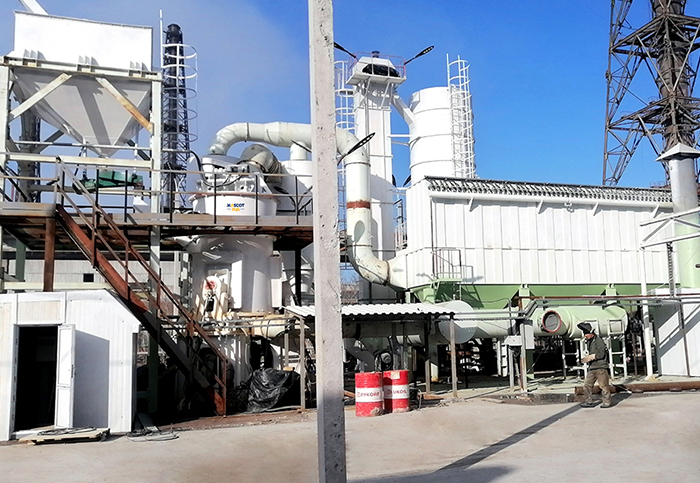
The production line of the vertical roller mill is a cost-effective and energy-efficient solution for processing powder, which is widely used in many industries, such as metallurgy, building materials, industrial solid waste treatment, thermal power plants, cement plants, and environmental protection fields. The primary purpose of this project is to finely grind raw materials through a vertical roller mill to meet the requirements of different industries for particle size, purity, and output of powder products.

The gypsum grinding production line is an efficient, stable, and environmentally friendly production solution, which is widely used in construction, decoration, the chemical industry, and other fields. In addition, the grinding process is particularly critical, which directly affects the quality and particle size of the final product. With the continuous development of science and technology, the technical level and production efficiency of gypsum grinding production lines will be further improved, providing strong support for the development of the gypsum processing industry.
Green and Intelligent Mining Machinery
Manufacturing and Export Base
Based on high quality and perfect after-sales service, our products have been
exported to more than 120 countries and regions.
Copyright © 2023 Zhengzhou Mascot Environmental Technology Co., Ltd Record number: Yu ICP No. 13021523-4





 WhatsApp