 23
23
 27
27
 27
27

Clinker grinding is where a cement plant spends most of its electrical energy, and the mill at the centre of that circuit is judged on two numbers: tons per hour and kilowatt-hours per ton. Everything else — the ball charge, the diaphragm, the liner alloy, the separator setting — exists to move those two numbers in the right direction. This guide covers how the charge is built and maintained, how the two chambers divide the work, what output each model actually delivers, and how to hold fineness between 280 and 450 m²/kg without paying for it in power.
Clinker is a hard, abrasive feed. In a typical grinding plant it arrives at 25 mm and below with a Mohs hardness around 6.5, and it has to leave the circuit as cement at a specified Blaine surface area with a stable particle-size distribution. A Cement Ball Mill built for that duty is a heavy-duty machine: a double-welded shell, high-chrome liners, heavy-duty bearings and an optimized two-chamber design, sized from 1.6 t/h on the smallest model up to 210 t/h on the largest.
The machine is not limited to clinker. The same class of mill handles granulated slag, fly ash, gypsum, limestone and pozzolana in the binder circuit, the limestone-clay-iron ore-silica sand mix in raw meal preparation, and industrial minerals such as calcium carbonate, quartz, barite, bentonite, kaolin and feldspar. That range matters commercially, because it is the reason a plant can sometimes share one mill across two duties instead of buying twice.

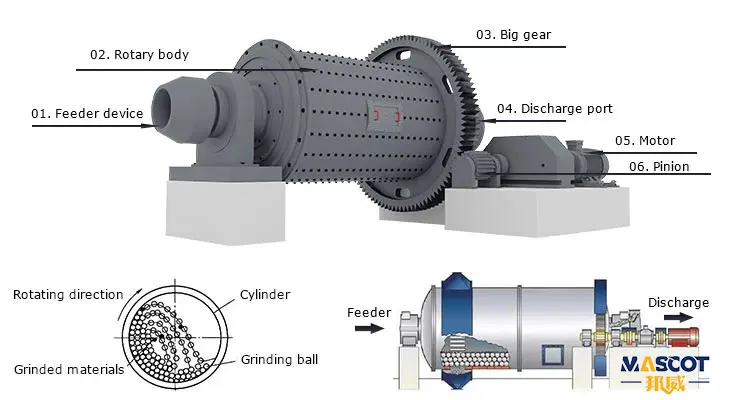
Material is fed at a controlled rate through a sealed chute into the first chamber via the hollow shaft, which keeps the mill load stable. From there the cycle is straightforward but unforgiving of poor charging:
1. Feeding. Controlled-rate feed through a sealed chute into chamber one via the hollow shaft.
2. Coarse grinding. The rotating shell lifts large steel balls which cascade and crush the clinker by impact and abrasion.
3. Chamber separation. A double-layer diaphragm retains coarse particles while finer material passes into the second chamber.
4. Fine grinding. Small balls in the second chamber finish the material to the target cement fineness.
5. Discharge and separation. Ground material exits through the discharge grate to a high-efficiency separator, which returns oversize particles for regrinding and collects qualified cement powder.
The charging rule follows from that geometry: the first chamber carries the large-diameter balls that do the breaking, and the second carries the small balls that do the finishing, with the double-layer diaphragm holding the division. Ball loads across the published model range run from 5 t on a 1200×4500 mill up to 278 t on the 4600×10000+3500 unit, so the charge is not an accessory — on the large models it is the single heaviest consumable in the plant.
High-chrome alloy liners and forged steel balls are the standard combination for maximum wear life. Rubber liners are available as an option for silica-free, low-noise operation. Because the charge, the chamber configuration and the separator settings all interact, the same mill can be switched between raw material and clinker grinding — many customers share one mill for both duties — and a three-chamber configuration with a pre-grinding compartment is available for raw meal lines.

The table below is the published range for the series. Treat it as the starting point for sizing, not the final answer: actual output depends on clinker grindability, feed moisture, circulating load and the target Blaine, which is why a mill is matched to a specific project before it is quoted.
| Model (mm) | Capacity (t/h) | Rotate Speed (r/min) | Grinding Balls (t) | Motor Power (kW) | Gear Box | Speed Ratio |
| 1200×4500 | 1.6-5.8 | 30.3 | 5 | 55 | ZD30 | 4.5 |
| 1500×5700 | 3.5-6 | 26.34 | 11 | 130 | ZD40 | 4 |
| 1830×6400 | 6.5-15 | 23.9 | 21 | 210 | ZD60 | 4.5 |
| 1830×7000 | 7.5-17 | 24.5 | 23 | 245 | ZD60 | 4.5 |
| 2200×6500 | 14-20 | 21.4 | 31 | 280 | ZD70 | 5 |
| 2400×7000 | 17-28 | 20.4 | 39 | 380 | ZD80 | 5 |
| 2400×8000 | 20-35 | 20.3 | 42 | 570 | ZD80 | 5 |
| 2400×12000 | 35-45 | 20 | 63 | 800 | MBY710 | 6.3 |
| 2400×13000 | 35-38 | 19.4 | 68 | 800 | MBY710 | 6.3 |
| 2600×13000 | 40-55 | 19.5 | 82 | 1000 | JDX800 | 6.3 |
| 3000×9000 | 50-55 | 18.34 | 78 | 1000 | JDX800 | 6.3 |
| 3200×9000 | 60-70 | 17.6 | 95 | 1250 | MBY900 | 7.1 |
| 3500×11000 | 75-85 | 16.8 | 150 | 1250 | JDX900 | 5.84 |
| 3800×12000 | 85-110 | 17 | 175 | 1600 | MBY800 | 5.6 |
| 4600×10000+3500 | 180-210 | 15 | 278 | 3550 | JQS3500 | 15.1 |
Output fineness is adjustable from 280 to 450 m²/kg (Blaine) by regulating the separator speed, the ball charge and the diaphragm setting. That single sentence is the whole control strategy: it is how one mill covers OPC, PPC and composite cements while keeping a stable D97, and it is also the reason over-grinding is a choice rather than an accident. Every extra minute a particle spends in the mill past its spec is energy that produces nothing but extra cost.
Closed-circuit operation is what makes the control practical. A high-efficiency separator returns oversize particles for regrinding instead of letting them leave the mill as cement, which cuts specific power consumption by 15-25% compared with open-circuit grinding while keeping the cement temperature under control. For output above 30 t/h, closed circuit is the configuration to specify. As a benchmark, a closed-circuit system typically consumes 25-32 kWh per ton of OPC at 350 m²/kg, depending on clinker grindability, feed moisture and target fineness.
Grinding generates heat, and in a cement mill heat is not a comfort problem — it is a quality problem. Excessive temperature drives gypsum dehydration, shortens liner life and disturbs the cement's setting behaviour. The countermeasure is a water-spray system at the mill inlet and outlet combined with adjustable ventilation, which keeps the material below 110 °C.
On modern mills the correction is automatic. Sound, power and temperature sensors feed a PLC that adjusts feed rate, separator speed and water spray in real time, so the mill keeps running at maximum efficiency instead of being nursed by an operator. When you compare suppliers, ask what the control system actually closes the loop on; a mill that only alarms on high temperature is a different proposition from one that corrects for it.
High-chrome liners typically last 8,000-12,000 operating hours, and the shell that carries them is double-welded for structural longevity. Liner replacement is the largest scheduled stop in a grinding plant's calendar, so the alloy specification is not a detail to negotiate downwards at the end of a purchase: a shorter lining life shows up as more downtime and more labour on a machine that is otherwise identical. Every mill also ships with a 12-month warranty and lifetime spare-parts supply.
A regional building-materials group operating two integrated cement plants serving the Moscow construction market needed CEM I 42.5N and CEM II/A-S 42.5N at 380 m²/kg Blaine with stable early strength, and set itself a target of below 30 kWh per ton of cement. The feed was OPC clinker at roughly Mohs 6.5 together with granulated blast-furnace slag, at a feed size of 25 mm and below.

The installation uses two MQG2400×7000 closed-circuit cement ball mills with high-efficiency dynamic separators, water-spray temperature control and full PLC process automation. Each mill delivers 22-25 t/h of CEM I 42.5N at 380 m²/kg with a D97 pass rate above 96%. Closed-circuit operation with the dynamic separator cut specific power consumption by 18% against the customer's former open-circuit line — roughly 6 kWh saved per ton of cement — and the customer reported that the energy savings alone paid back the upgrade within 14 months, with the mills running 24/7 for more than a year at consistent quality.
Q1: Open circuit or closed circuit — which should I specify?
A: In open-circuit grinding the material passes through the mill once. In closed circuit a high-efficiency separator returns oversize particles for regrinding. Closed circuit delivers higher capacity per kWh, tighter fineness control and lower cement temperature, and it is the recommended configuration for output above 30 t/h.
Q2: How many chambers does the mill have?
A: Standard cement mills have two chambers — large-diameter balls for coarse grinding in the first, small balls for fine grinding in the second, divided by a double-layer diaphragm. A three-chamber configuration with a pre-grinding compartment is available for raw meal lines.
Q3: What is a realistic power consumption per ton?
A: With a closed-circuit system, typical consumption is 25-32 kWh per ton of OPC at 350 m²/kg Blaine, depending on clinker grindability, feed moisture and target fineness.
Q4: How is the temperature inside the mill controlled?
A: A water-spray system at the mill inlet and outlet, combined with adjustable ventilation, keeps the material below 110 °C — protecting gypsum dehydration, liner life and cement quality. On automated mills a PLC adjusts feed rate, separator speed and water spray from live sound, power and temperature data.
Q5: What are the delivery time and installation support?
A: Stock items ship in 7-10 days; standard models in 15-30 days after deposit. Engineers are sent for on-site installation, commissioning and operator training, with a 12-month whole-machine warranty.
Clinker grinding rewards plants that treat the mill as a system rather than a machine. The charge must be graded to the two-chamber geometry, the diaphragm must hold the division, the separator must do the fineness control, and the PLC must keep temperature and feed rate in balance. Get those four things right and output moves with the separator setting; get them wrong and no amount of extra grinding time will buy back the kilowatt-hours.
For projects in the 1.6-210 t/h range, the Cement Ball Mill covers the duty with a published Blaine window of 280-450 m²/kg and a closed-circuit power advantage of 15-25%. A comparable reference installation is documented on the 20 TPH ball mill grinding production line case page. Where a product has to go finer than a ball mill can economically reach — the 325-2500 mesh band used by coatings, fillers and paper — the next step is the HGM Series Micro-powder Grinding Mill. Share your clinker data, target Blaine and required tonnage, and the mill, charge and circuit can be specified against your numbers rather than a catalogue range.

About of Mascot
Zhengzhou Mascot Industry is a high-tech mining equipment company integrating R&D, manufacturing, sales, and after-sales service. Focusing on crushing, grinding, and mineral processing equipment, we provide professional solutions to our customers. We are ISO9001:2015 certified, and our products include mobile crushing plants, crawler crushing plant, construction waste crushing plants, jaw crushers, sand making machines, cone crushers, fine crushers, grinding mills, ball mills, etc., all with reliable performance to meet diverse project needs.
• Professional pre-sales support: Free project design and comprehensive solutions to help you accurately select the right equipment;
• Comprehensive on-site service: Providing installation guidance and worker training to ensure smooth equipment commissioning;
• Reliable after-sales guarantee: A complete after-sales system, timely response to technical inquiries and equipment maintenance, ensuring long-term stable operation.
To protect your rights, please contact us through the following official channels for professional service:
WhatsApp: 0086-16650273865
Email: mascot@mascotenv.com
We are committed to providing high-quality equipment and full-cycle services to deliver comprehensive intelligent solutions for the global mining industry!
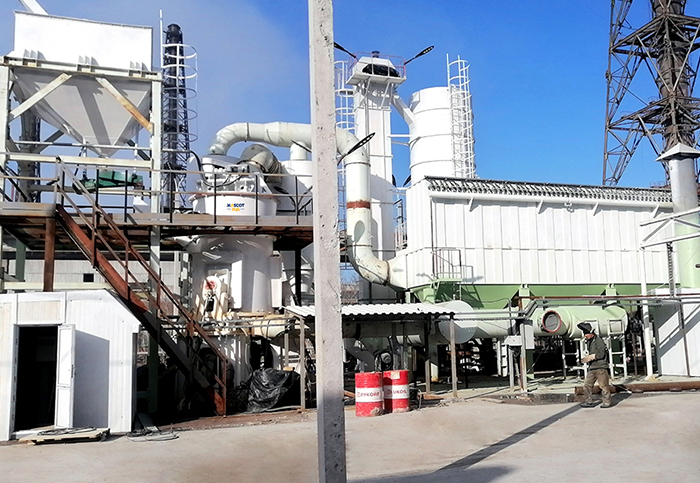
The production line of the vertical roller mill is a cost-effective and energy-efficient solution for processing powder, which is widely used in many industries, such as metallurgy, building materials, industrial solid waste treatment, thermal power plants, cement plants, and environmental protection fields. The primary purpose of this project is to finely grind raw materials through a vertical roller mill to meet the requirements of different industries for particle size, purity, and output of powder products.

The MTW series European grinding mill production line includes high-efficiency crushers, elevators, electromagnetic vibration feeders, milling machines, classifiers, and collectors. These pieces of equipment work together to achieve efficient crushing, grinding, and classification of various non-metallic ores, coal powder, slag, and other materials. It can meet the diverse needs of various industries for powder particle size, uniformity, shape, etc., and offer enterprises high-quality grinding products.

The ball mill production line is a comprehensive production line that integrates material crushing, grinding, grading, and collection. This production line is mainly used to process various materials, including sand and gravel, cement, new building materials, silicates, refractory materials, fertilizers, ferrous metal beneficiation, non-ferrous metals, glass ceramics, etc.

This production line utilizes a three-ring medium-speed micro-grinding mill as the central equipment, complemented by other auxiliary equipment like hammer crushers, bucket elevators, and storage silos to establish a comprehensive grinding operation system. It has demonstrated strong potential for application and market competitiveness in industries such as construction, chemical industry, and new materials.

The gypsum grinding production line is an efficient, stable, and environmentally friendly production solution, which is widely used in construction, decoration, the chemical industry, and other fields. In addition, the grinding process is particularly critical, which directly affects the quality and particle size of the final product. With the continuous development of science and technology, the technical level and production efficiency of gypsum grinding production lines will be further improved, providing strong support for the development of the gypsum processing industry.
Green and Intelligent Mining Machinery
Manufacturing and Export Base
Based on high quality and perfect after-sales service, our products have been
exported to more than 120 countries and regions.
Copyright © 2023 Zhengzhou Mascot Environmental Technology Co., Ltd Record number: Yu ICP No. 13021523-4





 WhatsApp