 25
 27
 27
Limestone coming out of a quarry in the wet season is not a feedstock a grinding mill handles well. It coats roller faces, packs the grinding ring, blinds the classifier and bridges in hoppers, and every one of those symptoms reads on the panel as a mill problem rather than a water problem. The usual answer is a rotary dryer ahead of the mill — and the usual mistake is to size that dryer on tonnes per hour.
A Three-Cylinder Dryer is sized on the water it has to remove, because water is what the fuel is spent on. This is the sequence for doing that properly: how to turn a moisture analysis into an evaporation load, how to read the published band against that load, and which numbers have to be written into the order before the machine is built.

The mechanisms are mechanical, not chemical. Damp limestone is cohesive: it arches over the mill feed inlet instead of flowing, so the mill starves and then surges. Inside the grinding chamber, moisture makes fines stick to the roller and ring, which reduces the bite and raises the circulating load. In an air-swept machine, water vapour raises the dew point of the gas stream, and once any part of the circuit drops below it, the bag filter blinds and airflow falls away.
The economics run in the same direction. A mill that is nominally rated for 20 t/h will deliver less on damp feed, at a higher specific energy, with more wear on the rollers because the bed is unstable. Drying the feed is usually cheaper than buying a larger mill to absorb the problem — and much cheaper than replacing filter bags on a schedule set by the weather.
The target moisture for a limestone filler line is typically around 1% at the mill inlet, because that is what keeps the classifier clean and the product consistent. Drying to 1% rather than 2%, however, costs real fuel, so the requirement should come from the process rather than from habit.
Six models from the range are enough to show the relationship between shell volume, capacity and water load. The derived columns are computed from the published figures on the 15%-to-1% basis above; they are arithmetic, not manufacturer data, and they exist to show which model covers which water load.
| Model | Drum volume (m³) | Capacity (t/h) | Water removed (t/h)* | Loading (m³ per t/h) | Drive power (kW) |
|---|---|---|---|---|---|
| Ф2.0×4m | 12.56 | 8–15 | 1.1–2.1 | 0.84–1.57 | 5.5×2 |
| Ф2.2×5m | 18.99 | 12–20 | 1.7–2.8 | 0.95–1.58 | 5.5×2 |
| Ф2.5×6m | 29.43 | 18–28 | 2.5–4.0 | 1.05–1.64 | 7.5×2 |
| Ф3.0×7m | 49.45 | 30–45 | 4.2–6.4 | 1.10–1.65 | 7.5×4 |
| Ф3.2×7m | 56.27 | 35–55 | 4.9–7.8 | 1.02–1.61 | 11×4 |
| Ф4.0×10m | 125.60 | 70–100 | 9.9–14.1 | 1.26–1.79 | 22×4 |
How to read this table: the third column is the published capacity, and the sheet does not say whether it refers to wet feed or dried product — on a 15%-to-1% duty the two differ by about 14%, so it is a question worth asking. The fourth column assumes it means wet feed and applies the 15%-to-1% ratio; treat it as an estimate of coverage, not a guarantee. The fifth column is shell volume divided by capacity, and it is the basis-free number: it describes how much drum the machine gives each tonne, and it holds whatever the moisture basis. The highlighted model is the one that covers the 30 t/h at 15% case from the previous section, and it does so at the bottom of its band rather than the middle — which is the point. Ф2.5×6m holds 30 t/h of capacity easily but tops out near 4 t of water per hour, just short of the 4.2 t that duty needs.
Once the water load is fixed, three derived figures tell you whether a quotation is coherent. The first is evaporation intensity: water removed per hour divided by drum volume. Across this range, on the 15%-to-1% basis, it works out at roughly 0.09–0.17 t of water per cubic metre per hour. A supplier claiming a much higher figure on the same shell is either assuming a drier feed than yours or counting on something the design does not deliver.
The second is gas volume. Inlet temperature is published at 700–750 °C, and the volume of gas the fan must move is set by the heat demand and the outlet temperature you allow. Running a lower outlet temperature recovers more heat into the material but narrows the dew point margin at the bag filter; the correct margin is calculated from the moisture in the gas, not chosen for comfort.
The third is residence behaviour. The three-stage cascade lifts and drops the material through inner, middle and outer shells in sequence, so the same shell volume gives several passes through fresh hot gas rather than one. That is the design reason the shell is compact for its tonnage, and it is also why the lifting plates — not the drum diameter alone — decide how much water the machine actually removes.

A dryer ahead of a mill is a buffer as much as a heat exchanger. It needs a feed hopper sized for the variability of the stockpile, a discharge that seals against air inleakage, and enough live storage between dryer and mill that a stoppage on either side does not cascade immediately. On a line grinding limestone for filler, the case for drying upstream is straightforward: the limestone grinding installation in Shandong runs a dedicated mill on this material, and a dry, consistent feed is what keeps that kind of line at rate.
The dust collector belongs to the drying circuit, not to the mill. It is sized on the gas volume at the outlet temperature, and its bags have to survive both the temperature and the acid dew point if the limestone carries any sulphur. Trying to share one collector between dryer and mill usually ends with a collector that is wrong for both.
Five items, and a supplier can size from them without guessing. The design feed moisture, taken from the wet season rather than the annual average. The required outlet moisture, and whether it is a process requirement or a preference. The wet feed rate in tonnes per hour at that moisture. The fuel available, with its calorific value. And the space available, because a compact shell is one of the reasons to choose this machine family in the first place.
Ask for the answer in tonnes of water per hour at those moisture figures, plus the fuel consumption per tonne of water. The heat side of that calculation is set out in what one ton of water costs to evaporate, and it is the only way to compare a dryer quotation with the running cost it commits you to. Where the moisture load is small enough that a single-drum machine competes, the trade-off is set out in three-cylinder dryer or single drum.

Q1: How much water does 30 t/h of limestone at 15% moisture contain?
A: About 4.2 t of water has to be removed per hour to reach 1%, using the ratio 0.141 t water per tonne of wet feed. If the wet-season moisture is 18%, the same tonnage carries about 5.15 t of water per hour, roughly 21% more evaporation for the same production.
Q2: Can the mill dry the limestone itself instead?
A: Partly, if it is an air-swept roller mill with hot gas admitted to the circuit, and barely at all in a ball mill. In-mill drying is limited by the gas volume the mill can pass and by the dew point at the bag filter, and it competes with the airflow needed to classify the product. For feed above roughly 5–8% moisture, a dedicated dryer is normally the more controllable arrangement.
Q3: Which model for 20 t/h at 12% down to 1%?
A: That is about 2.2 t of water per hour, which sits at the top of the Ф2.2×5m band. Ф2.5×6m would hold the tonnage easily but runs below its own water range, so it is only the right answer if the stockpile is uncovered and you are buying wet-season margin.
Q4: What outlet moisture should I specify?
A: The figure the grinding circuit needs, typically about 1% for a limestone filler product, and no lower. Every additional point of drying costs fuel per tonne, and a dryer run to 0.5% is buying margin nobody asked for.

About of Mascot
Zhengzhou Mascot Industry is a high-tech mining equipment company integrating R&D, manufacturing, sales, and after-sales service. Focusing on crushing, grinding, and mineral processing equipment, we provide professional solutions to our customers. We are ISO9001:2015 certified, and our products include mobile crushing plants, crawler crushing plant, construction waste crushing plants, jaw crushers, sand making machines, cone crushers, fine crushers, grinding mills, ball mills, etc., all with reliable performance to meet diverse project needs.
• Professional pre-sales support: Free project design and comprehensive solutions to help you accurately select the right equipment;
• Comprehensive on-site service: Providing installation guidance and worker training to ensure smooth equipment commissioning;
• Reliable after-sales guarantee: A complete after-sales system, timely response to technical inquiries and equipment maintenance, ensuring long-term stable operation.
To protect your rights, please contact us through the following official channels for professional service:
WhatsApp: 0086-16650273865
Email: mascot@mascotenv.com
We are committed to providing high-quality equipment and full-cycle services to deliver comprehensive intelligent solutions for the global mining industry!
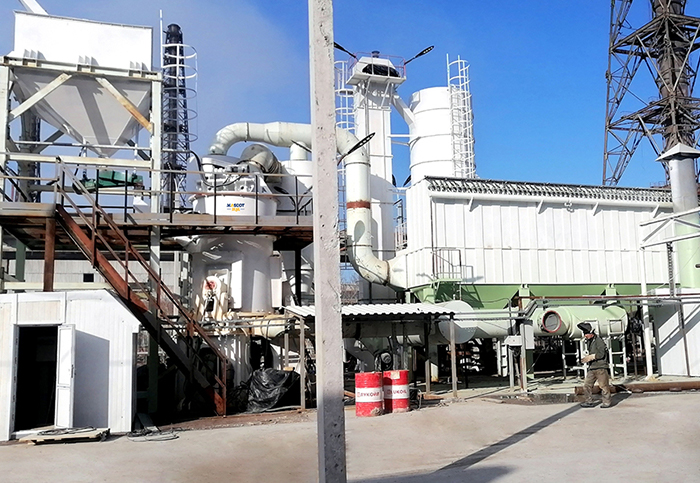
The production line of the vertical roller mill is a cost-effective and energy-efficient solution for processing powder, which is widely used in many industries, such as metallurgy, building materials, industrial solid waste treatment, thermal power plants, cement plants, and environmental protection fields. The primary purpose of this project is to finely grind raw materials through a vertical roller mill to meet the requirements of different industries for particle size, purity, and output of powder products.

The high-pressure grinding mill production line is a project specially designed for efficient grinding operations. It is widely used in metallurgy, building materials, the chemical industry, highways, water conservancy hydropower, and other industries. It is a suspended roller mill that uses springs to increase pressure. It can achieve efficient grinding processing of various non-metallic raw materials. It has high efficiency, stability, and environmental protection characteristics.

YGMX Enhanced High-Pressure Mill is a new type of high-performance grinding equipment, and the biggest improvement of this milling equipment lies in the increase of the high-pressure spring system in the grinding roller part. Compared with the traditional high-pressure roller mill, it has a wider scope of application and excellent performance to meet the production needs of a variety of powder fineness. It is widely used in non-metallic minerals, chemicals, building materials, metallurgy, environmental protection, etc. Multiple areas.

The gypsum grinding production line is an efficient, stable, and environmentally friendly production solution, which is widely used in construction, decoration, the chemical industry, and other fields. In addition, the grinding process is particularly critical, which directly affects the quality and particle size of the final product. With the continuous development of science and technology, the technical level and production efficiency of gypsum grinding production lines will be further improved, providing strong support for the development of the gypsum processing industry.

This production line utilizes a three-ring medium-speed micro-grinding mill as the central equipment, complemented by other auxiliary equipment like hammer crushers, bucket elevators, and storage silos to establish a comprehensive grinding operation system. It has demonstrated strong potential for application and market competitiveness in industries such as construction, chemical industry, and new materials.
Green and Intelligent Mining Machinery
Manufacturing and Export Base
Based on high quality and perfect after-sales service, our products have been
exported to more than 120 countries and regions.
Copyright © 2023 Zhengzhou Mascot Environmental Technology Co., Ltd Record number: Yu ICP No. 13021523-4





 WhatsApp
