 27
27
 27
27
 25
25
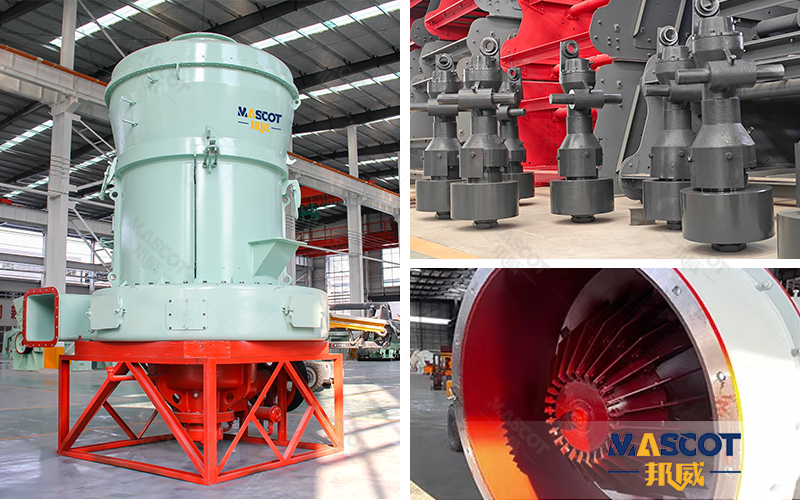
These two machines come up in the same quotation more often than any other pair in the medium-fine grinding range, and the conversation usually goes the same way: both can grind your material to your mesh, both are roller mills, and the difference in price has to be justified by something. That something is not a single specification. It is a set of five differences that only start to matter once you line up the published tables of the YGM High Pressure Grinding Mill and the MTW Trapezium Grinding Mill on top of each other. This article does exactly that, and then gives the decision sequence.
The YGM series is a vertical suspension roller mill with a clearly bounded job: grinding non-metallic minerals into the 80-425 mesh band, at capacities from 1.2 to 36 t/h across five models. Raw material is fed evenly into the grinding chamber, rollers press against the grinding ring to squeeze, impact and grind it, a built-in powder classifier separates qualified fine particles from coarse ones, the finished powder is carried by airflow into the dust collector, and oversized particles fall back for regrinding. It is a compact, mechanical, well-understood machine with a parts list that a plant can hold on a shelf.
The MTW series is the European-type trapezium redesign: curved rollers running against a trapezium ring, so the material is held in an even bed rather than being worked by point contact. Airflow carries powder to the classifier, fine particles pass while oversized ones fall back, qualified powder is discharged from the cyclone collector, and the remaining air is purified by a pulse dust collector with over 99.9% efficiency before release. Four models cover 3-50 t/h at 0.038-0.2 mm (80-400 mesh).
Put the two sentences side by side and the first real difference appears: the YGM is specified up to 36 t/h and the MTW up to 50 t/h, but the MTW's advantage is not only its top capacity. It is the architecture behind it.
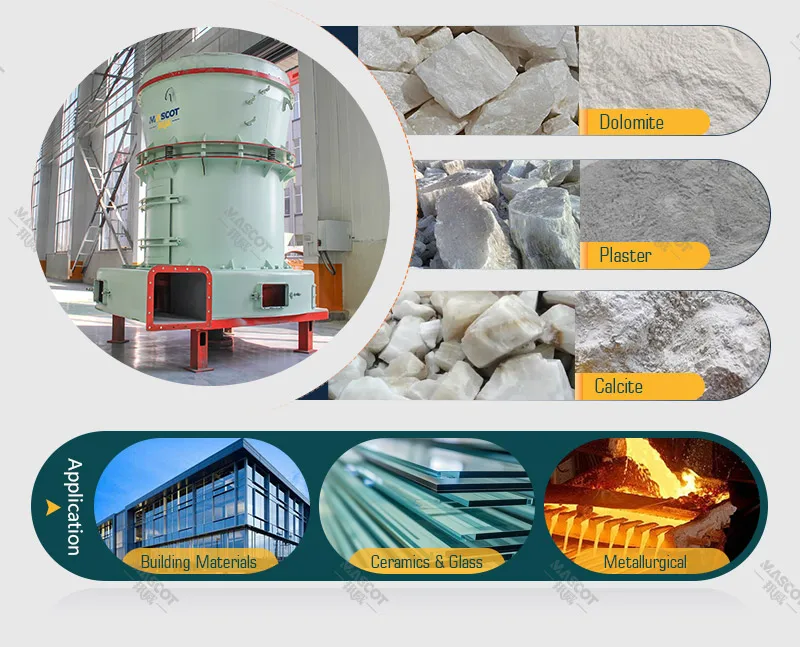
Five models, one fineness band, and a feed-size limit that rises with the model — which is why the upstream crushing stage gets sized alongside the mill rather than after it.
| Model | Roller No. | Roller Size (mm) | Ring Inner Dia. (mm) | Feed Size (mm) | Output Size (mm) | Capacity (t/h) | Power (kW) |
|---|---|---|---|---|---|---|---|
| YGM85 | 3 | 270×150 | 830×150 | ≤ 20 | 0.613-0.033 | 1.2-4 | 22 |
| YGM95 | 4 | 310×190 | 950×190 | ≤ 25 | 0.613-0.033 | 2.1-5.6 | 45 |
| YGM130 | 5 | 410×230 | 1280×230 | ≤ 30 | 0.613-0.033 | 2.5-9.5 | 90 |
| YGM160 | 6 | 450×300 | 1600×300 | ≤ 35 | 0.613-0.033 | 8-16 | 132 |
| YGM190 | 6 | 500×330 | 1900×330 | ≤ 40 | 0.613-0.033 | 18-36 | 250 |
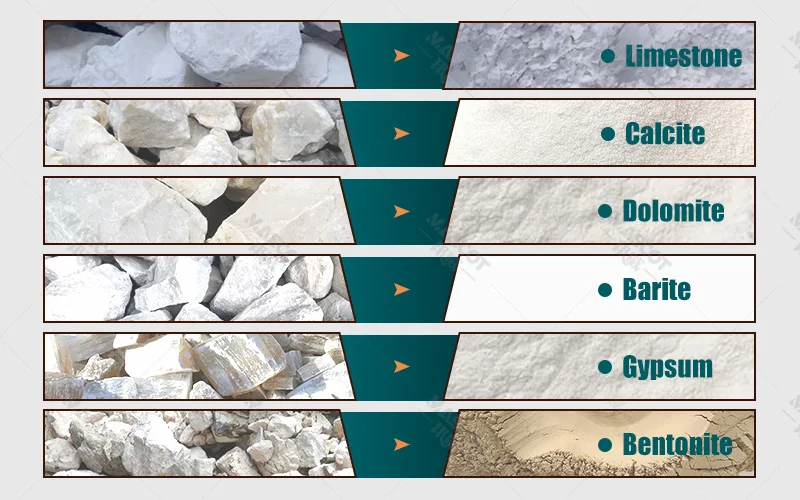
The same table also tells you which model the material selects. Mascot publishes three material groups for the series, and the recommendation follows hardness rather than tonnage: soft carbonates such as limestone, calcite, dolomite and marble at Mohs 3-4 point to the YGM130 or YGM160; hard silicates such as quartz, feldspar, bentonite and kaolin at Mohs 6-7 point to the YGM130 or YGM190; and soft industrial minerals such as gypsum, barite, talc and fluorite at Mohs 1-4 point to the YGM85 or YGM95. That is a useful discipline, because it stops a buyer from choosing a model on tonnage alone and then discovering that the hardness of the rock has eaten the margin.
Four models, one output band, and a power column split three ways. That last detail is the most important thing on the page.
| Model | Roller Size (mm) | Grind Ring Inner Dia. (mm) | Feeding Size (mm) | Output Size (mm) | Capacity (t/h) | Main Mill (kW) | Powder Classifier (kW) | Blower (kW) |
|---|---|---|---|---|---|---|---|---|
| MTW110 | 360×210 | 1100×210 | 30 | 0.038-0.2 | 3-10 | 55 | 18.5 | 55 |
| MTW138 | 460×260 | 1380×260 | 35 | 0.038-0.2 | 6-20 | 90 | 22 | 132 |
| MTW175 | 520×300 | 1750×300 | 40 | 0.038-0.2 | 10-35 | 160 | 37 | 200 |
| MTW215 | 640×340 | 2150×340 | 45 | 0.038-0.2 | 20-50 | 220 | 37 | 250 |
Mascot publishes four material groups for the MTW, and this time the recommendation follows both hardness and finished grade: building materials such as limestone, calcite, gypsum and dolomite at Mohs 3-4 for board, plaster filler and cement admixture at 80-200 mesh; coatings, plastics and rubber fillers such as barite, talc, kaolin and bentonite at Mohs 3-5 for functional filler at 200-325 mesh; glass and ceramics such as potassium feldspar, quartz and clinker at Mohs 5-7 at 200-325 mesh; and chemical and metallurgy duties such as limestone, marble and active carbon at Mohs 3-7, typically at 200 mesh. The series accepts non-flammable, non-explosive minerals with Mohs hardness below 9.3 and feed moisture below 6%.
1. Capacity band and the shape of the ladder. The YGM runs from 1.2 t/h to 36 t/h in five steps; the MTW runs from 3 t/h to 50 t/h in four. Below roughly 3 t/h only the YGM applies, and above 36 t/h only the MTW does. In the middle, both compete, and the question becomes which model in each series holds your tonnage with margin rather than which brand is larger.
2. The power column is not counting the same things. This is the single most common error in comparing these two quotations. The YGM table publishes one power figure per model — 22 kW on the YGM85 rising to 250 kW on the YGM190. The MTW table splits the number across three drives: main mill, powder classifier and blower. So the MTW215's main mill at 220 kW sits below the YGM190's 250 kW, but the same MTW215 also carries a 37 kW classifier and a 250 kW blower, and the smaller MTW110's 55 kW main mill travels with an 18.5 kW classifier and a 55 kW blower. Read only the main-mill column and the comparison reverses. The MTW table separates the drives because the total is what the electricity bill is calculated on, and the honest way to use either table is to ask for total installed power and kilowatt-hours per ton at your target mesh — not to compare one column against another.
3. How fineness is changed. On the YGM, fineness is a control-panel operation but not a running one: the mill needs a brief shutdown to adjust the classifier speed through the frequency converter, the adjustment itself takes under 10 minutes, and no physical parts are replaced. A plant that moves between grades frequently can specify a dual-classifier setup to shorten the turnaround between batches. On the MTW, the cut is set by the powder classifier and adjusted through its speed while the mill keeps running. For a producer selling several mesh grades from one machine on a single shift, that difference is worth more than a small gap in energy per ton; for a plant that runs one grade continuously, it is worth nothing.

| Decision Point | YGM High Pressure Grinding Mill | MTW Trapezium Grinding Mill |
|---|---|---|
| Models / capacity | 5 models, 1.2-36 t/h | 4 models, 3-50 t/h |
| Fineness band | 80-425 mesh; output size 0.613-0.033 mm across all models | 80-400 mesh; output size 0.038-0.2 mm across all models |
| Feed size | ≤20 mm on the YGM85 to ≤40 mm on the YGM190 | 30 mm on the MTW110 to 45 mm on the MTW215 |
| Grinding geometry | Rollers pressed against the grinding ring in a suspension layout | Curved rollers against a trapezium ring, holding an even material bed |
| Fineness change | Brief shutdown to adjust classifier speed via frequency converter; under 10 minutes, no parts replaced | Classifier speed adjusted while the mill runs |
| Published power | Single figure per model, 22-250 kW | Split across main mill, classifier and blower |
| Material envelope | Three published groups at Mohs 1-4, 3-4 and 6-7, model recommended by hardness | Mohs below 9.3, moisture below 6%; four groups mapped to finished grade |
| Typical fit | Small to medium tonnage, standard medium-fine grades, budget-sensitive projects | Medium to large tonnage, frequent grade changes, higher electricity cost, growth plans |
The most useful comparison is between two mills already running, because it moves the argument from specifications to money.
The YGM case. A limestone producer in Kogi State, Nigeria needed 8-10 t/h of consistent 200 mesh powder to supply three local cement batching plants, with a tight budget and an unstable local power supply. The installation is a single YGM160 with a variable-frequency classifier drive and a voltage stabiliser panel, plus a hot-air inlet to handle the 7-8% moisture in the rainy-season feedstock; the Mascot engineer spent five days on site for installation and operator training. The mill has since run at 9-10 t/h average output for 18 months, at a reported direct operating cost of $1.92 per ton covering power and wear parts. The first roller replacement came at 1,700 hours, inside the expected service window, and the customer ordered a second YGM160 in 2025 for a new site in Ondo State.
The MTW case. A major regional construction-material supplier in Surabaya, Indonesia needed high-volume limestone grinding at 325 mesh for high-strength cement, on a schedule that could not afford midday stoppages. Mascot supplied two MTW trapezium mills operating in parallel, delivered as one matched set with vibrating feeder, powder classifier, cyclone collector and pulse dust collector. Each mill achieved a stable 15 t/h at 325 mesh; the thin-oil lubrication system allowed three 8-hour shifts daily with zero stops for manual greasing; and total power per ton of powder dropped by 22% against the customer's older Raymond mill technology.
Read the two together and the pattern is the same as the specification tables. The Nigerian plant bought tonnage with a defined budget ceiling and a specific local constraint — unstable voltage — and the YGM met it at a documented cost per ton. The Indonesian plant bought throughput and uptime at a finer grade, and the MTW's cost advantage was measured against the technology it replaced. Neither number is transferable to your site; both show what the two platforms look like when they are matched to the job they were chosen for.

Q1: Which is cheaper to run per ton?
A: The comparison has to be made on total installed power and kilowatt-hours per ton at your target mesh, on your material, not on the main-mill column of the two tables. The YGM publishes a single power figure per model (22-250 kW); the MTW publishes its power split across main mill, classifier and blower, so a like-for-like comparison means adding the MTW's three drives and asking what work the YGM's auxiliary equipment is doing. In the Indonesian reference case, the MTW installation cut total power per ton by 22% against the older Raymond technology it replaced.
Q2: Can I change the finished mesh on either machine?
A: Yes, on both — but not in the same way. The MTW's cut is adjusted through the classifier speed while the mill keeps running. The YGM requires a brief shutdown to adjust the classifier through its frequency converter; the adjustment takes under 10 minutes and no parts are replaced, and a dual-classifier setup can be configured where frequent grade changes are expected.
Q3: My material is hard. Which series handles it?
A: The MTW publishes a ceiling of Mohs 9.3, with the lower tonnage and faster roller and ring wear above roughly Mohs 6 that you would expect. The YGM publishes hardness-matched recommendations within its three material groups — hard silicates such as quartz, feldspar, bentonite and kaolin at Mohs 6-7 point to the YGM130 or YGM190. In both cases the model should be confirmed against a sample of your rock rather than against a group label.
Q4: What if my product needs to go finer than 400 mesh?
A: Neither series is specified for that band, and pushing either one past its published range costs more than it earns. For ultra-fine powder in the 325-2500 mesh range, the HGM Series Micro-powder Grinding Mill is the platform built for it, with a variable-frequency turbo classifier for that band.
The YGM and the MTW are not the same machine at two prices. The YGM is a five-model suspension roller platform for 1.2-36 t/h in the 80-425 mesh band, with one published power figure per model, hardness-matched model recommendations for three material groups, and fineness changed through a brief shutdown of under 10 minutes. The MTW is a four-model trapezium platform for 3-50 t/h in the 80-400 mesh band, with friction-adjusted fineness while running, an explicit envelope of Mohs 9.3 and 6% moisture, and a published power split across three drives that makes the total — not the main-mill column — the number to compare.
The purchase decision follows six steps: fix the mesh and tonnage, check the material against the published envelope, ask how often the grade changes, compare total installed power and kWh per ton, price three years of rollers and rings, and remember that both platforms can run in the same plant. The YGM High Pressure Grinding Mill and the MTW Trapezium Grinding Mill are both Mascot machines with the same after-sales system, so the correct comparison is against your production profile rather than against each other in the abstract. Send your material, target mesh and required tonnage, and both series will be quoted on the same three numbers.

About of Mascot
Zhengzhou Mascot Industry is a high-tech mining equipment company integrating R&D, manufacturing, sales, and after-sales service. Focusing on crushing, grinding, and mineral processing equipment, we provide professional solutions to our customers. We are ISO9001:2015 certified, and our products include mobile crushing plants, crawler crushing plant, construction waste crushing plants, jaw crushers, sand making machines, cone crushers, fine crushers, grinding mills, ball mills, etc., all with reliable performance to meet diverse project needs.
• Professional pre-sales support: Free project design and comprehensive solutions to help you accurately select the right equipment;
• Comprehensive on-site service: Providing installation guidance and worker training to ensure smooth equipment commissioning;
• Reliable after-sales guarantee: A complete after-sales system, timely response to technical inquiries and equipment maintenance, ensuring long-term stable operation.
To protect your rights, please contact us through the following official channels for professional service:
WhatsApp: 0086-16650273865
Email: mascot@mascotenv.com
We are committed to providing high-quality equipment and full-cycle services to deliver comprehensive intelligent solutions for the global mining industry!

YGMX Enhanced High-Pressure Mill is a new type of high-performance grinding equipment, and the biggest improvement of this milling equipment lies in the increase of the high-pressure spring system in the grinding roller part. Compared with the traditional high-pressure roller mill, it has a wider scope of application and excellent performance to meet the production needs of a variety of powder fineness. It is widely used in non-metallic minerals, chemicals, building materials, metallurgy, environmental protection, etc. Multiple areas.

The ball mill production line is a comprehensive production line that integrates material crushing, grinding, grading, and collection. This production line is mainly used to process various materials, including sand and gravel, cement, new building materials, silicates, refractory materials, fertilizers, ferrous metal beneficiation, non-ferrous metals, glass ceramics, etc.

The Raymond mill production line is a highly efficient system designed for grinding operations, with a focus on energy efficiency, durability, and productivity. It caters to the needs of users by offering fine powder products in non-metallic ores, coal powder, and slag processing, aiding enterprises in achieving sustainable growth.

The gypsum grinding production line is an efficient, stable, and environmentally friendly production solution, which is widely used in construction, decoration, the chemical industry, and other fields. In addition, the grinding process is particularly critical, which directly affects the quality and particle size of the final product. With the continuous development of science and technology, the technical level and production efficiency of gypsum grinding production lines will be further improved, providing strong support for the development of the gypsum processing industry.

This production line utilizes a three-ring medium-speed micro-grinding mill as the central equipment, complemented by other auxiliary equipment like hammer crushers, bucket elevators, and storage silos to establish a comprehensive grinding operation system. It has demonstrated strong potential for application and market competitiveness in industries such as construction, chemical industry, and new materials.
Green and Intelligent Mining Machinery
Manufacturing and Export Base
Based on high quality and perfect after-sales service, our products have been
exported to more than 120 countries and regions.
Copyright © 2023 Zhengzhou Mascot Environmental Technology Co., Ltd Record number: Yu ICP No. 13021523-4





 WhatsApp