 25
25
 25
25
 27
27

Cement fineness is usually quoted as one number in a purchase specification, and that is where the trouble starts. Blaine and residue are the two metrics the cement industry actually works with, they are measured on completely different principles, and a mill can sit comfortably inside one of them while failing the other. Buyers who understand the difference order the right mill and the right circuit the first time; buyers who do not spend the whole commissioning period chasing a number that was telling them the wrong thing. Using the published specification of the Cement Ball Mill, this article sets out what each metric measures, what each one misses, and how both are moved on a real grinding circuit.
The two tests answer different questions about the same powder.
| Metric | What It Is | Unit | Reference Method | Why the Industry Uses It |
|---|---|---|---|---|
| Blaine | Specific surface area of the cement, calculated from the resistance a compacted powder bed offers to a fixed volume of air | m²/kg | ASTM C204 / EN 196-6 | Acts as the strength proxy: more surface per gram means faster early hydration and higher early strength |
| Residue | Mass fraction of the cement retained on a 45 µm (No. 325) sieve | % | ASTM C430 / EN 196-6 | Puts a ceiling on the coarse tail — the particles that will not hydrate in time and drag on setting behaviour |
Blaine is an average that responds to every particle in the sample; residue is a single point on the coarse end that ignores everything below the sieve cut. That one sentence explains most of the arguments that happen between a cement plant and its customer's laboratory.
Blaine is measured by air permeability: a known mass of cement is compacted into a bed of defined porosity, a fixed volume of air is drawn through it, and the time taken is converted into a surface area. The finer the powder, the more surface it presents, the slower the air passes and the higher the calculated figure. Because the calculation also needs the density of the sample, the number is a comparative rather than an absolute physical measurement — which is precisely why the standard is so prescriptive about sample mass, bed preparation and calibration. Two laboratories are only quoting the same Blaine if they are running the same method with the same reference material.
The blind spot is built into the principle. Blaine responds to the total surface in the bed, fines and coarse alike, so a powder with an unusually broad distribution can post a respectable figure while still carrying oversized particles. Those particles will not hydrate on the schedule the mix design assumes, and they are exactly what the second test is designed to catch.

Residue is the opposite kind of test. It washes a sample through a 45 µm sieve and reports what stays behind, so it says nothing at all about how fine the passing fraction is and nothing about the shape of the sub-45 µm distribution. Two cements can return identical residue figures and still behave very differently in a mixer if their fine fractions differ in width.
What residue does well is act as the customer's safety net. It is the number that stops an otherwise acceptable cement from reaching a site with a coarse tail capable of compromising early strength development, and for that reason it is quoted alongside Blaine rather than instead of it. On a well-controlled circuit the two are read together with a distribution metric: the Moscow installation described in Section 9 holds a D97 pass rate above 96% at 380 m²/kg, which is a statement about the top cut of the distribution that a single residue percentage could not make on its own.
As a field rule of thumb, neither figure is meaningful in isolation, and the combination points at a specific part of the circuit. The table below is how a grinding engineer reads a pair of results.
| Blaine | Residue | What the Pair Suggests | Where to Look First |
|---|---|---|---|
| High | High | Broad distribution with a coarse tail: total surface looks adequate on paper, but oversize particles are present and will show up as slow strength development | Separator cut point and circulating load — confirm the separator is returning coarse particles for regrinding instead of passing them |
| High | Low | Quality achieved and paid for twice: the product is finer than the specification requires, and every extra square metre was bought with kilowatt-hours | Residence time and separator setting; the charge may also be graded finer than the duty needs |
| Low | Low | Coarse-leaning, narrow distribution: the sieve requirement is satisfied but the surface area is short | Ball charge grading and second-chamber fill |
| Low | High | The circuit is not finishing the job — material is passing through coarser than the mill is capable of delivering | Feed rate against capacity, ball charge volume, diaphragm condition |
The practical value of the table is that it turns two numbers into one instruction. A plant that only tracks Blaine will keep adding grinding energy to a circuit whose real problem is the separator; a plant that only tracks residue will accept a cement that passes every sieve and still underperforms in the mixer.
National cement standards usually set a minimum surface area and a maximum residue rather than choosing between them, because the two guard against different failure modes: Blaine against weak early strength, residue against a coarse tail that the strength test alone would not flag.
The published fineness window for the Mascot cement mill series is 280 to 450 m²/kg Blaine, adjustable by regulating the separator speed, the ball charge and the diaphragm setting — a band wide enough to cover OPC, PPC and composite cements with stable D97 quality. That range is a statement about control, not about ambition: it means the same mill can be moved between products by changing settings rather than hardware, which is the reason many customers share one mill between raw material and clinker duties.

The two metrics are moved by different levers, and confusing them is the most expensive habit in a grinding plant.
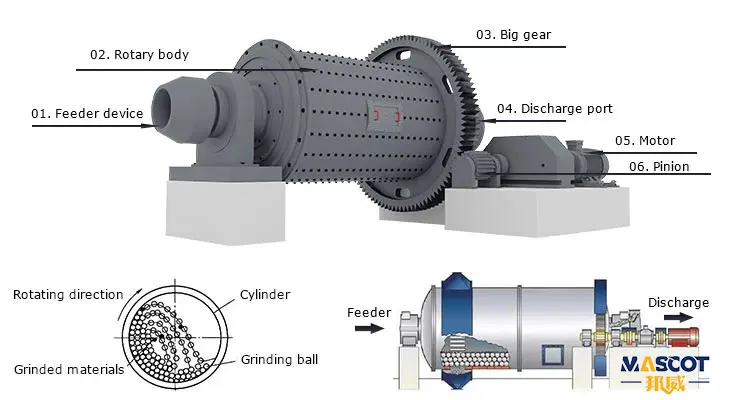
Blaine is bought with residence time and grinding energy. The material has to stay in the cylinder long enough, with a charge fine enough, to generate the required surface. On a two-chamber mill the large-diameter balls in the first chamber do the breaking and the small balls in the second do the finishing, with a double-layer diaphragm holding the division between them. Ball loads across the published model range run from 5 t on a 1200×4500 mill up to 278 t on the 4600×10000+3500 unit, so the charge is not an accessory — on the larger models it is the single heaviest consumable in the plant.
Residue is set by the circuit, not by the cylinder. A high-efficiency separator returns oversize particles for regrinding instead of letting them leave the mill as finished cement; the diaphragm setting and the circulating load decide how much of the coarse fraction gets a second pass. This is why closed-circuit grinding is the configuration that makes fineness control practical: it cuts specific power consumption by 15-25% against open-circuit grinding while keeping the cement temperature under control, and it is the recommended arrangement for output above 30 t/h.

Fineness is the most expensive specification in a cement plant because the energy curve is not linear. As a published benchmark, a closed-circuit system typically consumes 25-32 kWh per ton of OPC at 350 m²/kg, depending on clinker grindability, feed moisture and target fineness. Every square metre added above the specification is energy that produces nothing the customer asked for, and over-grinding also flattens the particle-size distribution — the plant pays more to make a powder that is less well graded than the one it could have shipped.
Two operating constraints cap how far a plant should push. The first is temperature: grinding generates heat, and in a cement mill heat is a quality problem rather than a comfort problem, because excessive temperature drives gypsum dehydration and disturbs the cement's setting behaviour. A water-spray system at the mill inlet and outlet combined with adjustable ventilation keeps the material below 110 °C. The second is the control loop. On an automated mill, sound, power and temperature sensors feed a PLC that adjusts feed rate, separator speed and water spray in real time, so the circuit keeps correcting itself rather than being nursed by an operator. When you compare suppliers, ask what the control system actually closes the loop on: a mill that only alarms on high temperature is a different proposition from one that corrects for it.
Wear is the third cost, and it is scheduled rather than hidden. High-chrome liners typically last 8,000-12,000 operating hours, and liner replacement is the largest scheduled stop on a grinding plant's calendar — so the alloy specification is not a detail to negotiate downwards at the end of a purchase. Every mill ships with a 12-month warranty and lifetime spare-parts supply.
The table below is a selection from the published series, which runs from 1.6 t/h to 210 t/h. For a given material and target fineness the choice between models is a capacity and drive-power decision rather than a fineness one; the mill delivers the specification, the separator and the charge decide whether it is held.
| Model (mm) | Capacity (t/h) | Rotate Speed (r/min) | Grinding Balls (t) | Motor Power (kW) | Gear Box | Speed Ratio |
|---|---|---|---|---|---|---|
| 1200×4500 | 1.6-5.8 | 30.3 | 5 | 55 | ZD30 | 4.5 |
| 1830×6400 | 6.5-15 | 23.9 | 21 | 210 | ZD60 | 4.5 |
| 2200×6500 | 14-20 | 21.4 | 31 | 280 | ZD70 | 5 |
| 2400×7000 | 17-28 | 20.4 | 39 | 380 | ZD80 | 5 |
| 2400×8000 | 20-35 | 20.3 | 42 | 570 | ZD80 | 5 |
| 3000×9000 | 50-55 | 18.34 | 78 | 1000 | JDX800 | 6.3 |
| 3200×9000 | 60-70 | 17.6 | 95 | 1250 | MBY900 | 7.1 |
| 3800×12000 | 85-110 | 17 | 175 | 1600 | MBY800 | 5.6 |
| 4600×10000+3500 | 180-210 | 15 | 278 | 3550 | JQS3500 | 15.1 |
Because output moves with clinker grindability, feed moisture, circulating load and the target Blaine, model selection needs three data points before it can be answered properly: the material, the required capacity in tons per hour, and the required fineness. Mascot application engineers work from those three numbers and will also advise whether the circuit should be open or closed at your tonnage.
A regional building-materials group operating two integrated cement plants for the Moscow construction market needed CEM I 42.5N and CEM II/A-S 42.5N at 380 m²/kg Blaine with stable early strength, and set itself a target of below 30 kWh per ton of cement. The feed was OPC clinker at roughly Mohs 6.5 together with granulated blast-furnace slag, at a feed size of 25 mm and below.

The installation uses two MQG2400×7000 closed-circuit cement ball mills with high-efficiency dynamic separators, water-spray temperature control and full PLC process automation. Each mill delivers 22-25 t/h of CEM I 42.5N at 380 m²/kg with a D97 pass rate above 96%. Closed-circuit operation with the dynamic separator cut specific power consumption by 18% against the customer's former open-circuit line — roughly 6 kWh saved per ton of cement — and the customer reported that the energy savings alone paid back the upgrade within 14 months, with the mills running 24/7 for more than a year at consistent quality.
That result is a fineness story as much as an energy story. The plant is holding a surface-area specification and a top-cut specification at the same time, on a circuit whose separator is doing the work that grinding time alone would otherwise have to do — which is the whole argument of this article applied to a working mill.
Q1: What is the difference between Blaine and residue?
A: Blaine is a specific surface area in m²/kg, measured by air permeability under ASTM C204 or EN 196-6, and it acts as the strength proxy for the cement. Residue is the mass percentage retained on a 45 µm (No. 325) sieve under ASTM C430 or EN 196-6, and it puts a ceiling on the coarse tail. One describes the average surface of the whole powder; the other counts only the particles that are too coarse to hydrate in time.
Q2: Which one should go into my purchase specification?
A: Both, wherever the application allows it. Blaine alone will not stop a broad distribution with a coarse tail from being shipped; residue alone will not guarantee early strength. National cement standards normally set a minimum surface area and a maximum residue for exactly that reason. If you can specify only one, ask your customer's laboratory which failure mode has actually caused rejections before.
Q3: What fineness can this mill hold?
A: The published window is 280-450 m²/kg Blaine, adjustable by regulating the separator speed, the ball charge and the diaphragm setting, covering OPC, PPC and composite cements with stable D97 quality. The reference installation in Section 9 holds 380 m²/kg with a D97 pass rate above 96% at 22-25 t/h on each of two MQG2400×7000 mills.
Q4: Why does my cement pass one metric and fail the other?
A: Because they measure different parts of the same distribution. Blaine responds to the total surface in the sample, so a broad distribution can carry a coarse tail and still post an acceptable figure; residue only counts what stays on the 45 µm sieve, so it is blind to how fine the passing fraction is. When the two disagree, look at the separator cut point and the circulating load before adding grinding time.
Q5: Is finer cement always better?
A: No, and it is the most expensive assumption in a grinding plant. Energy per ton rises steeply as the target fineness increases, and every square metre above the specification is paid for in kWh without adding value for the customer. Over-grinding also flattens the particle-size distribution and pushes mill temperature up, which risks gypsum dehydration. The efficient answer is a mill that hits the specification and a circuit that holds it, not a mill that exceeds it.
Blaine and residue are not two ways of saying the same thing, and a plant that treats them as one number will keep buying the wrong fix. Blaine, in m²/kg under ASTM C204, is the strength proxy and responds to the whole distribution; residue, in percent on a 45 µm sieve under ASTM C430, is the coarse-tail limit and is blind to everything below the cut. Read as a pair, they point at a specific part of the circuit — which is why the productive conversation is always about the separator cut point, the ball charge grading and the diaphragm rather than about grinding a little longer.
On the Cement Ball Mill, the published window of 280-450 m²/kg is held by separator speed, charge and diaphragm setting, with a closed-circuit configuration that cuts specific power consumption by 15-25% against open-circuit grinding and is the recommended arrangement above 30 t/h. A comparable reference installation is documented on the 20 TPH ball mill grinding production line case page. Send your clinker data, target Blaine, residue limit and required tonnage, and the mill, the charge and the circuit can be specified against your numbers rather than a catalogue range.

About of Mascot
Zhengzhou Mascot Industry is a high-tech mining equipment company integrating R&D, manufacturing, sales, and after-sales service. Focusing on crushing, grinding, and mineral processing equipment, we provide professional solutions to our customers. We are ISO9001:2015 certified, and our products include mobile crushing plants, crawler crushing plant, construction waste crushing plants, jaw crushers, sand making machines, cone crushers, fine crushers, grinding mills, ball mills, etc., all with reliable performance to meet diverse project needs.
• Professional pre-sales support: Free project design and comprehensive solutions to help you accurately select the right equipment;
• Comprehensive on-site service: Providing installation guidance and worker training to ensure smooth equipment commissioning;
• Reliable after-sales guarantee: A complete after-sales system, timely response to technical inquiries and equipment maintenance, ensuring long-term stable operation.
To protect your rights, please contact us through the following official channels for professional service:
WhatsApp: 0086-16650273865
Email: mascot@mascotenv.com
We are committed to providing high-quality equipment and full-cycle services to deliver comprehensive intelligent solutions for the global mining industry!

The MTW series European grinding mill production line includes high-efficiency crushers, elevators, electromagnetic vibration feeders, milling machines, classifiers, and collectors. These pieces of equipment work together to achieve efficient crushing, grinding, and classification of various non-metallic ores, coal powder, slag, and other materials. It can meet the diverse needs of various industries for powder particle size, uniformity, shape, etc., and offer enterprises high-quality grinding products.

The high-pressure grinding mill production line is a project specially designed for efficient grinding operations. It is widely used in metallurgy, building materials, the chemical industry, highways, water conservancy hydropower, and other industries. It is a suspended roller mill that uses springs to increase pressure. It can achieve efficient grinding processing of various non-metallic raw materials. It has high efficiency, stability, and environmental protection characteristics.

The Raymond mill production line is a highly efficient system designed for grinding operations, with a focus on energy efficiency, durability, and productivity. It caters to the needs of users by offering fine powder products in non-metallic ores, coal powder, and slag processing, aiding enterprises in achieving sustainable growth.

YGMX Enhanced High-Pressure Mill is a new type of high-performance grinding equipment, and the biggest improvement of this milling equipment lies in the increase of the high-pressure spring system in the grinding roller part. Compared with the traditional high-pressure roller mill, it has a wider scope of application and excellent performance to meet the production needs of a variety of powder fineness. It is widely used in non-metallic minerals, chemicals, building materials, metallurgy, environmental protection, etc. Multiple areas.

This production line utilizes a three-ring medium-speed micro-grinding mill as the central equipment, complemented by other auxiliary equipment like hammer crushers, bucket elevators, and storage silos to establish a comprehensive grinding operation system. It has demonstrated strong potential for application and market competitiveness in industries such as construction, chemical industry, and new materials.
Green and Intelligent Mining Machinery
Manufacturing and Export Base
Based on high quality and perfect after-sales service, our products have been
exported to more than 120 countries and regions.
Copyright © 2023 Zhengzhou Mascot Environmental Technology Co., Ltd Record number: Yu ICP No. 13021523-4





 WhatsApp