 27
 27
 25
Ask three suppliers for the power cost per ton of a dry ball mill and you will get three numbers that cannot be compared. One quotes motor kilowatts, one quotes a mill-plus-fan figure, one quotes a meter reading from a plant grinding a different material at a different fineness. All three are real. None of them describes your circuit.
This article takes the published dry ball mill table apart, converts it into the ratio a buyer can actually use, and follows that ratio through the places energy leaves a grinding circuit.
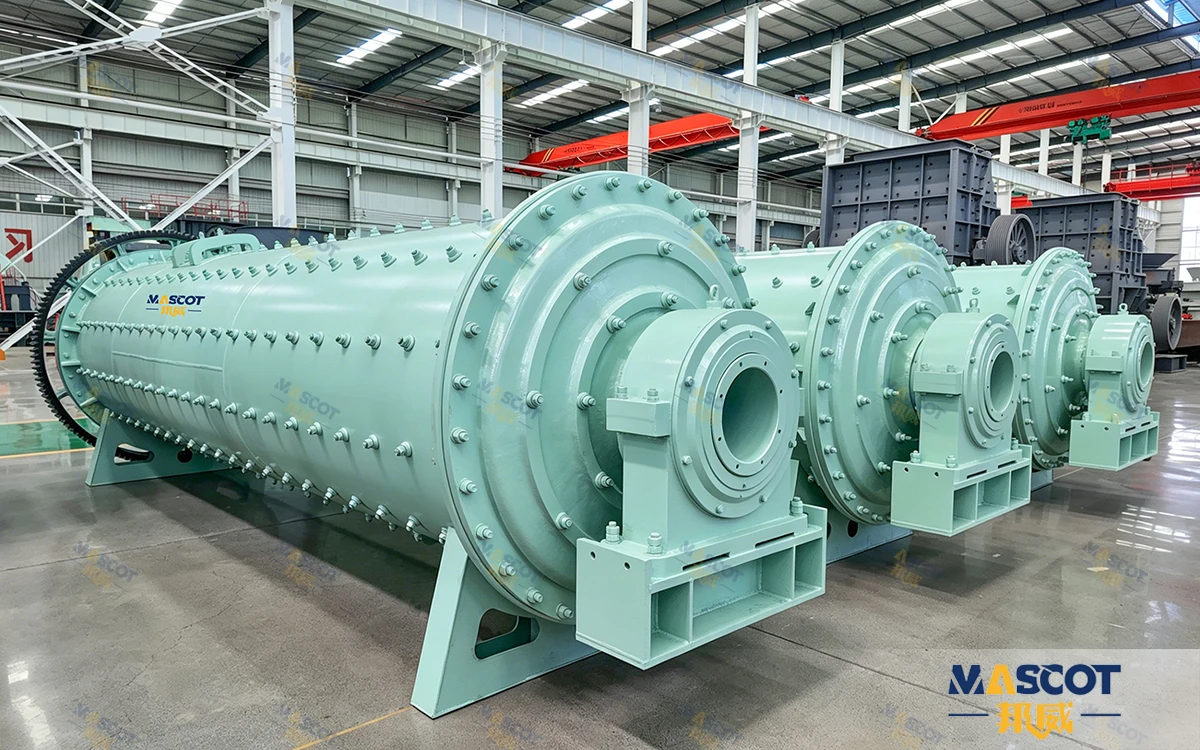
A mill sold with a 570 kW drive does not consume 570 kW. That figure is the motor's rated output, chosen with margin so the mill can start under a full ball charge and survive a hard feed. What the meter records depends on how much of that rating the mill is using at the moment you read it.
Two things separate the two numbers. Load factor comes first: a mill running at 70% of its rated torque draws roughly 70% of its rated power, so the same machine at half output can consume nearly the same kilowatts as at full output. The auxiliary circuit comes second. A dry grinding line also runs a classifier, a system fan, a bucket elevator, a feeder and a dust collector, and none of those appear in the mill's motor column.
One calculation the published table does support is worth doing, because it exposes how wide the range really is. Divide drive power by published capacity and you get installed kilowatts per ton per hour of rated output. It is not a meter reading. It is the shape of the machine, and it is the number to argue about before anyone quotes an energy figure.
| Model (m) | Capacity (t/h) | Drive (kW) | Media (t) | kW per t/h at top of range | kW per t/h at bottom of range |
|---|---|---|---|---|---|
| 1.2×4.5 | 1.6-5.8 | 55 | 5 | 9.5 | 34.4 |
| 1.83×6.4 | 6.5-15 | 210 | 21 | 14.0 | 32.3 |
| 2.4×8 | 20-35 | 570 | 42 | 16.3 | 28.5 |
| 2.6×13 | 40-55 | 1,000 | 82 | 18.2 | 25.0 |
| 3.5×11 | 75-85 | 1,250 | 150 | 14.7 | 16.7 |
| 4.6×10+3.5 | 180-210 | 3,550 | 278 | 16.9 | 19.7 |
How to read this table: the two right-hand columns are the same machine at two ends of its own tonnage band, and the distance between them is the first lesson. A 2.4×8 m mill sits at 16.3 kW per ton per hour at 35 t/h and 28.5 at 20. Nothing changed except the feed rate. That 75% swing is why a supplier can quote a low kWh/t on one contract and a high one on the next without either being dishonest.
The second lesson is at the small end. The 1.2×4.5 unit carries only 55 kW, but because its band starts at 1.6 t/h the ratio at that end reaches 34.4. Small mills are not inefficient by design; they are a fixed shell being asked to deliver a small tonnage. The ratio flattens as the models grow, which is the real argument for sizing up when the order book supports it.
It is also the reason to distrust any kWh/t quoted without a tonnage and a fineness attached. Both change the answer, and the published band already spans a factor of two before the material is considered.
Inside the circuit the kilowatt-hours leave through four doors. They are listed in the order they usually appear in a plant's energy review, not by size, because size varies too much between installations to generalise.
Most of the drive power goes into raising the ball charge and the material bed and letting it fall. That work is unavoidable, and it scales with the mass being lifted and the mill's speed. It is also where a badly graded charge costs money: a chamber filled with a single ball size does less useful work per revolution, so the mill runs longer for the same product. Media is a consumable, but the wrong distribution is an electricity bill that never appears as a line item.
In an open circuit every particle leaves when it is small enough to pass the discharge, whether or not it reached the target fineness in the first pass. The coarse fraction that should have been returned travels with the product instead, and the mill compensates by grinding the whole stream longer. This is the largest structural waste in a ball mill circuit, and the reason closed-circuit operation is the standard recommendation above roughly 30 t/h on a cement duty.
There is a published figure for what closing the circuit is worth on a cement duty: specific power falls by 15-25% against the equivalent open circuit, because the separator returns oversize for a second pass instead of letting it into the product. The mechanism applies to any dry ball mill circuit, though the size of the gain depends on how much oversize your feed produces.

A dry circuit needs air to carry powder out of the mill and through the separator, and a fan to move that air. The fan, the separator drive and the dust collector are all part of the power cost per ton, but they sit outside the mill's motor column. Comparing one supplier's mill drive against another's mill-plus-fan package compares different boundaries, and the smaller number is not the more efficient machine.
The air also sets the top cut. Pull too little and the mill holds material longer than it needs to; pull too much and coarse particles are carried into the product for the separator to handle. Both directions cost energy, in different places.
Almost no ball mill datasheet publishes kWh/t, because the figure depends on the material and the target fineness. The exception in this product line is the cement duty, where a number is published: 25-32 kWh per tonne of OPC at 350 m²/kg in closed circuit, with the separator and fans inside the boundary.
It is worth borrowing for two reasons. It names its boundary, which is the part most quotations leave out, and it shows how much of the total sits outside the mill. It is not worth borrowing as a target for limestone, barite, slag or quartz, because none of those grind to the same fineness or behave the same way. The Blaine and residue discussion explains why cement has its own fineness language; your material will have a different one.

When a plant decides its power cost per ton is too high, the first instinct is to change the media or add a variable-frequency drive. Both can be right. Neither is the first thing to check, because the largest losses are structural and show up before any equipment change.
| Check | What a Bad Result Looks Like | What It Costs You |
|---|---|---|
| Circulating load | Separator returns little oversize; product sieve shows a coarse tail | The mill grinds the whole stream longer to compensate, and the separator runs without doing its job |
| Charge fill and grading | Single ball size, or a charge well below the design fill | Fewer useful impacts per revolution, so more revolutions per ton |
| Feed size distribution | Feed arriving coarser than the mill was sized for | The first chamber does crushing work at grinding efficiency |
| Mill load factor | Rated tonnage rarely reached; long periods at half output | Fixed lifting work spread over fewer tons |
A separator that is not returning oversize is the most common of the four and the cheapest to fix. The rotor powder separator is a separate purchase on many lines, which is exactly why it is so often undersized relative to the mill behind it.
Q1: Is the kW per t/h column in the catalogue a power consumption figure?
A: No. It is drive power divided by rated capacity, an installed ratio. Real consumption is measured at the meter, includes the auxiliary circuit, and depends on fineness and material. Use the ratio to compare machine shapes, not to forecast a bill.
Q2: Why does my mill use more power per ton than the quotation said?
A: The usual reasons, in order, are a product ground finer than the contract, a mill running below rated tonnage, a separator that is not returning oversize, and auxiliaries that were never in the quoted boundary. Check the product sieve and the load profile before changing the media.
Q3: Does a variable-frequency drive reduce kWh per ton?
A: It reduces energy during part-load operation and starting, and it improves control. It does not change the work needed to grind a ton to a given fineness. If the mill already runs at full load the saving will be small; if it spends its day at half output, the drive addresses a symptom that sizing or scheduling created.

About of Mascot
Zhengzhou Mascot Industry is a high-tech mining equipment company integrating R&D, manufacturing, sales, and after-sales service. Focusing on crushing, grinding, and mineral processing equipment, we provide professional solutions to our customers. We are ISO9001:2015 certified, and our products include mobile crushing plants, crawler crushing plant, construction waste crushing plants, jaw crushers, sand making machines, cone crushers, fine crushers, grinding mills, ball mills, etc., all with reliable performance to meet diverse project needs.
• Professional pre-sales support: Free project design and comprehensive solutions to help you accurately select the right equipment;
• Comprehensive on-site service: Providing installation guidance and worker training to ensure smooth equipment commissioning;
• Reliable after-sales guarantee: A complete after-sales system, timely response to technical inquiries and equipment maintenance, ensuring long-term stable operation.
To protect your rights, please contact us through the following official channels for professional service:
WhatsApp: 0086-16650273865
Email: mascot@mascotenv.com
We are committed to providing high-quality equipment and full-cycle services to deliver comprehensive intelligent solutions for the global mining industry!

The Raymond mill production line is a highly efficient system designed for grinding operations, with a focus on energy efficiency, durability, and productivity. It caters to the needs of users by offering fine powder products in non-metallic ores, coal powder, and slag processing, aiding enterprises in achieving sustainable growth.

The gypsum grinding production line is an efficient, stable, and environmentally friendly production solution, which is widely used in construction, decoration, the chemical industry, and other fields. In addition, the grinding process is particularly critical, which directly affects the quality and particle size of the final product. With the continuous development of science and technology, the technical level and production efficiency of gypsum grinding production lines will be further improved, providing strong support for the development of the gypsum processing industry.

The high-pressure grinding mill production line is a project specially designed for efficient grinding operations. It is widely used in metallurgy, building materials, the chemical industry, highways, water conservancy hydropower, and other industries. It is a suspended roller mill that uses springs to increase pressure. It can achieve efficient grinding processing of various non-metallic raw materials. It has high efficiency, stability, and environmental protection characteristics.

This production line utilizes a three-ring medium-speed micro-grinding mill as the central equipment, complemented by other auxiliary equipment like hammer crushers, bucket elevators, and storage silos to establish a comprehensive grinding operation system. It has demonstrated strong potential for application and market competitiveness in industries such as construction, chemical industry, and new materials.

The MTW series European grinding mill production line includes high-efficiency crushers, elevators, electromagnetic vibration feeders, milling machines, classifiers, and collectors. These pieces of equipment work together to achieve efficient crushing, grinding, and classification of various non-metallic ores, coal powder, slag, and other materials. It can meet the diverse needs of various industries for powder particle size, uniformity, shape, etc., and offer enterprises high-quality grinding products.
Green and Intelligent Mining Machinery
Manufacturing and Export Base
Based on high quality and perfect after-sales service, our products have been
exported to more than 120 countries and regions.
Copyright © 2023 Zhengzhou Mascot Environmental Technology Co., Ltd Record number: Yu ICP No. 13021523-4





 WhatsApp
