
Ask five ultra-fine powder buyers what decides a purchase and most of them will name the same number, and it is not a price: D97. It is the figure written into the contract, the figure the compounder tests on the first delivery, and the figure that decides whether a consignment is accepted or turned away. The HGM Series Micro-powder Grinding Mill is engineered around that number, with a published finished-product range of 325-2500 mesh — approximately 5-47 microns. This article explains what D97 actually measures, how it differs from the mesh name printed on a datasheet, and how the HGM holds it shift after shift.
D97 is the particle size below which 97% of a powder passes — stated the other way round, it is the size that only 3% of the powder exceeds. It is a statistical description of a distribution, not a note on any single grain, and that is exactly what makes it useful. Every ton of powder contains a spread of particle sizes, and no supplier can promise that every particle is identical. What a supplier can promise is where the distribution sits, and D97 is the number that reports it.
The reason buyers treat it as the acceptance clause, rather than D50 or an average, is that in most powder applications the coarsest particles do the damage. A coating film, a masterbatch pellet or a ceramic glaze fails at the largest grain in the batch, not at the average one. Three percent of a 25-ton consignment is 750 kg of material sitting above the stated size — more than enough to spoil the surface quality of a customer's product, while a median value still reports the delivery as perfectly normal.
Two practical consequences follow. The first is that a D97 figure is only as good as the distribution it comes from: two powders can both report a D97 of 10 microns and still behave differently if one carries a long coarse tail and the other a tight, steep curve. Repeatability therefore matters as much as the headline number, and repeatability is a machine-design outcome rather than a testing one. The second is that at ultra-fine sizes D97 has to be measured rather than sieved, and a laser diffraction particle-size analyser reports both the cut point and the shape of the curve in a fraction of the time a screen test takes.

Ultra-fine contracts use a small vocabulary, and confusing its members is one of the most common ways a specification conversation goes wrong. These are the four numbers that appear on a powder datasheet.
| Metric | What It States | What It Controls In Practice |
|---|---|---|
| D50 | The median — half the powder is finer, half is coarser | Flow, bulk density and how much filler a compound will accept |
| D97 | 97% of the powder passes this size | The supply clause — surface quality and defect rate downstream |
| Top cut (measured maximum) | The largest particle actually found in the sample | Film scratches, seal failures and gloss loss from a single rogue grain |
| Sieve residue | Mass retained on a named sieve | Lot acceptance at coarser grades, where sieving is still practical |
There is a hard boundary inside this vocabulary that every buyer should know. On the ASTM E-11 sieve series, 325 mesh is 44 microns and 400 mesh is 37 microns, and past roughly that point a screen has too little open area left between its wires to make a useful test — standard industry practice is to stop describing particle size by mesh altogether and quote microns instead. That is why an ultra-fine contract is written as "D97 = 10 microns" rather than as "1250 mesh". The mesh name survives as trade shorthand; the micron figure is what gets enforced.
The same five questions come up in almost every ultra-fine powder enquiry. They are worth answering before the quotation stage, because each of them changes what gets quoted.
1. Is D97 the same thing as mesh? No, and the gap between the two is where most quotation errors begin. Mesh is a sieve count — the number of openings in one linear inch of screen — so "800 mesh powder" describes a trade band rather than a measured limit. Two suppliers can both answer a request for 800 mesh and ship meaningfully different top cuts. A D97 clause replaces the shorthand with a measured statement about the distribution, which is why it is the version that can be enforced.
2. Why quote D97 instead of the average particle size? Because the average particle is not the one that causes defects. A powder can post a perfectly respectable median and still carry a coarse tail that shows up as roughness in a coating, a weak point in a moulded part or a visible speck in a thin film. D97 is the number that constrains precisely that tail.
3. Can the mill hold the D97, or will it drift? On the HGM, D97 is set by the rotating speed of the turbo classifier through a variable-frequency drive, rather than by mechanical clearances that open up as parts wear. Oversize particles are returned to the grinding chamber and spec powder is passed to collection, so the cut point stays where the operator puts it. Grade-to-grade repeatability becomes a function of the classifier setting, not of how many hours the mill has run.
4. Does the D97 target change with the material? The machine setting does. Feed hardness, feed size and moisture all change how readily a mineral breaks, so a D97 that needs one classifier speed on calcite will need a different speed on barite or quartz. This is why a fineness guarantee is always tied to a stated material and a stated feed condition — and why application data matters more than a model number on its own.
5. How long does a grade change take? Under 30 minutes on an HGM, by adjusting the classifier speed and the airflow rate. No mechanical change is required, which is what allows a single mill to run an 800 mesh contract in the morning and a 1250 mesh contract in the afternoon.

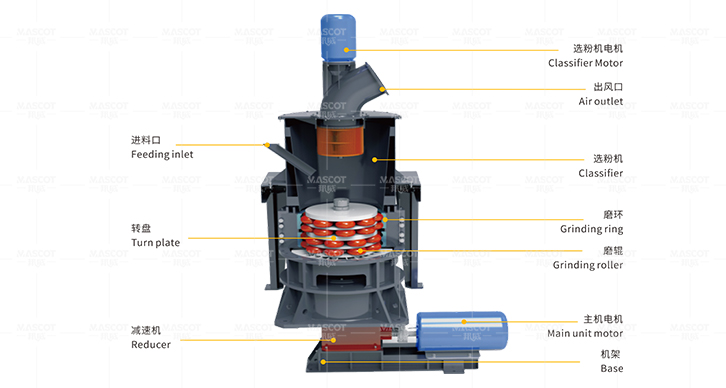
On an ultra-fine mill the classifier, not the grinding chamber, is the control element. In the HGM, raw material up to 10-20 mm is fed evenly into the grinding chamber, where grinding rollers pressed against the ring by centrifugal force crush, impact and grind it into fine particles. High-speed air then carries the powder into the built-in high-precision turbo classifier, which separates qualified fine particles from coarse ones. Only grains fine enough to satisfy the cut point pass through to the cyclone collector and pulse-jet bag filter; everything oversize falls back automatically into the grinding zone for regrinding until it reaches the required fineness.
Because the selection is aerodynamic and speed-based, the operator sets fineness electronically. Adjusting classifier RPM and airflow moves the cut point across the full published band without touching a single wear part, and powder that already meets specification leaves the circuit instead of being ground a second time — the mechanism that keeps the distribution tight at the coarse end instead of smeared. It is also the reason the same machine can be re-tasked between grades in under half an hour, which is the flexibility a filler producer needs when two compounders ask for two different D97 bands in the same week.
Four HGM models cover the ultra-fine production range. All four publish the same finished-product band of 5-47 microns — the 325-2500 mesh range — so model selection is decided by capacity, feed size and duty cycle rather than by fineness.
| Model | Feeding Size (mm) | Output (Micron) | Output (Mesh) | Main Motor (kW) | Classifier (kW) | Capacity (t/h) |
|---|---|---|---|---|---|---|
| HGM80 | ≤10 | 5-47 | 325-2500 | 37 | 11 | 0.35-2.5 |
| HGM1028 | ≤10 | 5-47 | 325-2500 | 75 | 22 | 0.6-4 |
| HGM1036 | ≤20 | 5-47 | 325-2500 | 110 | 30 | 0.9-6 |
| HGM1250 | ≤20 | 5-47 | 325-2500 | 132 | 37 | 1.2-10 |
The published band is a capability envelope, and the four numbers that decide a specification are the mineral and its Mohs hardness, the target D97 in microns, the required capacity at that fineness, and the feed size and moisture going in. A fifth point covers quality: where whiteness, iron contamination or volatiles are limited by the contract, the grinding rollers and ring can be specified in low-iron and ceramic composite grades and the powder path can be ceramic-lined, so the mill does not introduce the contamination the specification forbids. Feed above roughly 6% moisture has to be dried before grinding, and materials harder than Mohs 7 fall outside the HGM's published feed envelope — both are project-design decisions rather than reasons to change the mill.
Wear life is the last item a buyer weighs, and on ultra-fine duty it is a durability question rather than a consumable one. The HGM grinding rollers and rings are cast from high-performance wear-resistant alloy and are reported to last 2-5 times longer than standard steel, which reduces both downtime and maintenance cost on a machine that is expected to run around the clock.
The clearest evidence on D97 control is a plant already shipping against it. A manufacturer of industrial fillers and extenders in Ho Chi Minh City, Vietnam, supplies the Southeast Asian paint, paper and plastics industries, and needed to produce ultra-fine calcite powder at both 800 mesh (D97) and 1250 mesh (D97) from high-purity white calcite lumps of Mohs hardness 3.0 and a feed size of 20 mm and below. Architectural coatings and polymer masterbatch applications set the difficulty: the whiteness had to hold, which meant no iron could be picked up anywhere along the powder path.
Mascot supplied an HGM1028 micro-powder grinding line with a high-precision turbo classifier and a secondary pulse-jet bag filter system, with ceramic-lined piping throughout so that powder never contacts metal. The plant reports 1.5 tons per hour of 1250-mesh calcite powder at a consistent 94.5% ISO brightness, with the turbo classifier achieving D97 pass rates exceeding 98%. Against the jet mill the line replaced, the same fineness is reached with more than 40% less energy — the economics that decide whether an ultra-fine grade is worth producing at all.

Q1: What does D97 mean on a mill datasheet?
A: It is the particle size below which 97% of the finished powder passes. It describes the top of the distribution rather than the average, which is why it is the number normally written into a supply contract for ultra-fine powder.
Q2: Is D97 the same as a mesh specification?
A: No. Mesh counts sieve openings per linear inch and survives mainly as trade shorthand; D97 is a measured statement about the particle-size distribution. Past about 325-400 mesh (44-37 microns on the ASTM E-11 series), sieving stops being practical and the industry quotes microns only, which is why ultra-fine grades are specified as D97 values.
Q3: Which fineness can the HGM hold, and on which materials?
A: The series publishes a finished-product range of 325-2500 mesh, approximately 5-47 microns, for non-metallic minerals with Mohs hardness below 7 and moisture under 6% — calcite, limestone, barite, talc, kaolin, feldspar, gypsum, quartz, wollastonite and similar. The exact classifier setting is material-specific and is set for the project.
Q4: Can one HGM mill serve several D97 grades?
A: Yes. Fineness is set by the classifier through a variable-frequency drive, so the cut point can be moved from a coarse ultra-fine grade to a 2500 mesh grade in under 30 minutes by adjusting classifier speed and airflow, with no mechanical change and no production stoppage for parts.
Q5: What information is needed to quote a D97-matched mill?
A: The mineral and its Mohs hardness, the target D97 in microns (or the equivalent mesh band), the required capacity in tons per hour at that fineness, and the feed size and moisture content. Where the contract limits whiteness, iron or volatiles, those limits should be stated as well — they decide the wear-material and lining specification rather than the model.

D97 is the number ultra-fine powder buyers actually buy: it reports the size that only 3% of a consignment exceeds, and it is the clause that decides whether a delivery passes. It is not interchangeable with a mesh name — mesh is trade shorthand, D97 is a measured limit — and past roughly 400 mesh the industry abandons sieving and quotes microns outright. Holding that number in production is a classification job rather than a grinding job, which is what the HGM Series Micro-powder Grinding Mill is specified around: a variable-frequency turbo classifier that sets the cut point electronically across a published 325-2500 mesh (5-47 micron) band, four models from the HGM80 to the HGM1250 covering 0.35-10 t/h, and grade changes completed in under 30 minutes without mechanical adjustment. Specify the material, the D97 and the tonnage, and the mill can be matched to all three.

About of Mascot
Zhengzhou Mascot Industry is a high-tech mining equipment company integrating R&D, manufacturing, sales, and after-sales service. Focusing on crushing, grinding, and mineral processing equipment, we provide professional solutions to our customers. We are ISO9001:2015 certified, and our products include mobile crushing plants, crawler crushing plant, construction waste crushing plants, jaw crushers, sand making machines, cone crushers, fine crushers, grinding mills, ball mills, etc., all with reliable performance to meet diverse project needs.
• Professional pre-sales support: Free project design and comprehensive solutions to help you accurately select the right equipment;
• Comprehensive on-site service: Providing installation guidance and worker training to ensure smooth equipment commissioning;
• Reliable after-sales guarantee: A complete after-sales system, timely response to technical inquiries and equipment maintenance, ensuring long-term stable operation.
To protect your rights, please contact us through the following official channels for professional service:
WhatsApp: 0086-16650273865
Email: mascot@mascotenv.com
We are committed to providing high-quality equipment and full-cycle services to deliver comprehensive intelligent solutions for the global mining industry!

The ball mill production line is a comprehensive production line that integrates material crushing, grinding, grading, and collection. This production line is mainly used to process various materials, including sand and gravel, cement, new building materials, silicates, refractory materials, fertilizers, ferrous metal beneficiation, non-ferrous metals, glass ceramics, etc.

The gypsum grinding production line is an efficient, stable, and environmentally friendly production solution, which is widely used in construction, decoration, the chemical industry, and other fields. In addition, the grinding process is particularly critical, which directly affects the quality and particle size of the final product. With the continuous development of science and technology, the technical level and production efficiency of gypsum grinding production lines will be further improved, providing strong support for the development of the gypsum processing industry.

The MTW series European grinding mill production line includes high-efficiency crushers, elevators, electromagnetic vibration feeders, milling machines, classifiers, and collectors. These pieces of equipment work together to achieve efficient crushing, grinding, and classification of various non-metallic ores, coal powder, slag, and other materials. It can meet the diverse needs of various industries for powder particle size, uniformity, shape, etc., and offer enterprises high-quality grinding products.

This production line utilizes a three-ring medium-speed micro-grinding mill as the central equipment, complemented by other auxiliary equipment like hammer crushers, bucket elevators, and storage silos to establish a comprehensive grinding operation system. It has demonstrated strong potential for application and market competitiveness in industries such as construction, chemical industry, and new materials.

The Raymond mill production line is a highly efficient system designed for grinding operations, with a focus on energy efficiency, durability, and productivity. It caters to the needs of users by offering fine powder products in non-metallic ores, coal powder, and slag processing, aiding enterprises in achieving sustainable growth.
Green and Intelligent Mining Machinery
Manufacturing and Export Base
Based on high quality and perfect after-sales service, our products have been
exported to more than 120 countries and regions.
Copyright © 2023 Zhengzhou Mascot Environmental Technology Co., Ltd Record number: Yu ICP No. 13021523-4





 WhatsApp