 27
 27
 27

Bentonite is the softest material most grinding plants will ever run. Montmorillonite sits at Mohs 1 to 2, softer than the talc in a nursery, so the wear parts barely register it. What the mill registers is water — and bentonite is a mineral whose entire commercial value is its appetite for water.
That is why a bentonite line can pass its commissioning test at 200 mesh and then lose 15% of its tonnage between the morning sieve and the afternoon one with no part broken and no alarm raised. Output at 200 mesh is not really a machine property. It is a moisture property and an air-volume property that happen to be read off a mill.
The published sheet for a Raymond Mill gives 80–425 mesh, an outlet range of 0.125–0.044 mm, nine models from 3R1510 at 7.5 kW to 5R4119 at 75 kW, and capacity bands running from 0.8 to 60 t/h. The three numbers that actually decide a bentonite project — the residue you must hold, the moisture you can feed, and the tonnage that survives both — are not printed anywhere on that page.
The model table is the only part of the page written to a standard, so it is the part worth building on. Nine models, three to five rollers, ring diameters from 570 to 1,270 mm.
| Model | Rollers (pcs) | Roller L×H (mm) | Ring inner dia. (mm) | Max. feed (mm) | Outlet (mm) | Capacity (t/h) | Power (kW) |
|---|---|---|---|---|---|---|---|
| 3R1510 | 3 | 150×100 | 570 | 15 | 0.125–0.044 | 0.8–10 | 7.5 |
| 3R2115 | 3 | 210×150 | 630 | 15 | 0.125–0.044 | 1–12 | 15 |
| 3R2615 | 3 | 260×150 | 780 | 20 | 0.125–0.044 | 1.5–20 | 18.5 |
| 3R2715 | 3 | 270×150 | 830 | 20 | 0.125–0.044 | 2–28 | 22 |
| 3R3015 | 3 | 300×150 | 875 | 25 | 0.125–0.044 | 2–35 | 30 |
| 4R3016 | 4 | 300×160 | 890 | 25 | 0.125–0.044 | 3–36 | 30 |
| 4R3216 | 4 | 320×160 | 970 | 25 | 0.125–0.044 | 4–45 | 37 |
| 4R3220 | 4 | 320×200 | 970 | 25 | 0.125–0.044 | 4–55 | 45 |
| 5R4119 | 5 | 410×190 | 1,270 | 30 | 0.613–0.044 | 8–60 | 75 |
How to read this table: the outlet column is a range the machine can be adjusted inside, not a promise about what leaves the spout, and tonnage moves down as the cut moves fine. The highlighted model is where most single-line bentonite plants land: four rollers on a 970 mm ring, 37 kW, a band reading 4–45 t/h. Everything after this point is about the gap between that band and a 200 mesh product.
Three numbers on the page do not agree with the table. The badge says feed up to 0–25 mm against a table that allows 15–30 mm; it also says 0.5–60 t/h against a table floor of 0.8 t/h. And the feature block quotes a finished fineness of “613 to 440 microns” — 30 to 35 mesh, which nobody runs on bentonite — while the introduction promises 80–425 mesh. In each case the table is the engineering statement. Size from the table. One further line earns a note: customized versions reach 800 mesh, which is 18 µm and a special build rather than a setting. A standard roller mill asked for 200 mesh is working at a quarter of its floor capability, which is comfortable. Asked for 800 mesh it is a different machine.

200 mesh is 75 µm. On a soft mineral that sounds trivial, but the energy needed to make a 75 µm particle does not care how soft the parent rock was. It cares how small you want the child. Run Bond’s equation with a work index of 11.5 kWh/t — the usual figure for bentonite and soft clay minerals — a feed at 80% passing 15 mm, and a 75 µm product: about 12.3 kWh per tonne at the mill shaft. Divide each motor into that and the tonnage falls out.
| Model | Power (kW) | Bond energy at 75 µm (kWh/t)* | Tonnage at 200 mesh (t/h)* | Published band (t/h) |
|---|---|---|---|---|
| 3R2715 | 22 | 12.3 | 1.8 | 2–28 |
| 4R3216 | 37 | 12.3 | 3.0 | 4–45 |
| 4R3220 | 45 | 12.3 | 3.7 | 4–55 |
| 5R4119 | 75 | 12.3 | 6.1 | 8–60 |
How to read this table: the energy column is calculated, not metered — Bond’s law at 11.5 kWh/t, 15 mm feed, 75 µm product — and it is shaft energy, so the fan, classifier drive, feeder and elevator go on top. Tonnage is motor power divided by that energy. The last column is the brochure.
The gap between the third column and the fifth is the whole point. A 4R3216 that promises 4–45 t/h delivers about 3 t/h on bentonite at 200 mesh; a 5R4119 that promises 8–60 t/h delivers about 6. Neither is a disappointment. Both are what a 75 µm cut costs on a roller mill, and both are normal for a drilling-grade plant. The band was written across the whole outlet range, 125 µm down to 44 µm, and its top belongs to the coarse end.
Two things follow. Size on tonnes at your residue, and make the supplier state the residue its band was measured at. And never accept “200 mesh” as an acceptance clause: a sieve test measures residue, not a distribution, so 100% passing 75 µm and 98% passing 75 µm read as the same sentence and differ by roughly a fifth of your output. Write “residue on 75 µm not exceeding X%” and quotations become comparable.
A bentonite mill that drifts does not drift randomly. It drifts in one of four patterns, and the pattern names the cause before anyone opens a door. The panel gives two readings continuously — main motor current and tonnage — and the sieve gives the third. Read all three together.
| Residue | Mill current | Tonnage | Most likely cause | Check first |
|---|---|---|---|---|
| Rising | Falling | Falling | Damp feed; roller skating on a film | Inlet moisture, dryer outlet |
| Rising | Rising | Falling | Classifier damper closed too far, or worn blades | Damper position, blade clearance |
| Flat | Falling | Falling | Starved feed; bentonite bridging in the hopper | Hopper level, feeder speed, vibrator |
| Flat | Rising | Falling | Ring and roller gap worn open; recirculation climbing | Ring-to-roller measurement at shutdown |
| Unstable | Cycling | Cycling | Air volume fluctuating; filter cleaning too aggressive | Bag filter differential pressure trend |
How to read this table: current is a proxy for how much material is being held and re-ground inside the mill. Rising current with falling tonnage means the machine is working harder on the same material — recirculating more, or grinding a paste. Falling current with falling tonnage means it is not being fed enough work. The residue column separates the two families.
Moisture is the first suspect. A roller mill pinches material between a roller and a ring under spring load; a film of water turns that pinch into a slide. The roller passes over the bed instead of crushing it, the current drops, the product coarsens, and the operator — seeing coarse powder — closes the classifier to compensate, which is the wrong direction and costs more tonnage. Bentonite out of the pit in a wet season arrives at 20–30% moisture, and the mill wants a feed that behaves like sand.
Wear is the second, and it announces itself slowly. The ring wears where the rollers run, so the gap opens by a millimetre over months rather than hours; nothing on the panel changes except that the same spring setting now produces a coarser product. Measure the ring at every shutdown and grind a control sample monthly under fixed settings, so the powder itself becomes the wear gauge.
Air is the third and the least understood. A classifier sorts particles by drag against a rotor and an upward airstream, not by decision. Cut the air volume by 10% — a loaded bag filter, a leaking duct gasket, a damper nudged by vibration — and the cut goes coarse with no mechanical change. That is why the collector is a process instrument here, not just an environmental one: a pulse dust collector holding a stable cleaning cycle at 1.0–1.5 kPa is telling you the air volume is stable, and a rising differential at the same cycle means the classifier is about to lie to you.

A suspended roller mill accepts hot gas at the inlet and will dry two or three points of moisture on the way through, which is not twenty. Bentonite leaving the pit at 25% has to be dried before it is ground, and that decision carries most of the operating cost and most of the quality risk. The usual arrangement is a rotary dryer between crusher and mill: a single cylinder dryer at the small end of the tonnage range, a three-cylinder dryer once the line moves past roughly 30 t/h of wet feed. Either way the target is a moisture figure, not a temperature.
Montmorillonite carries water between the sheets of its structure, which gives it swelling and viscosity, and on the surface, which makes it sticky. Surface water comes off easily; the interlayer water also leaves at low temperature, and once it has gone the swelling index and the viscosity reading do not come back. A dryer tuned to run hot hits the moisture target and misses the product specification, and the failure surfaces at the customer’s viscometer rather than at your own sieve. Dry co-current, control outlet gas temperature, and treat the swelling index as a controlled variable.
Drilling mud is the grade that made 200 mesh a standard: it is bought on a wet-screen residue, a swelling index, a filtrate loss and a viscosity reading at 600 rpm, and the residue requirement is what fixes the mill setting. A 4R3216 making 3 t/h is a normal plant in that market. Foundry sand binder also runs at 200 mesh and tolerates a wider distribution, so the tonnage is higher. Putty and coating fillers sit at 200–325 mesh and are judged on whiteness as well as fineness, which pulls the specification toward an HGM micro-powder mill. Cat litter is 8–30 mesh granules and belongs to a different machine entirely. The route described under bentonite grinding and processing — crush, dry, grind, classify, collect — ends at a different set point for each of them.
Q1: Can a Raymond mill hold 200 mesh on bentonite for a whole shift?
A: Yes, and 200 mesh is its comfortable range rather than its limit. The arithmetic gives about 12.3 kWh per tonne at the shaft for a 75 µm cut, roughly 3 t/h on a 4R3216 and 6 t/h on a 5R4119. What it will not do is hold that number while the feed moisture wanders, so moisture control matters more than the mill spec.
Q2: Why does output fall through the shift while the residue stays acceptable?
A: Usually a starved feed. Bentonite is cohesive, bridges in the hopper and hangs on the walls, so the mill runs with less material than the feeder setting implies. Check hopper level and feeder calibration before touching the classifier: if current is also falling, the feed is the answer; if it is rising, it is wear or recirculation.
Q3: Do I need a dryer before the mill?
A: If the feed arrives above roughly 8% moisture, yes. A roller mill takes out two or three points with hot gas at the inlet, not twenty, and bentonite out of the pit commonly runs 20–30%. Running a wet feed and hoping the hot gas finishes the job is how a plant ends up with a blinded filter and a coarse product at the same time.
Q4: Raymond mill or HGM mill for bentonite?
A: Raymond for 200–325 mesh at a few tonnes an hour, which is where drilling grade and foundry grade live. HGM for 800 mesh and finer, where the price justifies the energy. They are not competitors in the same tender; a plant selling both needs two machines rather than one pushed to its floor. The fineness ceiling of the roller class is set out in how fine a Raymond mill can actually go.

About of Mascot
Zhengzhou Mascot Industry is a high-tech mining equipment company integrating R&D, manufacturing, sales, and after-sales service. Focusing on crushing, grinding, and mineral processing equipment, we provide professional solutions to our customers. We are ISO9001:2015 certified, and our products include mobile crushing plants, crawler crushing plant, construction waste crushing plants, jaw crushers, sand making machines, cone crushers, fine crushers, grinding mills, ball mills, etc., all with reliable performance to meet diverse project needs.
• Professional pre-sales support: Free project design and comprehensive solutions to help you accurately select the right equipment;
• Comprehensive on-site service: Providing installation guidance and worker training to ensure smooth equipment commissioning;
• Reliable after-sales guarantee: A complete after-sales system, timely response to technical inquiries and equipment maintenance, ensuring long-term stable operation.
To protect your rights, please contact us through the following official channels for professional service:
WhatsApp: 0086-16650273865
Email: mascot@mascotenv.com
We are committed to providing high-quality equipment and full-cycle services to deliver comprehensive intelligent solutions for the global mining industry!

The high-pressure grinding mill production line is a project specially designed for efficient grinding operations. It is widely used in metallurgy, building materials, the chemical industry, highways, water conservancy hydropower, and other industries. It is a suspended roller mill that uses springs to increase pressure. It can achieve efficient grinding processing of various non-metallic raw materials. It has high efficiency, stability, and environmental protection characteristics.

The ball mill production line is a comprehensive production line that integrates material crushing, grinding, grading, and collection. This production line is mainly used to process various materials, including sand and gravel, cement, new building materials, silicates, refractory materials, fertilizers, ferrous metal beneficiation, non-ferrous metals, glass ceramics, etc.

The MTW series European grinding mill production line includes high-efficiency crushers, elevators, electromagnetic vibration feeders, milling machines, classifiers, and collectors. These pieces of equipment work together to achieve efficient crushing, grinding, and classification of various non-metallic ores, coal powder, slag, and other materials. It can meet the diverse needs of various industries for powder particle size, uniformity, shape, etc., and offer enterprises high-quality grinding products.

The gypsum grinding production line is an efficient, stable, and environmentally friendly production solution, which is widely used in construction, decoration, the chemical industry, and other fields. In addition, the grinding process is particularly critical, which directly affects the quality and particle size of the final product. With the continuous development of science and technology, the technical level and production efficiency of gypsum grinding production lines will be further improved, providing strong support for the development of the gypsum processing industry.
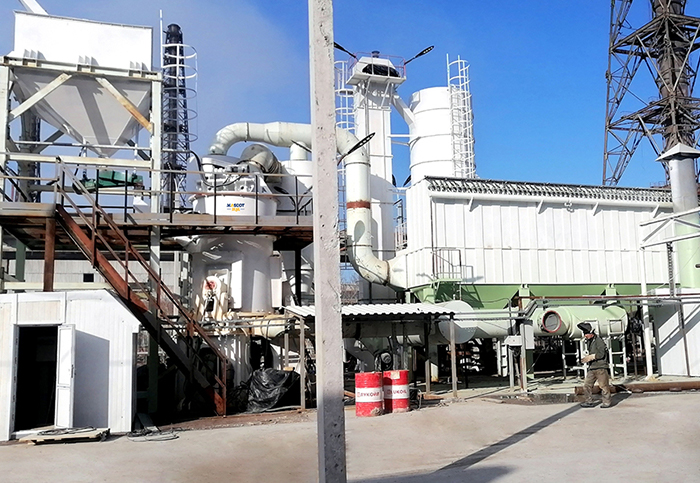
The production line of the vertical roller mill is a cost-effective and energy-efficient solution for processing powder, which is widely used in many industries, such as metallurgy, building materials, industrial solid waste treatment, thermal power plants, cement plants, and environmental protection fields. The primary purpose of this project is to finely grind raw materials through a vertical roller mill to meet the requirements of different industries for particle size, purity, and output of powder products.
Green and Intelligent Mining Machinery
Manufacturing and Export Base
Based on high quality and perfect after-sales service, our products have been
exported to more than 120 countries and regions.
Copyright © 2023 Zhengzhou Mascot Environmental Technology Co., Ltd Record number: Yu ICP No. 13021523-4





 WhatsApp
