
Limestone filler sounds like the easy end of cement grinding. It is softer than clinker, it does not need the same energy, and every quotation for a Raymond mill arrives with a capacity band that looks generous. Then the buyer's specification lands on the table, and it is not written in tonnes at all — it is written as a residue on a 45 µm sieve, sometimes with a Blaine figure beside it.
The published range for a Raymond Mill is 80–425 mesh, with the model table giving an outlet size of 0.125–0.044 mm and customized versions quoted up to 800 mesh. Read those three numbers together and the answer is already visible: a standard machine lives around 325 mesh, reaches 425 mesh only at reduced tonnage, and goes beyond that only as a special build.
Cement specifications describe filler fineness in two different currencies, and they are not interchangeable. The first is a sieve residue, usually the percentage retained on a 45 µm sieve. The second is specific surface, reported as Blaine in m²/kg or cm²/g. A sieve answers "how coarse is the coarsest fraction"; Blaine answers "how much surface have you created". A powder can pass a 45 µm sieve comfortably and still post a modest Blaine if the particles are dense, angular or lightly agglomerated.
That is why two customers can ask for "fine limestone filler" and mean different machines, and why the limestone allowance in a cement standard is a separate question from the grinding circuit. In EN 197-1, Portland-limestone cements carry limestone as a main constituent at 6–20% for CEM II/A-L and 21–35% for CEM II/B-L; in ASTM C150 the allowance is far smaller. The percentage decides how much filler you need to make. The fineness spec decides what it costs per tonne to make it — so get the buyer's certificate in front of you before sizing anything.
The Raymond series runs from 3R1510 to 5R4119, three to five rollers, 7.5–75 kW, with published capacities from 0.8 to 60 t/h. The outlet span is 0.125–0.044 mm on every model except the largest, whose sheet starts at 0.613 mm — that is the coarse setting, not a different machine.
| Model | Rollers (pcs) | Ring inner dia. (mm) | Max. feed (mm) | Outlet (mm) | Capacity (t/h) | Power (kW) |
|---|---|---|---|---|---|---|
| 3R1510 | 3 | 570 | 15 | 0.125–0.044 | 0.8–10 | 7.5 |
| 3R2115 | 3 | 630 | 15 | 0.125–0.044 | 1–12 | 15 |
| 3R2615 | 3 | 780 | 20 | 0.125–0.044 | 1.5–20 | 18.5 |
| 3R2715 | 3 | 830 | 20 | 0.125–0.044 | 2–28 | 22 |
| 3R3015 | 3 | 875 | 25 | 0.125–0.044 | 2–35 | 30 |
| 4R3016 | 4 | 890 | 25 | 0.125–0.044 | 3–36 | 30 |
| 4R3216 | 4 | 970 | 25 | 0.125–0.044 | 4–45 | 37 |
| 4R3220 | 4 | 970 | 25 | 0.125–0.044 | 4–55 | 45 |
| 5R4119 | 5 | 1270 | 30 | 0.613–0.044 | 8–60 | 75 |
How to read this table: the outlet column is a range, not a setting. Every model can be adjusted somewhere inside 0.125–0.044 mm, and the tonnage moves against that adjustment — coarse end gives the published top figure, fine end does not. The highlighted model is the usual starting point for a filler line feeding one cement plant: four rollers, 970 mm ring, 45 t/h published at the coarse end, still inside a moderate connected load.

The product page carries a general claim of 80–425 mesh equivalent to 0.045–0.18 mm, a model table whose floor is 0.044 mm, and a note that customized versions reach 800 mesh. Those are not the same statement, and a buyer is entitled to ask which one the quotation is priced against.
The arithmetic is simple. 0.044 mm is 44 µm, which is 325 mesh. 0.045 mm sits at the same place within rounding. 425 mesh is roughly 33 µm, a quarter finer than the table floor, and 800 mesh is around 18 µm — well outside what a standard suspended roller mill produces at commercial rates.
So the honest answer to "how fine can it go" has two parts. The machine will be set to a 45 µm-class cut in normal service, which is exactly what a cement filler spec asks for. It will reach finer cuts on soft limestone, but the tonnage you can sell at that fineness has to be established by test, not by reading the top of a band.
Specific energy is where fineness stops being a technical question and becomes a commercial one. Take the 5R4119 at its published 75 kW. Running at the coarse end of its band, 60 t/h, the mill draws about 1.25 kWh per tonne of product — a figure nobody should take to the bank, but useful as a scale. Pull the classifier down to a 44 µm cut and the same machine may deliver a fraction of that 60 t/h; at 15 t/h the specific figure is 5 kWh per tonne, and the fan, feeder and bucket elevator add their own draw on top.
The relationship is not linear, and that is the point. Cutting top size from 125 µm to 44 µm is a 65% reduction in the size of the largest particle, but the energy per tonne typically rises by a multiple, because comminution efficiency collapses as particles get small. A quotation that states one tonnage figure without naming the residue it was measured at is not a quotation, it is a range.

Limestone is soft and breaks into angular fragments. Grind it and a good share of the product will pass 45 µm on the first pass through the classifier, while the surface area stays moderate because the fragments are blocky rather than plate-like. A filler that meets the residue requirement can therefore miss a Blaine target, and a filler that meets Blaine can carry coarse tailings that show up on the sieve.
Three practical consequences. If the certificate is Blaine-based, do not accept a sieve-only guarantee. If it is residue-based, check whether the buyer is also testing reactivity or the methylene blue value, because fine clay contaminants in the limestone affect both and no mill setting fixes them. And if the circuit is closed with a dynamic classifier, remember that the cut is set by rotor speed and airflow together; chasing the last few percent of residue by winding the speed up will move tonnage faster than it moves the number.
A Raymond mill is the right answer for a filler line of moderate tonnage, dry feed and a 45 µm-class product. It is the wrong answer in three situations, and recognising them early saves a redesign.
The first is tonnage. Above roughly 60 t/h in a single unit, the economics move toward a vertical roller mill or a ball mill circuit, where the grinding and classification are scaled differently. The second is fineness far below filler grade: if the product has to sit at 800–1250 mesh for a specialty application, the HGM micro-powder mill covers 325–2500 mesh, at a fraction of the tonnage. The third is wet feed, which is a drying problem before it is a grinding problem.
The choice also depends on what else the plant is making. Where limestone filler is one component of a blended cement, the fineness decision interacts with how the other constituents are ground — the trade-offs between intergrinding and separate grinding are set out in which grinding mill handles calcined clay best, and the same logic applies once limestone enters the blend.

Two operating limits matter more than any fineness claim and neither appears in the parameter table. The first is feed moisture. Limestone that arrives damp coats the roller face, packs the grinding ring and blinds the classifier; the panel shows falling output and rising residue, and the operator reaches for classifier speed when the answer is a dry feed. Establish the moisture your stockpile actually carries and specify drying ahead of the mill if it is above a couple of percent.
The second is feed size against the published maximum. The table allows 15–30 mm depending on model. Running a jaw-crushed feed at the top of that allowance leaves no margin for the day the quarry changes, and a roller mill fed oversized lumps produces vibration, not powder. A 10–15 mm pre-crush is cheap insurance on a filler line that has to run continuously.
Hardness is the third, and it is usually fine: limestone sits well below the Mohs 7 ceiling for this mill family. The variable is the silica and clay carried inside it, which decides wear-part life rather than capacity.
Five commitments, all measurable, turn a fineness discussion into a contract. A guaranteed tonnage at a stated residue on a stated sieve, measured on your limestone rather than on a reference material. A specific energy figure in kWh per tonne at that fineness, so the operating cost is part of the guarantee. The Blaine value the product will hold, if the buyer's certificate is surface-based. The test method, the sampling point and who witnesses the acceptance run. And a wear-part life expectation stated in tonnes, so the maintenance budget is not a surprise in year two.
If a supplier cannot answer the first two on paper, the tonnage band in the brochure is decoration. That is true of every mill type, not just this one.
Q1: How fine can a Raymond mill grind limestone?
A: The published range is 80–425 mesh, and the model table gives an outlet floor of 0.044 mm, which is 325 mesh. Finer cuts are achievable on soft limestone and customized versions are quoted up to 800 mesh, but tonnage at that fineness has to be confirmed by test rather than assumed from the band.
Q2: Is 400 mesh necessary for limestone filler in cement?
A: Usually not. Filler specifications are written around a 45 µm residue, and 325 mesh is 44 µm, so a 325 mesh cut already meets a 45 µm requirement. Going finer adds grinding energy per tonne and buys little in a filler role; check which figure the buyer's certificate is written against before paying for fineness you cannot sell.
Q3: My mill will not reach the rated tonnage. What is wrong?
A: Most often nothing is broken. Published bands are measured at the coarse end of the outlet range, so running at 44 µm removes a large share of the headline figure. Before changing parts, check feed moisture, feed size against the 15–30 mm allowance, classifier setting, and roller and ring wear.
Q4: Raymond mill or ball mill for a limestone filler line?
A: For moderate tonnage with a dry feed and a 45 µm-class product, the roller mill is simpler and draws less per tonne. A ball mill earns its place at high tonnage or where the filler is ground together with clinker, and a vertical roller mill sits above both on capacity. The decision is driven by tonnage, moisture and how the product fits the rest of the plant.

About of Mascot
Zhengzhou Mascot Industry is a high-tech mining equipment company integrating R&D, manufacturing, sales, and after-sales service. Focusing on crushing, grinding, and mineral processing equipment, we provide professional solutions to our customers. We are ISO9001:2015 certified, and our products include mobile crushing plants, crawler crushing plant, construction waste crushing plants, jaw crushers, sand making machines, cone crushers, fine crushers, grinding mills, ball mills, etc., all with reliable performance to meet diverse project needs.
• Professional pre-sales support: Free project design and comprehensive solutions to help you accurately select the right equipment;
• Comprehensive on-site service: Providing installation guidance and worker training to ensure smooth equipment commissioning;
• Reliable after-sales guarantee: A complete after-sales system, timely response to technical inquiries and equipment maintenance, ensuring long-term stable operation.
To protect your rights, please contact us through the following official channels for professional service:
WhatsApp: 0086-16650273865
Email: mascot@mascotenv.com
We are committed to providing high-quality equipment and full-cycle services to deliver comprehensive intelligent solutions for the global mining industry!

The MTW series European grinding mill production line includes high-efficiency crushers, elevators, electromagnetic vibration feeders, milling machines, classifiers, and collectors. These pieces of equipment work together to achieve efficient crushing, grinding, and classification of various non-metallic ores, coal powder, slag, and other materials. It can meet the diverse needs of various industries for powder particle size, uniformity, shape, etc., and offer enterprises high-quality grinding products.

The gypsum grinding production line is an efficient, stable, and environmentally friendly production solution, which is widely used in construction, decoration, the chemical industry, and other fields. In addition, the grinding process is particularly critical, which directly affects the quality and particle size of the final product. With the continuous development of science and technology, the technical level and production efficiency of gypsum grinding production lines will be further improved, providing strong support for the development of the gypsum processing industry.
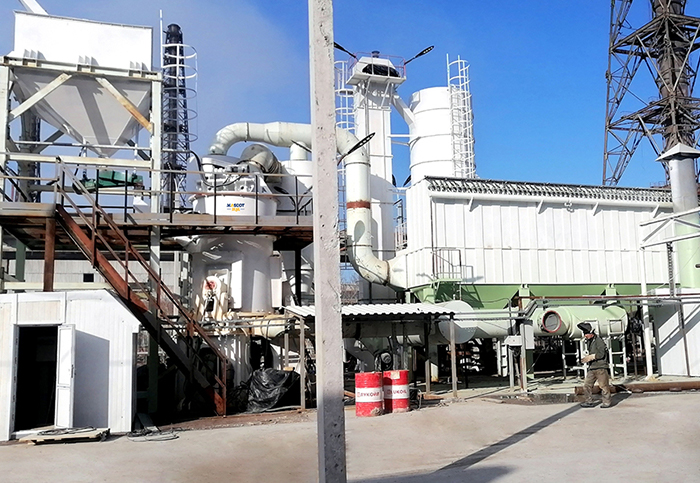
The production line of the vertical roller mill is a cost-effective and energy-efficient solution for processing powder, which is widely used in many industries, such as metallurgy, building materials, industrial solid waste treatment, thermal power plants, cement plants, and environmental protection fields. The primary purpose of this project is to finely grind raw materials through a vertical roller mill to meet the requirements of different industries for particle size, purity, and output of powder products.

The Raymond mill production line is a highly efficient system designed for grinding operations, with a focus on energy efficiency, durability, and productivity. It caters to the needs of users by offering fine powder products in non-metallic ores, coal powder, and slag processing, aiding enterprises in achieving sustainable growth.

This production line utilizes a three-ring medium-speed micro-grinding mill as the central equipment, complemented by other auxiliary equipment like hammer crushers, bucket elevators, and storage silos to establish a comprehensive grinding operation system. It has demonstrated strong potential for application and market competitiveness in industries such as construction, chemical industry, and new materials.
Green and Intelligent Mining Machinery
Manufacturing and Export Base
Based on high quality and perfect after-sales service, our products have been
exported to more than 120 countries and regions.
Copyright © 2023 Zhengzhou Mascot Environmental Technology Co., Ltd Record number: Yu ICP No. 13021523-4





 WhatsApp
