 25
25
 27
27
 27
27
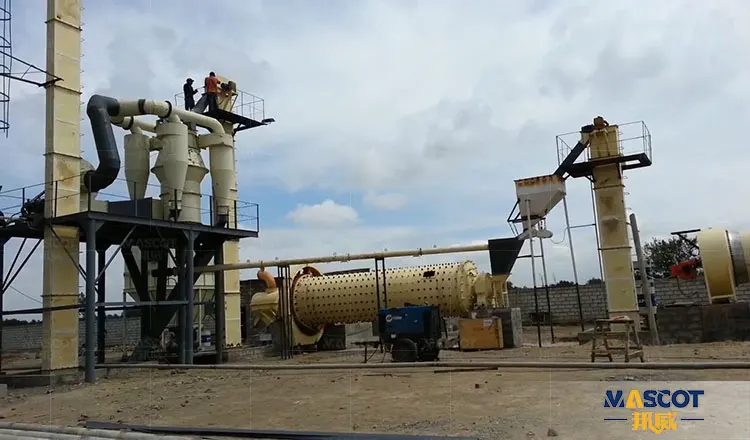
Gold ore grinding is a slurry problem before it is a mill problem. The ore arrives hard and abrasive, the target is usually written as a passing figure rather than a mesh range, and the pulp has to leave the mill in a condition the recovery circuit can use directly. That combination makes two decisions decisive: which media go in the cylinder, and what tonnage the mill can hold at the fineness the leach or flotation circuit actually needs. This guide works through the media and throughput side of a wet ball mill on gold ore — ball charge and ball size, liner choice in an abrasive slurry, slurry density, circulating load, and the published model data behind the numbers. For the sizing procedure itself, the companion article on how to size a wet ball mill for tonnage and mesh takes the calculation step by step.
A wet ball mill grinds ore in water as a slurry, typically at 60-75% solids, and hands that pulp straight to flotation, CIP/CIL or leaching. The choice is not only about dust: water keeps the ultra-fine particles from re-agglomerating, so the size distribution leaving the mill is the size distribution the recovery stage sees, and the transfer is a pump instead of a conveyor.
That has a direct consequence for the specification. Gold circuits normally state the target as a passing figure — for example 80% passing 0.074 mm (200 mesh) for cyanide leaching — rather than as a single mesh value, because liberation, not particle size for its own sake, is what the recovery stage pays for. The mill's job is therefore to deliver that curve at a tonnage the plant's recovery circuit can absorb, and both halves of that sentence are set by the media and the slurry, not by the motor alone.
Throughput complaints almost always trace back to one of six variables, and each of them announces itself with a different symptom. Reading the symptom before touching the ball charge saves a lot of unnecessary media.
| What You Control | What It Changes | The Symptom When It Drifts |
|---|---|---|
| Ball charge and ball size distribution | Impact energy, number of contacts, and the ratio of coarse breaking to fine grinding | Too small a charge or too little coarse media and tonnage falls while the product stays coarse; oversized balls raise wear and over-grind the fine end |
| Target fineness (the passing figure) | Energy per ton, because finer grinding creates more new surface | The same mill delivers fewer t/h at a finer target — a throughput figure is only meaningful with the passing figure written next to it |
| Slurry density (% solids) | Pulp viscosity, transport through the mill and residence time | Thick pulp slows flow and can blind the charge; thin pulp wastes water and mill volume and returns a coarser product |
| Circulating load and classification | How much oversize is returned for regrinding instead of leaving as final product | Too much return recycles work already done; too little lets oversize through the circuit and shows up as recovery loss, not as a tonnage change |
| Liner and lifter condition | How the charge is lifted and cascaded inside the cylinder | Worn lifters flatten the charge trajectory; throughput falls at unchanged power draw, which is the classic worn-media symptom |
| Feed top size versus the model limit | How much coarse breaking the first chamber has to do | Feed above the published limit (20-25 mm depending on model) steals capacity from the target cut and accelerates liner wear |
Three numbers decide the media side of a gold ore mill, and all three are set before the mill is ordered rather than adjusted afterwards.
Total ball charge. The published table gives the loading ball weight for each shell size, from 1.5 t on the 900x1800 pilot unit to 9 t on the 1500x3000 and beyond. Operating below the published charge sacrifices coarse-breaking capacity, which the operator then tries to recover by running the slurry thinner — a fix that usually costs more throughput than it returns.
Ball size distribution. Gold ore is hard and often coarse, so the charge needs enough large balls to break the feed top size, with the smaller sizes doing the fine grinding. Mascot supplies forged or cast steel balls and calculates the optimal initial ball ratio — the size distribution — for the ore and the target fineness, which is a more reliable starting point than copying a charge from a different deposit.
Make-up practice. Media wear is continuous and uneven, because the largest balls disappear first. Replacing them on a measured schedule — by weight and by size class — is what keeps the throughput figure stable between liner changes instead of drifting down with the charge. The same discipline applied to tube mills is set out in media charging practice on a tube mill.
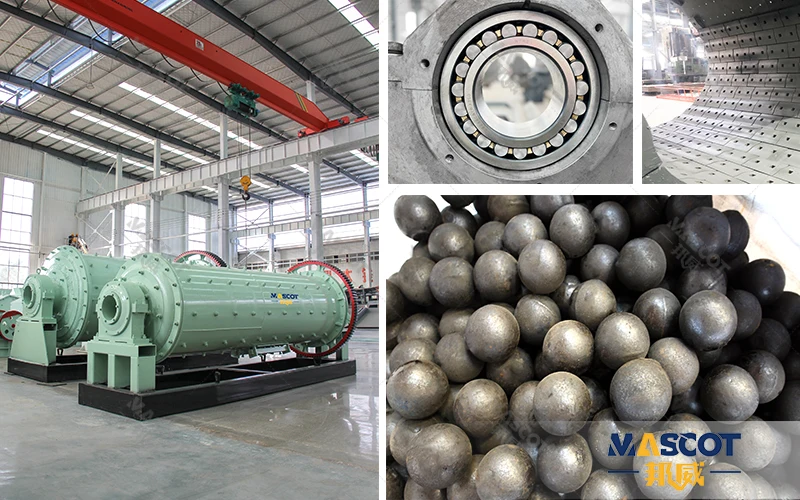
Gold ore slurry is abrasive, and the liner decision is where a wet mill's cost per ton is quietly decided. The published configuration runs Mn13 high-manganese steel liners as standard, with rubber liners offered for finer, highly abrasive slurry; both are matched to the ore, the ball size and the target fineness rather than supplied as a default. Both types are bolt-fitted, so a worn plate is replaced without welding.
Around the liners, several details exist specifically for slurry duty: the shell carries a multi-layer anti-corrosion coating because the pulp is wet and often chemically aggressive; sealed trunnion covers keep slurry and fines out of the shaft, which is the first failure point on a wet mill; and large self-aligning bearings with centralized lubrication points carry the load at the low speeds these mills run (27-38 r/min across the published range). Drive arrangements are sized per model, with star-delta or soft start as standard and a variable-frequency drive optional on the larger shells. For a wider comparison of liner and media practice on wet duty, see the guide to media and liner selection on a wet ball mill.

Slurry is the part of a wet circuit that operators adjust most and understand least. Three rules cover most of it.
The published output size band for the wet series is 0.075-0.89 mm depending on model and duty. In practice, standard models reach 0.074 mm (200 mesh) comfortably — and 400 mesh with an optimised ball charge — because the water keeps fine particles from re-agglomerating. Closed-circuit classification is what keeps the distribution narrow rather than merely fine.
The trade-off is honest and worth writing into a quotation: the finer the passing figure, the lower the tonnage at the same shell size. A mill quoted at its coarse-duty capacity will not deliver that figure at 80% passing 200 mesh, and vice versa. The practical consequence is that a gold project should specify both numbers together — passing figure and t/h — plus the ore's hardness, because those three factors are exactly what a model recommendation has to be built on. Where the cost side of that trade-off matters, the companion analysis of how a wet ball mill's cost per ton is built up sets out the components.
The published series runs from the 900x1800 pilot unit to the 3200x4500 shells, across 22 models. The rows below are the standard sizes most often quoted for small and mid-scale gold slurry duty:
| Model | Speed (r/min) | Ball Charge (t) | Max Feed (mm) | Output Size (mm) | Capacity (t/h) | Power (kW) |
|---|---|---|---|---|---|---|
| 900x1800 | 38 | 1.5 | ≤20 | 0.075-0.89 | 0.65-2 | 18.5 |
| 900x3000 | 38 | 2.7 | ≤20 | 0.075-0.89 | 1.1-3.5 | 22 |
| 1200x2400 | 35 | 4.6 | ≤25 | 0.075-0.6 | 1.6-5.8 | 37 |
| 1200x3000 | 36 | 3.5 | ≤25 | 0.074-0.4 | 1.6-5 | 37 |
| 1500x3000 | 29 | 9 | ≤25 | 0.074-0.4 | 2-7 | 75 |
| 1500x4500 | 27 | 11 | ≤25 | 0.074-0.4 | 3-6 | 110 |
Two practical notes on this table. Capacity is the rated envelope across the output-size band, so a plant targeting the finer end should size on the lower figure. And packing is part of the design: models up to 1500x3000 ship in a single 40 ft container with motor and accessories, while larger shells are split and shipped in sections with assembly drawings. Stock models ship in 7-10 days; customised production takes 15-30 days. The whole circuit — crushing, grinding, classification, slurry pumps, thickener and tailings handling, up to the feed to the recovery stage — can be quoted and commissioned as one package, which is what the 20 TPH ball mill grinding production line case illustrates from the buyer's side.
A useful benchmark for the media-and-throughput relationship comes from a 200 TPD CIP plant in Ghana's Ashanti gold belt. The requirement was continuous grinding of gold ore to 80% passing 0.074 mm for cyanide leaching. The installed configuration was a 1500x3000 wet ball mill with high-manganese steel liners, in closed circuit with a spiral classifier — the same shell listed in the table above at 9 t of balls and 2-7 t/h rated capacity.
The reported operating result: a stable 5-6 t/h at 80% below 0.074 mm, 15% above the customer's original target, with gold recovery in the subsequent leaching stage improving from 88% to 92%. Commissioning took 21 days with two engineers on site, including operator training and a maintenance protocol. That outcome is the argument for closed-circuit classification in a gold circuit: the gain came from holding the passing curve, not from pushing the mill harder.

Q1: What slurry density should a gold ore mill run at?
The published working band is 60-75% solids by weight. Within that band, density is the main control on pulp transport and residence time, so it should be adjusted together with the passing figure rather than to chase a tonnage target. Process water is recirculated from the classifier or hydrocyclone, with fresh makeup of roughly 0.3-0.5 m³ per ton of ore.
Q2: Steel or rubber liners for gold ore?
Mn13 high-manganese steel is the standard choice for coarse feed and higher-impact duty; rubber is offered for finer, highly abrasive slurry. Both are bolt-fitted and replaceable without welding, and both are matched to your ore, ball size and target fineness — which is also the answer to the related question covered in the guide to media and liner selection on a wet ball mill.
Q3: What fineness can the mill reach for leaching or flotation?
Standard models reach 0.074 mm (200 mesh) comfortably, and 400 mesh with an optimised ball charge; the published output band is 0.075-0.89 mm depending on model and duty. The finer the passing figure, the lower the tonnage at a given shell size, so both numbers belong in the same specification.
Q4: How do I know the mill will deliver the tonnage?
Fix the three inputs first — required capacity, ore hardness and target fineness — because those are what a model recommendation is calculated from. A 5-10 kg sample can be run in the laboratory to return a fineness curve with the recommended media. Reading the tonnage figure without the passing figure next to it is the most common source of disappointment in gold circuits; the sizing procedure itself is set out in how to size a wet ball mill for tonnage and mesh.
Q5: What are the delivery and warranty terms?
Stock models ship in 7-10 days and customised production takes 15-30 days. A 12-month warranty covers the whole machine and a further 12-month warranty covers core components such as bearings, motors and liners, with 24/7 online consultation and engineers available for installation, commissioning and operator training. Where the operating cost side matters more than the purchase price, the breakdown is in how a wet ball mill's cost per ton is built up.
A wet ball mill on gold ore is decided by two things: the media in the cylinder and the passing figure the recovery circuit requires. Media selection means the total ball charge from the published table, a ball size distribution matched to the ore's top size and target fineness, and a make-up practice measured by weight and size class. Throughput means the trade between passing figure and t/h, the slurry density band of 60-75% solids, and a closed classifier circuit that returns oversize instead of letting it through.
Mascot's wet ball mill series runs from the 900x1800 pilot unit to the 3200x4500 shells across 22 published models, with Mn13 or rubber liners matched to the duty, anti-corrosion shell coating and sealed trunnion covers for slurry service, and 5-10 kg laboratory grinding tests that return a fineness curve for your ore. The counterpart machine for water-free duty is the Dry Ball Mill, which is the right choice when the ore reacts with water or the downstream process requires dry powder. Send the passing figure, the tonnage and a sample of the ore, and the charge, the shell size and the classifier can be specified against your own material.

About of Mascot
Zhengzhou Mascot Industry is a high-tech mining equipment company integrating R&D, manufacturing, sales, and after-sales service. Focusing on crushing, grinding, and mineral processing equipment, we provide professional solutions to our customers. We are ISO9001:2015 certified, and our products include mobile crushing plants, crawler crushing plant, construction waste crushing plants, jaw crushers, sand making machines, cone crushers, fine crushers, grinding mills, ball mills, etc., all with reliable performance to meet diverse project needs.
• Professional pre-sales support: Free project design and comprehensive solutions to help you accurately select the right equipment;
• Comprehensive on-site service: Providing installation guidance and worker training to ensure smooth equipment commissioning;
• Reliable after-sales guarantee: A complete after-sales system, timely response to technical inquiries and equipment maintenance, ensuring long-term stable operation.
To protect your rights, please contact us through the following official channels for professional service:
WhatsApp: 0086-16650273865
Email: mascot@mascotenv.com
We are committed to providing high-quality equipment and full-cycle services to deliver comprehensive intelligent solutions for the global mining industry!

The high-pressure grinding mill production line is a project specially designed for efficient grinding operations. It is widely used in metallurgy, building materials, the chemical industry, highways, water conservancy hydropower, and other industries. It is a suspended roller mill that uses springs to increase pressure. It can achieve efficient grinding processing of various non-metallic raw materials. It has high efficiency, stability, and environmental protection characteristics.

The gypsum grinding production line is an efficient, stable, and environmentally friendly production solution, which is widely used in construction, decoration, the chemical industry, and other fields. In addition, the grinding process is particularly critical, which directly affects the quality and particle size of the final product. With the continuous development of science and technology, the technical level and production efficiency of gypsum grinding production lines will be further improved, providing strong support for the development of the gypsum processing industry.
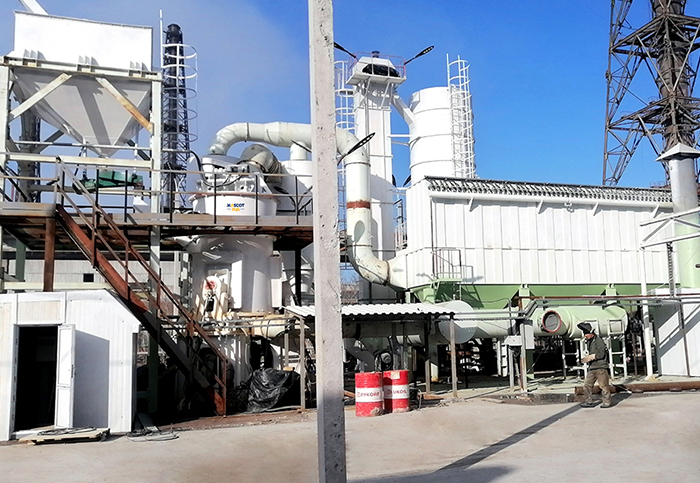
The production line of the vertical roller mill is a cost-effective and energy-efficient solution for processing powder, which is widely used in many industries, such as metallurgy, building materials, industrial solid waste treatment, thermal power plants, cement plants, and environmental protection fields. The primary purpose of this project is to finely grind raw materials through a vertical roller mill to meet the requirements of different industries for particle size, purity, and output of powder products.

The ball mill production line is a comprehensive production line that integrates material crushing, grinding, grading, and collection. This production line is mainly used to process various materials, including sand and gravel, cement, new building materials, silicates, refractory materials, fertilizers, ferrous metal beneficiation, non-ferrous metals, glass ceramics, etc.

YGMX Enhanced High-Pressure Mill is a new type of high-performance grinding equipment, and the biggest improvement of this milling equipment lies in the increase of the high-pressure spring system in the grinding roller part. Compared with the traditional high-pressure roller mill, it has a wider scope of application and excellent performance to meet the production needs of a variety of powder fineness. It is widely used in non-metallic minerals, chemicals, building materials, metallurgy, environmental protection, etc. Multiple areas.
Green and Intelligent Mining Machinery
Manufacturing and Export Base
Based on high quality and perfect after-sales service, our products have been
exported to more than 120 countries and regions.
Copyright © 2023 Zhengzhou Mascot Environmental Technology Co., Ltd Record number: Yu ICP No. 13021523-4





 WhatsApp