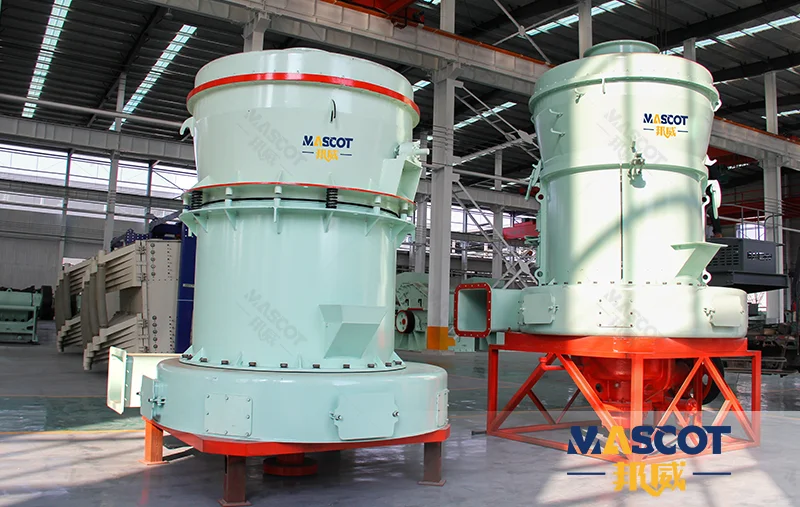
Limestone powder buyers ask two questions before anything else: what mesh, and how many tons per hour. Both answers come from the same place — the model you choose and the fineness you set it to — and getting them out of sequence is the most common reason a limestone line disappoints in its first month. This guide sets out the YGM High Pressure Grinding Mill mesh window, the capacity each of the five models actually delivers, and how to match the machine to your rock rather than the other way round.
The YGM series is a vertical suspension roller mill with a single, clearly stated job: grinding non-metallic minerals to the 80-425 mesh band with consistent output and predictable operating cost. Published capacities run from 1.2 to 36 tons per hour, which covers both pilot plants and full-scale production lines.
Limestone is the classic application. It is a soft carbonate, and the whole family — calcite, dolomite and marble included — sits in the same material group at Mohs 3-4, which is why a limestone duty is usually specified by mesh and tonnage rather than by hardness. The powder goes into construction materials, cement additive blending, filler production and power-plant desulfurization, and each of those markets buys on a residue specification rather than on a machine specification.

Across all five models the published output-size range is 0.613-0.033 mm, and the series is built around the 80-425 mesh working band. Where your product lands inside that band depends on the material and the classifier setting, not on the model alone — which is why a 200 mesh limestone contract and a 325 mesh limestone contract can be run on the same machine at different settings.
Changing fineness is a control-panel operation rather than a parts change. It cannot be done while the mill is running: the machine needs a brief shutdown to adjust the classifier speed through the frequency converter, and the adjustment itself takes under 10 minutes with no physical components replaced. If your process calls for frequent moves between, say, 100 mesh and 325 mesh, a dual-classifier setup can be configured to shorten the turnaround between batches.
For a buyer, the practical reading is this: mesh flexibility is a machine capability, but the batch schedule is a plant decision. A producer supplying several mesh grades from one mill should plan the campaign sequence around the shutdown window rather than treating fineness changes as instant.
The table below is the published specification for the series. Note how the feed-size limit rises with the model: a YGM85 accepts up to 20 mm, while the YGM190 takes up to 40 mm, so the upstream crushing stage is sized alongside the mill rather than after it.
| Model | Roller No. | Roller Size (mm) | Ring Inner Dia. (mm) | Feed Size (mm) | Output Size (mm) | Capacity (t/h) | Power (kW) |
| YGM85 | 3 | 270×150 | 830×150 | ≤ 20 | 0.613-0.033 | 1.2-4 | 22 |
| YGM95 | 4 | 310×190 | 950×190 | ≤ 25 | 0.613-0.033 | 2.1-5.6 | 45 |
| YGM130 | 5 | 410×230 | 1280×230 | ≤ 30 | 0.613-0.033 | 2.5-9.5 | 90 |
| YGM160 | 6 | 450×300 | 1600×300 | ≤ 35 | 0.613-0.033 | 8-16 | 132 |
| YGM190 | 6 | 500×330 | 1900×330 | ≤ 40 | 0.613-0.033 | 18-36 | 250 |
Two worked examples show how the table is used in practice. For 5 t/h of limestone at 200 mesh, the YGM130 at 2.5-9.5 t/h with a 90 kW main motor and a feed limit of 30 mm is the starting point. If the same project targets 8-10 t/h, the step up is the YGM160 at 8-16 t/h and 132 kW. And a word of caution that saves money later: the YGM95 at 2.1-5.6 t/h will fall short at 200 mesh on limestone, so it should not be pressed into 5 t/h continuous duty on that duty alone.
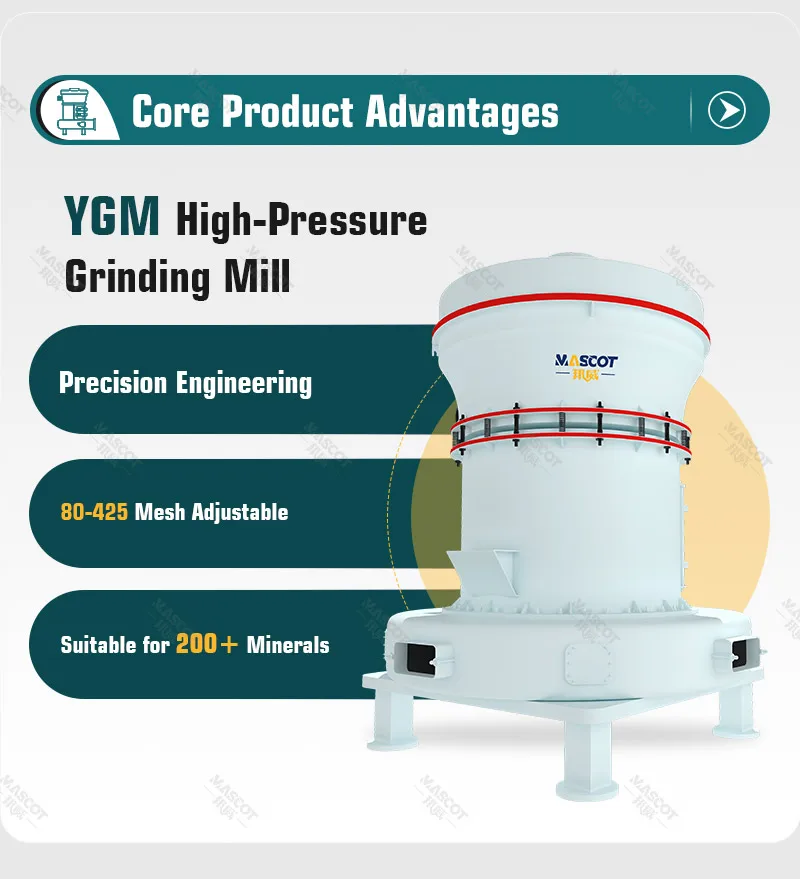
Limestone is not the only feed a YGM mill sees, and hardness changes the model recommendation. The three material groups below are the ones most often quoted against this series; the recommended models assume a normal duty, not the extreme edge of the range.
| Material Group | Examples | Hardness | Best Fit Model |
| Soft Carbonates | Limestone, Calcite, Dolomite, Marble | Mohs 3-4 | YGM130 / YGM160 |
| Hard Silicates | Quartz, Feldspar, Bentonite, Kaolin | Mohs 6-7 | YGM130 / YGM190 |
| Soft Industrial | Gypsum, Barite, Talc, Fluorite | Mohs 1-4 | YGM85 / YGM95 |
The pattern is worth reading twice: the same YGM130 appears in both the soft carbonate and hard silicate groups, because it is the machine that fits a mid-sized tonnage whatever the material — while the largest model is reserved for high tonnage or hard feed, and the smallest two for soft industrial minerals where the tonnage requirement is modest.
The fineness a YGM mill delivers is set by its classification loop, not by the grinding force alone. The five stages run in a closed cycle:
1. Feeding. Raw mineral materials are fed evenly and continuously into the grinding chamber by the feeding device at a stable feeding speed.
2. Grinding. Driven by the main motor, the grinding rollers and grinding ring squeeze, impact and grind the material repeatedly into fine particles.
3. Classification. High-speed air flow works with the built-in powder classifier to separate qualified fine particles from coarse ones precisely.
4. Collection. Qualified fine powder is carried by airflow into the dust collector and collected as finished product.
5. Re-circulation. Oversized unqualified particles fall back to the grinding area automatically for secondary regrinding until they reach the required fineness.
Because the classifier returns oversize material automatically, the mill's output fineness is a function of classifier speed and airflow rather than of the operator's judgement. That is what makes a documented mesh contract achievable shift after shift — and it is also why the fineness adjustment in step 2 of this article is a control change rather than a mechanical rebuild.
A Nigerian producer in Kogi State needed 8-10 tons per hour of consistent 200 mesh limestone powder to supply three local cement batching plants. Two constraints shaped the project: a tight budget, and an unstable local power supply with frequent voltage drops.
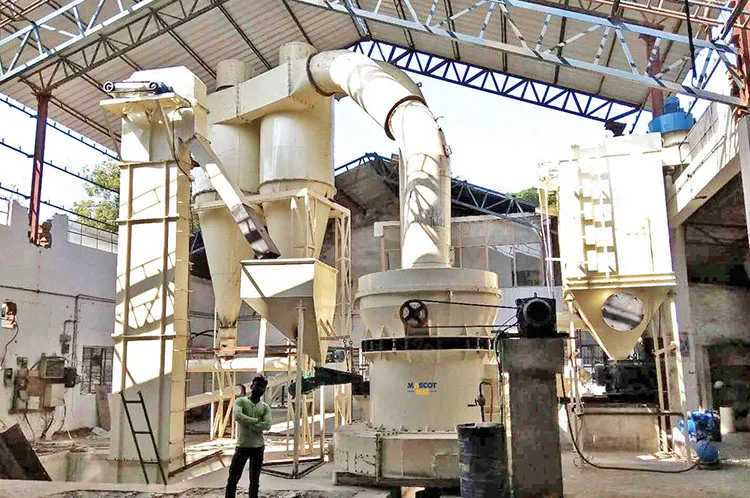
The installation is a single YGM160 configured with a variable-frequency classifier drive and a voltage stabilizer panel, with a hot-air inlet added to handle the 7-8% moisture in the rainy-season feedstock. The Mascot engineer spent five days on site for installation and operator training. The mill has since run at 9-10 t/h average output for 18 months, at a reported direct operating cost of $1.92 per ton covering power and wear parts. The first roller replacement came at 1,700 hours, inside the expected service window, and the customer ordered a second YGM160 in 2025 for a new site in Ondo State.
The lesson from that project is worth stating plainly: the mill matched the tonnage, but the voltage stabilizer and the hot-air inlet are what made the tonnage repeatable through a rainy season. Capacity on paper and capacity on site are separated by the conditions at the plant.
A YGM installation is deliberately modular. A reinforced concrete base of 300-400 mm thickness is standard, with anchor bolts cast in place according to the foundation drawing; the base measures roughly 4×3 m for YGM85-YGM130 and roughly 5×4 m for YGM160-YGM190, and total civil work typically takes 5-7 days. The main grinding unit — base, body and classifier housing — ships as a single skid-mounted assembly, with the blower, cyclone collector, piping and electrical panel on separate pallets. On-site assembly takes 3-5 days with an engineer supervising; no heavy crane is needed for YGM85-YGM130, while YGM160 and YGM190 require a 25-ton mobile crane for the main unit lift.
On consumables, the operating discipline is simple: rollers, rings, classifier blades and bearings for all five models are held in inventory year-round, with express air freight typically 5-7 days to a major port and sea freight 25-35 days to most African and Southeast Asian ports. The recommendation is to order spares when the current set reaches 60-70% of its expected service life rather than when it fails, which keeps one set of rollers and one ring on the shelf at all times.

Q1: I need 5 t/h of limestone at 200 mesh — which model fits?
A: The YGM130 (2.5-9.5 t/h) is the starting point, running a 90 kW main motor and accepting feed up to 30 mm. If the target is closer to 8-10 t/h, step up to the YGM160 (8-16 t/h, 132 kW). The YGM95 (2.1-5.6 t/h) will fall short at 200 mesh on limestone and should not be used for 5 t/h continuous duty.
Q2: Can I switch between 100 mesh and 325 mesh without stopping the machine?
A: No. Fineness changes require a brief shutdown to adjust the classifier speed through the frequency converter; the adjustment itself takes under 10 minutes and no physical parts are replaced. For processes that change mesh frequently, a dual-classifier setup can be configured for faster turnaround between batches.
Q3: Does the mill come with certification for import clearance?
A: All YGM mills ship with ISO 9001 factory certification as standard, and motors and electrical components carry CE marking. Where a destination country requires specific documentation — SASO for Saudi Arabia, SONCAP for Nigeria, PVOC for Kenya — the compliance package is provided.
Q4: Can I test my material before ordering?
A: Yes, and it is encouraged. Ship 20-30 kg of material to the Zhengzhou factory; it is run through the recommended model with throughput, power draw and particle size distribution recorded, and a test report with photos and a 500 g finished sample is returned within 5 working days. The test is free of charge; the customer covers freight.
Q5: What maintenance does the operator need to do?
A: Daily: check the lubrication oil level in the main bearing housing, inspect belt tension and clean the dust collector filter bags. Weekly: grease all roller bearing points (2-3 strokes each) and check classifier blade wear. A standard mechanic's toolkit and a grease gun are sufficient, and a laminated daily checklist is supplied with every machine.
For limestone, mesh and capacity are one decision, not two. Fix the target fineness and the required tonnage first, then read the model off the table — YGM130 for a 5 t/h 200 mesh line, YGM160 for 8-10 t/h on the same material, YGM190 when the tonnage or the hardness rises. Remember that fineness is changed through the classifier at the control panel rather than by swapping parts, that feed size limits rise with the model, and that the ancillary decisions (voltage stabilisation, hot-air drying for high-moisture feed, spare rollers on the shelf) are what decide whether the nameplate tonnage is the tonnage you actually produce.
The YGM High Pressure Grinding Mill covers the 80-425 mesh band with capacities from 1.2 to 36 t/h across five models. Where a product has to go finer than that band, the next step up in fineness class is the HGM Series Micro-powder Grinding Mill. Send your material, target mesh and required tonnage, and the model, classifier setting and foundation plan can be specified against your numbers.

About of Mascot
Zhengzhou Mascot Industry is a high-tech mining equipment company integrating R&D, manufacturing, sales, and after-sales service. Focusing on crushing, grinding, and mineral processing equipment, we provide professional solutions to our customers. We are ISO9001:2015 certified, and our products include mobile crushing plants, crawler crushing plant, construction waste crushing plants, jaw crushers, sand making machines, cone crushers, fine crushers, grinding mills, ball mills, etc., all with reliable performance to meet diverse project needs.
• Professional pre-sales support: Free project design and comprehensive solutions to help you accurately select the right equipment;
• Comprehensive on-site service: Providing installation guidance and worker training to ensure smooth equipment commissioning;
• Reliable after-sales guarantee: A complete after-sales system, timely response to technical inquiries and equipment maintenance, ensuring long-term stable operation.
To protect your rights, please contact us through the following official channels for professional service:
WhatsApp: 0086-16650273865
Email: mascot@mascotenv.com
We are committed to providing high-quality equipment and full-cycle services to deliver comprehensive intelligent solutions for the global mining industry!

YGMX Enhanced High-Pressure Mill is a new type of high-performance grinding equipment, and the biggest improvement of this milling equipment lies in the increase of the high-pressure spring system in the grinding roller part. Compared with the traditional high-pressure roller mill, it has a wider scope of application and excellent performance to meet the production needs of a variety of powder fineness. It is widely used in non-metallic minerals, chemicals, building materials, metallurgy, environmental protection, etc. Multiple areas.

The Raymond mill production line is a highly efficient system designed for grinding operations, with a focus on energy efficiency, durability, and productivity. It caters to the needs of users by offering fine powder products in non-metallic ores, coal powder, and slag processing, aiding enterprises in achieving sustainable growth.

This production line utilizes a three-ring medium-speed micro-grinding mill as the central equipment, complemented by other auxiliary equipment like hammer crushers, bucket elevators, and storage silos to establish a comprehensive grinding operation system. It has demonstrated strong potential for application and market competitiveness in industries such as construction, chemical industry, and new materials.

The high-pressure grinding mill production line is a project specially designed for efficient grinding operations. It is widely used in metallurgy, building materials, the chemical industry, highways, water conservancy hydropower, and other industries. It is a suspended roller mill that uses springs to increase pressure. It can achieve efficient grinding processing of various non-metallic raw materials. It has high efficiency, stability, and environmental protection characteristics.

The ball mill production line is a comprehensive production line that integrates material crushing, grinding, grading, and collection. This production line is mainly used to process various materials, including sand and gravel, cement, new building materials, silicates, refractory materials, fertilizers, ferrous metal beneficiation, non-ferrous metals, glass ceramics, etc.
Green and Intelligent Mining Machinery
Manufacturing and Export Base
Based on high quality and perfect after-sales service, our products have been
exported to more than 120 countries and regions.
Copyright © 2023 Zhengzhou Mascot Environmental Technology Co., Ltd Record number: Yu ICP No. 13021523-4





 WhatsApp