 27
27
 27
27
 27
27

A liner budget is not decided by the liner alone. On a dry ball mill the plate is asked to do two jobs at once — protect the shell and lift the grinding charge — and both of them are governed by readings the plant already takes every shift. Most mills that "eat liners" are not running an inferior grade of steel; they are running a feed, a charge or a speed outside the envelope the machine was dimensioned around, and the liner is simply where the excess shows up first. This guide sets out five checks that can be run on a working dry mill from the published specification of the dry ball mill range from Zhengzhou Mascot Industry, which covers drives from 18.5 kW to 800 kW with grinding media loads from 1.5 t to 65 t and cylinder speeds from 38 down to 18 r/min.
The duty behind liner wear is set before the plate is ever chosen. In a wet circuit the slurry cushions the charge and carries heat away from the contact zone; in a dry circuit there is no liquid to do either job, the feed arrives as an abrasive bulk material, and the powder itself acts as a third body between the media and the plate. The mill is built for that: the Dry Ball Mill uses a barrel of 15-36 mm thick welded steel plate for rigidity, with cast steel flanges welded at both ends to raise the wear resistance and stability of the structure, and the mill is fed with hard industrial minerals up to Mohs 9.
The liner is therefore a working component rather than a sacrificial skin. Its profile lifts the media and shapes the trajectory of the charge, which is why the profile is engineered to maximise grinding contact and not only wear resistance. That single sentence explains the economics of the whole article: a plate that lasts longer and still lifts the charge correctly returns more tons per liner cycle, while a plate that survives but no longer lifts simply converts drive power into heat and noise.
Two published figures frame every check that follows. Standard practice on this range is a Mn13 high-manganese steel liner with a typical service life of 12-18 months under normal conditions; for highly abrasive materials such as quartz and iron ore, a Cr26 high-chrome alloy liner is offered, with a service life of 24 months and beyond. Whether a plant lands at the top or the bottom of those bands is decided in the field, by the five checks below.

The first check is not made at the mill. It is made at the crusher. The dry ball mill range accepts material up to 20 mm on the two smallest models and up to 25 mm on every model from the 1200x2400 upwards, and the published figure applies to what actually arrives at the feed trunnion, not to the nominal setting printed on the crusher. A closed-side setting that has opened by a few millimetres delivers a coarser feed, and oversize material is broken by impact work the liner was never dimensioned to absorb on every revolution.
The check is a screen test on the crusher discharge, taken at the same point in the shift each time, with the oversize fraction recorded as a percentage. Two practical rules follow. First, sample the real discharge rather than the design figure — wear on jaw plates and liners in the crushing stage moves the product curve month by month, so a setting that was correct at commissioning may not be correct in month eight. Second, treat a rising oversize fraction as a liner issue even though it is a crusher issue, because that is where the cost of ignoring it will appear. Closing the circuit, tightening the setting or adding a screening stage is almost always cheaper than consuming an extra liner set per year.

The published media load of each model is a specification, not a suggestion. Across the range the loading ball weight runs from 1.5 t on the smallest mill to 65 t on the largest, and Mascot supplies forged or cast steel balls and calculates the initial ball size distribution to match the feed. For a liner, the two variables that matter are the mass of the charge and the size of its largest balls, because both set the energy delivered at the moment of impact.
A charge heavier than the published load raises the load on the plate and on the drive, and a distribution coarser than the feed requires converts work that should be done by attrition into work done by impact — on the plate rather than on the particle. The same trade runs in the other direction: an under-charged mill has to run longer to reach the target fineness, which increases the number of revolutions the liner sees per ton of product.
The field measurement is the mill's own drive reading. Compare the power drawn at the reference feed rate against the published motor rating for the model, and compare the weighed charge at each reline against the published loading weight. Top-up practice matters as much as the initial charge: balls are added to replace the mass lost to wear, so a plant that tops up by volume rather than by weight gradually drifts away from the distribution the mill was set up with. Keep the make-up record with the liner record, because the two explain each other.
Cylinder speed decides whether the charge cascades or is thrown. The published speeds below are the design envelope of each model, and they fall as the cylinder grows: the smallest mills turn at 38 r/min and the largest at 18 r/min. A mill run above its design speed carries the media higher before release, which changes the trajectory from a controlled cascade into a harder impact against the shell liner, and it does so at every revolution.
| Model | Cylinder Speed (r/min) | Loading Ball Weight (t) | Drive Power (kW) |
|---|---|---|---|
| 900x1800 | 38 | 1.5 | 18.5 |
| 900x3000 | 38 | 2.7 | 22 |
| 1200x2400 | 35 | 4.6 | 37 |
| 1200x4500 | 35 | 5.5 | 55 |
| 1500x4500 | 27 | 11 | 110 |
| 1500x5700 | 29 | 17 | 130 |
| 1830x4500 | 25.4 | 15 | 155 |
| 1830x7000 | 24.1 | 23 | 245 |
| 2100x4500 | 23.7 | 24 | 245 |
| 2200x4500 | 21.5 | 27 | 280 |
| 2400x4500 | 21 | 30 | 320 |
| 2700x4500 | 20.7 | 48 | 430 |
| 3200x4500 | 18 | 65 | 800 |
How to read this table: the values are the published specification of the dry ball mill range: cylinder speed, loading ball weight and drive power for each model. The table carries no capacity column deliberately, because tonnage on a dry line moves with feed hardness, feed size, target fineness and circuit arrangement and has to be confirmed against your material, while the three columns shown here are fixed properties of the machine. Read the table as the reference line for checks 2 and 3: what the drive should draw and what the charge should weigh are published facts, so any departure is a finding rather than an opinion.
In the field, the speed check is a tachometer reading against the published r/min, taken with the mill at normal operating load rather than at no load. On a variable-speed drive it is also worth confirming that the operating set point the operators actually use is the published speed and not a higher figure inherited from a period when the plant was chasing tonnage. Steel on steel is unforgiving of good intentions.
On a dry line the liner is not the only wear part that reports on itself; the air circuit does too, and it is the check most plants never make. Ground powder leaves the cylinder either carried by continuous airflow or by gravity in an open-circuit arrangement, and where the specification is demanding the mill runs in closed circuit with an air classifier. Mascot builds the ball mill and classifier as one closed negative-pressure system with little dust release, and the collection stage — cyclone separator and pulse-jet bag filter — recovers the product while keeping the circuit under suction.
Three readings belong in the round. The negative pressure across the circuit tells you whether the powder is being carried out or held in the cylinder. The differential pressure across the bag filter tells you whether the airflow the mill depends on is still available; the pulse-jet filter captures 99.9% of the dust, but only while its media are clean. The recirculating load at the classifier tells you how much material the mill is sending back for regrinding, and this is the reading that shows liner and media wear before the product sieve does. The reason is straightforward: a classifier holds the cut by returning oversize rather than by releasing it, so as the charge and the plate wear and the mill produces a coarser discharge, the classifier quietly absorbs the difference. Product fineness can look acceptable at the laboratory while the mill and the classifier are working harder to achieve it.
A fineness guarantee is written into the contract on systems shipped with a classifier, and the mechanism behind it is a cut point held within about ±5 microns. That guarantee is a reason to keep the air circuit instrumented, not a reason to stop checking it.

The last check is the obvious one, and it is the one most often done by calendar rather than by measurement. A liner is replaced when it reaches its worn limit, not when it reaches a date, and the two are only the same if the duty has not changed. The method that turns this into data costs an hour per stop: put reference marks on the shell at the feed end, mid-cylinder and discharge end, and measure plate thickness at the same positions on every inspection, writing the figures into the same log as the ball charge and the drive reading.
Three findings come out of that log. A thickness that falls at a steady, predictable rate means the operating envelope is right and the replacement can be planned into a production break. A rate that accelerates after a feed change, a crusher adjustment or a charge top-up points at the variable that changed, and the liner is the messenger. And a wall that is thin at one position while the rest of the cylinder is sound points at the profile and the charge distribution rather than at the grade of steel.
Replacement itself should be planned around the construction of the mill. Liners on this range are supplied as a modular segmented set, so individual plates can be swapped without stripping the whole cylinder, which reduces the stop to hours rather than days. That is also why the grade decision is worth revisiting once a plant has real operating data: Mn13 at 12-18 months is the normal-duty answer, and where the feed is quartz, iron ore or another highly abrasive material, moving to a Cr26 high-chrome alloy liner at 24 months and beyond is a straightforward comparison against the cost of an extra shutdown per year.
| Field Check | Where You Read It | What Normal Looks Like | What a Deviation Suggests |
|---|---|---|---|
| Feed size | Screen test on the crusher discharge, not the setting | Oversize fraction stable against the published 20 mm / 25 mm limit | Crusher wear has opened the setting; the liner is absorbing breakage work |
| Ball charge | Drive power at reference feed rate; weighed charge at reline | Power near the published drive rating and charge near the published loading weight | Excess mass or an oversize top ball is converting attrition into impact |
| Cylinder speed | Tachometer reading against the published r/min | Operating set point equals the published speed of the model | The charge is being thrown rather than cascaded, every revolution |
| Air circuit | Negative pressure, filter differential, classifier recirculating load | Suction stable, filter differential within its band, recirculation steady | Wear is being hidden by the classifier returning more oversize |
| Liner plate | Thickness at marked positions at feed end, mid-cylinder, discharge end | A steady, predictable rate of loss across the set | The change point is upstream of the mill, not in the plate |
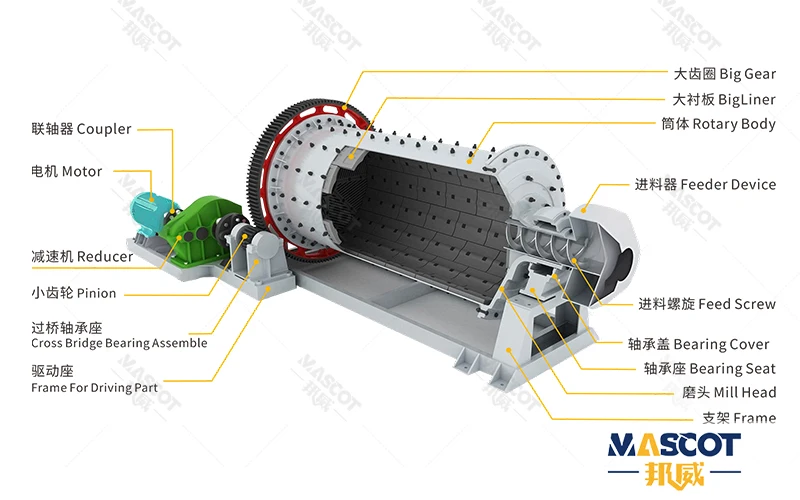
No single reading identifies a liner problem, and that is the practical difficulty. A liner that has worn to the point where it no longer lifts the charge properly produces a characteristic combination rather than a single alarm: throughput falls at a feed rate and a classifier setting that have not changed, the recirculating load at the classifier rises, and the discharge from the cylinder becomes coarser while the finished product still passes. The plant sees a tonnage problem; the cause is in the contact zone.
The combination to separate first is charge against liner. A coarser distribution or a charge above the published load produces higher power draw and faster plate wear; a worn plate produces lower power draw and less grinding work per revolution. Both end in lost tonnage, and they are distinguished by reading the drive and the plate together rather than one at a time. The second combination to separate is the air circuit against the mill: if the classifier is returning more oversize while the drive reading is unchanged and the plate thickness is following its predicted line, the mill is behaving normally and the cut point or the filter is not.
Run in that order, the five checks identify the variable that changed before the maintenance budget does. That is the whole return on the exercise: a liner replaced on measurement is a scheduled stop with a known duration, while a liner replaced after a failure is an unplanned stoppage with a delivery lead time attached to it.
Everything above works only if it is written down in one place. Six entries are enough for a plant to move from replacing liners on a calendar to predicting them, and the list is deliberately short enough to survive a shift change.
| Log Entry | Why It Matters |
|---|---|
| Liner grade and installation date | Sets the baseline interval the plant is measuring against, and separates a grade problem from an operating problem |
| Plate thickness at each marked position, each stop | Converts wear from an impression into a rate, which is what makes the next reline plannable |
| Ball load and make-up added, by weight and size | Explains most step changes in plate wear, because the charge and the contact zone move together |
| Drive power at the reference feed rate | The nearest thing to a continuous measurement of what the charge is doing inside the cylinder |
| Classifier cut point and recirculating load | Shows whether fineness is being held by the mill or by the classifier compensating for the mill |
| Feed size sample from the crusher discharge | Dates any change in the material entering the mill, which is where several liner problems begin |
Two operational notes belong alongside the log. The drive and the shell structure should be inspected on the same schedule: this range uses self-aligning roller bearings, an automatic thin-oil lubrication system with a long oil change cycle, and cast steel flanges welded at both ends, and a bearing that is running hot or a bolt that is holding torque differently will distort the way the cylinder carries the charge. And the mill should be treated as part of a system when spares are planned — grates, bearing assemblies and transmission parts are the items that stop a machine unexpectedly, which is why a recommended spare parts list ships with every order so the plant can hold critical items from day one.
The value of running a mill inside its envelope shows up in the numbers a plant is not measuring. A regional cement manufacturer in Rajasthan expanded its clinker pulverising capacity with a Φ3200x13000 dry ball mill integrated with a Mascot air classifier, to hold 300-350 kg/m² Blaine fineness against local construction standards. The reported result was a 12% reduction in power consumption per ton of cement compared with the older units it replaced, with fineness control delegated to the classifier so that several cement grades could be produced on the same mill.
Read against the five checks, the installation is a case of a circuit specified as a system rather than a machine: the feed was prepared to the mill's limit, the charge and the drive were matched to the published specification of the model, the air circuit was designed with the classification stage rather than added to it, and the plant was staffed to run it — Mascot provided a 30-day on-site commissioning service including 10 days of intensive operator training. The 12% figure is an energy result, but the mechanism behind it is the same mechanism that protects a liner: material leaves the circuit at the right size the first time, instead of circulating through the mill until it does.

Q1: How often should liners be replaced on a dry ball mill?
A: The published figure for the standard Mn13 high-manganese steel liner is a typical service life of 12-18 months under normal conditions. Where the feed is highly abrasive — quartz, iron ore and similar materials — a Cr26 high-chrome alloy liner is offered with a service life of 24 months and beyond. Both are intervals rather than guarantees: they move with feed hardness, feed size and running hours, which is why plate thickness should be measured rather than assumed.
Q2: Which liner should a quartz or iron ore plant specify?
A: The Cr26 high-chrome alloy option, on the arithmetic of shutdowns rather than on the price of the plate. At Mn13 service life the plant replaces the set twice as often in the same period, and each replacement carries a stop as well as a parts cost. Mascot also matches the liner profile to the duty, so the plate that is specified lifts the charge correctly for the material rather than only surviving longer.
Q3: How long does a liner change take?
A: Shorter than most plants expect, because the liners on this range are supplied as a modular segmented set: individual plates can be swapped without removing the entire set, which brings the work down to hours rather than days. The practical limit is usually the planned production break rather than the reline itself.
Q4: What are the signs that a liner is wearing faster than it should?
A: Throughput falling at an unchanged feed rate and classifier setting, a rising recirculating load from the classifier, a coarser discharge from the cylinder, and a drive reading that drifts away from the published rating for the model. Any of these can have another cause, which is why the readings are checked together and against the plate thickness record rather than one at a time.
Q5: Can the mill keep its fineness as the liners and balls wear?
A: Yes, where the mill runs in closed circuit with an air classifier. The classifier recirculates oversize particles back to the mill and releases only powder that has reached the cut point, holding fineness within about ±5 microns, and every system shipped with a classifier includes a fineness guarantee in the contract. Without a classifier, fineness drifts as liners and balls wear, because there is nothing in the circuit to return the coarse fraction.
Q6: What are the delivery, warranty and service terms?
A: Standard models are typically produced in 20-25 days and large-scale customised mills in 35-50 days, with sea-worthy packing and full documentation. Mascot provides a 12-month warranty on the whole machine and a 12-month warranty on core components such as the classifier, with 24/7 online consultation by email and WhatsApp: 16650273865, engineers available for on-site installation and commissioning, and a recommended spare parts list with every order. For the two decisions that sit either side of this one, see how output and liner choice work on a feldspar and quartz dry line and which dry ball mill fineness sells best at 200, 325 and 400 mesh.
Liner wear on a dry mill is controlled by five readings rather than by a grade of steel: the size of the feed arriving from the crusher, the mass and distribution of the ball charge, the cylinder speed at normal load, the air circuit that carries the powder out and returns the oversize, and the thickness of the plate at marked positions. Checked in that order, they separate the four variables that actually shorten liner life — oversize feed, an over-heavy or over-coarse charge, a mill run above its design speed, and a circuit that is compensating for a worn charge — from the one variable that is genuinely a wear-part decision, which is the grade and profile of the plate.
The published range carries the reference values for those checks: drives from 18.5 kW to 800 kW, media loads from 1.5 t to 65 t, cylinder speeds from 38 down to 18 r/min, and feed limits of 20 mm on the two smallest models and 25 mm across the rest. The Dry Ball Mill is built for that envelope end to end, with a barrel of 15-36 mm welded steel plate, cast steel flanges at both ends, self-aligning roller bearings under an automatic thin-oil lubrication system, segmented liners that make a reline a planned stop, and a closed negative-pressure circuit with the air classifier where the specification demands it. Where the product is purity-critical rather than bulk — glaze, silica or an electronic material where iron pickup rules the batch out — the same checks apply to a machine built around a different contact zone, the Ceramic Ball Mill. Send your feed size, charge record, drive reading and target fineness, and the five checks can be read against your numbers rather than against a table.

About of Mascot
Zhengzhou Mascot Industry is a high-tech mining equipment company integrating R&D, manufacturing, sales, and after-sales service. Focusing on crushing, grinding, and mineral processing equipment, we provide professional solutions to our customers. We are ISO9001:2015 certified, and our products include mobile crushing plants, crawler crushing plant, construction waste crushing plants, jaw crushers, sand making machines, cone crushers, fine crushers, grinding mills, ball mills, etc., all with reliable performance to meet diverse project needs.
• Professional pre-sales support: Free project design and comprehensive solutions to help you accurately select the right equipment;
• Comprehensive on-site service: Providing installation guidance and worker training to ensure smooth equipment commissioning;
• Reliable after-sales guarantee: A complete after-sales system, timely response to technical inquiries and equipment maintenance, ensuring long-term stable operation.
To protect your rights, please contact us through the following official channels for professional service:
WhatsApp: 0086-16650273865
Email: mascot@mascotenv.com
We are committed to providing high-quality equipment and full-cycle services to deliver comprehensive intelligent solutions for the global mining industry!

The Raymond mill production line is a highly efficient system designed for grinding operations, with a focus on energy efficiency, durability, and productivity. It caters to the needs of users by offering fine powder products in non-metallic ores, coal powder, and slag processing, aiding enterprises in achieving sustainable growth.

The ball mill production line is a comprehensive production line that integrates material crushing, grinding, grading, and collection. This production line is mainly used to process various materials, including sand and gravel, cement, new building materials, silicates, refractory materials, fertilizers, ferrous metal beneficiation, non-ferrous metals, glass ceramics, etc.

YGMX Enhanced High-Pressure Mill is a new type of high-performance grinding equipment, and the biggest improvement of this milling equipment lies in the increase of the high-pressure spring system in the grinding roller part. Compared with the traditional high-pressure roller mill, it has a wider scope of application and excellent performance to meet the production needs of a variety of powder fineness. It is widely used in non-metallic minerals, chemicals, building materials, metallurgy, environmental protection, etc. Multiple areas.

The MTW series European grinding mill production line includes high-efficiency crushers, elevators, electromagnetic vibration feeders, milling machines, classifiers, and collectors. These pieces of equipment work together to achieve efficient crushing, grinding, and classification of various non-metallic ores, coal powder, slag, and other materials. It can meet the diverse needs of various industries for powder particle size, uniformity, shape, etc., and offer enterprises high-quality grinding products.

The high-pressure grinding mill production line is a project specially designed for efficient grinding operations. It is widely used in metallurgy, building materials, the chemical industry, highways, water conservancy hydropower, and other industries. It is a suspended roller mill that uses springs to increase pressure. It can achieve efficient grinding processing of various non-metallic raw materials. It has high efficiency, stability, and environmental protection characteristics.
Green and Intelligent Mining Machinery
Manufacturing and Export Base
Based on high quality and perfect after-sales service, our products have been
exported to more than 120 countries and regions.
Copyright © 2023 Zhengzhou Mascot Environmental Technology Co., Ltd Record number: Yu ICP No. 13021523-4





 WhatsApp