 27
27
 27
27
 25
25
Two very different buyers keep arriving at the same grinding question. One is buying powder for a battery-adjacent supply chain, where the acceptable answer is written in single-digit microns and the tolerance for iron, foreign matter and moisture is close to zero. The other is buying filler for paints, plastics, rubber, paper or ceramics, where the powder is judged on gloss, dispersion, brightness and how it behaves in a formulation. They sound like separate industries, and in commercial terms they are — but when they write their specifications down, both describe the same three controls: the cut, the contamination and the consistency. This article sets out what each family of buyers actually asks for, where the two specifications overlap, and what an HGM Micro-Powder Grinding Mill from Zhengzhou Mascot Industry can hold on each.
Battery-adjacent and filler applications are usually described as different markets, and from a sales point of view they are. From the mill's point of view they make the same demands in a different order of severity. A filler buyer's quality discussion is about performance: will this powder give the gloss, the hiding power, the dispersion the formulation needs? A battery-adjacent buyer's quality discussion is about exclusion: what is not in the powder, and whether that has been proven.
Both discussions end in the same three numbers. The cut — in this part of the industry almost always stated as a D97 or a D50 in micron rather than as a mesh figure, because that is the number the buyer's process is formulated around. The contamination profile — iron and foreign matter, which affect brightness in a filler and can render a purity-critical powder unusable. And consistency, the assumption that the tenth delivery behaves like the sample that won the trial. Where the two families differ is in how much of each they demand, not in whether they demand it.

"Battery-adjacent" is the honest description of most mineral powder positions in a battery supply chain: the powder producer supplies a component maker, a separator or coating supplier, a carbon or ceramic processor, or a distributor — not the cell line itself. The specification pattern that follows from that is strict and simple: a fine cut stated in micron, an iron and foreign-matter limit, a moisture limit, and lot-to-lot consistency tight enough that the buyer does not have to re-qualify every delivery.
In this manufacturer's published application notes, the new-energy side of the powder business appears in two concrete places. Lithium carbonate battery powder is named as an application for the company's high-efficiency TS Series vortex powder separator, where the requirement is high-purity fine powder separation rather than size reduction. And kaolin, activated carbon, carbon black and talc are listed among the minerals that feed electronic ceramics, battery materials and paper coatings in the plant application notes, while graphite is named among the minerals the micro-powder line itself is built to process. Those entries describe a demand pattern rather than a set of installed battery projects: the powder has to be fine and it has to be clean, and the buyer intends to prove both before the first container is loaded.
Why the tolerance is so tight is worth stating plainly. A filler buyer who receives a slightly contaminated lot can sometimes blend it away. A purity-critical buyer usually cannot: the contamination is already distributed through the powder, and correcting it downstream costs more than the powder itself. That is why the discussion in this family moves so quickly from fineness to the powder path — the route the product takes after grinding, and whether steel is allowed to touch it.

Filler specifications are just as demanding, but the demands are written in the language of performance. A coatings buyer is buying gloss, hiding power and film smoothness, which translate into a top cut and a brightness value. A plastics or rubber compounder is buying dispersion and mechanical behaviour, which in practice means the fine fraction, a controlled coarse tail and, in many grades, a surface treatment applied after grinding. A paper coating buyer is buying a smooth, bright surface, which makes coarse residue and brightness the critical numbers. A ceramic buyer is buying consistent shrinkage and fired colour, which puts contamination and size consistency first.
Across all of them the same rule applies: the buyer's specification is the cut plus the colour, and the mill has to hold both without one being traded for the other. That is the part of filler supply that separates a supplier who can quote a grade from a supplier who can hold it — the difference discussed from the price side in why ultra-fine powder commands premium prices. The specification pattern for treated grades is the same one described in ultra-fine filler specs for rubber and plastics.
Set the two families against the same five lines and the comparison becomes usable in a quotation.
| What the Buyer Writes | On Battery-Adjacent Powder | On Filler Powder | What the Mill Must Hold |
|---|---|---|---|
| The cut, as D50 or D97 in micron | A fine cut at the top of the mill's range, with the finest fractions controlled | A cut matched to the application: coarser for economy filling, finest where gloss and smoothness matter | A classifier that sets fineness without changing grinding parts, and repeats the cut batch after batch |
| Iron and foreign matter | Purity-critical: contamination cannot be corrected downstream | Brightness-critical: iron and scale tint the product and cut its value as a pigment | A powder path that does not introduce iron, with ceramic-lined classifier housing and piping available where the duty requires it |
| Moisture | Controlled for feeding and for stability in storage after long transit | Controlled for dispersion, storage and coated-grade handling | A sealed, dry air circuit and a controlled discharge and packing stage |
| Lot-to-lot consistency | The buyer must not have to re-qualify each delivery | The buyer's formulation assumes the same behaviour every time | Fineness stability of about ±2% rather than the ±5% conventional lines drift across |
| Evidence and traceability | Measured reports and inspection replace the buyer's own process knowledge | Batch records support the specification the buyer is paying for | Recorded parameters, test data on the buyer's mineral, and a documented reference project |
One column deserves a second look. "What the mill must hold" is identical for a lithium carbonate separator feed and for a paper coating pigment, because the machine requirement does not depend on the industry — it depends on the tolerance. That is why the same platform serves both families and why a producer can move between them without rebuilding the plant.

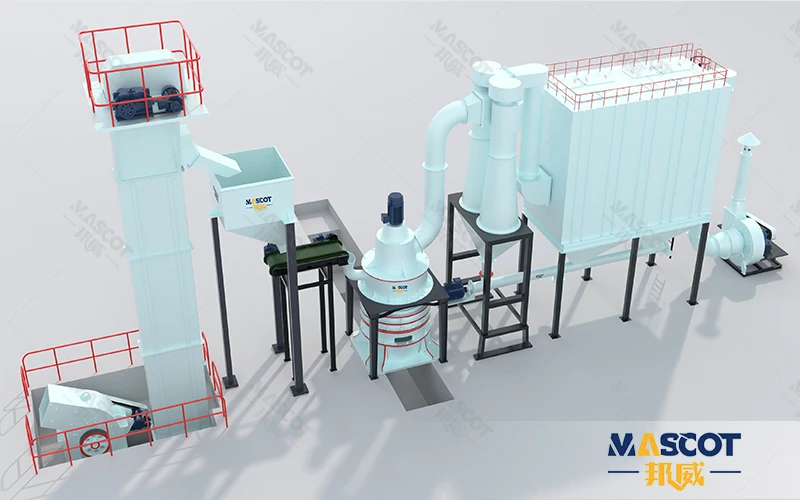
The HGM series is built around the controls in that table. Its multi-layer rollers press the material against the ring under centrifugal force, grinding by pressure and shear rather than impact, so heat generation is minimal and no iron is introduced by the grinding action itself; for whiteness-critical and purity-critical duty the classifier housing and piping are supplied ceramic-lined so the powder never contacts bare steel. A variable-frequency turbo classifier sets the cut, holding a D97 pass rate above 98% with fineness stability of about ±2% and allowing the grade to be changed without swapping grinding parts. Crushing, grinding, classification and collection are integrated in one sealed system with a cyclone collector and a pulse-jet bag filter, which is what keeps the finest fraction — the fraction both families are paying for — inside the product rather than in the air.
The published working range is the ultra-fine band: 325-2500 mesh on the series range, with the finest configurations reaching 3000 mesh, about 4-5 microns. Where an application sits at that extreme, an air-jet mill remains the alternative for a very narrow particle size distribution, at a substantially higher energy cost per ton — a trade-off worth settling with data rather than assumption. How the cut is held on this machine family is set out in D97 explained on the HGM micro-powder grinding mill.
One honest limit belongs in this section, because it is the first thing a serious buyer tests. Absolute output, power draw and the achievable top cut all depend on the mineral itself, so those figures have to be confirmed by a grinding test on the buyer's own material rather than extrapolated from a catalogue. Mascot's answer to this is the one to ask any supplier for: on request, the measured output reports and plant video of the closest comparable reference project, so a producer can see the numbers on a mineral close to their own before committing. The applicable materials run through kaolin grinding and talc grinding to calcite, limestone, dolomite, barite, feldspar, gypsum and graphite.

Because the two spec families share their machine requirements, the same five questions separate a supplier who can hold a grade from one who can only quote it.
| The Question | Why It Matters | What a Strong Answer Looks Like |
|---|---|---|
| Can fineness be changed without changing grinding parts? | Decides whether a second grade needs a second machine or a classifier setting | A variable-frequency classifier that sets the cut across the working range, with the manufacturer's own range published |
| Is the powder path lined? | Iron contamination is the failure mode that ends purity-critical and brightness-critical business | Ceramic-lined classifier housing and piping available for the duty, plus a description of every stage the powder touches |
| Will the cut be confirmed on my own mineral? | Output and achievable top cut are material-dependent | A grinding test on the buyer's sample, or measured data from the closest comparable reference project |
| What evidence accompanies the quotation? | Evidence replaces the buyer's ability to inspect the process | Measured output reports, plant video, reference projects, certification and stated warranty terms |
| What happens to the specification as wear parts age? | Fineness that drifts across the wear cycle creates exactly the complaints a specification was written to prevent | Wear parts designed for the duty, modular replacement, and a service arrangement that keeps the setting repeatable |
Q1: Does the HGM grind battery materials?
The micro-powder line's published applicable materials include graphite alongside kaolin, talc, calcite, limestone, dolomite, barite, feldspar and gypsum. Battery-adjacent demand in this manufacturer's application notes also covers lithium carbonate battery powder on the separator line and kaolin, activated carbon, carbon black and talc feeding battery materials. Because a battery-adjacent grade is mineral-specific, the exact cut and purity have to be confirmed by a grinding test on your own material.
Q2: Why do buyers in both families insist on D97 or D50 instead of mesh?
Because mesh describes an aperture and D97 or D50 describes the product. The micron figure captures the top cut that decides gloss, dispersion and defect levels, and it is the number the buyer's process has already been formulated around.
Q3: What fineness can I expect from one machine?
The series works the ultra-fine band, published as 325-2500 mesh on the series range, with the finest configurations reaching 3000 mesh — about 4-5 microns. The cut is set by the variable-frequency classifier, and the achievable tonnage at the finest end is lower than at coarse grades, so the grade you intend to sell should be the basis of the sizing calculation.
Q4: How is brightness protected on filler grades?
The mill grinds by pressure and shear rather than impact, so little heat is generated and no iron is added by the grinding action, and ceramic-lined classifier housing and piping are available so the powder never contacts bare steel. A sealed circuit with cyclone and pulse-jet bag filter then keeps the fine fraction in the product.
Q5: What warranty and support apply?
A 12-month warranty covers the whole machine and core components — rollers, rings and classifier — with around-the-clock online support, engineer-led installation and commissioning, and operator training on site.
Battery-adjacent and filler buyers arrive from different industries with specifications that look different and behave the same. Both write the cut in D97 or D50 micron, both treat iron and foreign matter as a limit rather than a preference, both require the delivery to match the trial sample, and both ask for evidence. The machine consequences are identical: precise classification that can hold the cut, a powder path that does not introduce contamination, a sealed circuit that keeps the finest fraction in the product, and a fineness setting that can be changed without changing grinding parts.
The HGM Micro-Powder Grinding Mill holds a D97 pass rate above 98% at about ±2% stability across the ultra-fine band, grinds by pressure and shear without introducing iron, offers ceramic-lined classifier housing and piping for purity-critical duty, and covers the range up to 2500 mesh with the finest configurations reaching 3000 mesh. Because absolute output and achievable cut depend on the mineral, Mascot confirms them on your material — send the mineral, the target D50 or D97 and the tonnage, and the closest reference data will be shared with the design.

About of Mascot
Zhengzhou Mascot Industry is a high-tech mining equipment company integrating R&D, manufacturing, sales, and after-sales service. Focusing on crushing, grinding, and mineral processing equipment, we provide professional solutions to our customers. We are ISO9001:2015 certified, and our products include mobile crushing plants, crawler crushing plant, construction waste crushing plants, jaw crushers, sand making machines, cone crushers, fine crushers, grinding mills, ball mills, etc., all with reliable performance to meet diverse project needs.
• Professional pre-sales support: Free project design and comprehensive solutions to help you accurately select the right equipment;
• Comprehensive on-site service: Providing installation guidance and worker training to ensure smooth equipment commissioning;
• Reliable after-sales guarantee: A complete after-sales system, timely response to technical inquiries and equipment maintenance, ensuring long-term stable operation.
To protect your rights, please contact us through the following official channels for professional service:
WhatsApp: 0086-16650273865
Email: mascot@mascotenv.com
We are committed to providing high-quality equipment and full-cycle services to deliver comprehensive intelligent solutions for the global mining industry!

The MTW series European grinding mill production line includes high-efficiency crushers, elevators, electromagnetic vibration feeders, milling machines, classifiers, and collectors. These pieces of equipment work together to achieve efficient crushing, grinding, and classification of various non-metallic ores, coal powder, slag, and other materials. It can meet the diverse needs of various industries for powder particle size, uniformity, shape, etc., and offer enterprises high-quality grinding products.

The gypsum grinding production line is an efficient, stable, and environmentally friendly production solution, which is widely used in construction, decoration, the chemical industry, and other fields. In addition, the grinding process is particularly critical, which directly affects the quality and particle size of the final product. With the continuous development of science and technology, the technical level and production efficiency of gypsum grinding production lines will be further improved, providing strong support for the development of the gypsum processing industry.

YGMX Enhanced High-Pressure Mill is a new type of high-performance grinding equipment, and the biggest improvement of this milling equipment lies in the increase of the high-pressure spring system in the grinding roller part. Compared with the traditional high-pressure roller mill, it has a wider scope of application and excellent performance to meet the production needs of a variety of powder fineness. It is widely used in non-metallic minerals, chemicals, building materials, metallurgy, environmental protection, etc. Multiple areas.

This production line utilizes a three-ring medium-speed micro-grinding mill as the central equipment, complemented by other auxiliary equipment like hammer crushers, bucket elevators, and storage silos to establish a comprehensive grinding operation system. It has demonstrated strong potential for application and market competitiveness in industries such as construction, chemical industry, and new materials.

The Raymond mill production line is a highly efficient system designed for grinding operations, with a focus on energy efficiency, durability, and productivity. It caters to the needs of users by offering fine powder products in non-metallic ores, coal powder, and slag processing, aiding enterprises in achieving sustainable growth.
Green and Intelligent Mining Machinery
Manufacturing and Export Base
Based on high quality and perfect after-sales service, our products have been
exported to more than 120 countries and regions.
Copyright © 2023 Zhengzhou Mascot Environmental Technology Co., Ltd Record number: Yu ICP No. 13021523-4





 WhatsApp