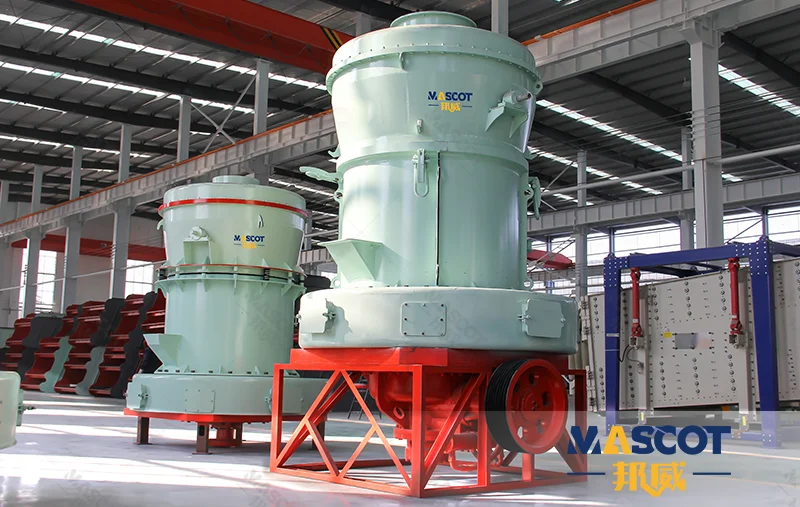
Coal slag arrives at the mill as the residue left behind after coal has been burned or gasified, and it behaves unlike the soft minerals a grinding plant is usually built around: it is abrasive, it varies from one stockpile to the next, and it wears the parts that do the work. That is why a coal slag project is usually decided by two questions rather than one — what tonnage the mill holds, and how often the grinding parts have to be replaced. This guide looks at both on the MTW Trapezium Grinding Mill: the fineness window it works in, the output each model publishes, and the parts that set the cost per ton.
Three properties of a slag-type feed change the way a grinding project is specified, and they arrive together.
The hardness sits higher than the material the plant was probably designed for. In the published material table for this series, slag is grouped with magnesite and manganese ore under mining and metallurgy, at Mohs 5-9, ground to 100-400 mesh for tailings reprocessing. The mill itself is rated for non-flammable, non-explosive minerals below Mohs 9.3, so a slag feed is inside the envelope — but the series' own guidance is explicit about the consequence: above roughly 6 Mohs, expect lower tonnage and faster roller and ring wear. That single sentence is the reason output and wear parts belong in the same specification meeting.
Abrasion is the budget, not the fineness. The published wear consumables on this series are limited to two components — the grinding roller and the grinding ring — both cast in a wear-resistant contour profile. On a soft carbonate those parts are a background cost. On slag they are the dominant recurring line in the operating budget, which is why the model choice and the wear-part strategy have to be made together.
Moisture is a hard limit rather than a preference. Feed moisture up to 6% runs directly in this series. A wetter feedstock should be blended, drained or pre-dried, because moisture in the grinding chamber blocks the material path and drags output down. For slag that has been stored in the open or quenched, the moisture survey belongs in the project design rather than in the operator's daily workaround.
One caution applies to the whole of this section. The Mohs figures and mesh bands in the published material tables are standard industry references for each material group, not test results on your own stockpile. Slag is unusually variable, and the group it is filed under is a starting point for a model recommendation rather than a substitute for a sample.

Across the four models the published output-size range is 0.038-0.2 mm, and the working fineness is adjustable from 80 to 400 mesh. For a slag-type feed the published application band is narrower and coarser at the top end — 100-400 mesh for tailings reprocessing — which is the band to size against if the product is a reprocessed slag powder rather than a fine filler.
How that window is held matters more than its width. The cut is set by the powder classifier, and on this series the electrical control system is designed for one-button startup and for fineness changes made while the mill keeps running, so a plant moving between grades does not schedule a production stop around every change. The same design detail lowers the cost of the wrong setting: because the classifier can be moved without stopping the line, trim it to the specification the market actually buys.
The trade-off to hold in view is the one the series states plainly: capacity is published as a range because the same mill produces less tonnage as the target powder gets finer. On an abrasive feed the practical reading is that the fine end of the window is the expensive end — in wear as well as in tonnage — so a specification should be written to the mesh the customer measures, not to the finest number the mill can reach. Where the gypsum duty of the same series is described in the MTW fineness and wear parts guide, the same window is applied to a feed that does not punish the wear parts; reading the two together is the quickest way to see how much of this series' cost envelope belongs to the material rather than to the machine.
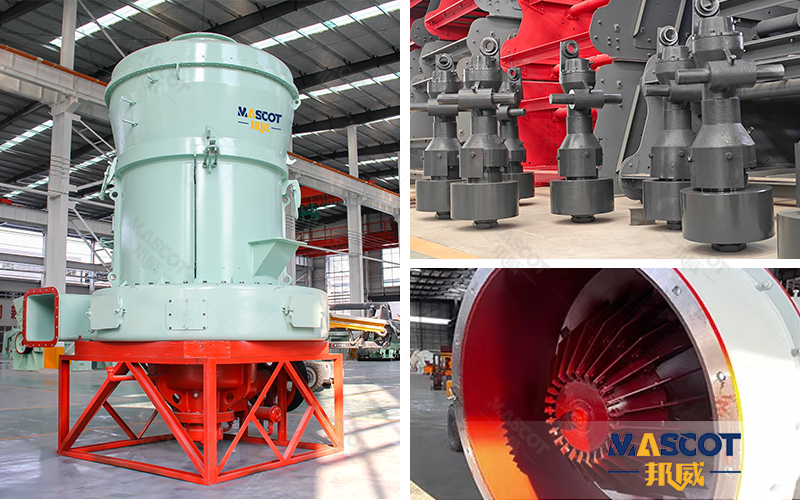
The table below is the published specification for the four models. Three columns decide a slag duty before the capacity figure does: the maximum feed size, which sets the pre-crusher; the power split across the three drives, which is where the efficiency case for a larger frame usually rests; and the capacity band read at your target mesh rather than at its upper limit.
| Model | Roller Size (mm) | Ring Inner Dia. (mm) | Max. Feed Size (mm) | Output Size (mm) | Capacity (t/h) | Main Mill (kW) | Classifier (kW) | Blower (kW) |
|---|---|---|---|---|---|---|---|---|
| MTW110 | 360×210 | 1100×210 | 30 | 0.038-0.2 | 3-10 | 55 | 18.5 | 55 |
| MTW138 | 460×260 | 1380×260 | 35 | 0.038-0.2 | 6-20 | 90 | 22 | 132 |
| MTW175 | 520×300 | 1750×300 | 40 | 0.038-0.2 | 10-35 | 160 | 37 | 200 |
| MTW215 | 640×340 | 2150×340 | 45 | 0.038-0.2 | 20-50 | 220 | 37 | 250 |
How to read this table: the figures are the published specification for the series. The highlighted MTW175 row is included because on an abrasive feed the model that holds the specification with margin is usually worth more than the model that just reaches it: a mill running at the top of its range has no headroom left for a stockpile that turns out harder than the sample. The capacity guide that sets out real tons per hour by model and fineness is the right companion to this table, because it answers how the band narrows as the mesh target rises.
Two sizing points are worth stating for a slag project specifically. The first is that the published capacity band assumes a normal duty, so a feed above the group's middle hardness should be planned toward the lower part of the band rather than the upper. The second is that projects above 50 t/h are served by running more than one unit as a matched set — the same pattern the series' largest frame follows in cement and mineral lines, rather than a step into a different mill class.

The grinding roller and the grinding ring convert motor power into powder, and they are the only grinding consumables the series publishes. Both are cast in a wear-resistant contour profile, and that contour is doing two jobs: it extends service life, and it holds the finished product more uniform, because a plant selling on a residue clause is paid for consistency rather than for average particle size.
| Item | What It Is | Why It Matters on an Abrasive Feed |
|---|---|---|
| Grinding roller and grinding ring | The published wear consumables of the series, cast in a wear-resistant contour profile | They set the replacement interval and therefore the cost per ton; published guidance is to expect faster wear above roughly 6 Mohs |
| Curved air duct | A design feature that lowers air resistance in the classification circuit | Airflow stability matters more when the circuit carries heavy dust: the published field record on a dusty duty is described in section 5 below |
| Thin-oil lubrication | Core bearings run on a thin-oil system rather than grease | Supports continuous three-shift operation without greasing stops, which is what a slag reprocessing line runs on |
| Classifier and its blades | Sets the cut point and is adjustable while the mill is running | Fineness drifting at constant power draw is the usual first sign of wear, so the two readings belong in the same shift log |
| Pulse dust collector | Published at over 99.9% collection efficiency | On a powdered product, dust leaving the stack is product leaving the gate; it also keeps the working area inside local emission limits |
How to read this table: the components and their published descriptions come from the series' own documentation; the third column explains what each one changes in service. The roller and ring row is highlighted because it is the one line in the operating budget that a slag feed moves most, and it is the reason the sample test matters more on this material than on a carbonate.
Two habits turn wear from an event into a plan. The first is to keep the feed inside the published moisture limit: caking in the grinding zone loads the rollers unevenly and costs both throughput and part life. The second is to record product fineness and main-motor power draw every shift — wear normally appears first as a slow drift in fineness at constant power, which is exactly the point at which a replacement can be scheduled instead of absorbed.
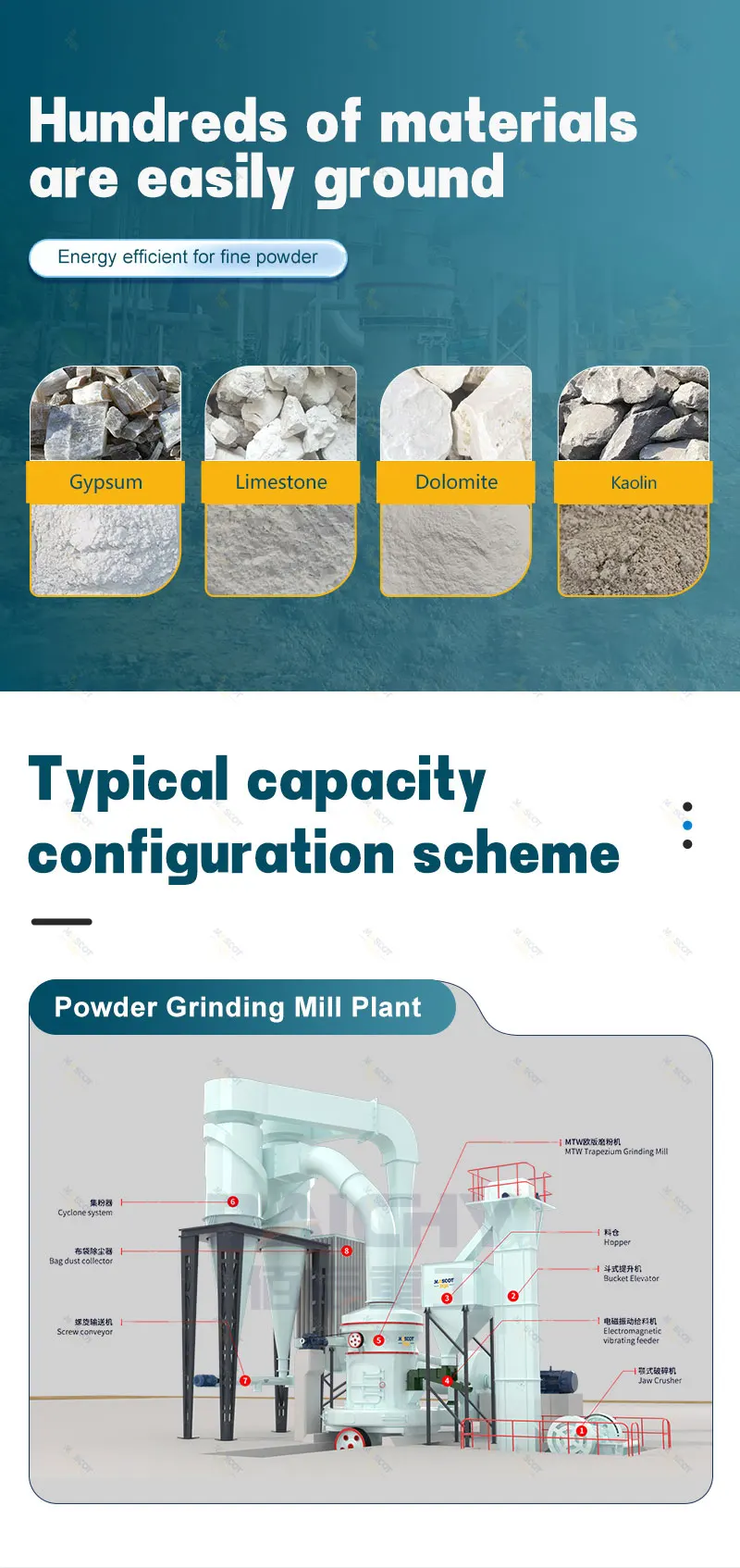
On this series, output and fineness are produced by the same mechanism, and the published description of that mechanism points at a small number of things worth controlling. Material is scooped by scraper blades into the gap between the grinding rollers and the trapezium ring, where it is reduced by rolling compression rather than by impact; airflow then carries the powder to the classifier, which passes the qualified cut and returns the oversize for regrinding.
Even feeding is the first control. A vibrating feeder spreads material into the grinding chamber, and the published operating note is blunt about why the evenness matters: uneven feed is the usual cause of both vibration and unsteady power draw. On an abrasive feed that matters twice, because the same instability that shows on the ammeter is loading the rollers unevenly.
The circuit around the mill is the second. The curved air duct lowers resistance and raises throughput for a given power; the pulse dust collector holds released air above 99.9% efficiency; and the thin-oil lubrication system on the core bearings is what allows three consecutive eight-hour shifts without greasing stops — the operating pattern a slag reprocessing line normally runs. A published cement-additive installation of two of these mills in parallel, producing 15 t/h each at 325 mesh, reported a 22% reduction in power per ton against the older Raymond mills it replaced, together with uninterrupted three-shift operation. That is the same set of design choices seen on a different material, and it is the version of this mill that a continuous slag line should be specified against.
Then the settings themselves. The cut is held by the classifier, so the discipline that makes output repeatable is the one that makes fineness repeatable: move one variable at a time, keep the feed steady, verify with a sample rather than with the panel, and log the setting beside the mill's power draw. The working order for that routine is set out in how to tune MTW fineness and output, and it applies unchanged on a slag duty — with one difference, which is that on an abrasive feed the drift you are looking for appears sooner.
A slag enquiry is answered quickly if the plant sends six things, and each one removes a guess from the specification. Slag varies more between stockpiles than most industrial minerals, which is why the sample matters more here than on a carbonate.
| Input | Why It Decides the Specification |
|---|---|
| A sample of the actual slag, with its measured hardness | Slag is published in the Mohs 5-9 group; where inside that band your stockpile sits decides the model, the wear-part grade and the tonnage to plan on |
| Target mesh and the pass rate behind it | The published application band for slag-type feed is 100-400 mesh, and the pass rate is what the classifier is set for |
| Tonnes per hour of finished powder | Selects the frame from the 3-50 t/h ladder, and above 50 t/h decides how many units run in parallel |
| A seasonal moisture reading | Feed above 6% must be blended, drained or pre-dried before it reaches the grinding chamber |
| The feed size the crushing stage will deliver | The published feed limit is 30-45 mm across the four models, so the crusher and the mill are sized as one set |
| Whether the plant touches the cut daily | Fineness is adjustable while the mill runs, which turns a grade change into a scheduling decision rather than a shutdown |
Where the same series is used at the far end of its capacity range, the published integration record is worth reading before the layout meeting: a Southeast Asian cement group replaced three smaller mills with a single MTW215 on a 1200 tpd raw material line, reporting a 40% reduction in footprint and labour cost with the mill supported by a heavy-duty impact crusher and a centralized control system. The equipment list of a comparable matched set — crusher, mill, classifier, collector and dust filter — is documented in the MTW grinding production line case, which is the checklist any two quotations on a slag line should be compared against. Where the tonnage requirement moves into the very large category and the product is a coarse powder rather than a fine one, the same question is answered by a different machine class, and the Vertical Roller Mill is the frame to compare against at that scale.
Q1: Can an MTW trapezium mill grind coal slag?
A: The series is rated for non-flammable, non-explosive minerals below Mohs 9.3 and 6% moisture, and slag is published in its material table under mining and metallurgy at Mohs 5-9 for 100-400 mesh tailings reprocessing, so a slag feed sits inside the published envelope. Because slag varies between stockpiles, the model and the wear-part grade should be confirmed against a sample of your material rather than against the group figure.
Q2: What output can I expect on a slag-type feed?
A: The published capacity ladder runs 3-10 t/h on the MTW110, 6-20 t/h on the MTW138, 10-35 t/h on the MTW175 and 20-50 t/h on the MTW215, with the band narrowing as the target powder gets finer. On an abrasive feed the published guidance is to expect lower tonnage above roughly 6 Mohs, so plan toward the lower part of the band and choose the model that holds the specification with margin.
Q3: How often do the rollers and rings need replacing on abrasive feed?
A: The series publishes the roller and ring as its only grinding consumables, cast in a wear-resistant contour profile, and states plainly that wear accelerates above roughly 6 Mohs. The published field reference that measures this is a heavy-dust line where high-manganese alloy parts gave 25% longer roller life than the standard parts they replaced — which is why the alloy grade is a specification decision and not a spare-part detail.
Q4: What if the slag arrives wetter than 6%?
A: Feed moisture up to 6% runs directly; above that the material should be blended, drained or pre-dried before it reaches the grinding chamber, because moisture inside the mill blocks the material path and pulls output down. Because the answer changes the capital scope of the line, it should be decided on a seasonal moisture survey of the actual stockpile rather than on a single sample.

About of Mascot
Zhengzhou Mascot Industry is a high-tech mining equipment company integrating R&D, manufacturing, sales, and after-sales service. Focusing on crushing, grinding, and mineral processing equipment, we provide professional solutions to our customers. We are ISO9001:2015 certified, and our products include mobile crushing plants, crawler crushing plant, construction waste crushing plants, jaw crushers, sand making machines, cone crushers, fine crushers, grinding mills, ball mills, etc., all with reliable performance to meet diverse project needs.
• Professional pre-sales support: Free project design and comprehensive solutions to help you accurately select the right equipment;
• Comprehensive on-site service: Providing installation guidance and worker training to ensure smooth equipment commissioning;
• Reliable after-sales guarantee: A complete after-sales system, timely response to technical inquiries and equipment maintenance, ensuring long-term stable operation.
To protect your rights, please contact us through the following official channels for professional service:
WhatsApp: 0086-16650273865
Email: mascot@mascotenv.com
We are committed to providing high-quality equipment and full-cycle services to deliver comprehensive intelligent solutions for the global mining industry!

The gypsum grinding production line is an efficient, stable, and environmentally friendly production solution, which is widely used in construction, decoration, the chemical industry, and other fields. In addition, the grinding process is particularly critical, which directly affects the quality and particle size of the final product. With the continuous development of science and technology, the technical level and production efficiency of gypsum grinding production lines will be further improved, providing strong support for the development of the gypsum processing industry.

The ball mill production line is a comprehensive production line that integrates material crushing, grinding, grading, and collection. This production line is mainly used to process various materials, including sand and gravel, cement, new building materials, silicates, refractory materials, fertilizers, ferrous metal beneficiation, non-ferrous metals, glass ceramics, etc.
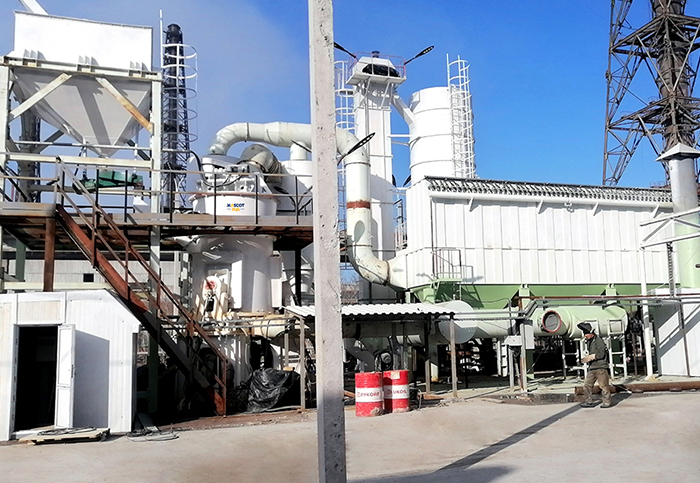
The production line of the vertical roller mill is a cost-effective and energy-efficient solution for processing powder, which is widely used in many industries, such as metallurgy, building materials, industrial solid waste treatment, thermal power plants, cement plants, and environmental protection fields. The primary purpose of this project is to finely grind raw materials through a vertical roller mill to meet the requirements of different industries for particle size, purity, and output of powder products.

The Raymond mill production line is a highly efficient system designed for grinding operations, with a focus on energy efficiency, durability, and productivity. It caters to the needs of users by offering fine powder products in non-metallic ores, coal powder, and slag processing, aiding enterprises in achieving sustainable growth.

The MTW series European grinding mill production line includes high-efficiency crushers, elevators, electromagnetic vibration feeders, milling machines, classifiers, and collectors. These pieces of equipment work together to achieve efficient crushing, grinding, and classification of various non-metallic ores, coal powder, slag, and other materials. It can meet the diverse needs of various industries for powder particle size, uniformity, shape, etc., and offer enterprises high-quality grinding products.
Green and Intelligent Mining Machinery
Manufacturing and Export Base
Based on high quality and perfect after-sales service, our products have been
exported to more than 120 countries and regions.
Copyright © 2023 Zhengzhou Mascot Environmental Technology Co., Ltd Record number: Yu ICP No. 13021523-4





 WhatsApp