 25
 25
 25

Loading a ceramic mill is not a batch operation, even though it happens between batches. The media go in once and stay for years, and every batch discharged afterwards inherits that one decision. A plant that changes its recipe every week but has never weighed its charge is running a process it cannot describe, let alone repeat.
The published frame for the ceramic ball mill range is 100-800 mesh output (0.015-0.154 mm), feed up to 25 mm, dual fine-grinding chambers and an all-ceramic contact path. What the mill does inside that frame is set by four things the loading decision fixes: how much media, of what sizes, filling how much of the cylinder, worked against how much material per batch.
Alumina media and liners are quoted at three to five years of service on feed below Mohs 7. That timescale is the reason loading deserves a record rather than a habit: a batch cycle is measured in hours, a charge in years, and the ratio between them is roughly one decision to several thousand batches.
It also explains why a drifting batch result is hard to trace. By the time the powder changes, the loading sheet (if there was one) is in a drawer and the only evidence left is the product. Four numbers written on the day of loading — mass, size mix, fill level and the batch it was proved on — turn that archaeology into a comparison.
The commonest loading error is a tonnage borrowed from a steel mill. Alumina is roughly half the density of steel, so the same mass of ceramic media occupies close to twice the volume. A charge copied by weight fills a ceramic cylinder far higher than the mill it came from, and the mill then runs with media against media at the top of the cascade instead of media against material.
The published media load for a model is the mass the mill and its drive were specified around — 5 t on the Φ1.2x4.5, 42 t on the Φ2.4x8, 150 t on the Φ3.5x11 — and it is a starting point, not a target to exceed. What the batch actually feels is the fill: the share of cylinder volume the charge occupies. That is the number to measure when the mill is stopped, and the number to change if the batch result needs to move further than the recipe can take it.
| Model (m) | Speed (r/min) | Media load (t) | Power (kW) |
|---|---|---|---|
| 1.2×4.5 | 30.3 | 5 | 55 |
| 1.83×6.4 | 23.9 | 21 | 210 |
| 2.4×8 | 20.3 | 42 | 570 |
| 2.6×13 | 19.5 | 82 | 1,000 |
| 3.5×11 | 16.8 | 150 | 1,250 |
How to read this table: speed and media load are published specification, and the two are linked — the mill runs at 65-80% of critical speed, so a larger cylinder turns more slowly to keep the same cascade. Charge above the published mass does not add grinding capacity; it adds starting torque, drive current and heat, and it is the change most often made when a batch is slow for a different reason.
A dual-chamber mill is two grinding jobs in one cylinder. The first chamber carries the larger media that break the feed down to a workable size; the second carries the smaller media that refine it into the 100-800 mesh window. Charging both chambers with the same size is not a compromise — it means one chamber is doing the wrong job, and the powder shows which one.
In a batch mill the split also sets how evenly the batch is ground. Large media alone leave a wide size spread with a coarse tail; small media alone take too long to reach the same top cut. The working mix is graded — enough large media to break, enough small media to finish — and weighed by chamber rather than poured in as one blend.

The batch recipe fixes material mass; the charge fixes how much work that mass receives. Together they set the ratio the mill actually runs at, and both ends of that ratio fail in recognisable ways. Too little material and the media strike each other: wear rises, iron and alumina pick-up rise with it, and the batch runs hot for no gain in fineness. Too much material and the charge is cushioned, the cascade is damped, and the cycle lengthens until the operator shortens it and discharges a coarse batch.
This is the number to hold constant when nothing else is. Material, moisture and target mesh all change between campaigns; the media-to-material ratio is the part of the recipe the plant owns, and changing it should be a decision with a date on it, not a side effect of filling the mill to the same mark every time.
How the charge goes in matters as much as how much of it goes in. Dumping media from height onto a bare shell puts point loads on ceramic plates that were designed for sliding abrasion, and a cracked plate found at the next inspection is usually traced to a loading day nobody recorded.
Load in lifts, spread the media along the length, and turn the cylinder by barring gear between lifts so the charge settles instead of heaping at one end. Before the first batch, confirm the drive starts cleanly: starting current on an overloaded mill is the first place the error shows. The same stop is worth an hour of inspection — plate condition, grate slots and the diaphragm — because those decide whether the charge you built will behave as designed.

Run a trim batch and sample it before committing the campaign. The sample decides two things: whether the top cut is inside the specification, and whether the cycle time is repeatable. If the cut is right but the cycle is long, the answer is usually the size mix rather than more media. If the cycle is right and the cut drifts, the answer is usually the ratio or the fill.
| What the batch shows | Most likely charge cause | What to change before more media |
|---|---|---|
| Top cut coarse, cycle normal | Too much large media, too little finishing surface | Re-grade the second chamber toward smaller sizes |
| Top cut fine, cycle long | Charge short of breaking capacity, or material ratio too high | Review the first-chamber mix and the batch mass |
| Result drifts batch to batch | Ratio and fill not held constant between batches | Fix the weighed ratio, then re-run the trim batch |
| Iron or colour rejects | Media striking media, or a worn plate in the contact path | Check fill level and inspect liners before adding media |
Read the first row before the others. Most "the mill has gone coarse" reports are answered with more media, when the charge already has enough mass and the wrong distribution. How the lining side of the same decision works is set out in choosing liner material for a ceramic ball mill, and the difference between batch and continuous running — where the charge is loaded once and never re-proved — is covered in batch and continuous operation.
Q1: Should a ceramic mill be loaded by weight or by volume?
A: Weight is how media is bought and recorded; volume is what the mill feels. Because alumina is about half the density of steel, a tonnage copied from a steel mill overfills a ceramic cylinder. Use the published mass for the model as the purchase figure, then confirm the fill on a stopped mill.
Q2: Can the same charge grind both a coarse and a fine product?
A: Within limits. The 100-800 mesh window is covered by the same charge, but a batch specified at the fine end needs either a longer cycle or a finer second-chamber mix. Deciding which one to move is cheaper than re-loading the mill.
Q3: How often should media be topped up?
A: By measurement, not by calendar. Weigh a sample of the charge and compare it with the loading record; a batch that has gone coarse at the same cycle time usually means the small sizes have worn away, not that the mill is short of total mass.
Q4: Does a bigger charge shorten the batch cycle?
A: Only up to the point where the drive and the fill allow the charge to cascade. Beyond that, extra media raise starting current and running power while the cascade shortens, and the cycle barely moves.

About of Mascot
Zhengzhou Mascot Industry is a high-tech mining equipment company integrating R&D, manufacturing, sales, and after-sales service. Focusing on crushing, grinding, and mineral processing equipment, we provide professional solutions to our customers. We are ISO9001:2015 certified, and our products include mobile crushing plants, crawler crushing plant, construction waste crushing plants, jaw crushers, sand making machines, cone crushers, fine crushers, grinding mills, ball mills, etc., all with reliable performance to meet diverse project needs.
• Professional pre-sales support: Free project design and comprehensive solutions to help you accurately select the right equipment;
• Comprehensive on-site service: Providing installation guidance and worker training to ensure smooth equipment commissioning;
• Reliable after-sales guarantee: A complete after-sales system, timely response to technical inquiries and equipment maintenance, ensuring long-term stable operation.
To protect your rights, please contact us through the following official channels for professional service:
WhatsApp: 0086-16650273865
Email: mascot@mascotenv.com
We are committed to providing high-quality equipment and full-cycle services to deliver comprehensive intelligent solutions for the global mining industry!

The gypsum grinding production line is an efficient, stable, and environmentally friendly production solution, which is widely used in construction, decoration, the chemical industry, and other fields. In addition, the grinding process is particularly critical, which directly affects the quality and particle size of the final product. With the continuous development of science and technology, the technical level and production efficiency of gypsum grinding production lines will be further improved, providing strong support for the development of the gypsum processing industry.

The ball mill production line is a comprehensive production line that integrates material crushing, grinding, grading, and collection. This production line is mainly used to process various materials, including sand and gravel, cement, new building materials, silicates, refractory materials, fertilizers, ferrous metal beneficiation, non-ferrous metals, glass ceramics, etc.

The high-pressure grinding mill production line is a project specially designed for efficient grinding operations. It is widely used in metallurgy, building materials, the chemical industry, highways, water conservancy hydropower, and other industries. It is a suspended roller mill that uses springs to increase pressure. It can achieve efficient grinding processing of various non-metallic raw materials. It has high efficiency, stability, and environmental protection characteristics.
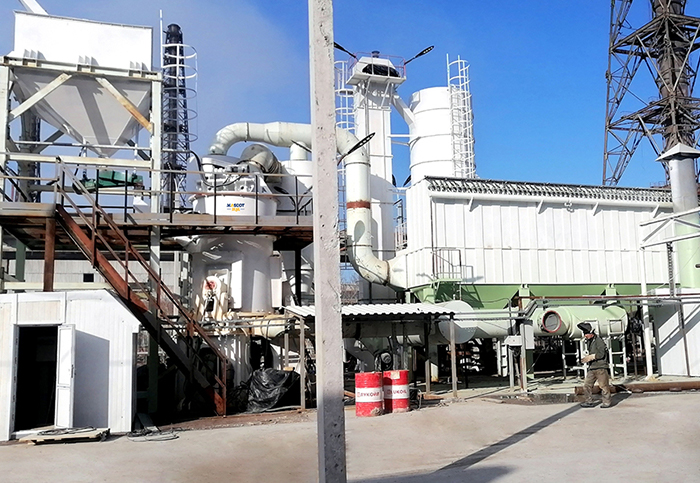
The production line of the vertical roller mill is a cost-effective and energy-efficient solution for processing powder, which is widely used in many industries, such as metallurgy, building materials, industrial solid waste treatment, thermal power plants, cement plants, and environmental protection fields. The primary purpose of this project is to finely grind raw materials through a vertical roller mill to meet the requirements of different industries for particle size, purity, and output of powder products.

The MTW series European grinding mill production line includes high-efficiency crushers, elevators, electromagnetic vibration feeders, milling machines, classifiers, and collectors. These pieces of equipment work together to achieve efficient crushing, grinding, and classification of various non-metallic ores, coal powder, slag, and other materials. It can meet the diverse needs of various industries for powder particle size, uniformity, shape, etc., and offer enterprises high-quality grinding products.
Green and Intelligent Mining Machinery
Manufacturing and Export Base
Based on high quality and perfect after-sales service, our products have been
exported to more than 120 countries and regions.
Copyright © 2023 Zhengzhou Mascot Environmental Technology Co., Ltd Record number: Yu ICP No. 13021523-4





 WhatsApp
