 27
27
 25
25
 27
27

Choosing a lining for a ceramic ball mill is not a spare-part decision. In a steel mill the lining is a wear item that is replaced on an interval; in a ceramic mill it is the component that decides what the plant is allowed to sell, because the same plate that protects the shell is also the surface that determines how much iron ends up in the powder. That is why the published fineness window of the ceramic range, 100-800 mesh or roughly 0.154 mm down to 0.015 mm, is only half of the specification: the other half is a contamination figure that the buyer's own customer enforces. This guide sets out the order in which the lining decision should be made, using the specification of the ceramic ball mill range from Zhengzhou Mascot Industry, which is built with a fully ceramic contact zone and grinding media rather than metal ones.
Plants usually approach the lining question from the price list. A mill quoted with an alumina lining costs more than the same cylinder quoted with manganese steel, so the comparison looks like a straightforward upgrade with a slow payback. Reframed around the product, the arithmetic changes completely: the lining decides whether a batch can be sold at all. A Ceramic Ball Mill is specified for high-purity grinding and mixing where iron contamination has to be avoided, and the industry comparison is blunt — a conventional steel-lined mill typically introduces 0.05-0.15% iron contamination, while a ceramic-lined machine holds the figure below 0.008%.
The two numbers are not variations on a theme; they belong to different markets. Powder at 0.008% iron can be sold to a solar glass line or a glaze house that checks colour batch by batch. Powder at 0.05% iron and above is sold to whoever will take it, at the price that implies. So the first decision is not which lining, but which product: fix the contamination budget your customer enforces, then choose the lining that can hold it, then compare the cost of holding it against the value of the order book it unlocks.
Two mechanical facts belong with the commercial one. The mill rotates at 65-80% of critical speed, so the media cascade under control and the breakage work is done by impact and attrition inside a sealed, metal-free environment rather than by grinding between steel surfaces. And the machine is a two-mode machine: the same unit handles wet grinding as a slurry and dry grinding as a powder with optional ventilation, with no hardware modification required. A tile factory that prepares glaze wet and body mixes dry can therefore run one model line for both duties — which makes the lining decision a single decision rather than two.

Before a lining grade is discussed, three figures should be on the table: the iron content your customer's specification allows, the colour or whiteness standard the batch is judged against, and the value of a rejected batch. The third number is the one that decides the specification, and it is usually far larger than the lining price difference that first prompted the conversation.
The classic case is mineral powder sold into the glass industry, where a single rejected container of solar-glass silica represents a product loss in the region of US$18,000-35,000 before freight is added — against which the incremental cost of an alumina lining is a rounding item. For a ceramics producer the equivalent penalty arrives differently but with the same force: a glaze or body batch that fails on colour is not reworked, it is scrapped, and the cost includes the kiln time it consumed. A lining that prevents one such batch a year has paid for itself in a single occurrence.
That is the argument to put in front of a purchasing committee: contamination is not a quality preference, it is a yield variable. The lining either holds the budget or it does not, and the plant's own QA records — reject rate, colour complaints, iron assays — already contain the evidence of which one is happening today.

Lining selection becomes simple once the inputs are taken in a fixed order. Each input narrows the options, and the useful habit is to write down the answers before contacting any supplier, because those answers are what a quotation should be judged against.
| Decision Input | What the Plant Supplies | What It Settles |
|---|---|---|
| Contamination budget | Iron limit in the finished powder, and how it is measured | Whether a ceramic contact zone is required at all, or a metal lining can be tolerated |
| Material hardness | Mohs hardness and the size of the feed as ground | The wear class of the lining, and whether the standard grade is sufficient or the most demanding grade is needed |
| Chemistry | Acidity or corrosivity of the material, and its sensitivity to reaction | Whether an inert ceramic lining is the correct choice, or a specific chemical-compatibility lining is required |
| Colour criticality | Whiteness target or colour standard applied to the batch | How much metal pickup is acceptable, which is usually far less than a physical specification would suggest |
| Duty and mode | Wet slurry or dry powder; batch or continuous; target residue | The chamber configuration, the media size, and the cycle or throughput the lining has to survive |
How to read this table: the inputs are ordered by consequence, not by difficulty. The contamination budget decides whether the machine is a ceramic mill or an ordinary ball mill; the remaining four inputs decide which ceramic configuration suits the duty. Taken in any other order, the exercise tends to end with a lining recommended on price, which is precisely the outcome the plant is trying to avoid.
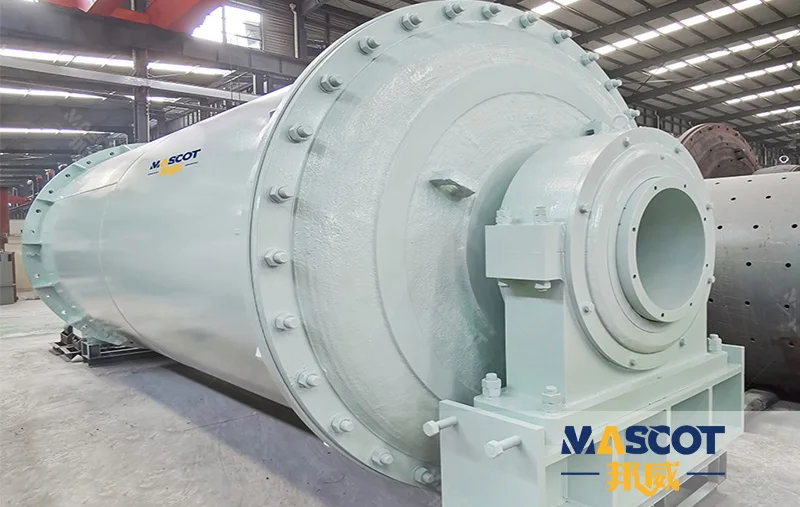
Once the plant knows what it is buying, the grade question is a short one. A 92% high-alumina (Al&sub2;O&sub3;) lining is the working specification for most duties: glaze, feldspar, silica and the bulk of purity-critical production where the material sits below Mohs 7. A 95% ultra-high alumina lining is specified where wear conditions or purity requirements are at their most severe, and it is a decision made per application rather than as a default upgrade. Where a process has a chemical-compatibility requirement that ceramics do not satisfy, a silica lining is the alternative, and the recommendation should follow the material's chemistry and hardness rather than a price preference.
The material in service is not the material most buyers picture. Ceramic linings in industrial mills are not pottery: the plates have a compressive strength above 850 MPa and are precision-cut to interlock inside a steel shell that absorbs the impact, so that the ceramic does the contact work and the steel does the structural work. That composite construction is what makes a lined mill a production machine rather than a laboratory curiosity, and it is the reason the lining can be both the purity solution and the long-life solution at the same time.
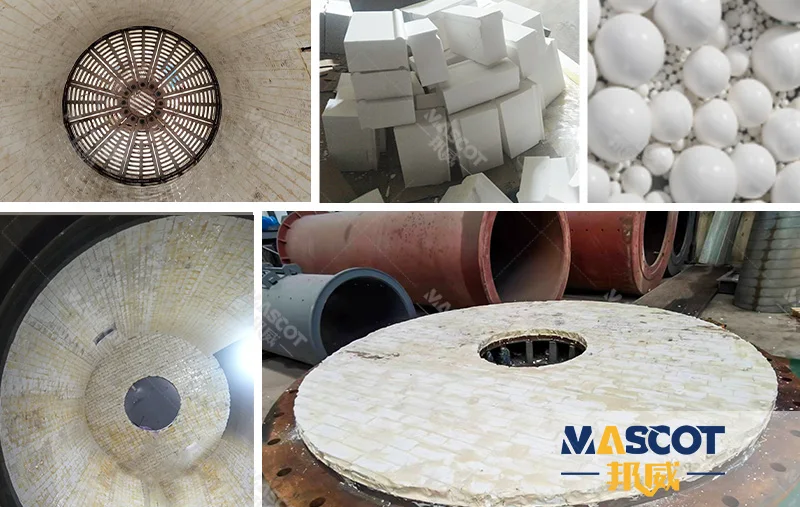
Two further construction points decide how the lining behaves in service. The cylinder on this range is thickened and carries inert ceramic liners with reinforced end covers and heavy-duty bearings, and the grinding chamber is arranged as dual fine-grinding chambers with optimised ceramic liners, which is what produces uniform ultra-fine particle size at a stable fineness rather than a wide distribution that has to be corrected downstream. Where the material is colour-critical, that stability is worth as much as the contamination figure itself.

A lining decision is only as good as the parts it is paired with. Powder does not stop at the cylinder wall: it meets the end covers, passes the discharge grate and is struck by the grinding media, and if any one of those surfaces is steel, the lining has bought nothing. That is why the ceramic configuration on this mill runs through the whole material path — cylinder, end covers, discharge grate and grinding media — with ceramic media replacing metal balls and the circuit sealed against metal pickup and dust.
For a buyer this converts into a short, verifiable question to put to any supplier: which internal parts are ceramic, and what documentation comes with the unit? A mill with an alumina cylinder lining and a steel discharge grate is not an iron-free mill, whatever the quotation says. Mascot issues a material composition certificate with every shipment, which is what turns a purity claim into a specification that the plant's own QA department can check on arrival rather than infer from a rejected batch six months later.
It is worth naming the accessories in the same list, because they are part of the same contact zone in practice. The discharge arrangement and the screening stage, the fully enclosed sealed system that keeps dust down and material in, and the transmission that holds the drum speed stable at 65-80% of critical speed all affect how much of the batch sits in the mill at the specified fineness instead of circulating. Purity is a property of the whole flow path, not of the cylinder alone.
Ceramic linings are more expensive to buy and cheaper to run, and the comparison is easiest to hold in the form of a three-year table. The figures below are the published comparison for this range against a conventional steel-lined mill.
| Cost Factor | Steel-Lined Mill | Mascot Ceramic Mill |
|---|---|---|
| Lining service life | 12-18 months | 3-5 years |
| Lining replacements over three years | 2-3 times | Zero |
| Downtime per replacement | 5-7 days | None for 3+ years |
| Iron contamination | 0.05-0.15% typical | Below 0.008% |
| Rejected batch risk | Moderate to high | Near zero |
| Product selling price | Standard grade | Qualifies for premium-purity pricing |
How to read this table: the first three rows are maintenance arithmetic and the last three are commercial consequences of the same property. The rows that matter most are the two that are usually left out of a purchase comparison: the downtime attached to each replacement, which removes production rather than parts, and the product grade the mill is allowed to sell into. Read together, they explain why the uptime figure is quoted as "none for three years and beyond" rather than as a percentage.
The field evidence follows the same shape. A Vietnamese silica processor supplying the solar glass industry was losing batches to iron pickup from an existing steel ball mill: the batch rejection rate had reached ~12%, and buyers were threatening to switch suppliers. Mascot supplied an MCBM-1830 ceramic ball mill with a 92% high-alumina lining and matching alumina grinding media, with the full material path — cylinder, end covers, grate and media — converted to ceramic, factory-tested under partial media load, and shipped in reinforced wooden crating. Three years on, iron content is below 0.008%, batch rejection is below 1%, annual maintenance spend is down 40%, output is stable at 2.8 tons per batch, and the lining is still in service without replacement. The plant now quotes for premium-purity contracts its previous mill could not have served.
The lining is the one component in the machine that a buyer cannot inspect at the port in any meaningful way, so the specification has to be secured on paper. Five items cover the gap between a claim and a contract.
| What to Ask | Why It Matters | What a Good Answer Looks Like |
|---|---|---|
| Who makes the liners | The lining is the component that decides purity, so a resold lining is a markup on the one part you cannot verify by eye | The supplier formulates, casts and fires its own 92% and 95% alumina liners in house |
| Composition certificate | Turns the alumina content and the contact-zone claim into a checkable document | A material composition certificate issued with the shipment, listing the parts that are ceramic |
| Factory test evidence | Alignment, vibration and leakage are caught on the supplier's floor or on yours | The unit is run under partial media load before crating, with video of your specific machine in operation |
| Warranty scope | Many suppliers exclude the ceramic lining, which is the most expensive component to replace | A 12-month full-machine warranty that explicitly covers the ceramic lining, the drive system and the bearings |
| Consumables and spares | An eight-week lead time on a liner set turns a scheduled stop into a shutdown | Standard liner sets and grinding media held in stock for express dispatch, with a recommended spare list on order |
Two supporting facts are worth having in the file when a committee asks about risk. Mascot has been exporting for over 20 years to more than 40 countries, and transit damage claims on ceramic components sit below 0.3%, which is the relevant number for a buyer whose main worry is whether a brittle lining survives the sea freight. The engineering behind that figure is unglamorous: interlocking precision-cut liners, oversized bearings and conservative motor sizing, plus reinforced wooden crates with foam separation for every ceramic component.

The most useful step in a lining decision costs nothing and removes most of the risk: have the material ground in the supplier's test mill before the order is placed. The procedure is a sample of 20-50 kg of your own raw material, run through a test machine, with the output measured for particle size distribution and iron content. The powder comes back with the laboratory report, and your QC department checks the result against the specification the finished product has to meet.
What this buys is not a demonstration; it is data. A plant that has run its own material can compare a measured iron figure against its customer's limit before it commits capital, and it can see whether the target residue is reached in the cycle time assumed in the production plan. It also settles the grade question honestly: if the 92% lining holds the specification on the actual feed, there is no reason to pay for more; if it does not, the case for the 95% grade has just been made by the material itself rather than by a sales argument. Mascot provides this test service free of charge, and a plant that expects to run the mill for a decade should treat the sample as the cheapest engineering hour in the project.
A ceramic mill is a heavy machine with a brittle lining, so the commercial terms matter as much as the specification. Published models run from the 1200x4500 at the entry level to the 2600x13000 for industrial output, with larger capacities from 2800x14000 and above quoted on request against the target throughput. Every model in the range is supplied with a gearbox matched to the drum, from the ZD30 up to the JDX800, and each machine is configurable for wet or dry duty so that the same unit can serve glaze preparation and body grinding.
On schedule, standard models are typically delivered in 25-35 business days to shipping, and large customised models such as the 2600x13000 and above in 45-60 business days, with sea freight adding 15-45 days depending on destination port. Two points are worth writing into the plan rather than discovering later: the lining is installed and factory-tested before crating, so the transit period is not a lining-installation period, and the site should be ready to receive the machine before the vessel arrives rather than after.
The warranty on this mill is a 12-month full-machine warranty that covers the ceramic lining, the drive system and the bearings. Beyond the warranty period, Mascot supplies on-site installation and operator training, and where the plant needs more than a mill it supplies the complete grinding line — upstream crushers, screens and conveyors, and downstream classifiers — together with a plant layout drawing and process flow diagram tailored to the site. Consumables are held as standard liner sets and grinding media in stock for express dispatch, so a planned lining change does not wait on a manufacturing slot. Support runs 24/7 by email and WhatsApp: 16650273865, and orders are protected by Alibaba Trade Assurance, which matters most in the first order before any working relationship exists.

Q1: When is a ceramic lining justified over a steel lining?
A: When the product specification is written in iron or in colour rather than only in mesh. A steel-lined mill typically introduces 0.05-0.15% iron contamination, while an alumina-lined ceramic mill holds the figure below 0.008%. If your customer checks a colour standard or an iron assay, the ceramic contact zone is the specification; if not, the comparison reverts to normal wear-part economics.
Q2: Should I specify 92% or 95% alumina?
A: 92% high-alumina is the working grade for most duties, including glaze, feldspar and silica below Mohs 7. The 95% ultra-high alumina grade is specified where wear conditions or purity requirements are at their most severe; it is decided per application, and the sensible way to decide it is on the results of a test grind of your own material rather than on a margin of safety in the quotation.
Q3: Is the cylinder lining the only part that has to be ceramic?
A: No, and this is where many mills fall short of their claim. The whole material path has to be ceramic — cylinder lining, end covers, discharge grate and grinding media — because powder meets all of them. Mascot issues a material composition certificate with every shipment so that the specification can be verified on arrival.
Q4: How long does a ceramic lining actually last?
A: Published service life for the 92% high-alumina lining is 3-5 years under normal operating conditions with materials below Mohs 7. For comparison, a rubber lining is quoted at 1-2 years and a manganese steel lining at 12-18 months in abrasive service. In practice the interval moves with feed hardness and running hours, which is why the reference installation in Vietnam was still on its original lining after three years.
Q5: Can I test my material before buying the mill?
A: Yes, and it is the recommended first step. Send 20-50 kg of your raw material; it is processed through a test mill and the output is returned with a laboratory report covering particle size distribution and iron content. The service is free of charge, and it gives your QC team the figures to compare against the specification before the order is placed.
Q6: How do I compare two suppliers quoting similar machines?
A: Three questions separate them quickly: do they manufacture their own alumina liners or resell them, will they factory-test your specific machine and send video of it running, and does the warranty explicitly cover the ceramic lining. A negative answer to any of the three explains most price gaps, and it is a cost that reappears in downtime and rejected batches rather than in the invoice. For the surrounding decisions, see the liner and batch guide for glaze and feldspar and how slurry control differs between batch and continuous operation.
Choosing a lining for a ceramic ball mill is a five-step decision in a fixed order: fix the contamination budget your customer enforces, match the lining to the material's hardness and chemistry, confirm the colour standard the batch will be judged against, settle the duty and the mode, and then choose between the 92% working grade and the 95% grade for the most demanding conditions. The lining itself is a composite — precision-cut interlocking plates doing the contact work inside a steel shell doing the structural work — and it only performs as advertised if the end covers, grate and media are ceramic with it.
Get the order right and the commercial case is measurable rather than theoretical: a lining life of 3-5 years against 12-18 months, no replacement stop for three years and beyond, iron held below 0.008% against 0.05-0.15% typical, and a rejected batch rate that a plant can quote to its own customers. The Ceramic Ball Mill covers that duty in batch or continuous service and in wet or dry mode, with a published fineness window of 100-800 mesh, a fully ceramic contact zone and a composition certificate with the shipment. Where the product has to go finer than the ceramic range or into a dry ultra-fine powder at 325-2500 mesh, the HGM Series Micro-powder Grinding Mill takes over in the same flow sheet. Send your material, target residue, iron limit and batch size, and the lining grade, media charge and cycle time can be specified around your recipe — and tested on your own powder before you commit.

About of Mascot
Zhengzhou Mascot Industry is a high-tech mining equipment company integrating R&D, manufacturing, sales, and after-sales service. Focusing on crushing, grinding, and mineral processing equipment, we provide professional solutions to our customers. We are ISO9001:2015 certified, and our products include mobile crushing plants, crawler crushing plant, construction waste crushing plants, jaw crushers, sand making machines, cone crushers, fine crushers, grinding mills, ball mills, etc., all with reliable performance to meet diverse project needs.
• Professional pre-sales support: Free project design and comprehensive solutions to help you accurately select the right equipment;
• Comprehensive on-site service: Providing installation guidance and worker training to ensure smooth equipment commissioning;
• Reliable after-sales guarantee: A complete after-sales system, timely response to technical inquiries and equipment maintenance, ensuring long-term stable operation.
To protect your rights, please contact us through the following official channels for professional service:
WhatsApp: 0086-16650273865
Email: mascot@mascotenv.com
We are committed to providing high-quality equipment and full-cycle services to deliver comprehensive intelligent solutions for the global mining industry!
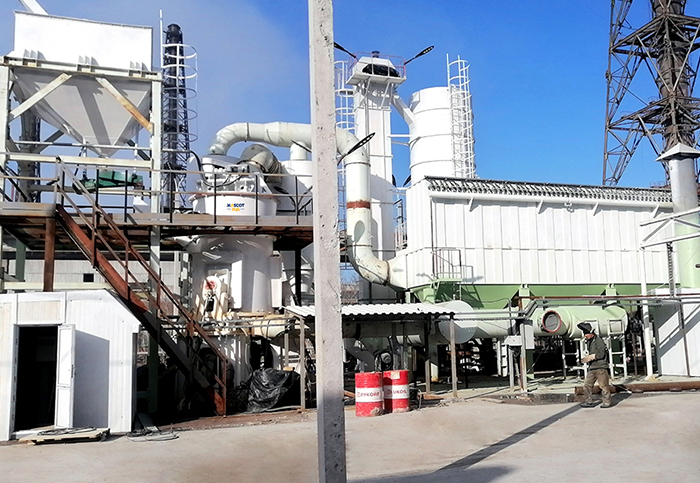
The production line of the vertical roller mill is a cost-effective and energy-efficient solution for processing powder, which is widely used in many industries, such as metallurgy, building materials, industrial solid waste treatment, thermal power plants, cement plants, and environmental protection fields. The primary purpose of this project is to finely grind raw materials through a vertical roller mill to meet the requirements of different industries for particle size, purity, and output of powder products.

The ball mill production line is a comprehensive production line that integrates material crushing, grinding, grading, and collection. This production line is mainly used to process various materials, including sand and gravel, cement, new building materials, silicates, refractory materials, fertilizers, ferrous metal beneficiation, non-ferrous metals, glass ceramics, etc.

The MTW series European grinding mill production line includes high-efficiency crushers, elevators, electromagnetic vibration feeders, milling machines, classifiers, and collectors. These pieces of equipment work together to achieve efficient crushing, grinding, and classification of various non-metallic ores, coal powder, slag, and other materials. It can meet the diverse needs of various industries for powder particle size, uniformity, shape, etc., and offer enterprises high-quality grinding products.

This production line utilizes a three-ring medium-speed micro-grinding mill as the central equipment, complemented by other auxiliary equipment like hammer crushers, bucket elevators, and storage silos to establish a comprehensive grinding operation system. It has demonstrated strong potential for application and market competitiveness in industries such as construction, chemical industry, and new materials.

The Raymond mill production line is a highly efficient system designed for grinding operations, with a focus on energy efficiency, durability, and productivity. It caters to the needs of users by offering fine powder products in non-metallic ores, coal powder, and slag processing, aiding enterprises in achieving sustainable growth.
Green and Intelligent Mining Machinery
Manufacturing and Export Base
Based on high quality and perfect after-sales service, our products have been
exported to more than 120 countries and regions.
Copyright © 2023 Zhengzhou Mascot Environmental Technology Co., Ltd Record number: Yu ICP No. 13021523-4





 WhatsApp