
On an HGM micro-powder mill the classifier is the one part of the circuit that can be changed while the machine keeps running. Roller pressure, ring profile and fan curve are design decisions; the classifier sits on a variable-frequency drive, and that drive is where most fineness arguments are settled — usually by whoever last touched it.
The setting is not a fineness dial, though. It is one of three controls that have to move together, and the number on the drive means nothing without the sample that follows it. What the setting works inside is the published frame of the HGM micro-powder grinding mill range: 325-2500 mesh, and 0.6-10 t/h across the three models.
Material is ground between the rollers and the ring, carried upward by the air stream, and stopped at the classifier wheel. Particles fine enough to pass the wheel leave with the air; the rest are thrown back down the mill and ground again. Speed changes that cut-off point: faster wheel, finer cut, more material returned.
Two consequences follow directly. Raising the speed does not make the mill grind better — it makes it re-grind more, which costs residence time and therefore tonnage. And lowering the speed does not "open up" the mill; it lets coarse particles through, which is a specification decision rather than a production one.
The published window for this series is 325-2500 mesh, or 5-47 microns, and the capacity band is quoted per model against that window rather than as a single figure. When the cut moves to the fine end, the tonnage moves down — not because the machine has less power, but because the same material has to cycle more times before it is allowed out.
That is why a fineness change should be quoted as a pair. A plant told "HGM1036, 1.2-10 t/h" has been told very little until the mesh is named; asked for 1250 mesh, the same machine sits near the bottom of that band, and the electrical cost per ton rises with every step finer.
| Model | Product size (mesh) | Capacity (t/h) | Main motor (kW) | Classifier motor (kW) | Fan (kW) |
|---|---|---|---|---|---|
| HGM80 | 325-2500 | 0.6-4 | 75 | 22 | 45 |
| HGM100 | 325-2500 | 0.9-6 | 110 | 30 | 75 |
| HGM1036 | 325-2500 | 1.2-10 | 132 | 37 | 75 |
How to read this table: the classifier has its own motor column because it runs at a speed set by the cut, not by the tonnage. At half output the fan and the classifier still turn, so the fixed part of the circuit's load is spread over fewer tons — the arithmetic behind every "the fine powder costs more per ton" report.

Classifier speed, feed rate and air volume form a triangle. Move one and the other two need a decision, otherwise the mill reports a symptom that belongs to a setting nobody touched. The table below is the working version of that triangle.
| If you change | What happens in the mill | What usually needs to follow | Where you see it first |
|---|---|---|---|
| Classifier speed up | Finer cut, more material returned to the grinding zone | Slightly lower feed, or accept lower tonnage | Classifier current and product fineness sample |
| Classifier speed down | Coarser cut leaves, less circulating load | Watch the top cut, not the average | Residue on the coarsest sieve in the spec |
| Feed rate up | More material per pass at the same wheel speed | Hold the cut only if the classifier can clear it | Rising classifier current, then a coarse tail |
| Air volume up | More carry-over; coarse particles can be dragged past the wheel | Raise wheel speed to hold the cut, or reduce the damper | D97 sample, not the sieve shaker average |
Read the last row twice. An over-strong air stream is the most common reason a mill "will not hold fineness" at a wheel speed that used to work. The powder looks coarse, the operator slows the classifier to compensate, and the cut goes coarser still.
The percentage or frequency shown on the drive belongs to that machine and that installation. Two mills of the same model, fed the same material, can hold the same cut at different settings, because ducting, damper position and wheel wear all shift the curve. Copying a number from a sister plant is a starting point at best.
Set it by stepping and sampling. Change the speed by a small increment, let the circuit stabilize for 20-30 minutes, then take a sample and read the top cut — not the average, and not a single sieve result. Record the setting alongside the sample; after four or five points the plant has its own curve, which is worth more than any table because it includes its own ducting.
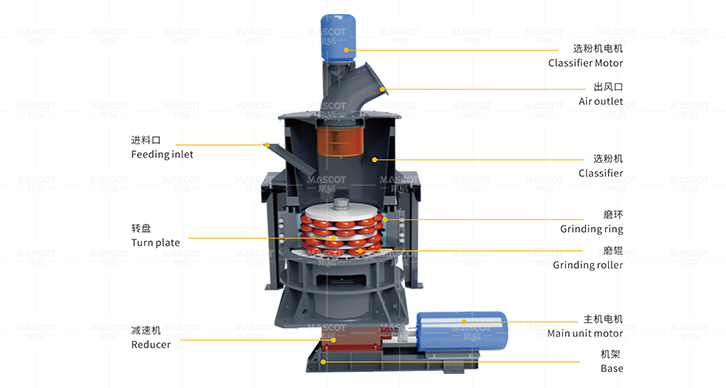
A coarse product invites one reflex: slow the classifier. Before that, read the classifier current. If it is high, the wheel is being asked to handle more material than it can classify, and slowing it down simply passes the overload into the product. The cause is upstream — feed too high for the cut, air too strong, or a grinding zone that has stopped delivering fines because the roller and ring have worn.
Two other signatures are worth knowing. Fineness that holds but tonnage that falls usually means the circuit is recycling more than it used to, which points at wheel wear or a damper that has crept. Fineness that oscillates between samples at an unchanged setting usually means the feed is not steady, and no classifier setting fixes an unsteady feeder. The same discipline applied to the trapezium mill's separator is set out in setting classifier speed on a YGM mill, and the difference between D97 and a single sieve result is covered in what D97 actually measures.

Q1: Does a higher classifier speed always give a finer product?
A: It gives a finer cut-off, which usually shows as a finer product — but only if the air stream and the feed are behaving. With too much air, coarse particles are dragged past the wheel regardless of speed, and the sample stays coarse while the drive reads high.
Q2: Why does tonnage drop when I chase a finer mesh?
A: Because the material has to pass the classifier more times before it leaves. The mill's installed power does not change, so the same energy is spread over fewer finished tons. Published capacity bands for this series are quoted across the 325-2500 mesh window for that reason.
Q3: Can I copy the classifier setting from another plant?
A: As a first trial only. Ducting, damper position and wheel wear differ between installations, so the same cut is often held at a different setting. Step, stabilize, sample, record — four or five points give you a curve that belongs to your machine.
Q4: How do I know the classifier is overloaded rather than set too slow?
A: By the current and the feed together. High classifier current with a coarse product means the wheel is handling more than it can classify, and the correction belongs at the feeder or the damper. A wheel set too slow draws normally and simply lets a coarser cut through.

About of Mascot
Zhengzhou Mascot Industry is a high-tech mining equipment company integrating R&D, manufacturing, sales, and after-sales service. Focusing on crushing, grinding, and mineral processing equipment, we provide professional solutions to our customers. We are ISO9001:2015 certified, and our products include mobile crushing plants, crawler crushing plant, construction waste crushing plants, jaw crushers, sand making machines, cone crushers, fine crushers, grinding mills, ball mills, etc., all with reliable performance to meet diverse project needs.
• Professional pre-sales support: Free project design and comprehensive solutions to help you accurately select the right equipment;
• Comprehensive on-site service: Providing installation guidance and worker training to ensure smooth equipment commissioning;
• Reliable after-sales guarantee: A complete after-sales system, timely response to technical inquiries and equipment maintenance, ensuring long-term stable operation.
To protect your rights, please contact us through the following official channels for professional service:
WhatsApp: 0086-16650273865
Email: mascot@mascotenv.com
We are committed to providing high-quality equipment and full-cycle services to deliver comprehensive intelligent solutions for the global mining industry!

This production line utilizes a three-ring medium-speed micro-grinding mill as the central equipment, complemented by other auxiliary equipment like hammer crushers, bucket elevators, and storage silos to establish a comprehensive grinding operation system. It has demonstrated strong potential for application and market competitiveness in industries such as construction, chemical industry, and new materials.

The high-pressure grinding mill production line is a project specially designed for efficient grinding operations. It is widely used in metallurgy, building materials, the chemical industry, highways, water conservancy hydropower, and other industries. It is a suspended roller mill that uses springs to increase pressure. It can achieve efficient grinding processing of various non-metallic raw materials. It has high efficiency, stability, and environmental protection characteristics.

The gypsum grinding production line is an efficient, stable, and environmentally friendly production solution, which is widely used in construction, decoration, the chemical industry, and other fields. In addition, the grinding process is particularly critical, which directly affects the quality and particle size of the final product. With the continuous development of science and technology, the technical level and production efficiency of gypsum grinding production lines will be further improved, providing strong support for the development of the gypsum processing industry.
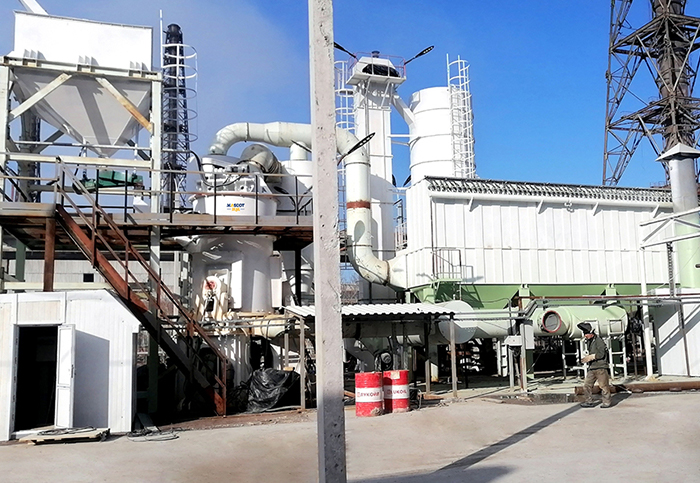
The production line of the vertical roller mill is a cost-effective and energy-efficient solution for processing powder, which is widely used in many industries, such as metallurgy, building materials, industrial solid waste treatment, thermal power plants, cement plants, and environmental protection fields. The primary purpose of this project is to finely grind raw materials through a vertical roller mill to meet the requirements of different industries for particle size, purity, and output of powder products.

The Raymond mill production line is a highly efficient system designed for grinding operations, with a focus on energy efficiency, durability, and productivity. It caters to the needs of users by offering fine powder products in non-metallic ores, coal powder, and slag processing, aiding enterprises in achieving sustainable growth.
Green and Intelligent Mining Machinery
Manufacturing and Export Base
Based on high quality and perfect after-sales service, our products have been
exported to more than 120 countries and regions.
Copyright © 2023 Zhengzhou Mascot Environmental Technology Co., Ltd Record number: Yu ICP No. 13021523-4





 WhatsApp
