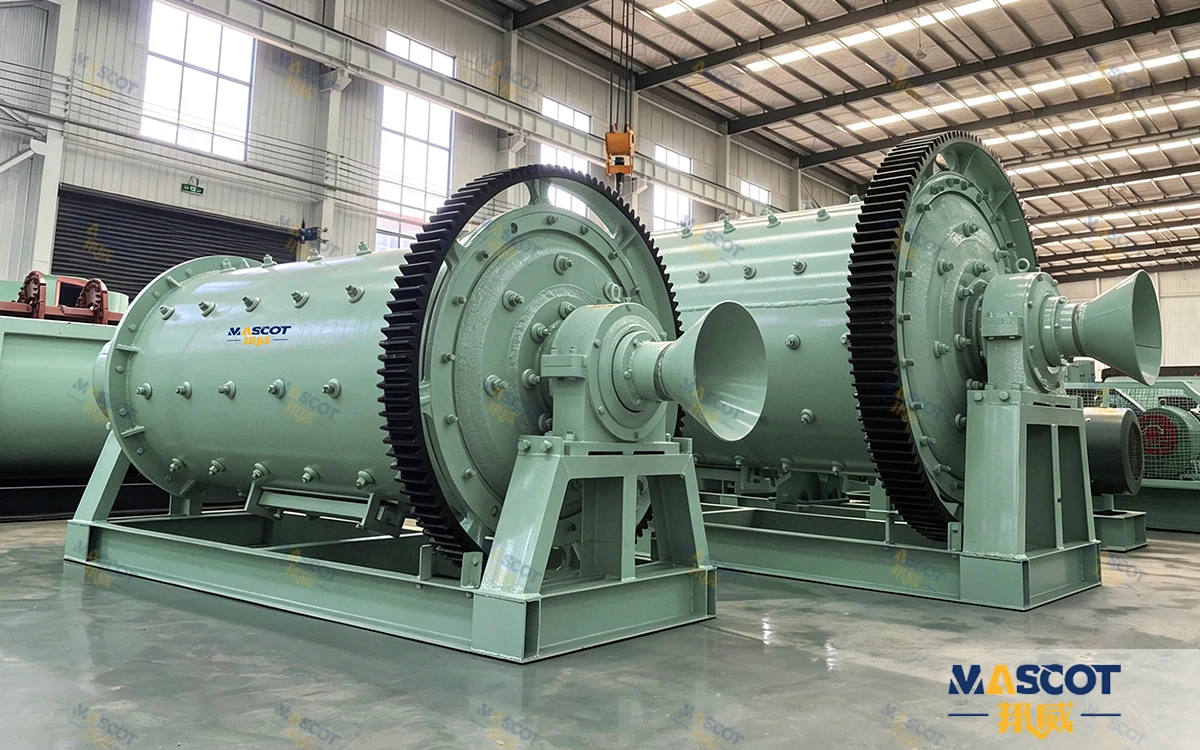
The charge in a Cement Ball Mill is rarely wrong in the sense of being badly made. It is usually wrong in the sense of belonging to a different job — a charge and a separator setting carried over from clinker grinding and expected to deliver kiln feed. Raw mix asks for a different balance, because limestone is far softer than clinker, the target is a residue rather than a Blaine figure, and the material often arrives wet. The published comparison is blunt: the same mill delivers 30-40% higher capacity when it is grinding limestone rather than clinker. A plant that ignores that difference is not running a balanced mill; it is running a cement mill on raw material.
Raw meal is a mixture, not a single material. Limestone is dosed with clay, sandstone and iron ore by weighing feeders, and the resulting mix is ground to kiln feed: a published target of 12-14% residue on the 80 µm sieve with chemistry stable enough that the kiln does not have to chase it. That is a coarse target compared with finished cement, and it sits on a much softer feed.
Three consequences follow for the grinding circuit, and they arrive together.
The mill has more capacity than the nameplate suggests. Capacity figures for this series are published for clinker grinding, and limestone raw meal output is stated as roughly 30-40% higher. A plant that sizes its raw department on the clinker figure leaves 30-40% of the mill unused — or, read the other way, a mill bought for a given tonnage of raw meal can be smaller than the clinker arithmetic suggests.
The work the charge has to do changes. Clinker demands coarse breaking in the first chamber and hard fine grinding in the second. Limestone-dominated feed needs less of the breaking work and more consistency at the fine end, because the target is a residue figure that must not drift.
Moisture enters the balance. Wet raw materials call for drying ahead of the mill, while slightly damp feed can be handled by the mill's own internal ventilation. Either way, the drying decision is taken before the charge is designed, because it decides how much residence time in the chamber is available for grinding at all.

The clearest way to see what has to change is to put the two duties side by side. Both are published applications of the same two-chamber mill.
| What Changes | Raw Mix (Kiln Feed) | Cement (Clinker Duty) |
|---|---|---|
| Feed material | Limestone dosed with clay, sandstone and iron ore by weighing feeders | Clinker with a 3-5% gypsum addition, plus any slag or fly ash |
| Feed hardness | Far softer than clinker — the published case runs quarry limestone at Mohs 3 | Hard and abrasive; the published liner life of 8,000-12,000 hours is stated for this duty |
| Capacity basis | About 30-40% higher output than the published clinker figure for the same model | The published model capacity band, stated for clinker ground with 3-5% gypsum |
| Output target | 12-14% residue on the 80 µm sieve, held for kiln stability | 280-450 m²/kg Blaine, or 1-10% residue on the 45 µm sieve |
| What the charge is asked to do | Consistent fine grinding to hold a residue target on a soft, sometimes damp feed | Coarse breaking in chamber one, fine grinding in chamber two to a Blaine target |
| Moisture handling | A dryer ahead of the mill for wet raw materials, or mill internal ventilation for slightly damp feed | The gypsum-bearing mix is held below 110 °C at the mill outlet to protect the set behaviour |
| Downstream | Homogenizing silos blend the meal before it reaches the kiln | Storage and packing, with the grade fixed by proportioning |
How to read this table: both columns are published applications of the same ball mill series, and every figure is taken from that series' own documentation — with one exception worth noting: the 30-40% capacity gain is a published statement for limestone raw meal against the clinker-rated band, not a guarantee for every quarry. The point of the table is that the raw mix column changes the charge, the separator setting and the drying arrangement together, which is why a media balance carried over from cement duty under-performs.
The series' own documentation names the three things that control fineness on this mill, and they are the same three that constitute the balance: ball charge, chamber configuration and separator settings. Treating them as one system rather than three independent knobs is the whole discipline.
The ball charge sets what the mill can do. Standard cement mills run two chambers: the first uses large-diameter balls for coarse grinding and the second uses small balls for fine grinding, divided by a double-layer diaphragm that retains coarse particles while finer material passes through. On a soft raw mix the first chamber is doing less heavy breaking than it would on clinker, which is why the grading — not simply the total tonnage of balls — is the first thing to review.
Chamber configuration sets where the work happens. The split between the two chambers, and the diaphragm setting that divides them, decide how much of the mill length is spent on coarse work and how much on the fine grinding that fixes the residue. The diaphragm is not a wear item to be forgotten between liner changes: its setting is published as one of the three controls over output fineness.
The separator closes the balance. Ground meal leaves the mill through the discharge grate to a dynamic separator, which returns oversize particles for regrinding and collects the qualified raw meal. Separator speed is adjustable without stopping the mill, which makes it the practical day-to-day control — while the ball charge and the diaphragm are the settings you design and then live with until the next planned stop.
| Balance Lever | What It Changes | Where You Read the Result |
|---|---|---|
| Ball grading (the size mix in each chamber) | How much coarse breaking capacity chamber one holds against the fine grinding surface chamber two provides | Mill power draw, together with the residue the separator is delivering |
| Chamber configuration and diaphragm setting | How the mill's length is divided between coarse and fine work, and what the diaphragm retains | Residue trend at a fixed feed rate; the diaphragm's condition is checked at every liner stop |
| Total ball load | The mass the drive lifts and therefore the power the mill draws | Motor current against the commissioning baseline |
| Separator speed | Which particles leave the circuit and which return — the fineness control that can be moved while running | 80 µm residue for raw meal; Blaine or 45 µm residue for cement |
| Mill internal ventilation and drying | Whether damp meal moves freely through the chamber or cakes in it | Throughput and chamber behaviour on wet or humid feed |
| Feed rate | The residence time the charge has to work with at a given grading | Tonnage at a fixed residue target |
How to read this table: the levers, the mechanisms and the readouts are drawn from the published description of this mill series; the illustrations of what each one changes are engineering reasoning applied to that description, not separate published specifications. The first row is the one that differs most between raw mix and clinker duty, which is why a charge review starts there rather than with the separator.

Raw materials arrive from a quarry, not from a process. Where the feed is wet, the published solution is a dryer ahead of the mill; where it is only slightly damp, the mill's internal ventilation can carry it. The distinction matters because the two answers cost differently and change the flowsheet differently.
A dryer in front of the mill is a capital item, a maintenance item and an energy consumer, but it makes the mill's job simple: the charge sees a consistent, dry feed. Internal ventilation avoids the extra machine but leaves the drying duty inside the grinding circuit, where it competes with grinding for residence time. Either way the moisture decision should be made on a seasonal survey of the actual feed, because a mill balanced on dry-season material will behave differently when the quarry is wet.
This is also why raw-mix plants need the homogenizing silo the published flowsheet includes. Stable chemistry is the second half of kiln feed quality, and it is a blending problem rather than a grinding problem: the mill's task is the residue, the silo's task is the consistency.
Many plants — particularly smaller ones — share a single mill between raw material and clinker grinding. It is a published capability of this series: by adjusting ball grading, chamber configuration and separator settings, the same mill switches between the two duties.
What the arrangement really requires is planning, not hardware. Three points decide whether the shared mill works or becomes a bottleneck.
Charging is a planned stop. A change of duty means a change of charge, and that is maintenance work with a duration attached. Plants that switch often should schedule the change against the kiln's own outage pattern rather than against whichever order arrived last — and it is worth noting that a mesh or grade change that does not require re-charging is a different and much quicker operation, which is what the series achieves on the separator side.
Segregation has to be designed in. Raw meal and cement share the transport, the silos and the packing, and the flowsheet has to keep them apart as deliberately as it keeps the chemistries apart.
The two targets must be written down separately. A residue target for kiln feed and a Blaine target for cement are not the same specification with a different number — they are measured on different instruments and controlled by different parts of the circuit. Writing both down, with the charge and separator settings that hold each one, converts a shared mill from a compromise into a schedule.

A Kenyan cement producer expanding raw meal capacity for a new 3,000 tpd kiln line serving the East African market was working a quarry feed of limestone at Mohs 3, with clay and iron ore and a feed size of 25 mm. The requirement was raw meal at 12-14% residue on the 80 µm sieve with chemistry stable enough for smooth kiln operation — and that second clause is the one that separates a raw meal line from a general-purpose mill installation.
The published solution is a single MQG2400×7000 closed-circuit ball mill supplied with proportioning feeders, a dynamic separator and a raw-meal homogenizing silo system, so that the mill's output and the silo's blending are specified together rather than as separate packages.
The reported result: the line delivers 32-36 t/h of raw meal at 13% residue on the 80 µm sieve, feeding the kiln without interruption. Homogenized meal with consistent chemistry cut kiln feed fluctuations, which improved clinker output and reduced fuel consumption — the outcome that a media balance is ultimately bought for. The customer's own summary: "The Mascot raw meal line keeps our new kiln running at full load."

Two numbers in that case are worth keeping in view. The mill is rated in the published table for its clinker duty, and it is delivering raw meal at a rate above that band — which is the 30-40% limestone statement made concrete. And the fineness control in daily use is the separator, adjusted without stopping the mill, while the charge that makes the tonnage sits underneath as a design decision.
A balance review is a short conversation if the plant arrives with the right six inputs. Each one removes a guess from the charge design.
| Input | Why It Matters |
|---|---|
| The product and its metric | Raw meal residue at 80 µm and cement Blaine at 45 µm are different control problems; naming the metric decides what the charge is balanced for |
| The actual feed mix and its hardness | A limestone-dominated mix grinds far faster than clinker, and the published capacity gain of 30-40% follows the material rather than the machine |
| A seasonal moisture survey | Decides whether drying sits ahead of the mill or inside the circuit through ventilation |
| Whether the mill will also grind cement | Dual duty is a ball-grading, chamber and separator question, and it should be designed in at the start rather than discovered at the first grade change |
| Motor, gearbox and available power on site | The charge is built against the drive that has to lift it; the total ball load is what the power draw reflects |
| The separator actually installed, and its adjustment range | The balance is only as good as the device that closes the circuit; the mill and the separator should be sized as one set |
Q1: Can one cement ball mill grind both raw meal and clinker?
A: Yes. The published capability of this series is that the same mill switches between raw material and clinker grinding by adjusting ball grading, chamber configuration and separator settings, and many customers share one mill for both duties. What the arrangement needs is planning: a charge change is a planned stop, the two products have to be kept apart in transport and storage, and both specifications should be written down with the settings that hold them.
Q2: Why is my raw meal tonnage higher than the mill's rated capacity?
A: Because the published capacity band is stated for clinker grinding, and limestone raw meal output is published at roughly 30-40% above that figure. The mill is not over-performing; it is grinding a softer material, which is also why the charge that suits clinker is not automatically the charge that suits raw mix.
Q3: What fineness does kiln feed actually need?
A: The published standard is 12-14% residue on the 80 µm sieve, held consistently rather than chased for a finer number. Consistency is the point: homogenized raw meal with stable chemistry is what cuts kiln feed fluctuations, improves clinker output and reduces fuel consumption.
Q4: My raw material is wet. Do I need a separate dryer?
A: It depends how wet. The published answer is a dryer ahead of the mill for wet raw materials, and the mill's internal ventilation for slightly damp feed. Because the answer changes the capital scope of the line, it should be decided on a seasonal moisture survey of the actual quarry feed rather than on a single sample.
Q5: Which of the three levers should I move first?
A: Ball grading first, because it belongs to the material: a limestone-dominated mix needs a different balance from clinker. Separator speed is the day-to-day control and is adjustable while the mill runs, so it is the right lever to trim with. Chamber configuration and diaphragm setting sit between the two — designed once, checked at every liner stop.
Q6: What does a complete raw meal line include?
A: The published scope of a complete line is a jaw crusher, proportioning weigh feeders, a dryer where the feed requires one, a bucket elevator, a stable-flow silo, the two-chamber ball mill with its drive and gearbox, a dynamic separator, a bag filter and a homogenizing silo system — plus layout design, installation and commissioning guidance, operator training, a 12-month warranty and spare parts at low cost. Contact WhatsApp 0086-16650273865.
Media balance on a cement ball mill is the business of matching three things — ball charge, chamber configuration and separator setting — to the material in front of them. For raw mix that means a softer feed with a published capacity gain of 30-40%, a coarse residue target that must not drift, a moisture decision taken before the charge is designed, and a homogenizing silo carrying the chemistry side of kiln feed quality. Get those right and the mill delivers kiln feed without interruption; carry a clinker charge over to a limestone duty and the plant pays for the difference every hour.
The Cement Ball Mill series covers 1.6-210 t/h in closed circuit with two-chamber grinding and a double-layer diaphragm, and the two fineness metrics it is asked to hold are set out in the guide to Blaine and 45 µm residue. How the charge itself is built and maintained is covered in how to charge media in a cement ball mill, with the clinker-duty version of the same subject in the clinker media charging and output guide. Where the raw meal section sits inside a full station, the flowsheet comparison is in cement grinding station: cement ball mill vs vertical roller mill, and the equipment list of a complete ball mill line — crusher, feeders, mill, separator and dust collection — is documented in the ball mill production line case. Send your feed analysis, the residue target and the tonnage you need, and the charge, the chamber split and the separator setting can be specified against your material rather than against a clinker reference.

About of Mascot
Zhengzhou Mascot Industry is a high-tech mining equipment company integrating R&D, manufacturing, sales, and after-sales service. Focusing on crushing, grinding, and mineral processing equipment, we provide professional solutions to our customers. We are ISO9001:2015 certified, and our products include mobile crushing plants, crawler crushing plant, construction waste crushing plants, jaw crushers, sand making machines, cone crushers, fine crushers, grinding mills, ball mills, etc., all with reliable performance to meet diverse project needs.
• Professional pre-sales support: Free project design and comprehensive solutions to help you accurately select the right equipment;
• Comprehensive on-site service: Providing installation guidance and worker training to ensure smooth equipment commissioning;
• Reliable after-sales guarantee: A complete after-sales system, timely response to technical inquiries and equipment maintenance, ensuring long-term stable operation.
To protect your rights, please contact us through the following official channels for professional service:
WhatsApp: 0086-16650273865
Email: mascot@mascotenv.com
We are committed to providing high-quality equipment and full-cycle services to deliver comprehensive intelligent solutions for the global mining industry!

The high-pressure grinding mill production line is a project specially designed for efficient grinding operations. It is widely used in metallurgy, building materials, the chemical industry, highways, water conservancy hydropower, and other industries. It is a suspended roller mill that uses springs to increase pressure. It can achieve efficient grinding processing of various non-metallic raw materials. It has high efficiency, stability, and environmental protection characteristics.

The ball mill production line is a comprehensive production line that integrates material crushing, grinding, grading, and collection. This production line is mainly used to process various materials, including sand and gravel, cement, new building materials, silicates, refractory materials, fertilizers, ferrous metal beneficiation, non-ferrous metals, glass ceramics, etc.

The gypsum grinding production line is an efficient, stable, and environmentally friendly production solution, which is widely used in construction, decoration, the chemical industry, and other fields. In addition, the grinding process is particularly critical, which directly affects the quality and particle size of the final product. With the continuous development of science and technology, the technical level and production efficiency of gypsum grinding production lines will be further improved, providing strong support for the development of the gypsum processing industry.

The MTW series European grinding mill production line includes high-efficiency crushers, elevators, electromagnetic vibration feeders, milling machines, classifiers, and collectors. These pieces of equipment work together to achieve efficient crushing, grinding, and classification of various non-metallic ores, coal powder, slag, and other materials. It can meet the diverse needs of various industries for powder particle size, uniformity, shape, etc., and offer enterprises high-quality grinding products.

YGMX Enhanced High-Pressure Mill is a new type of high-performance grinding equipment, and the biggest improvement of this milling equipment lies in the increase of the high-pressure spring system in the grinding roller part. Compared with the traditional high-pressure roller mill, it has a wider scope of application and excellent performance to meet the production needs of a variety of powder fineness. It is widely used in non-metallic minerals, chemicals, building materials, metallurgy, environmental protection, etc. Multiple areas.
Green and Intelligent Mining Machinery
Manufacturing and Export Base
Based on high quality and perfect after-sales service, our products have been
exported to more than 120 countries and regions.
Copyright © 2023 Zhengzhou Mascot Environmental Technology Co., Ltd Record number: Yu ICP No. 13021523-4





 WhatsApp