 27
 27
 25
A ceramic ball mill is bought on a purity argument and then judged on a cost sheet, and the two rarely agree. The quotation lists a machine. The cost sheet lists what the machine will consume: grinding media, lining, power, and on the lines that go wrong, rejected batches.
The figures below come from the published specification of the ceramic ball mill range: 100-800 mesh output (0.154-0.015 mm), feed up to 25 mm, and a model table that starts at Φ1.2x4.5.

Two mills with the same shell and the same motor can carry very different cost per ton, because the plant is not paying for the cylinder. It is paying for what happens inside it. A ceramic charge is lighter than a steel charge of the same volume, and that one difference runs through all three budget lines: fewer joules per ball impact, so a smaller top size or a longer cycle; fewer amps on the drive; and a lining that has to absorb the same wear without putting iron into the product.
Build the budget in the order the money leaves: media, lining, power. The fourth line, rejects, becomes a consequence of the first three rather than a surprise.
The charge in a quotation is a capital item. The top-up is the operating item, and it is the one that never appears in the price. Here is the published charge mass for part of the range:
| Model (m) | Capacity (t/h) | Ceramic media (t) | Drive (kW) | Media per t/h (t) |
|---|---|---|---|---|
| 1.2×4.5 | 1.6-5.8 | 5 | 55 | 0.9 |
| 1.83×6.4 | 6.5-15 | 21 | 210 | 1.4 |
| 2.4×8 | 20-35 | 42 | 570 | 1.2 |
| 2.6×13 | 40-55 | 82 | 1,000 | 1.5 |
| 3.5×11 | 75-85 | 150 | 1,250 | 1.8 |
How to read the last column: charge mass divided by the top of the capacity band, that is, the media inventory a mill carries per ton per hour of rated output. It climbs from 0.9 t to 1.8 t as the models grow, so the spare-parts account grows faster than the tonnage.
The number worth getting from a supplier is not the charge mass but the wear rate in grams per tonne at your hardness and your target mesh. Without it the media line can only be guessed at, and on most ceramic installations it is the largest single consumable.
One habit is worth more than any price negotiation: recharge to the published mass on a fixed schedule. A worn charge shifts fineness and power draw long before it is visible, and the drift usually gets blamed on the material.

In a steel mill the lining is a maintenance interval. In a ceramic mill it is part of the specification, because the plates that protect the shell are the surface the powder touches. Published service life for the working grade, 92% high alumina, is 3-5 years with feed below Mohs 7; rubber is quoted at 1-2 years and manganese steel at 12-18 months in abrasive duty. A steel lining change also removes 5-7 days of production, which is usually the larger half of the cost.
The other half of that budget stays invisible until it fails. A steel-lined mill typically puts 0.05-0.15% iron into the powder; a fully ceramic contact zone holds it below 0.008%. Where the buyer checks iron or colour, the lining is not an upgrade to weigh against a price; it is the difference between a batch that ships and one that is scrapped. That liner and material choice is settled before any model is quoted.

The published drive column runs from 55 kW at Φ1.2x4.5 to 1,250 kW at Φ3.5x11. None of those figures is a consumption number, and three things sit between the column and the meter.
The charge. Lighter media draw fewer amps at the same fill and deliver less energy per impact, so the saving is paid back in residence time. A ceramic mill is not automatically cheaper per ton than a steel one at the same mesh; it is cheaper only where the shorter lining and media life of the steel alternative would have cost more.
Part load. The charge is lifted whether the mill makes 8 t/h or 15 t/h, so a unit parked at the bottom of its band spends most of its rated power producing half its rated output.
The circuit. Drums turn at 65-80% of critical speed, the mill runs sealed, and in dry duty the fan and collector sit outside the motor column. In batch duty, cycle time replaces tonnage as the unit of comparison, and batch and continuous running differ in where the cost sits, not only in throughput.
| Cost line | What moves it | Number to ask for |
|---|---|---|
| Grinding media | Feed hardness, target mesh, charge mass | Wear rate in g/t on your material |
| Lining | Grade, service life, stop length | Liner set price and hours per change |
| Power | Fill level, load factor, auxiliaries | kWh/t at your mesh, boundary named |
| Rejects | Iron limit, colour standard | Reject rate and value per batch |
Four numbers turn a price comparison into a cost comparison. A quotation that offers only the first line is asking you to fund the other three later.
Q1: Is ceramic media dearer to run than steel?
A: It is normally dearer to buy per tonne of charge, and the running answer depends on the wear rate and on the mesh you hold. Compare grams per tonne on your material, plus the electricity the lighter charge saves, rather than the purchase price alone.
Q2: How often should the charge be topped up?
A: No single interval fits every material. Track power draw at a fixed fill and fineness drift at a fixed setting; when both move together, the charge is short. A supplier who cannot quote a wear rate in g/t is guessing.
Q3: Does a 92% alumina lining make the mill iron-free on its own?
A: Only if the contact path is ceramic end to end: cylinder, end covers, discharge grate and media. Powder meets all four. Ask for the material composition certificate with the shipment instead of trusting the drawing.
Q4: Can one ceramic mill run glaze wet and body dry?
A: Yes. The range is published as a two-mode machine, slurry wet and powder dry with optional ventilation, with no hardware change between duties, so the lining and media decision is made once.

About of Mascot
Zhengzhou Mascot Industry is a high-tech mining equipment company integrating R&D, manufacturing, sales, and after-sales service. Focusing on crushing, grinding, and mineral processing equipment, we provide professional solutions to our customers. We are ISO9001:2015 certified, and our products include mobile crushing plants, crawler crushing plant, construction waste crushing plants, jaw crushers, sand making machines, cone crushers, fine crushers, grinding mills, ball mills, etc., all with reliable performance to meet diverse project needs.
• Professional pre-sales support: Free project design and comprehensive solutions to help you accurately select the right equipment;
• Comprehensive on-site service: Providing installation guidance and worker training to ensure smooth equipment commissioning;
• Reliable after-sales guarantee: A complete after-sales system, timely response to technical inquiries and equipment maintenance, ensuring long-term stable operation.
To protect your rights, please contact us through the following official channels for professional service:
WhatsApp: 0086-16650273865
Email: mascot@mascotenv.com
We are committed to providing high-quality equipment and full-cycle services to deliver comprehensive intelligent solutions for the global mining industry!
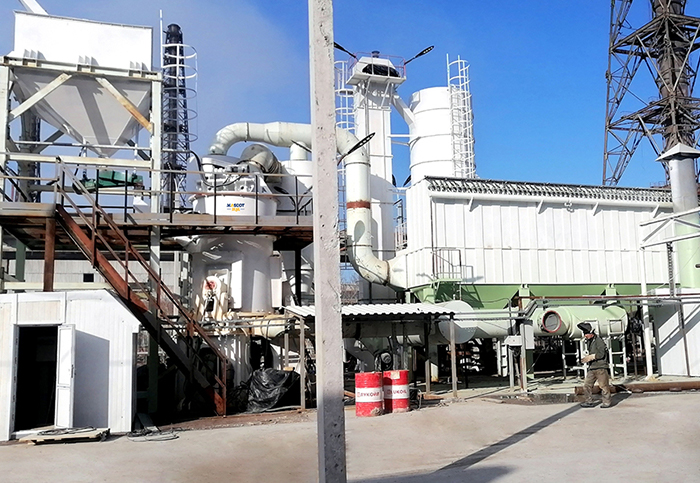
The production line of the vertical roller mill is a cost-effective and energy-efficient solution for processing powder, which is widely used in many industries, such as metallurgy, building materials, industrial solid waste treatment, thermal power plants, cement plants, and environmental protection fields. The primary purpose of this project is to finely grind raw materials through a vertical roller mill to meet the requirements of different industries for particle size, purity, and output of powder products.

YGMX Enhanced High-Pressure Mill is a new type of high-performance grinding equipment, and the biggest improvement of this milling equipment lies in the increase of the high-pressure spring system in the grinding roller part. Compared with the traditional high-pressure roller mill, it has a wider scope of application and excellent performance to meet the production needs of a variety of powder fineness. It is widely used in non-metallic minerals, chemicals, building materials, metallurgy, environmental protection, etc. Multiple areas.

The gypsum grinding production line is an efficient, stable, and environmentally friendly production solution, which is widely used in construction, decoration, the chemical industry, and other fields. In addition, the grinding process is particularly critical, which directly affects the quality and particle size of the final product. With the continuous development of science and technology, the technical level and production efficiency of gypsum grinding production lines will be further improved, providing strong support for the development of the gypsum processing industry.

The MTW series European grinding mill production line includes high-efficiency crushers, elevators, electromagnetic vibration feeders, milling machines, classifiers, and collectors. These pieces of equipment work together to achieve efficient crushing, grinding, and classification of various non-metallic ores, coal powder, slag, and other materials. It can meet the diverse needs of various industries for powder particle size, uniformity, shape, etc., and offer enterprises high-quality grinding products.

The Raymond mill production line is a highly efficient system designed for grinding operations, with a focus on energy efficiency, durability, and productivity. It caters to the needs of users by offering fine powder products in non-metallic ores, coal powder, and slag processing, aiding enterprises in achieving sustainable growth.
Green and Intelligent Mining Machinery
Manufacturing and Export Base
Based on high quality and perfect after-sales service, our products have been
exported to more than 120 countries and regions.
Copyright © 2023 Zhengzhou Mascot Environmental Technology Co., Ltd Record number: Yu ICP No. 13021523-4





 WhatsApp
