 25
25
 27
27
 27
27
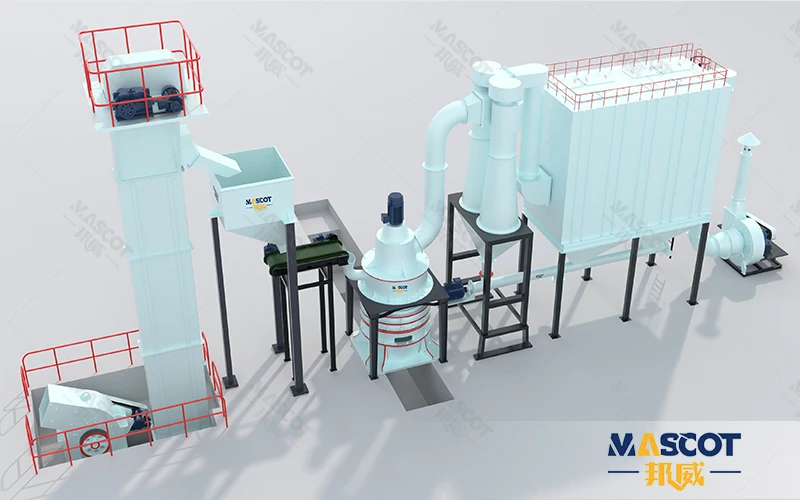
A micro-powder project is rarely lost on the mill. It is lost on the stations around it. The grinding unit is one machine in a sequence that starts with raw lumps at a crusher and ends with saleable powder in a silo, and every one of those stations is configured against the mill rather than chosen independently. That is the difference between a line that reaches its rated tonnage in the first month and a line that reaches it after two rounds of modifications — and it is why the published range is quoted as a set. This guide sets out the configuration sequence for a complete HGM micro-powder grinding mill line from Zhengzhou Mascot Industry, whose four models span 0.5-20.5 t/h across a common fineness band of 106-4 micron (150-3000 mesh).
Start with the shape of the installation rather than the machine. The HGM Series Micro-powder Grinding Mill is delivered as a circuit: pre-crushing, lifting, metered feeding, grinding, classification, collection, product storage and a central control panel. Each station has one job inside the same specification, and each one is sized from a number that the other stations have to respect.
| Station | What It Is Sized Against | What Goes Wrong If It Is Chosen Independently |
|---|---|---|
| Pre-crushing | The feed limit of the model selected (10 mm to 20 mm across the range) | Oversize feed produces unstable grinding pressure and erratic output from the first shift |
| Lifting and feeding | The mill's rated tonnage at the mesh you will sell | Uneven feed drifts the fineness and the power draw through the shift |
| Grinding unit | Tonnage and finest cut required by the order book | The most common error of all: buying a model on a tonnage figure quoted at a coarse cut |
| Turbo classifier | The finest grade the plant must hold, and the grades it must switch between | A cut point that cannot reach the fine grade, or a changeover that requires shutting the line down |
| Air system (fan and ducting) | The classifier's working air volume | The classifier cannot hold its cut point because the air it depends on is not there |
| Collection and dust control | The powder path and the whiteness or purity of the product | Product recovered through a path that changes its colour or its specification |
| Product silo and discharge | Dispatch format and downstream packing or tanker loading | Powder produced but not dispatchable without an extra manual stage |
| Control panel | All of the above, in one operating window | Operators adjusting one station against another on the shop floor instead of from a set point |
How to read this table: the third column is not a list of vendor failures, it is the list of interfaces. A line is configured when all eight stations have been sized from the same two product numbers — the tonnage the plant must deliver and the finest cut it must hold — and when the published equipment set is quoted as one delivery rather than assembled from separate suppliers.
The first configuration step does not involve machinery. Write down the tonnage the line must deliver at the mesh the plant will actually sell, and the finest cut the order book requires. Those two numbers decide the model, and almost every other choice follows from them.
It helps to separate the two capacities that a product sheet mixes together. The published capacity of a model on this range is a range, not a figure, because throughput falls as the target fineness rises: the same machine that reaches the top of its band at a construction grade will deliver materially less at a coating grade. When a line is configured on a tonnage figure quoted at the coarse end and then asked to run at the fine end, the shortfall appears at the customer's weighbridge rather than in the workshop.
The range itself is deliberately narrow in a useful way: every model covers the same 106-4 micron (150-3000 mesh) working band, with HGM125 rated 106-5 micron (150-2500 mesh). Inside that envelope the model determines throughput, not the grades a plant is allowed to sell — which means a producer who proves a grade on a small line can move the same specification to a larger model later without re-qualifying it with its own customers.

With the two product numbers fixed, the model ladder is a short and direct calculation. The four published models are set out below with the columns that matter during configuration: the working band, the throughput band and the feed limit that the crushing stage has to respect.
| Model | Capacity (t/h) | Finished Product Size (Mesh) | Feed Size (mm) | Main Grinder (kW) |
|---|---|---|---|---|
| HGM80 | 0.5-6 | 150-3000 | ≤10 | 75 |
| HGM100 | 1.2-10.2 | 150-3000 | ≤15 | 110 |
| HGM100+ | 1.2-11.5 | 150-3000 | ≤15 | 132 |
| HGM125 | 2.5-20.5 | 150-2500 | ≤20 | 185 |
How to read this table: the values are the published specification of the HGM series. Two reading rules belong with them. First, the capacity band is the range a model covers across its whole working band, so the model should be quoted against the tonnage required at the mesh you will sell rather than against the top figure of the column; the plant that sizes on the coarse-end number and sells fine powder has configured the line one or two models short. Second, the feed limit changes between models while the fineness band does not — which is why the crushing stage belongs in the same conversation as the mill and not in a separate purchase order.
One configuration consequence is worth stating explicitly, because it decides which model is correct rather than which is largest. If the product specification calls for a 3000 mesh top cut, the answer is one of the three models rated to 3000 mesh; HGM125 holds 2500 mesh and should not be quoted against a 3000 mesh requirement. Configuring upward through the ladder does not buy a finer cut — it buys tonnage.
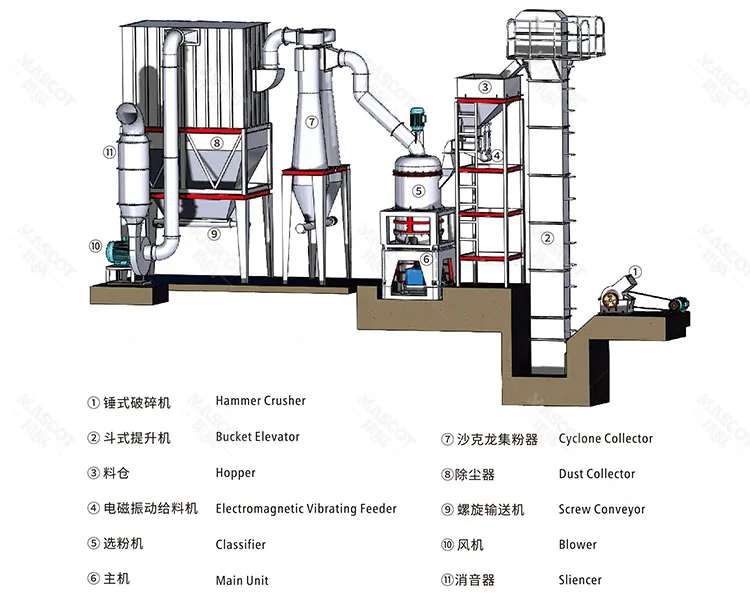
The crushing stage is configured last in value and first in sequence: raw material has to be reduced to the feed limit of the model before it reaches the grinding chamber. Across the range that limit runs from 10 mm on HGM80 through 15 mm on HGM100 and HGM100+ to 20 mm on HGM125, and the crusher is specified to that figure rather than to a single number used for every line.
This is the interface where configuration errors are most expensive, because the symptom appears as a grinding problem. Oversize feed destabilises the grinding pressure inside the unit, and unstable pressure shows up as erratic output and drifting fineness — two complaints that are usually attributed to the mill. A jaw crusher stage that is correctly matched to the model removes the cause before commissioning rather than after the first service visit.
Two configuration details belong with the crusher choice. The first is that the crushing stage should be sized with margin for the feed the quarry actually delivers, not the feed the geology report describes; clay content, moisture and lump size all vary through a wet season. The second is that the line's working envelope has to be respected from the very start: the series is published for non-metallic minerals at Mohs hardness below 7 and moisture under 6%, and because moisture has to stay under that figure, a separate dryer is normally not required for dry non-metallic minerals — the requirement is a stockpile discipline, not an extra machine.

The feeder is the least expensive station on the line and the one that decides whether the operating point holds. Material is delivered into the grinding chamber at a steady, controlled rate by an electromagnetic vibrating feeder, and even feeding is what keeps the power draw and the finished fineness stable through a shift instead of drifting between the start and the end of it.
The configuration question here is not capacity but control: the feeder has to be able to move the mill's rated tonnage at the mesh the plant sells, while remaining adjustable downward for the fine grades. A feeder sized to the coarse-grade tonnage and a plant that sells coating grades is a line that operates permanently at the bottom of its control range, where a small change in material condition moves the operating point further than the operator can correct comfortably.
Uniform feed also protects the wear parts. Grinding rollers pressed against the ring by centrifugal force do their work in a bed of material; a mill that is alternately starved and flooded is a mill whose rollers meet the ring with less material between them than the design assumes. That is a wear condition, not a throughput condition, and it is created at the feeder.
Product fineness on an HGM line is held by two settings, and only two: the speed of the turbo classifier and the airflow rate through the circuit. The classifier is a high-precision unit driven through a variable-frequency drive, so both the operating grade and a change between grades are set from the control panel while the line runs.
This is the property that decides how the line should be configured commercially. Because a mesh change is a setting rather than a rebuild, a plant can hold several grades on one machine: a change from a 325 mesh construction grade to a 1250 mesh coating grade is completed in 30-60 minutes including cleaning, with no grinding part replaced and no shutdown of the mill itself. During configuration, that means the model should be chosen for the tonnage at the finest grade the plant expects to sell in volume, and the grade mix should be treated as an operating decision rather than a second capital purchase.
The mechanism behind the setting is the reason airflow rate belongs in the same conversation. High-speed air carries the ground powder up through the classifier, which passes only the particles matching the set cut point and returns the rest to the grinding area for regrinding. That closed loop is what holds the particle size distribution tight enough for coating-grade or masterbatch sales, and it is also why the fan and the ducting cannot be treated as accessories. A classifier is only as accurate as the air volume it is given, so the fan, the ducts and the classifier have to be sized together — which is how the equipment set from a single supplier is quoted.

The last stations decide whether the powder that leaves the line is the powder the customer bought. Qualified powder is separated in the cyclone collector and recovered in a pulse-jet bag filter, and the whole circuit runs under negative pressure and fully sealed, so no dust escapes into the workshop while the product travels from classifier to silo without a manual handling step. The pulse-jet collector filters at 99.9% efficiency, and the heavy-duty frame with mufflers keeps noise well below that of high-speed impact mills.
For some products, this section carries a specification rather than a housekeeping duty. Where the grade is sold on whiteness or on iron content, the powder path itself has to be non-contaminating: on installations of this kind the piping and the surfaces in contact with the product are specified as ceramic-lined, so the product is not changed by the equipment that conveys it. That decision has to be made during configuration, because retrofitting a powder path is a rebuild of the line rather than a change of part.
Storage completes the sequence. The product silo and its discharge are configured around how the plant dispatches — bags, big bags or tanker — and the silo belongs in the original equipment list for the same reason the crusher does: a line that produces powder faster than the plant can pack it has not been configured, it has been assembled.
A complete HGM line is quoted as one set: the HGM main unit, turbo classifier, draft fan, pulse-jet dust collector, feeder, bucket elevator, pre-crushing stage, product silo and the centralized electrical control panel, sized against each other before shipment so that no station becomes the bottleneck after commissioning. The commercial package that belongs with it is layout design, installation and commissioning guidance, operator training and a spare-parts arrangement for the wearing parts.
The configuration worksheet below is the document that makes the quotation comparable. It is also the shortest route to a correct model recommendation, because every input is a number the plant already knows or can measure.
| Configuration Input | What It Decides on the Line | What to Supply |
|---|---|---|
| Material and source | Whether the feed sits inside the working envelope at all (Mohs below 7, moisture under 6%) | Mineral type, quarry or mine, and a representative sample |
| Tonnage at the mesh you sell | The model, and therefore the drive power and the capacity of every station around it | Required t/h stated at a named mesh, not a single annual total |
| Finest cut required | The classifier specification and whether the 3000 mesh models are needed | Finest micron or mesh figure the order book requires |
| Feed condition as delivered | The crushing stage and its margin; the need for blending or stockpile control | Lump size range, and moisture variation through the year |
| Grade mix | How often the line changes mesh, and therefore the value of the VFD classifier | The grades you expect to sell and their share of volume |
| Product purity requirement | Whether the powder path is specified as non-contaminating | Whiteness or iron limit the customer enforces, and how it is tested |
| Dispatch format | The silo, discharge and packing arrangement | Bags, big bags or bulk; and the tonnage to be held |
| Site and utilities | Layout, civil works, installed power and the control panel arrangement | Available power, voltage, and the footprint the site can give the line |
How to read this table: the entries are ordered as a supplier should ask for them, and the two highlighted rows are the ones that most often change the model. A worksheet answered in this order produces a quotation that can be compared line by line with another one; the same worksheet answered as "a mill for calcium carbonate" produces a price that cannot be checked at all.
Two commercial facts are worth fixing at the same time as the configuration. The wearing parts are the grinding rollers and the grinding ring, cast in wear-resistant alloy that lasts 2-5 times longer than standard steel, and there is no grinding media to reload at any point in the cycle — which is why maintenance stops on this line are short. The machine carries a 12-month warranty, with the same 12-month cover on core components including the rollers, the ring and the classifier, and spare parts held in stock for scheduled replacement.
The sequence above is easiest to check against an installation rather than a drawing. The photograph below is an HGM80 micro-powder line photographed at a customer site in Thailand, and the stations appear in the order the configuration logic predicts: the bucket elevator lifting crushed material, the hopper and feeder metering it into the main unit, and the cyclone collector with a pulse-jet dust collector on the discharge side, all inside one steel-frame building rather than spread across a site.
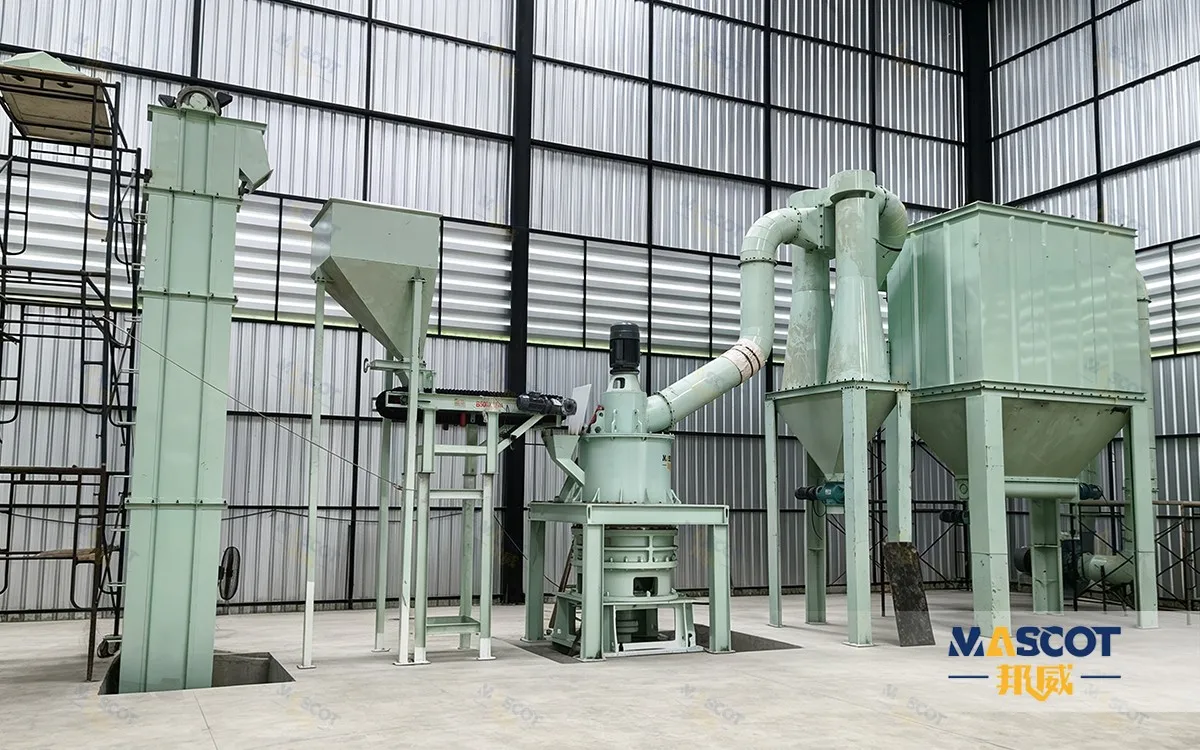
Two things are worth reading from the arrangement. The first is the compactness: because every station is sized together, the line occupies a footprint rather than a site plan, which is why a micro-powder line can be added inside an existing building. The second is the layout of the air side — the cyclone and the bag filter are adjacent, with short duct runs, which is the physical form of the configuration rule that the fan, the ducts and the classifier belong to one system.
The plant's own production data is not published here, and that is deliberate. Mesh, material and tonnage are the customer's commercial information, and a configuration is not verified by another plant's numbers in any case: the rated capacity band of a model is only turned into a figure you can invoice by testing your own material. A sample of 20-50 kg is enough for that test, and the result comes back as a measured fineness distribution rather than a brochure figure.
Q1: How do I know which HGM model my project needs?
A: Two numbers decide it: the tonnage you must deliver at the mesh you will sell, and the finest cut your order book requires. The four published models cover 0.5-6 t/h (HGM80), 1.2-10.2 t/h (HGM100), 1.2-11.5 t/h (HGM100+) and 2.5-20.5 t/h (HGM125). If the product needs a 3000 mesh top cut, the answer is HGM80, HGM100 or HGM100+; HGM125 is rated to 2500 mesh, so a finer specification is not a matter of choosing a larger machine.
Q2: What does a complete HGM line include?
A: Pre-crushing, a bucket elevator, an electromagnetic vibrating feeder, the HGM main unit, the turbo classifier, a cyclone collector, a pulse-jet bag filter, the product silo and a centralized electrical control panel — with layout design, installation and commissioning guidance and operator training as part of the delivery, not as separate purchases.
Q3: Can the line change product grades without stopping production?
A: Yes. Fineness is set by the turbo classifier, which is speed-adjustable through a variable-frequency drive, so the operating point is changed while the line runs. A change such as a 325 mesh construction grade to a 1250 mesh coating grade takes 30-60 minutes including cleaning, and no grinding part has to be replaced. That is why the grade mix is an operating decision and the model is a capacity decision.
Q4: What feed size and moisture does the line require?
A: Material must be reduced to the model's limit before it enters the grinding chamber: 10 mm for HGM80, 15 mm for HGM100 and HGM100+, and 20 mm for HGM125. The working envelope is Mohs hardness below 7 with moisture under 6%; because of that moisture limit a separate dryer is normally not required for dry non-metallic minerals, but stockpile control in a wet season is part of running the line properly.
Q5: How are dust, noise and product purity handled?
A: The circuit runs under negative pressure and is fully sealed, with the pulse-jet collector filtering at 99.9% efficiency, so powder does not escape into the workshop, and the heavy-duty frame with mufflers keeps noise well below high-speed impact mills. Where a grade is sold on whiteness or iron content, the powder path — including piping in contact with the product — is specified as ceramic-lined so the conveying equipment does not change the specification.
Q6: What are the warranty and service terms, and where do I go next?
A: The machine carries a 12-month warranty, with the same 12-month cover on core components including the rollers, the ring and the classifier; wearing parts are cast in wear-resistant alloy with 2-5 times the life of standard steel and are held in stock, and there is no grinding media to reload. Mascot provides 24/7 online consultation by email and WhatsApp: 16650273865, with engineers available for on-site installation and commissioning. For the economics of the grade you plan to sell, see how the 325 to 1250 mesh grade ladder pays back; for a worked example of a coating-grade line, see the paper coating calcium carbonate line; and for the fineness specification the classifier has to hold, see what D97 means on this mill.
Configuring an HGM micro-powder line is a sequence rather than a shopping list: fix the tonnage at the mesh you sell and the finest cut your order book requires, size the grinding unit on that pair of numbers, set the pre-crushing stage from the model's feed limit, size the feeder to hold the operating point at the fine grades, treat the classifier speed and the airflow rate as one control system, seal and protect the powder path, and finish at the silo and the control panel. Every station is sized from the same two product numbers, which is why the published range is delivered as one set.
The published numbers that anchor the configuration are a common working band of 106-4 micron (150-3000 mesh) across HGM80, HGM100 and HGM100+ with HGM125 rated 106-5 micron (150-2500 mesh), throughput from 0.5 t/h to 20.5 t/h, feed limits from 10 mm to 20 mm, and a working envelope of Mohs hardness below 7 with moisture under 6%. The HGM Series Micro-powder Grinding Mill is offered as that complete circuit, with the pre-crushing, classification, collection and control stations matched to the main unit before shipment. Send your material, the tonnage at your selling mesh and the finest cut you must hold — and have the sample tested — and the line can be configured against your numbers rather than against a table.

About of Mascot
Zhengzhou Mascot Industry is a high-tech mining equipment company integrating R&D, manufacturing, sales, and after-sales service. Focusing on crushing, grinding, and mineral processing equipment, we provide professional solutions to our customers. We are ISO9001:2015 certified, and our products include mobile crushing plants, crawler crushing plant, construction waste crushing plants, jaw crushers, sand making machines, cone crushers, fine crushers, grinding mills, ball mills, etc., all with reliable performance to meet diverse project needs.
• Professional pre-sales support: Free project design and comprehensive solutions to help you accurately select the right equipment;
• Comprehensive on-site service: Providing installation guidance and worker training to ensure smooth equipment commissioning;
• Reliable after-sales guarantee: A complete after-sales system, timely response to technical inquiries and equipment maintenance, ensuring long-term stable operation.
To protect your rights, please contact us through the following official channels for professional service:
WhatsApp: 0086-16650273865
Email: mascot@mascotenv.com
We are committed to providing high-quality equipment and full-cycle services to deliver comprehensive intelligent solutions for the global mining industry!

The high-pressure grinding mill production line is a project specially designed for efficient grinding operations. It is widely used in metallurgy, building materials, the chemical industry, highways, water conservancy hydropower, and other industries. It is a suspended roller mill that uses springs to increase pressure. It can achieve efficient grinding processing of various non-metallic raw materials. It has high efficiency, stability, and environmental protection characteristics.

This production line utilizes a three-ring medium-speed micro-grinding mill as the central equipment, complemented by other auxiliary equipment like hammer crushers, bucket elevators, and storage silos to establish a comprehensive grinding operation system. It has demonstrated strong potential for application and market competitiveness in industries such as construction, chemical industry, and new materials.

The Raymond mill production line is a highly efficient system designed for grinding operations, with a focus on energy efficiency, durability, and productivity. It caters to the needs of users by offering fine powder products in non-metallic ores, coal powder, and slag processing, aiding enterprises in achieving sustainable growth.

The gypsum grinding production line is an efficient, stable, and environmentally friendly production solution, which is widely used in construction, decoration, the chemical industry, and other fields. In addition, the grinding process is particularly critical, which directly affects the quality and particle size of the final product. With the continuous development of science and technology, the technical level and production efficiency of gypsum grinding production lines will be further improved, providing strong support for the development of the gypsum processing industry.

The MTW series European grinding mill production line includes high-efficiency crushers, elevators, electromagnetic vibration feeders, milling machines, classifiers, and collectors. These pieces of equipment work together to achieve efficient crushing, grinding, and classification of various non-metallic ores, coal powder, slag, and other materials. It can meet the diverse needs of various industries for powder particle size, uniformity, shape, etc., and offer enterprises high-quality grinding products.
Green and Intelligent Mining Machinery
Manufacturing and Export Base
Based on high quality and perfect after-sales service, our products have been
exported to more than 120 countries and regions.
Copyright © 2023 Zhengzhou Mascot Environmental Technology Co., Ltd Record number: Yu ICP No. 13021523-4





 WhatsApp