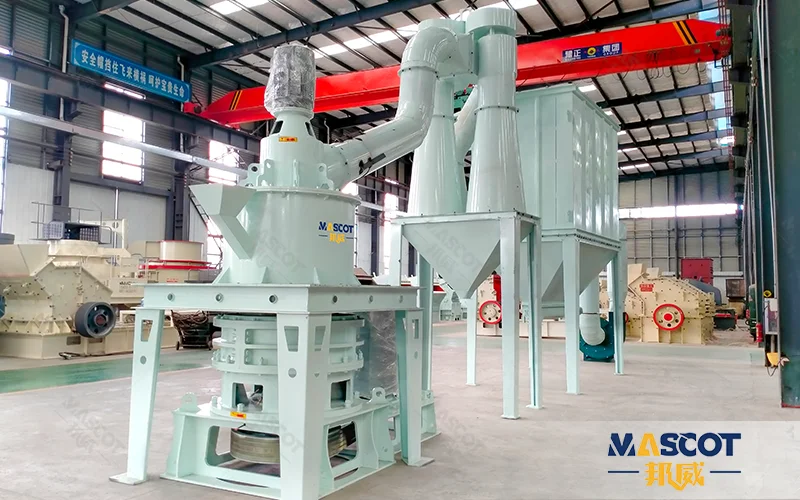
Two producers can buy the same HGM Series Micro-powder Grinding Mill, run it at the same tonnage, and end up with completely different returns — because the money on an ultra-fine mill is not in the tons, it is in where those tons sit on the fineness ladder. The published working band runs from 325 mesh (45 µm) to 2500 mesh (5 µm), and between 325 mesh and 1250 mesh the applications change twice: from construction filler to paper and pulp filler, then to coatings, masterbatch and rubber. This article follows that ladder, sets out what the published cost comparison says about running the top of it, and identifies the changes that decide whether a fine-grinding investment returns 30-45% on cost per ton or nothing at all.
Mesh is an ordering of openings per linear inch, so a higher number means a smaller particle: 325 mesh is 45 microns, and the HGM's published band reaches 2500 mesh, about 5 microns. The span this article deals with — 325 to 1250 mesh — is the range in which non-metallic mineral powder stops being a bulk material and starts being a functional one.
The reason the ladder matters commercially is set out in more depth in the site's look at the ultra-fine powder market from 800 to 2500 mesh: above a certain fineness, powder stops being sold by the ton and starts being sold against a specification. Three things change as a producer moves up that ladder, and only the first is a machine setting.
The customer changes. At the coarse end the buyer is a construction or general filler user purchasing on price and consistency. Higher up, the buyer is a coatings, masterbatch, rubber or paper formulator purchasing against a specification — a D97 value, a whiteness figure, a residue limit — and paying for the assurance that it will be met on every delivery rather than on average.
The tonnage falls. Any grinding machine trades fineness against tonnage, and the HGM is no exception: rated capacity is published as a band across the whole working range, so the tonnage at 1250 mesh is not the tonnage at 325 mesh.
The cost per ton rises. More energy per ton, more classifier work, and the same wear parts working harder per ton produced. The grade has to be worth more than the extra cost — which is precisely what the applications at the top of the ladder pay for.

The published application map for the platform pairs a mesh band with the industry that buys it. Read as a portfolio rather than as a specification, it shows what a single HGM line can sell into.
| Material Group | Typical Materials | Mohs Hardness | Typical Mesh Band |
|---|---|---|---|
| Paints & Coatings | Calcite / calcium carbonate, barite, kaolin, talc | 3-4 | 600-2500 mesh |
| Plastics & Rubber | Calcium carbonate, talc, barium sulfate, wollastonite | 3-5 | 800-2500 mesh |
| Paper & Pulp | Calcite (GCC), kaolin, talc | 3 | 325-1500 mesh |
| Construction Materials | Calcite, limestone, dolomite, gypsum | 3-5 | 325-800 mesh |
The distribution is the investment case. Construction buys the widest tonnage at the lowest grade; paper and pulp buy across the middle; coatings and plastics buy the top of the ladder in smaller volumes. Calcium carbonate is the platform's core application, and the grade-to-industry map above is the same ladder the calcium carbonate grinding process is built around. A line that can serve only the construction band is competing on tonnage in the most crowded part of the market; a line that can hold 1250 mesh is selling into a specification-driven segment where the price is set by performance rather than by the size of the order. Because every model in the series publishes the same 5-47 micron band, the grade ladder is not a property of the biggest machine — it is a property of the platform.
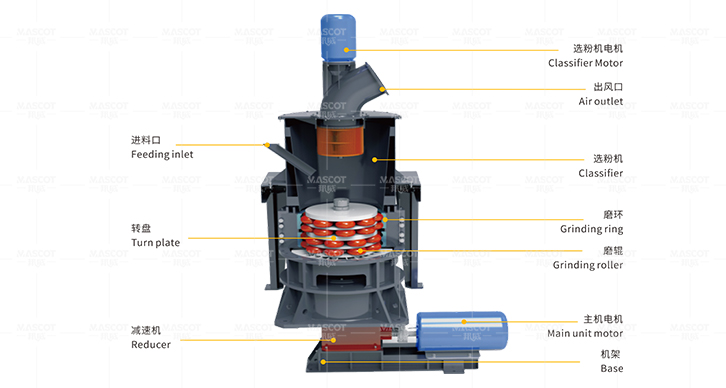
Every ROI on an ultra-fine mill is decided by a pair of numbers, not by one. The published capacity ranges below are quoted across each model's whole working band, which is exactly why a project has to be quoted on the fineness it will sell rather than on the top of the tonnage column.
| Model | Feeding Size (mm) | Output (Micron) | Main Motor (kW) | Classifier (kW) | Capacity (t/h) |
|---|---|---|---|---|---|
| HGM80 | ≤10 | 5-47 | 37 | 11 | 0.35-2.5 |
| HGM1028 | ≤10 | 5-47 | 75 | 22 | 0.6-4 |
| HGM1036 | ≤20 | 5-47 | 110 | 30 | 0.9-6 |
| HGM1250 | ≤20 | 5-47 | 132 | 37 | 1.2-10 |
Field numbers show what that trade-off looks like in practice. An HGM1028 in Vietnam, grinding high-purity white calcite for architectural coatings and polymer masterbatch, produces 1.5 t/h at 1250 mesh (D97) with a consistent 94.5% ISO brightness and D97 pass rates above 98%. The same model is published up to 4 t/h — so a 1250-mesh contract sits in the lower half of the model's own working band, and the same machine on a coarser grade moves several times more tonnage. A plant that sizes its mill on the coarse figure and then sells the fine grade is the classic way to lose money on an ultra-fine line.
Mascot publishes a cost comparison for exactly the pair of numbers this article is about: 1250-mesh (D97) non-metallic mineral powder at 2 t/h output, comparing the HGM micro-powder mill against a traditional ball mill system. It is stated on the source page as a typical estimation based on industry-average data, and it is reproduced here on that basis.
| Cost Item | HGM Micro-Powder Mill | Ball Mill System |
|---|---|---|
| Power consumption (kWh/t) | 45-55 | 75-90 |
| Wear parts cost | Low — high-chrome alloy (HRC 58-62) rated for Mohs 1-6.5 minerals | Medium — grinding balls and liners replaced regularly |
| Equipment investment | Medium — integrated grinding, classifying and collecting system | Low-medium — classifier and conveying purchased extra |
| Floor space and civil works | Small | Large |
| Noise level (dB) | ~85 | >100 |
| Fineness stability (D97) | ±2% | ±5% |
| Maintenance frequency | Low | High — stops needed for ball reloading |
| Annual power cost | 1.0x (baseline) | ~1.7x |
The annual power figures are calculated on 2 t/h output, 6,000 operating hours per year and an average electricity price of $0.08/kWh. Two rows deserve more attention than the others when the table is read as an investment case rather than as a specification sheet. The first is the kWh/t row: the gap between roughly 45-55 and 75-90 is the difference that funds the investment, but it is a per-ton figure at a stated fineness, so a plant that sells a coarser mix will see a narrower gap. The second is the D97 stability row: ±2% against ±5% is not an energy number at all — it is the difference between shipping against a specification clause and absorbing rejections, and on coating and masterbatch grades that line can outweigh the power saving in a single season.
The published result of the same comparison is that annual power cost falls by roughly 40% against a ball mill system on that duty, and that including wear parts, maintenance and floor space, total cost per ton is 30-45% lower, with the investment difference typically recovered within 1-2 years.
Those figures are worth reading carefully, because they contain their own conditions. The payback is expressed on the difference between the two investments, not on the whole project; it assumes the line runs 6,000 hours a year at 2 t/h on a 1250-mesh product; and it depends on the plant actually selling the grade the calculation is based on. Change any of the three and the period moves:
Hours. A line running two shifts instead of continuous operation reduces the annual saving almost proportionally, because the capital is already committed.
Grade. Run the same mill on construction filler instead of a coating grade and both sides of the cost comparison compress — the ball mill's disadvantage shrinks along with the fineness.
Tariff. The power line is the largest single saving, so a project in a high-tariff market pays back faster on the same tonnage.
The conclusion a buyer should draw is not the payback period itself but the operating rule behind it: an HGM line is an investment in the top of the ladder. It pays when the plant has contracts at 800 mesh and above, and it pays least when the mill is used only to make grades that a cheaper mill can already produce.
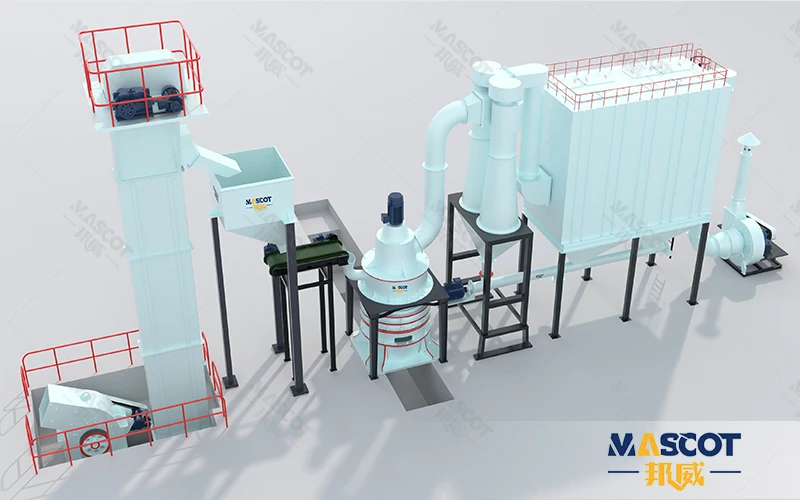
Three operating characteristics of the platform show up in the ROI rather than in the datasheet.
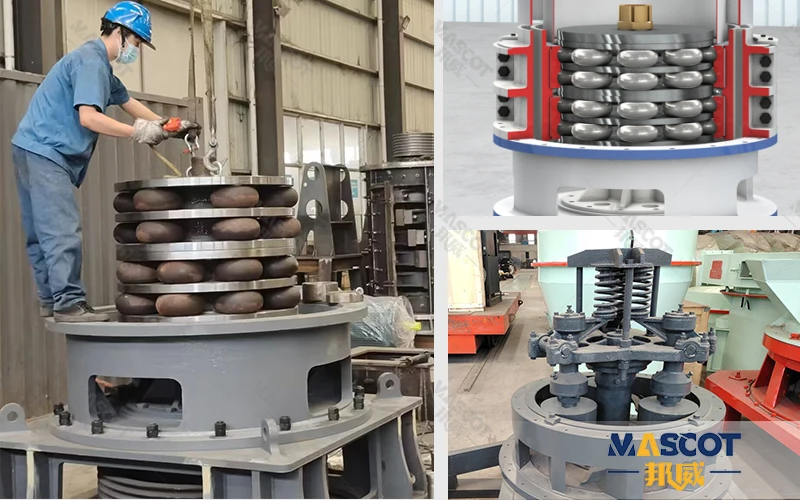
Wear parts are consumables with a published life advantage. The grinding rollers and rings are cast from high-performance wear-resistant alloy and are stated to last 2-5 times longer than standard steel, with service life varying by mineral — reported at 1,500+ hours on feldspar and considerably longer on soft talc. Since wear cost per ton is the second-largest controllable line after power on a fine-grinding circuit, the mineral matters: an ultra-fine line on soft calcite at Mohs 3 is a different wear proposition from the same line worked at the hard end of the published envelope.
The cut point moves without stopping production. Fineness is set by the turbo classifier through a variable-frequency drive, so a grade change is a control-panel operation rather than a shutdown or a parts change — under 30 minutes between mesh grades, and 30-60 minutes when the plant switches between different minerals entirely. One machine can therefore hold a construction contract, a paper contract and a coating contract in the same week.
Markets multiply per unit of capital. A multi-mineral filler producer in Jakarta put one HGM1036 line to work on three products: 2 t/h of 1250-mesh calcite, 3 t/h of 1250-mesh talc and 2.5 t/h of 800-mesh kaolin, switching between them in 40-60 minutes, with D97 pass rates above 98% on all three and whiteness protected by a ceramic-lined powder path. The single line replaced two separate ball mill lines the plant had planned to install, cutting capital cost by over 50% and power cost by 40% or more. That is the shape of the ROI on this platform at its best: not one grade produced more cheaply, but three markets served from one capital item.

Five conditions turn a viable ultra-fine project into a stranded asset, and all five are visible before the order is placed.
1. Buying the fine band without the orders to fill it. The material envelop and the machine are capable of grades the plant may never sell. Mascot's own selection guidance is explicit: decide by the coarsest grade the order book requires. If every grade sits inside the 80-425 mesh range, a YGM or MTW mill is the cheaper route; once the order book includes coating or masterbatch grades below 45 microns, the HGM is the machine that can hold that fineness consistently — and it can still produce the coarse construction grades on the same unit.
2. Sizing on the wrong pair of numbers. A capacity range quoted across the whole band is not a promise at the fine end. Quote the model on the tonnage required at the mesh you will sell.
3. Feed moisture above the working limit. The platform's published working envelope is moisture under 6%; wetter feed has to be dried or blended first, and that cost belongs in the project, not in the operating surprise column.
4. Hardness outside the envelope. The series is published for Mohs hardness below 7. A mineral above that limit is a different machine decision, not a settings change, and forcing it produces the fastest wear rate in the whole cost model.
5. Ignoring contamination limits until the product is rejected. On coating, masterbatch and paper grades the contract often constrains whiteness and iron content as tightly as it constrains fineness. Where that applies, the powder path — rollers, lining and piping — is specified around it, as in the Jakarta and Vietnam installations, both of which used a ceramic-lined path to protect brightness.
The model ladder is short, and the feed limit — not the fineness — is what changes between models. The HGM80 and HGM1028 accept feed up to 10 mm, the HGM1036 and HGM1250 up to 20 mm, so the pre-crushing stage is configured to the model rather than to a fixed figure. Because the fineness band is common across the series, a grade proven on a small line can be moved to a larger model later without re-qualifying the specification with the plant's own customers — a useful property for a producer whose fine-grade contracts grow.
Q1: Which mesh grade should I build the ROI around?
A: The finest grade you have contracts or firm demand for, not the finest the machine can reach. The published cost case for the HGM is calculated at 1250 mesh (D97) and 2 t/h; the same mill on construction grades competes with cheaper platforms, while the coating, masterbatch and paper bands are where the specification premium sits.
Q2: How much does the fine end reduce capacity?
A: It reduces it materially, which is why the trade-off has to be priced. Each model is published as a range across its whole band — the HGM1028 at 0.6-4 t/h, the HGM1250 at 1.2-10 t/h — and the field case for a 1250-mesh calcite contract on an HGM1028 is 1.5 t/h, in the lower half of that model's range.
Q3: What is the actual energy consumption per ton?
A: The published comparison for 1250-mesh (D97) powder puts the HGM at 45-55 kWh/t against 75-90 kWh/t for a ball mill system, calculated on 2 t/h, 6,000 hours a year and $0.08/kWh; annual power cost is about 40% lower and total cost per ton 30-45% lower. It is a typical estimation based on industry-average data: confirm the figure on your own material, at your own grade, before fixing the model.
Q4: Can one HGM mill serve several grades and several minerals?
A: Yes. The cut point is set by the turbo classifier through a variable-frequency drive and changed while the mill runs — under 30 minutes between mesh grades and 30-60 minutes between minerals. The four models all publish the same 5-47 micron band, so model choice sets throughput rather than the grades the plant can sell.
Q5: What limits the platform?
A: Mohs hardness below 7, moisture under 6%, and feed reduced to the model's limit by pre-crushing (10 mm on the HGM80 and HGM1028, 20 mm on the HGM1036 and HGM1250). Where a contract also constrains whiteness or iron content, the wear-material specification and the powder path are configured for it.
On an ultra-fine mill the grade decides the return. Between 325 mesh (45 µm) and 1250 mesh the HGM's market changes twice — from construction filler to paper and pulp, then to coatings, masterbatch and rubber — and the tonnage falls as the ladder is climbed, which is why the published field case for a 1250-mesh contract sits at 1.5 t/h on a model rated up to 4 t/h. The published cost comparison for 1250-mesh (D97) powder at 2 t/h, on 6,000 hours a year, puts the HGM at 45-55 kWh/t against 75-90 kWh/t for a ball mill system, with annual power cost about 40% lower, total cost per ton 30-45% lower, and the investment difference typically recovered within 1-2 years. The case only holds where the fine grades actually sell: a Jakarta filler producer turned one HGM1036 line into three products and replaced two planned ball mill lines, cutting capital cost by more than half. The four models cover 0.35-10 t/h across a common 5-47 micron band, so the mill can be sized on the tonnage required at the grade the plant will sell — and the platform's finer grades, including how a D97 target is held shift after shift, are covered in the site's explanation of the D97 specification on the HGM mill. Send your material, the target grade and the tonnage you must ship at that grade, and the HGM Series Micro-powder Grinding Mill can be sized on all three.

About of Mascot
Zhengzhou Mascot Industry is a high-tech mining equipment company integrating R&D, manufacturing, sales, and after-sales service. Focusing on crushing, grinding, and mineral processing equipment, we provide professional solutions to our customers. We are ISO9001:2015 certified, and our products include mobile crushing plants, crawler crushing plant, construction waste crushing plants, jaw crushers, sand making machines, cone crushers, fine crushers, grinding mills, ball mills, etc., all with reliable performance to meet diverse project needs.
• Professional pre-sales support: Free project design and comprehensive solutions to help you accurately select the right equipment;
• Comprehensive on-site service: Providing installation guidance and worker training to ensure smooth equipment commissioning;
• Reliable after-sales guarantee: A complete after-sales system, timely response to technical inquiries and equipment maintenance, ensuring long-term stable operation.
To protect your rights, please contact us through the following official channels for professional service:
WhatsApp: 0086-16650273865
Email: mascot@mascotenv.com
We are committed to providing high-quality equipment and full-cycle services to deliver comprehensive intelligent solutions for the global mining industry!

The Raymond mill production line is a highly efficient system designed for grinding operations, with a focus on energy efficiency, durability, and productivity. It caters to the needs of users by offering fine powder products in non-metallic ores, coal powder, and slag processing, aiding enterprises in achieving sustainable growth.

The MTW series European grinding mill production line includes high-efficiency crushers, elevators, electromagnetic vibration feeders, milling machines, classifiers, and collectors. These pieces of equipment work together to achieve efficient crushing, grinding, and classification of various non-metallic ores, coal powder, slag, and other materials. It can meet the diverse needs of various industries for powder particle size, uniformity, shape, etc., and offer enterprises high-quality grinding products.

The ball mill production line is a comprehensive production line that integrates material crushing, grinding, grading, and collection. This production line is mainly used to process various materials, including sand and gravel, cement, new building materials, silicates, refractory materials, fertilizers, ferrous metal beneficiation, non-ferrous metals, glass ceramics, etc.
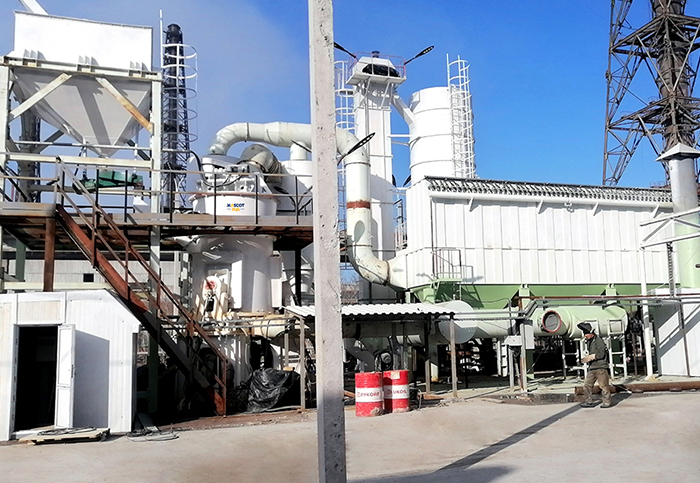
The production line of the vertical roller mill is a cost-effective and energy-efficient solution for processing powder, which is widely used in many industries, such as metallurgy, building materials, industrial solid waste treatment, thermal power plants, cement plants, and environmental protection fields. The primary purpose of this project is to finely grind raw materials through a vertical roller mill to meet the requirements of different industries for particle size, purity, and output of powder products.

YGMX Enhanced High-Pressure Mill is a new type of high-performance grinding equipment, and the biggest improvement of this milling equipment lies in the increase of the high-pressure spring system in the grinding roller part. Compared with the traditional high-pressure roller mill, it has a wider scope of application and excellent performance to meet the production needs of a variety of powder fineness. It is widely used in non-metallic minerals, chemicals, building materials, metallurgy, environmental protection, etc. Multiple areas.
Green and Intelligent Mining Machinery
Manufacturing and Export Base
Based on high quality and perfect after-sales service, our products have been
exported to more than 120 countries and regions.
Copyright © 2023 Zhengzhou Mascot Environmental Technology Co., Ltd Record number: Yu ICP No. 13021523-4





 WhatsApp