Finish grinding is the last stage of a cement plant and the one where the product is finally defined. Clinker arrives hot and coarse, gypsum is added, and what leaves the mill has to satisfy a fineness specification, a sulphate balance and a temperature limit at the same time. Most comparisons of the Dry Ball Mill and the Vertical Roller Mill start from the grinding mechanism. This one starts from the purchase order, because a finish mill is bought on three numbers, and the two technologies answer them in different currencies.
What the finish mill produces is not "fine clinker". It is cement, and cement is accepted against a set of measured properties rather than against a particle size alone. The published working window for the cement ball mill states the shape of that specification: 280-450 m²/kg Blaine, or equivalently 1-10% residue on the 45 micron sieve, reached by regulating separator speed, ball charge and diaphragm setting. The two metrics are not interchangeable, and the difference between them is set out in Blaine and residue as fineness metrics.
Two further limits sit alongside the fineness. Gypsum is dosed at 3-5% of clinker weight against an SO3 target of 2.5-3.5% in the finished cement, because the sulphate balance controls setting time and strength development. And the material in the mill is held below 110 °C by water spray at the inlet and outlet, because above that temperature the gypsum dehydrates into hemihydrate, which can cause false set and a loss of 28-day strength.
Those four numbers — Blaine, residue, SO3 and temperature — are the specification the mill has to hold. Everything that follows is about which machine holds it more cheaply, and about how each machine's datasheet reports whether it will.

Every credible finish-mill quotation answers three questions, and a quotation that answers only one of them has not described a plant.
| The Guarantee | Published Reference Point | What It Actually Decides |
|---|---|---|
| Tonnes per hour at a stated Blaine | Capacity tables are rated at 350 m²/kg on OPC clinker with 3-5% gypsum | Whether the mill keeps up with the kiln or the contract, at the grade you actually sell |
| Kilowatt-hours per tonne at that Blaine | 25-32 kWh per tonne of OPC at 350 m²/kg in a closed circuit, separator and fans included | The largest recurring cost in the finish mill, and the number a power tariff multiplies for the next decade |
| Product quality window | 45 micron residue 1-10%, SO3 2.5-3.5%, material below 110 °C | Whether the cement is accepted by the standard, by the ready-mix customer and by the 28-day strength test |
How to read this table: the first row is the one that gets negotiated and the third is the one that gets forgotten. A capacity figure quoted without the Blaine it belongs to is not a specification — the published ranges are rated at 350 m²/kg, and every step upward in fineness moves the achievable tonnage downward, because the material spends longer in the grinding zone and more of it circulates. The middle row is the only one that can be compared between technologies, and only if both sides declare the same boundary. Treat the three rows as a package: a mill that wins on energy but loses the temperature limit has not won anything.
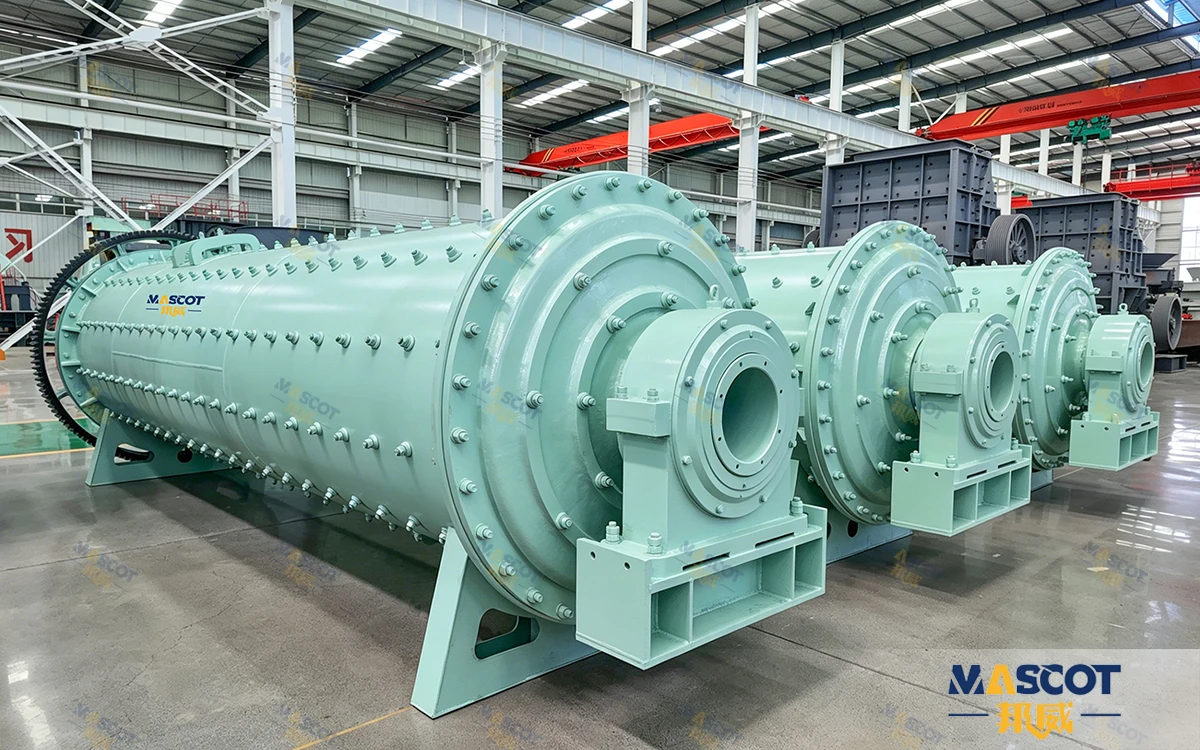
A cement finish mill is a two-chamber tube mill with a double-layer diaphragm between the chambers. Large forged balls in the first chamber break the clinker by impact; small balls in the second chamber finish it by attrition; the diaphragm keeps the coarse fraction in the first chamber so the second one is not doing work that has already been done. The published ladder runs from 1.6 t/h to 210 t/h, with grinding charges from 5 t to 278 t and drive power from 55 kW to 3,550 kW.
Its fineness reporting is direct. The specification is written in Blaine and in 45 micron residue, which are the two units a cement standard uses, so a quotation can be matched against the buyer's own test method without conversion. The control levers are named in the same table: separator speed, ball charge, diaphragm setting.

Its energy reporting is also direct, and unusually specific. The published benchmark for a closed-circuit system is 25-32 kWh per tonne of OPC at 350 m²/kg, depending on clinker grindability and target fineness, and closed-circuit operation is published as 15-25% lower in specific power than the equivalent open circuit. That is why closed circuit is the standard recommendation above 30 t/h: the separator returns oversize instead of letting it into the product, and the mill stops grinding material that is already fine enough.
The thermal side is a control system rather than a drying function. Water spray at the inlet and outlet, combined with adjustable ventilation, holds the material under 110 °C; it cannot dry a wet feed, and it is not meant to. Wear is a steady cost: high-chrome liners published at 8,000-12,000 operating hours on clinker at Mohs 6-7, with grinding media topped up continuously. Product flexibility is a genuine strength in markets that switch grades: on a documented closed-circuit installation, moving between OPC and PPC took under two hours, using proportioning, separator speed and grinding-aid dosage rather than a mechanical change.
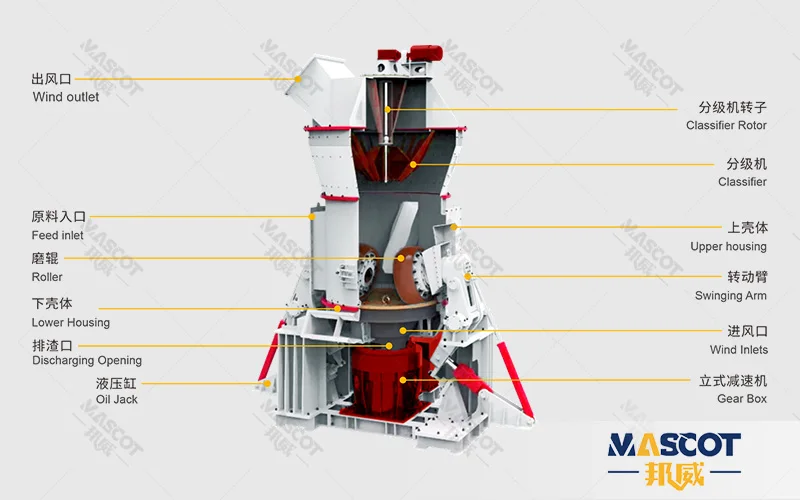
The vertical roller mill grinds on a material bed. Material is fed to the centre of a rotating table, centrifugal force carries it under hydraulically loaded rollers, and the crushed bed is lifted by gas into a dynamic classifier that returns the coarse fraction to the table. Hard, ungrindable material is discharged automatically to protect the system. The published ladder is 10-135 t/h across five models, feed up to 38 mm, with 4-15% feed moisture dried in the same pass to a final moisture of ≤1%.
Its product size is published as a particle cut: 212-45 micron, written as 70-325 mesh, and how that cut behaves on a cement or slag duty is compared in vertical roller mill or ball mill for cement and slag. That is a complete and useful specification for a slag or mineral powder duty. For cement finish grinding it is one step removed from the number the buyer signs against, because cement is bought on Blaine and the SRM table carries no Blaine column. The two are not convertible by arithmetic: mesh and micron describe how large the particles are, while Blaine describes the surface area per unit mass, which is what correlates with early strength and with the standard's acceptance test.
The energy statement has the same shape. The series is published as consuming 30-50% less energy than a ball mill on the material-bed principle, and that is a technology-level claim, not a figure for your clinker at your Blaine. It is a legitimate reason to shortlist a vertical mill. It is not a substitute for kWh per tonne at 350 or 380 m²/kg on the material you will actually grind, and it does not tell you what the auxiliary circuit draws.
Two things the vertical mill does publish clearly, and they matter at the finish stage. The first is the thermal window: hot gas up to 350 °C in, 70-95 °C out, which is deliberately below the gypsum dehydration point and therefore compatible with a gypsum-bearing cement mix. The second is the maintenance structure: roller sleeves and table liners in modular segments, with no grinding media to top up — a scheduled event rather than a daily consumable.
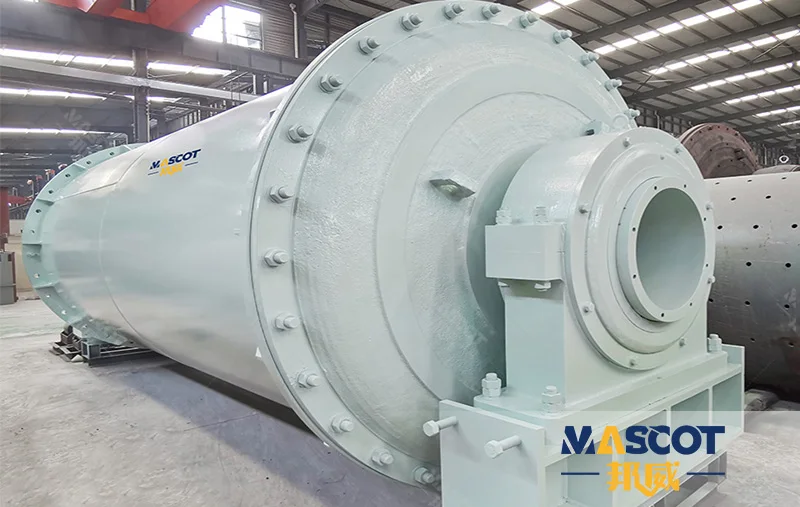
Put the two model ranges on one page at the tonnages where a finish mill is normally bought, and the structural difference appears before any efficiency argument: the vertical mill reaches a given tonnage with a smaller drive, and the ball mill reaches it with a longer shell and a heavier ball charge.
| Model | Series | Capacity (t/h) | Drive Power (kW) | Grinding Charge (t) | Published Fineness |
|---|---|---|---|---|---|
| 2400×7000 | Ball mill | 17-28 | 380 | 39 | 280-450 m²/kg |
| 2400×8000 | Ball mill | 20-35 | 570 | 42 | 280-450 m²/kg |
| 2600×13000 | Ball mill | 40-55 | 1,000 | 82 | 280-450 m²/kg |
| 3500×11000 | Ball mill | 75-85 | 1,250 | 150 | 280-450 m²/kg |
| 3800×12000 | Ball mill | 85-110 | 1,600 | 175 | 280-450 m²/kg |
| SRM1300 | Vertical | 10-35 | 185-250 | None | 70-325 mesh |
| SRM1500 | Vertical | 13-48 | 250-355 | None | 70-325 mesh |
| SRM1700 | Vertical | 18-68 | 355-600 | None | 70-325 mesh |
| SRM1900 | Vertical | 23-85 | 450-600 | None | 70-325 mesh |
| SRM2200 | Vertical | 36-135 | 710-1,000 | None | 70-325 mesh |
How to read this table: compare rows at the same tonnage, not the same position in the list. At around 35 t/h the ball mill carries a 570 kW drive against 185-250 kW on the SRM1300; at around 85 t/h it carries 1,250 kW against 450-600 kW on the SRM1900. Those are the figures that make a vertical mill look decisive, and they are also the figures that make this table dangerous. Each column is a mill drive only. On the ball mill side the plant still has to run the separator, the bucket elevators, the mill vent fan and the dust collector; on the vertical mill side it has to run the hot-gas fan and the system fan. Neither column is a plant's kilowatt-hours per tonne, so use the ladder to size a machine and the next section to compare the cost.
The reason finish-mill comparisons go wrong is not that either technology is misrepresented. It is that the two quotations answer different questions in different units, and the difference is only visible when they are laid on the same grid.
| Item | What a Ball Mill Quote Usually States | What a Vertical Mill Quote Usually States | Normalise To |
|---|---|---|---|
| Capacity | t/h in the model table, rated at 350 m²/kg | t/h in the model table, no fineness reference attached | t/h at your target Blaine, on your clinker, in writing |
| Specific power | 25-32 kWh/t benchmark for the closed circuit at 350 m²/kg | 30-50% lower than a ball mill, stated as a principle | kWh/t at the same Blaine, boundary including fans, separator, feeding and dust collection |
| Fineness | Blaine, plus 45 micron residue where specified | 212-45 micron (70-325 mesh) particle cut | The metric your cement standard enforces, with the other one reported alongside it |
| Thermal | Water spray and ventilation, material below 110 °C | Hot gas drying, 4-15% feed moisture to ≤1%, outlet 70-95 °C | Product temperature at the mill outlet and the sulphate balance of the finished cement |
| Wear and spares | Liners at 8,000-12,000 h, plus continuous media top-up | Roller sleeves and table liners, modular replacement, no media | Cost per tonne of cement over the same operating hours, not price per part |
How to read this table: the fourth column is the whole method. Each row is a question that both suppliers can answer, but only one of them answers it unprompted. The capacity row is the most consequential, because a vertical mill quotation that omits the Blaine reference is not necessarily hiding anything — its series is published on a particle cut, so the cement specification has to be added by agreement. Put that agreement in the order: tonnage at a stated Blaine, measured on a stated clinker, with the test method named.
The technology argument rarely decides a finish mill. The plant's situation does, and the situations repeat. Where the whole grinding station is being drawn rather than one machine replaced, the flowsheet-level comparison belongs to cement grinding station: ball mill vs vertical roller mill; this table stays inside the finish mill.
| Your Situation | The Machine to Look At | Why |
|---|---|---|
| An existing tube mill, and 20 t/h more of the same cement | Ball mill, in closed circuit | Same spares, same operating crew and the same Blaine test; a separator upgrade is published at 15-25% lower specific power than an open circuit |
| Greenfield, 60-100 t/h, power cost dominant | Vertical roller mill | One unit inside the published ladder where a ball mill needs a longer shell and a heavier charge |
| OPC, PPC and PSC changed weekly at 30-50 t/h | Ball mill | Grade changes are made by proportioning, separator speed and grinding aid; a documented circuit switched OPC to PPC in under two hours |
| Damp gypsum or wet additions, no dryer on site | Vertical roller mill | Drying happens in the grinding pass, so the dryer leaves the flowsheet |
| Product specified at 400 m²/kg Blaine or above | Ball mill, with the tonnage confirmed at that Blaine | The ball mill is published in Blaine, so the guarantee is written in the unit the standard enforces |
| Very tight plot with no room for a tube mill train | Vertical roller mill | Integrated vertical arrangement, with classifier and drying in the same machine |
Q1: Can a vertical roller mill grind cement to 350 m²/kg Blaine?
A: The series is published on a 212-45 micron particle cut, not on Blaine, so the honest answer is that it has to be confirmed on your clinker rather than assumed from the table. Ask for the guarantee as tonnes per hour at your Blaine, with the test method named, and for the residue on 45 micron at the same time. A supplier who can state both has answered the question.
Q2: Is the ball mill really 30-50% more power-hungry?
A: That figure describes the grinding principle, not a plant. The ball mill has its own published benchmark — 25-32 kWh per tonne of OPC at 350 m²/kg in closed circuit — which includes the separator and fans, while the vertical mill's headline is a technology comparison. Compare kWh per tonne at the same Blaine with the same boundary and the gap narrows to whatever your clinker and your auxiliary circuit make it.
Q3: Why is the ball mill still specified when the vertical mill uses less energy?
A: Because the finish mill is bought on a specification as well as an energy bill. The ball mill states its product in Blaine and in 45 micron residue, it takes grade changes through the separator and the ball charge, and its wear parts are liners and media that any cement plant can source. On a dry clinker duty with a fixed product, those advantages are worth less; on a multi-grade plant they are worth a great deal.
Q4: What does a finish mill do about hot clinker?
A: It controls temperature rather than drying. The published arrangement keeps the material below 110 °C with water spray at the inlet and outlet plus adjustable ventilation, which protects the gypsum from dehydrating into hemihydrate and keeps the sulphate balance inside 2.5-3.5% SO3. If the feed itself is wet, that is a drying problem, and a dryer or a mill with in-pass drying has to be part of the project.

About of Mascot
Zhengzhou Mascot Industry is a high-tech mining equipment company integrating R&D, manufacturing, sales, and after-sales service. Focusing on crushing, grinding, and mineral processing equipment, we provide professional solutions to our customers. We are ISO9001:2015 certified, and our products include mobile crushing plants, crawler crushing plant, construction waste crushing plants, jaw crushers, sand making machines, cone crushers, fine crushers, grinding mills, ball mills, etc., all with reliable performance to meet diverse project needs.
• Professional pre-sales support: Free project design and comprehensive solutions to help you accurately select the right equipment;
• Comprehensive on-site service: Providing installation guidance and worker training to ensure smooth equipment commissioning;
• Reliable after-sales guarantee: A complete after-sales system, timely response to technical inquiries and equipment maintenance, ensuring long-term stable operation.
To protect your rights, please contact us through the following official channels for professional service:
WhatsApp: 0086-16650273865
Email: mascot@mascotenv.com
We are committed to providing high-quality equipment and full-cycle services to deliver comprehensive intelligent solutions for the global mining industry!

YGMX Enhanced High-Pressure Mill is a new type of high-performance grinding equipment, and the biggest improvement of this milling equipment lies in the increase of the high-pressure spring system in the grinding roller part. Compared with the traditional high-pressure roller mill, it has a wider scope of application and excellent performance to meet the production needs of a variety of powder fineness. It is widely used in non-metallic minerals, chemicals, building materials, metallurgy, environmental protection, etc. Multiple areas.

The Raymond mill production line is a highly efficient system designed for grinding operations, with a focus on energy efficiency, durability, and productivity. It caters to the needs of users by offering fine powder products in non-metallic ores, coal powder, and slag processing, aiding enterprises in achieving sustainable growth.

This production line utilizes a three-ring medium-speed micro-grinding mill as the central equipment, complemented by other auxiliary equipment like hammer crushers, bucket elevators, and storage silos to establish a comprehensive grinding operation system. It has demonstrated strong potential for application and market competitiveness in industries such as construction, chemical industry, and new materials.

The ball mill production line is a comprehensive production line that integrates material crushing, grinding, grading, and collection. This production line is mainly used to process various materials, including sand and gravel, cement, new building materials, silicates, refractory materials, fertilizers, ferrous metal beneficiation, non-ferrous metals, glass ceramics, etc.

The MTW series European grinding mill production line includes high-efficiency crushers, elevators, electromagnetic vibration feeders, milling machines, classifiers, and collectors. These pieces of equipment work together to achieve efficient crushing, grinding, and classification of various non-metallic ores, coal powder, slag, and other materials. It can meet the diverse needs of various industries for powder particle size, uniformity, shape, etc., and offer enterprises high-quality grinding products.
Green and Intelligent Mining Machinery
Manufacturing and Export Base
Based on high quality and perfect after-sales service, our products have been
exported to more than 120 countries and regions.
Copyright © 2023 Zhengzhou Mascot Environmental Technology Co., Ltd Record number: Yu ICP No. 13021523-4





 WhatsApp
