
A tonne of cement now carries a carbon bill with four lines on it, and only two of them have anything to do with a Cement Ball Mill. One line is the kilowatt-hours the mill draws; the other is how much clinker the mill is asked to blend away. The first is small, the second is enormous, and attacking the wrong one is the standard mistake in this subject.
What follows is the arithmetic for one tonne of CEM I, done on published factors with the assumptions stated. It is a planning estimate, not a quotation of any plant's liability, and it is worth doing line by line because the structure of the bill — not the total — is what tells you where a grinding circuit can act.
Take 95% clinker at 0.88 tCO2/t, ground to a normal finish at 30 kWh/t, on a grid at 0.5 kgCO2/kWh. The certificate price is the published Q3 2026 figure of €82.32, and the deduction is the 2026 grey-clinker benchmark of 0.666 tCO2e multiplied by the 97.5% CBAM factor.
| Line in the bill | tCO2e per tonne | € per tonne | Who controls it |
|---|---|---|---|
| Calcination of limestone (0.52 × 0.95) | 0.494 | €40.67 | Chemistry and clinker factor |
| Kiln fuel (0.36 × 0.95) | 0.342 | €28.15 | Kiln, fuel mix, alternative fuels |
| Grinding electricity (30 kWh × 0.5 kg) | 0.015 | €1.23 | The grinding circuit |
| Less free-allocation deduction (0.64935 × 0.95) | −0.617 | −€50.78 | Fixed by the benchmark |
| Certificates to surrender | 0.234 | €19.27 | — |
How to read this table: the deduction offsets direct emissions and is scaled by the clinker content, which is where the 0.95 comes from. It does not offset electricity — indirect emissions pass through in full — which is why the grinding row has no matching deduction against it. On default values instead of measured ones, the same tonne lands near €76.94 rather than €19.27, and that gap is paperwork rather than carbon.
Limestone decomposed above 900 °C gives calcium oxide and carbon dioxide, and that CO2 is a product of the reaction rather than a by-product of the flame. It is 0.52 t per tonne of clinker, taken from the default factor in the IPCC guidelines and confirmed by every kiln measurement published since. Nothing in a grinding circuit reaches it: a mill running on free electricity would still leave 0.494 t of process CO2 in a tonne of CEM I.
The only lever that touches this line is how much clinker is in the tonne at all — CEM I at 95–100%, CEM II at 65–94%, CEM III down to 5–64%. Moving a product from the first band to the third removes more carbon than every energy project in the plant combined, and it is the reason the clinker line, not the electricity line, decides a cement producer's competitive position after 2030.

Fifteen kilograms per tonne is 1.8% of the footprint and €1.23 of a €19.27 bill. Easy to dismiss, and dismissing it is wrong, because it is the only line a mill operator can move this quarter without changing the kiln or the product.
The arithmetic fits on a phone. Ten kilowatt-hours per tonne at a half-kilo grid is 5 kgCO2e, which is €0.41 per tonne at the Q3 price. On 500,000 tonnes that is €205,800 a year — not enough to rescue a business, easily enough to pay for the separator review, the media grading and the meter that proves the figure.
Two conditions decide whether the saving is real. The mill has to be metered, because a kWh figure derived from nameplate power and rated tonnage is a design intention and a verifier will not accept it as an actual value. And the output has to be measured at the fineness you ship, because a low kWh/t achieved at a coarser grind is not a saving — it is a different product sold under the same name.
The published series runs from Φ1.2×4.5 to Φ4.6×10+3.5, covering 1.6 to 210 t/h. For carbon purposes the useful way to read it is to divide each model's drive power by its capacity band. That produces installed kilowatts per hourly tonne — comparable across the range, and a useful first filter before any supplier quotes a specific energy consumption.
| Model | Capacity (t/h) | Power (kW) | Installed kW per t/h |
|---|---|---|---|
| Φ1.83×6.4 | 6.5–15 | 210 | 14.0–32.3 |
| Φ2.2×6.5 | 14–20 | 280 | 14.0–20.0 |
| Φ2.4×8 | 20–35 | 570 | 16.3–28.5 |
| Φ2.4×12 | 35–45 | 800 | 17.8–22.9 |
| Φ2.6×13 | 40–55 | 1,000 | 18.2–25.0 |
| Φ3.2×9 | 60–70 | 1,250 | 17.9–20.8 |
| Φ3.8×12 | 85–110 | 1,600 | 14.5–18.8 |
| Φ4.6×10+3.5 | 180–210 | 3,550 | 16.9–19.7 |
How to read this table: the band inside each row matters as much as the row. A small mill reaches a competitive power per tonne only at the top of its capacity range, which is why a plant running at 60% of rating sees kWh per tonne climb without anything being wrong with the machine. The highlighted model sits in the same 15–19 kW per t/h band as the largest unit in the series, and that is the comparison a buyer should make — a large mill at part load against a smaller mill near full load — rather than comparing list prices.
Cement is routinely shipped above the fineness its standard requires, because extra Blaine is cheap insurance against a strength result that fails in the laboratory. It is cheap in the lab and expensive in the mill: power draw rises with fineness, and every point of Blaine above specification is electricity and carbon nobody ordered.
The circuit that avoids this is not a cleverer machine but a closed one. Material leaves through the discharge grate to a dynamic separator, which returns oversize for regrinding and passes only what meets the cut. Separator speed can be adjusted while the mill runs, which makes it the one fineness control that needs no shutdown and no change to the ball charge. The published fineness window is 280–450 m²/kg, which covers ordinary Portland cement, slag blends and composite products on the same mill.
Two measurements make the discipline provable: Blaine in m²/kg, and residue on the 45 µm sieve. A plant logging both at a fixed feed rate can see the week it started grinding harder than it needed to, and that is the week the carbon line moved. The two metrics are compared in Blaine versus 45 µm residue, including what each one is blind to. What the circuit around the mill looks like is listed on the 20 TPH ball mill production line case page, from jaw crusher through to dust collector.

The lever that removes the most carbon is clinker substitution, but the deduction falls as the clinker falls, so the invoice saving in 2026 is much smaller than the carbon saving. Both are real, and they have to be read together.
| Lever | tCO2e removed per t | Saved in 2026 | Saved at full phase-in |
|---|---|---|---|
| 10 kWh/t off the grinding circuit | 0.005 | €0.41 | €0.41 |
| Clinker factor 95% → 85% | 0.088 | €1.90 | €7.24 |
| Clinker factor 95% → 75% | 0.176 | €3.80 | €14.49 |
| 8 kWh/t off by trimming fineness to spec | 0.004 | €0.33 | €0.33 |
How to read this table: the electricity rows are charged in full and do not change with the phase-in, so their value is fixed today and stays fixed. The clinker rows shrink in 2026 because each point of clinker removed also removes a point of benchmark deduction, then grow to full value as the CBAM factor falls from 97.5% toward zero by 2034. In 2026 a kilowatt-hour saved is worth more per tonne of CO2 than a point of clinker removed. By 2030 the order reverses, and by 2034 the clinker lever is worth roughly thirty-five times the electricity lever.
That is the strategic case for a grinding circuit rather than a grinding machine. Slag, calcined clay and fly ash are harder to grind than clinker and usually need a finer product: slag cement at 420 m²/kg is a normal specification, beyond what a CEM I duty demands. A mill that cannot hold that fineness at rate quietly locks the plant into a high clinker factor, and the locked-in cost is the €14.49 per tonne in the last column.
Off-spec cement is re-ground or downgraded, and both cost money. In carbon terms the number is unglamorous: a 2% reject rate on a 30 kWh/t circuit is 0.6 kWh per tonne sold, about 0.3 kgCO2e, or two and a half euro cents at today's price. The case for consistency is a cost and reputation case, not a carbon case, and pretending otherwise weakens the argument for the changes that do pay.
Part-load operation belongs in the same honest category. The kW-per-tonne column above widens sharply at the bottom of every capacity band, so a mill run at 60% of rating pays a premium on every tonne for a decision made in the sales office. That is worth fixing because it is worth money in electricity; the carbon saving is the receipt, not the reason.

Q1: Is €19 per tonne the CBAM cost of cement?
A: It is one worked example, not a rate. It assumes 95% clinker at 0.88 tCO2/t, 30 kWh/t of grinding on a half-kilo grid, and actual values accepted by a verifier. On default values the same tonne lands near €77, and a CEM III product lands far lower. The structure is the point, not the single figure.
Q2: Why is the grinding line charged in full when the clinker line is not?
A: Because the free-allocation deduction is built on the clinker benchmark and subtracted from direct emissions. Electricity is an indirect emission and passes through without that deduction, which makes every kilowatt-hour saved worth its full certificate value — and it is the only line a mill operator can move this quarter.
Q3: Can a grinding aid reduce the carbon cost?
A: It can reduce the kilowatt-hours needed to reach a given fineness, and the saving appears on the electricity line in proportion. It does not touch the clinker line, so it belongs in the energy budget rather than in a decarbonisation strategy.
Q4: Does a vertical roller mill beat a ball mill on this bill?
A: On electricity per tonne, usually — but the difference is worth €1 to €2 per tonne of cement at today's certificate price, not €20. The larger question is which circuit holds the fineness your product mix needs on the materials you actually intend to grind, because that decision sets the clinker line for the next decade.

About of Mascot
Zhengzhou Mascot Industry is a high-tech mining equipment company integrating R&D, manufacturing, sales, and after-sales service. Focusing on crushing, grinding, and mineral processing equipment, we provide professional solutions to our customers. We are ISO9001:2015 certified, and our products include mobile crushing plants, crawler crushing plant, construction waste crushing plants, jaw crushers, sand making machines, cone crushers, fine crushers, grinding mills, ball mills, etc., all with reliable performance to meet diverse project needs.
• Professional pre-sales support: Free project design and comprehensive solutions to help you accurately select the right equipment;
• Comprehensive on-site service: Providing installation guidance and worker training to ensure smooth equipment commissioning;
• Reliable after-sales guarantee: A complete after-sales system, timely response to technical inquiries and equipment maintenance, ensuring long-term stable operation.
To protect your rights, please contact us through the following official channels for professional service:
WhatsApp: 0086-16650273865
Email: mascot@mascotenv.com
We are committed to providing high-quality equipment and full-cycle services to deliver comprehensive intelligent solutions for the global mining industry!

The high-pressure grinding mill production line is a project specially designed for efficient grinding operations. It is widely used in metallurgy, building materials, the chemical industry, highways, water conservancy hydropower, and other industries. It is a suspended roller mill that uses springs to increase pressure. It can achieve efficient grinding processing of various non-metallic raw materials. It has high efficiency, stability, and environmental protection characteristics.

The ball mill production line is a comprehensive production line that integrates material crushing, grinding, grading, and collection. This production line is mainly used to process various materials, including sand and gravel, cement, new building materials, silicates, refractory materials, fertilizers, ferrous metal beneficiation, non-ferrous metals, glass ceramics, etc.

This production line utilizes a three-ring medium-speed micro-grinding mill as the central equipment, complemented by other auxiliary equipment like hammer crushers, bucket elevators, and storage silos to establish a comprehensive grinding operation system. It has demonstrated strong potential for application and market competitiveness in industries such as construction, chemical industry, and new materials.
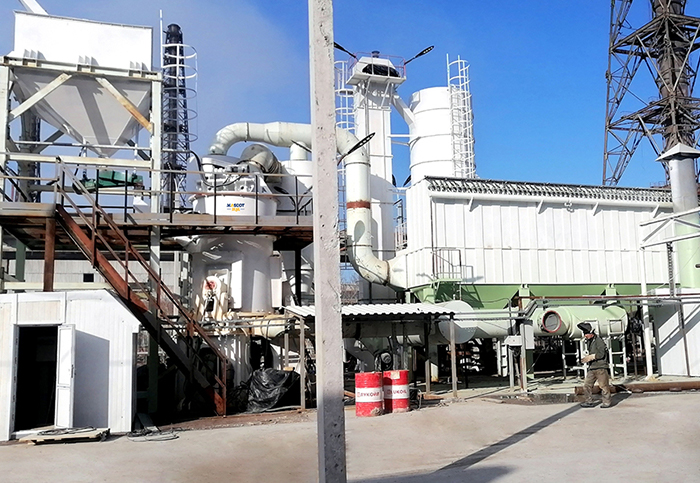
The production line of the vertical roller mill is a cost-effective and energy-efficient solution for processing powder, which is widely used in many industries, such as metallurgy, building materials, industrial solid waste treatment, thermal power plants, cement plants, and environmental protection fields. The primary purpose of this project is to finely grind raw materials through a vertical roller mill to meet the requirements of different industries for particle size, purity, and output of powder products.

The MTW series European grinding mill production line includes high-efficiency crushers, elevators, electromagnetic vibration feeders, milling machines, classifiers, and collectors. These pieces of equipment work together to achieve efficient crushing, grinding, and classification of various non-metallic ores, coal powder, slag, and other materials. It can meet the diverse needs of various industries for powder particle size, uniformity, shape, etc., and offer enterprises high-quality grinding products.
Green and Intelligent Mining Machinery
Manufacturing and Export Base
Based on high quality and perfect after-sales service, our products have been
exported to more than 120 countries and regions.
Copyright © 2023 Zhengzhou Mascot Environmental Technology Co., Ltd Record number: Yu ICP No. 13021523-4





 WhatsApp
