 27
 25
 27

A Cement Ball Mill has two wear parts that are bought and replaced separately: the grinding media and the liners. In service they are one system. The liner is what lifts the charge, the charge is what wears the liner, and the shape of the plate at the end of its life decides how the next charge behaves inside the same shell.
That is why a reline is not simply a maintenance event. New plates change the lift, and a mill that receives a new liner set while keeping its old charge is a mill running to a specification nobody wrote down. The five steps below keep the two sides matched — at commissioning, through the wear cycle, and at the stop where the plates are replaced.
A liner profile does two jobs: it protects the shell and it gives the charge something to grip. A plate with a pronounced step or wave carries balls higher and releases them with more impact energy. A smooth or finely corrugated plate produces more of a cascading, abrasive action instead. Ball diameter has to suit that difference, because the profile sets the trajectory and the ball size sets the energy carried along it.
Large balls on a low-lift profile roll rather than fall: the impact work the first chamber exists for never happens, and the plates take the load as sliding abrasion. Small balls on an aggressive profile send energy into steel against steel instead of into the material. Both mistakes read as a wear problem in the maintenance log and as a tonnage problem in the production report.
The published arrangement for the Cement Ball Mill series is a two-chamber shell with grading liners: chamber one built for impact on feed up to 25 mm, chamber two built for attrition to the target fineness. Ball diameter follows the top feed size in the first chamber and the fineness the plant sells in the second.
A two-chamber mill divides its length between breaking and finishing, and the diaphragm between them holds the division. The charge should not be the same mix on both sides of it, and neither should the liners: the first chamber is lined for lift, the second for a controlled cascade that keeps balls inside a bed of fine material rather than throwing them across the mill.
The diaphragm is the balance point. It retains coarse particles and passes what is already fine enough, so an under-charged first chamber sends coarse feed into a second chamber whose ball size was never chosen to break it. Residue then climbs at an unchanged separator setting, and the usual response — speeding the separator — holds the specification by giving up tonnage. Published fineness control on this series is 280-450 m²/kg Blaine, or 1-10% residue on the 45 µm sieve, held by ball charge, diaphragm setting and separator speed together.

Charge mass is bought against installed power, not against ambition. The series carries 5 t of grinding balls behind a 55 kW drive on the Φ1.2x4.5 and 278 t behind 3,550 kW on the Φ4.6x10+3.5. Adding steel past that mass does not buy tonnage: the drive lifts a heavier load, the charge rides higher and cascades less, and the energy that should have reached the product leaves as heat.
The working range quoted for these ball mills is a media fill of roughly 30-40% of mill volume, loaded as a graded mix rather than a single ball size. Fill is a stopped-mill measurement, and it is the number to check whenever a mill is suspected of being short-charged or overloaded.
The cost-free check is the pair of figures every cement mill already records. Power draw and tonnage at a fixed fineness, compared with the commissioning baseline, say whether the balance has moved without anyone touching the feeder.
Imbalance rarely announces itself. It arrives as a tonnage figure slightly low, then a residue figure that needs a separator adjustment, and by the time the laboratory flags a grade problem the mill has been out of balance for weeks. These five signatures cover most of the drift on a two-chamber mill.
| What the panel shows | What it usually means | Where to confirm it |
|---|---|---|
| Tonnage down, power draw flat | Ball size distribution has worn fine; impact capacity gone, mass still there | Sample the charge and check the size mix per chamber |
| Power draw down at unchanged feed | Charge is slipping: low fill, or plates worn smooth at the toe | Liner profile inspection at the lifting side |
| Residue up at unchanged separator speed | Second chamber short of surface area, not short of separator | Ball size mix in chamber two before any separator change |
| Power up, tonnage down | Mill overfilled, or a plate profile that no longer lifts the charge | Stopped-mill fill measurement plus plate thickness |
| Uneven plate wear, loose bolts | Charge trajectory is off and impact is landing in one zone | Thickness map around the circumference and bolt torque |
Read two rows at a time. Tonnage down with flat amps and residue up at unchanged separator speed are often one event seen from two ends of the mill, and the correction belongs in the charge rather than the separator setting. The distinction also separates a liner problem from a media problem: the first shows on power before tonnage, the second on tonnage first.

Liner life is quoted in hours, and for good reason: high-chrome plates on clinker at Mohs 6-7 are typically published at 8,000-12,000 operating hours. That is an average across installations, not a schedule for any one of them, because the wear that matters is not thickness. A plate worn from a stepped profile into a smooth one still has metal left and has already stopped lifting the charge.
Measure thickness at fixed points around each chamber and record it at every stop, so the reline becomes a comparison between two measurements rather than a date on a planner. A plate that has lost roughly half its height in the lifting zone is no longer doing the job it was bought for, whatever tonnage it still appears to hold on paper.
A reline resets the charge as well. New plates restore lift, so a charge tuned to a worn profile is no longer the right one, and both decisions belong at the same stop. Treat the weeks after a reline as a short commissioning: fresh baseline for amps and tonnage at the design fineness, so the next drift has something to drift from.
| Model (m) | Speed (r/min) | Grinding balls (t) | Power (kW) |
|---|---|---|---|
| 1.2×4.5 | 30.3 | 5 | 55 |
| 1.83×6.4 | 23.9 | 21 | 210 |
| 2.4×8 | 20.3 | 42 | 570 |
| 3.5×11 | 16.8 | 150 | 1,250 |
| 4.6×10+3.5 | 15 | 278 | 3,550 |
How to read this table: the four columns are published specification for the cement ball mill series, and they are the fixed side of the balance. Ball load and drive power belong to the model; fill percentage, size mix and liner profile are what the plant controls. A charge set outside these figures adds no capacity — it moves the working point beyond the envelope the drive was built for. How that charge is built is covered in the guide to charging media in a cement ball mill, and the fineness figures the second chamber must hold in Blaine and 45 µm residue.
Q1: Should liners and grinding media be replaced at the same time?
A: Not necessarily in the same quantity, but at the same stop. New plates restore lift and change the ball trajectory, so a charge tuned to the worn profile no longer matches the mill. Review the charge when the plates come out, then take a fresh power and tonnage baseline.
Q2: How can a liner be worn out while thickness is still within limits?
A: Because the profile matters more than the mass. Once the step or wave has worn flat, the plate stops carrying the charge to the release height, and the signature is a power draw that falls at unchanged feed while tonnage drifts down. Measure the profile in the lifting zone, not only the thinnest point.
Q3: Can output be raised by adding more balls?
A: Only up to the charge mass the drive was specified for. Beyond it, power rises, grinding-zone temperature rises, the cascade shortens and the extra energy leaves as heat. On this series the published pairing runs from 5 t behind 55 kW to 278 t behind 3,550 kW.
Q4: Do rubber liners change the balance?
A: Yes, in the same way any profile change does. Rubber is offered where the feed is silica-free and low noise is required, and its lower lift changes how the charge is carried, so ball size and charge mass have to be reviewed with the liner change rather than after it.

About of Mascot
Zhengzhou Mascot Industry is a high-tech mining equipment company integrating R&D, manufacturing, sales, and after-sales service. Focusing on crushing, grinding, and mineral processing equipment, we provide professional solutions to our customers. We are ISO9001:2015 certified, and our products include mobile crushing plants, crawler crushing plant, construction waste crushing plants, jaw crushers, sand making machines, cone crushers, fine crushers, grinding mills, ball mills, etc., all with reliable performance to meet diverse project needs.
• Professional pre-sales support: Free project design and comprehensive solutions to help you accurately select the right equipment;
• Comprehensive on-site service: Providing installation guidance and worker training to ensure smooth equipment commissioning;
• Reliable after-sales guarantee: A complete after-sales system, timely response to technical inquiries and equipment maintenance, ensuring long-term stable operation.
To protect your rights, please contact us through the following official channels for professional service:
WhatsApp: 0086-16650273865
Email: mascot@mascotenv.com
We are committed to providing high-quality equipment and full-cycle services to deliver comprehensive intelligent solutions for the global mining industry!

The high-pressure grinding mill production line is a project specially designed for efficient grinding operations. It is widely used in metallurgy, building materials, the chemical industry, highways, water conservancy hydropower, and other industries. It is a suspended roller mill that uses springs to increase pressure. It can achieve efficient grinding processing of various non-metallic raw materials. It has high efficiency, stability, and environmental protection characteristics.

This production line utilizes a three-ring medium-speed micro-grinding mill as the central equipment, complemented by other auxiliary equipment like hammer crushers, bucket elevators, and storage silos to establish a comprehensive grinding operation system. It has demonstrated strong potential for application and market competitiveness in industries such as construction, chemical industry, and new materials.
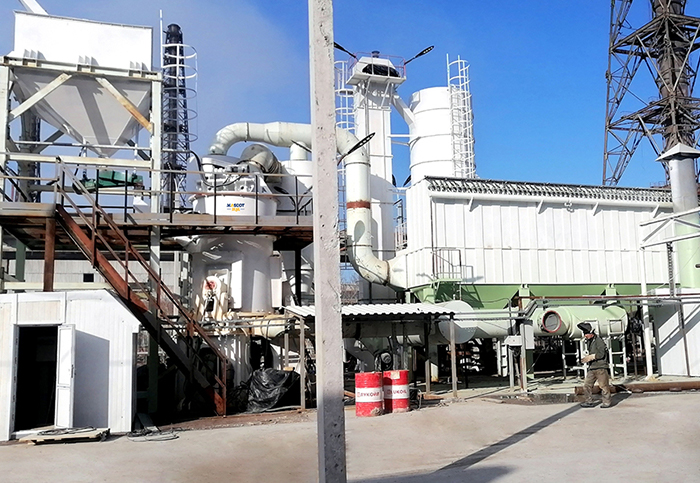
The production line of the vertical roller mill is a cost-effective and energy-efficient solution for processing powder, which is widely used in many industries, such as metallurgy, building materials, industrial solid waste treatment, thermal power plants, cement plants, and environmental protection fields. The primary purpose of this project is to finely grind raw materials through a vertical roller mill to meet the requirements of different industries for particle size, purity, and output of powder products.

The Raymond mill production line is a highly efficient system designed for grinding operations, with a focus on energy efficiency, durability, and productivity. It caters to the needs of users by offering fine powder products in non-metallic ores, coal powder, and slag processing, aiding enterprises in achieving sustainable growth.

The MTW series European grinding mill production line includes high-efficiency crushers, elevators, electromagnetic vibration feeders, milling machines, classifiers, and collectors. These pieces of equipment work together to achieve efficient crushing, grinding, and classification of various non-metallic ores, coal powder, slag, and other materials. It can meet the diverse needs of various industries for powder particle size, uniformity, shape, etc., and offer enterprises high-quality grinding products.
Green and Intelligent Mining Machinery
Manufacturing and Export Base
Based on high quality and perfect after-sales service, our products have been
exported to more than 120 countries and regions.
Copyright © 2023 Zhengzhou Mascot Environmental Technology Co., Ltd Record number: Yu ICP No. 13021523-4





 WhatsApp
