
400, 800 and 1250 mesh are usually presented as three settings of one machine. Commercially they are three different businesses: different tonnages, different cost structures, different customers, and often different mill classes. Choosing between them by looking at the price per ton is the most common way a powder project picks a grade it cannot make money on. This article sets out what actually changes between the three grades, why margin per ton and margin per hour move in opposite directions, and how to size an HGM Series Micro-powder Grinding Mill so that the grade you sell is the grade the machine was built for.
The mesh number is a shorthand for a particle size and, more importantly, for a set of customers. Read across the three bands and the reason each one exists becomes obvious.
| Grade | Approx. Size | What the Grade Is Bought For | What the Mill Has to Hold |
|---|---|---|---|
| 400 mesh | About 37-38 micron | Bulk filler, construction and industrial fillers, desulphurisation limestone, general mineral powder | Tonnage and cost per ton; the top cut is comparatively loose |
| 800 mesh | About 15 micron | Plastics and rubber fillers, mid-range coatings, profiles and film where surface quality shows | A D97 that survives the compounder's first-delivery test, lot after lot |
| 1250 mesh | About 10 micron | Premium coatings, masterbatch, paper coating, sealants and other surface-critical grades | A tight top cut, plus whiteness and iron control, plus repeatability across shipments |
How to read this table: the micron figures are standard sieve and trade equivalents for the three mesh names, consistent with the conversion used in Mascot's published cases, where a 1250 mesh grade is specified at a D97 of 10 micron. They are reference values rather than a specification: above roughly 400 mesh the industry stops sieving and writes the contract in microns, so the mesh name is a label and the micron or D97 figure is the enforceable number. The third column is the part buyers underestimate — each band has a different customer, and the customer is what sets the price.
The bands are also unequal in size. The published HGM working range is 150-3000 mesh (106-4 micron), which means 400 mesh sits toward the coarse end of the machine's capability, 800 mesh sits in the middle, and 1250 mesh is well into the fine half. Demand across the fine bands is not evenly distributed either, as the review of who buys micro-powder in the 800-2500 mesh range sets out.

Between 400 and 1250 mesh the machine does not change much. The way it is asked to work does.
The classifier turns faster, so the cut is finer. Airflow is rebalanced to carry the finer product out of the classifying zone. More material is returned for a second pass, so residence time in the chamber rises and tonnes per hour fall against the same drive power. Because the same installed kilowatts now serve fewer tonnes, specific energy per tonne climbs. Because more of the product is ground more than once, wear cost per tonne climbs with it. The plant's cost profile shifts from labour and capital towards power and wear — which is exactly why a fine grade needs a price premium to be worth producing, and why a coarse-duty mill pushed to its floor is a bad way to make one.
Three secondary changes follow and are usually missed in the quotation. Dust load rises with the proportion of fines, so the bag filter and its air-to-cloth ratio have to be sized for the finest grade on the schedule rather than the average. Bulk density falls, so a silo holds fewer tonnes and a truck carries fewer tonnes — a real cost on an export grade. And quality control has to move to laser diffraction, because sieve testing stops being meaningful at these sizes; a producer who cannot measure the distribution cannot defend it when a customer disputes a lot.
The grade boundaries themselves are commercial rather than mineral. Two grades of the same calcium carbonate can be sold into different industries at different prices while differing mainly in top cut and brightness, which is the pattern described in the comparison of paper coating and paint-grade calcium carbonate.

Fineness raises the price per ton and lowers the tonnes per hour. Which of those wins is an arithmetic question, and it can be answered before a machine is ordered.
Start with drive power, because it is published and it does not change with the grade. Take the HGM100+ at 132 kW main grinder. At the top of its capacity envelope, 11.5 t/h, the nameplate works out to roughly 11.5 kWh per tonne. At the bottom of the same envelope, 1.2 t/h, the same motor gives roughly 110 kWh per tonne — a tenfold difference in drive energy per tonne from one machine, with no change of parts. Those figures exclude the fan, classifier and feeder and are nameplate arithmetic rather than metered consumption, so they show a direction rather than a bill. The direction is the point.
Now the revenue side. Revenue per hour is price multiplied by tonnage. If tonnage at the finer grade falls to a fraction of the coarser rate, the price must rise by the inverse of that fraction simply to hold hourly revenue: a drop from 6 t/h to 2 t/h needs a price three times higher, before any allowance for the extra energy and wear per tonne. Add those costs and the required premium goes above three. Whether the market pays it is a question about customers, not about mills — but it is the question that decides which grade the plant should be built for.
This is why the fine-grade business is rarely run by pushing a coarse-duty mill to its floor. It is run either where a genuine premium exists, or on a frame sized to the fine grade so that the machine operates near its design point rather than at the edge of its envelope. The full cost-per-ton mapping from 325 to 1250 mesh, including where the payback sits, is worked through in the 325 to 1250 mesh cost model, and the commercial logic behind fine-grade premiums in export markets is covered in why export-grade mineral powder commands higher prices.

400 mesh sits in an overlap. It is the finest grade the MTW trapezium class is published for, and it sits in the coarse part of the HGM range, so both can produce it — at very different capital cost and at very different tonnages. Getting that choice right matters more than any later optimisation.
| Series | Model | Published Working Range | Capacity (t/h) | Main Motor (kW) |
|---|---|---|---|---|
| MTW Trapezium Mill | MTW110 | 80-400 mesh (0.038-1.6 mm) | 3-10 | 75 |
| MTW138 | 6-20 | 90 | ||
| MTW175 | 10-35 | 185 | ||
| MTW215 | 20-50 | 280 | ||
| HGM Micro-Powder Mill | HGM80 | 106-4 micron (150-3000 mesh) | 0.5-6 | 75 |
| HGM100 | 106-4 micron (150-3000 mesh) | 1.2-10.2 | 110 | |
| HGM100+ | 106-4 micron (150-3000 mesh) | 1.2-11.5 | 132 | |
| HGM125 | 106-5 micron (150-2500 mesh) | 2.5-20.5 | 185 |
How to read this table: every figure is the published parameter for the series. The capacity column is a model's envelope across its whole working range, not its output at your grade — at a coarse grade the machine runs toward the upper end, at a fine grade toward the lower end, and the exact figure for one grade on one mineral has to come from a grinding test. Two selection rules follow. If the business is 400 mesh at high tonnage and nothing finer, the MTW class reaches that grade with a much larger tonnage per frame, which is why the MTW trapezium mill is the cheaper route to a bulk filler. If 800 or 1250 mesh is on the plan, the HGM class is required, and the frame should be chosen on the finest grade you intend to sell. Note the one exception in the HGM row: HGM125 is published to 2500 mesh, so it cannot be quoted for a 3000 mesh top cut.
For all the attention fine grades receive, 400 mesh remains the volume business, and it is profitable for reasons that have nothing to do with price per ton. Capital cost per annual tonne is the lowest of the three bands. The machine runs near its design point rather than at the edge of it, so maintenance is predictable. The product is forgiving: a bulk filler tolerates a wider distribution than a masterbatch grade, so throughput is not traded away for a top cut nobody tests.
Delivered cost also favours it. A coarse powder travels cheaply relative to its value, so a plant can serve a regional market that a fine-grade exporter cannot reach economically, and proximity is a defensible position against imports. The competitive risk runs the other way: a 400 mesh plant competes with every other mill in the region, differentiation is thin, and price is the usual battlefield.
The strategic case for 400 mesh is therefore cash flow rather than margin percentage. It builds tonnage, a customer base and operating experience at a capital cost that a fine-grade line cannot match, and it produces the cash that funds a second grade later. What it does not tolerate is the assumption that a coarse grade carries no specification. A 400 mesh filler sold to a pipe or profile compounder still has a top-cut clause and a brightness clause; the numbers are simply looser than at 1250 mesh.


An HGM can hold the whole ladder. Fineness is set by the variable-frequency turbo classifier and the airflow, so a grade change takes 30-60 minutes with no mechanical work and no parts to swap. That single fact changes the investment case: a plant does not need three mills to sell three grades, and it can enter a fine grade when a customer commits rather than betting the line on it.
Four conditions have to be met for the ladder to work. Separate silos per grade, because a silo that held 400 mesh cannot be sold as 1250 mesh without a clean-out. Lot testing on both D50 and D97, since a grade change that only half lands produces powder that passes one number and fails the other. A packing line that can be cleared between campaigns. And a grade schedule that respects the envelope — a week of 1250 mesh will not deliver the tonnage of a week of 400 mesh, and promising otherwise is how a plant loses a customer it could have kept.
The physical limits are fixed and worth stating plainly: feed size 10 mm to 20 mm depending on model, feed moisture below 6%, and minerals softer than Mohs 7. Those are project-design questions — a dryer and a crusher belong in the line, not in the mill — and they apply equally at every grade on the ladder.

The most expensive mistake in a multi-grade project is quoting the mill on the average of the grades. Send the schedule instead.
| Input | Why It Decides the Specification |
|---|---|
| The grades you intend to sell, each as a mesh name plus a micron or D97 figure | It fixes the finest cut the frame must reach — and that one number filters the model list before tonnage is discussed |
| Tonnes per hour required at each grade | The envelope has to cover the fine grade, not the average; the finest grade is what sizes the machine |
| Monthly or annual split between the grades | Decides whether one mill with changeovers is enough, or whether a second frame pays for itself |
| The mineral, its Mohs hardness and its brightness | Sets the wear-material grade, the achievable whiteness and how much the curve moves as parts wear |
| Feed size and feed moisture | Places the crusher and dryer in the line; the published limits are 10-20 mm and below 6% moisture |
| Storage, packing and loading arrangement | Bulk density falls with fineness, so silo volume and truck payload have to be sized on the finest grade |
Mascot tests each intended grade on the customer's own material free of charge and reports a measured D97 with an output figure at that setting, which is the only reliable way to convert an envelope into a tonnage you can promise a customer. Lines are delivered with control panel, drawings and on-site commissioning, and the mill carries a 12-month warranty on the whole machine with a further 12 months on core components including rollers, rings and the classifier.
Q1: Can one HGM mill produce 400, 800 and 1250 mesh?
A: Yes. The series is published for 150-3000 mesh on HGM80, HGM100 and HGM100+, and 150-2500 mesh on HGM125, with fineness set by a variable-frequency classifier. Changing between the three grades takes 30-60 minutes and needs no mechanical work. Tonnage at each grade is not the same, and the output at a specific grade on a specific mineral has to come from a grinding test.
Q2: Which of the three grades gives the best margin?
A: Price per ton is highest at 1250 mesh and lowest at 400 mesh, but margin per hour depends on how far tonnage falls as the cut tightens. If output falls by a factor of three, the price needs to be three times higher to hold hourly revenue before energy and wear are counted. Run that calculation with your own selling prices and your own measured tonnage; the grade that wins is the one where the premium exceeds the throughput loss.
Q3: Is 400 mesh better produced on an MTW mill than on an HGM?
A: For a single-grade bulk business at high tonnage, the MTW class reaches 400 mesh with far larger capacity per frame, so capital cost per annual tonne is lower. The HGM becomes the better choice when 800 or 1250 mesh is on the roadmap, because it covers the fine bands on the same machine and can be turned down to 400 mesh at any time. The decision is about the second grade, not the first.
Q4: How much output is lost between 400 and 1250 mesh?
A: The published capacity of each model is an envelope across the whole working range, so it cannot state the loss between two grades. The direction is unambiguous — finer cut, lower tonnage, higher energy and wear per tonne — but the magnitude depends on the mineral, the feed and the brightness target. A grinding test at both grades on your own material is the only way to size a line against a tonnage you can commit to.

About of Mascot
Zhengzhou Mascot Industry is a high-tech mining equipment company integrating R&D, manufacturing, sales, and after-sales service. Focusing on crushing, grinding, and mineral processing equipment, we provide professional solutions to our customers. We are ISO9001:2015 certified, and our products include mobile crushing plants, crawler crushing plant, construction waste crushing plants, jaw crushers, sand making machines, cone crushers, fine crushers, grinding mills, ball mills, etc., all with reliable performance to meet diverse project needs.
• Professional pre-sales support: Free project design and comprehensive solutions to help you accurately select the right equipment;
• Comprehensive on-site service: Providing installation guidance and worker training to ensure smooth equipment commissioning;
• Reliable after-sales guarantee: A complete after-sales system, timely response to technical inquiries and equipment maintenance, ensuring long-term stable operation.
To protect your rights, please contact us through the following official channels for professional service:
WhatsApp: 0086-16650273865
Email: mascot@mascotenv.com
We are committed to providing high-quality equipment and full-cycle services to deliver comprehensive intelligent solutions for the global mining industry!

The Raymond mill production line is a highly efficient system designed for grinding operations, with a focus on energy efficiency, durability, and productivity. It caters to the needs of users by offering fine powder products in non-metallic ores, coal powder, and slag processing, aiding enterprises in achieving sustainable growth.
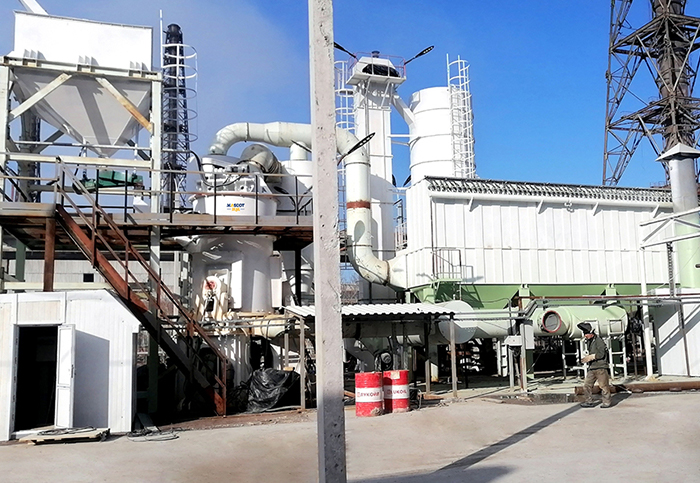
The production line of the vertical roller mill is a cost-effective and energy-efficient solution for processing powder, which is widely used in many industries, such as metallurgy, building materials, industrial solid waste treatment, thermal power plants, cement plants, and environmental protection fields. The primary purpose of this project is to finely grind raw materials through a vertical roller mill to meet the requirements of different industries for particle size, purity, and output of powder products.

The ball mill production line is a comprehensive production line that integrates material crushing, grinding, grading, and collection. This production line is mainly used to process various materials, including sand and gravel, cement, new building materials, silicates, refractory materials, fertilizers, ferrous metal beneficiation, non-ferrous metals, glass ceramics, etc.

The gypsum grinding production line is an efficient, stable, and environmentally friendly production solution, which is widely used in construction, decoration, the chemical industry, and other fields. In addition, the grinding process is particularly critical, which directly affects the quality and particle size of the final product. With the continuous development of science and technology, the technical level and production efficiency of gypsum grinding production lines will be further improved, providing strong support for the development of the gypsum processing industry.

This production line utilizes a three-ring medium-speed micro-grinding mill as the central equipment, complemented by other auxiliary equipment like hammer crushers, bucket elevators, and storage silos to establish a comprehensive grinding operation system. It has demonstrated strong potential for application and market competitiveness in industries such as construction, chemical industry, and new materials.
Green and Intelligent Mining Machinery
Manufacturing and Export Base
Based on high quality and perfect after-sales service, our products have been
exported to more than 120 countries and regions.
Copyright © 2023 Zhengzhou Mascot Environmental Technology Co., Ltd Record number: Yu ICP No. 13021523-4





 WhatsApp
