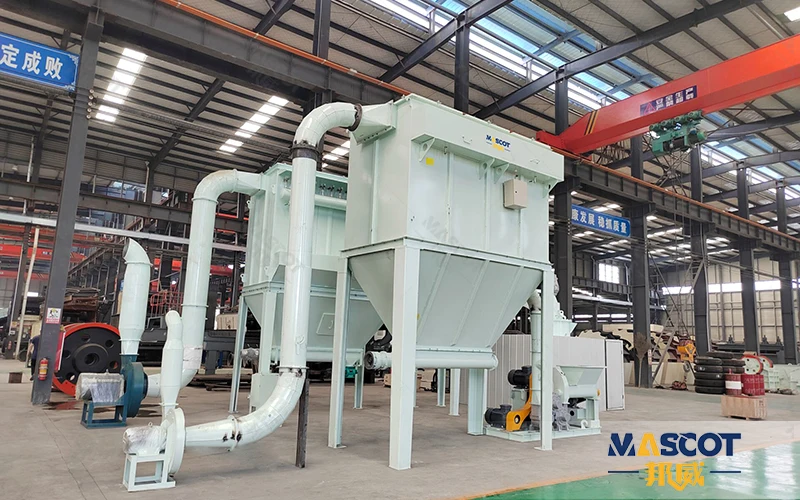
Paper coating grade and paint grade are the same mineral sold into two different specifications, and the gap between them is worth understanding before a producer decides which one to build a line for. Both are ground calcium carbonate. Both are bought on fineness. But the paper mill and the paint plant are solving different problems with that fineness — one needs a smooth, bright printed surface, the other needs a film that hides the substrate and holds its colour — and the specification each writes, and is willing to pay for, follows from that. This article compares the two grades line by line, shows where they diverge beyond fineness, and explains how one HGM Micro-Powder Grinding Mill from Zhengzhou Mascot Industry can serve both grades from a single investment.
Calcium carbonate is the cheapest white pigment and filler the coatings and paper industries have, which is why both industries buy enormous volumes of it — and why both insist on defining exactly what they are buying. In both cases the definition is a top cut plus a colour value. What changes is which of the two carries the commercial weight.
In paper coating, the powder becomes part of a thin layer that must dry to a smooth, bright, uniform surface: the surface the printer and the reader actually see. In paint, the powder becomes part of a film that must hide the substrate, keep its tint and stay stable in the can. Both buyers reject a delivery for the same underlying reason — the powder did not behave as the specification promised — but what they are measuring, and what a producer must control to satisfy them, is not identical.

Coating smoothness and gloss come from fine, uniform particles. A coating-grade calcium carbonate is typically ground to the fine end of the range — a cut such as 1250 mesh at D97 is the working reference in this application — and the mill must hold that cut batch after batch, because the coating colour is formulated around it. If the pigment's particle size drifts, the coating gloss changes; if the powder carries colour or contamination, sheet brightness falls.
Two further requirements follow from the process rather than the product. Coarse residue is critical in coating: one oversize particle can print as a visible defect, so the coarse tail matters more than the average. And moisture has to be controlled for storage and for the coating colour preparation. The full treatment of this grade — fineness, whiteness and the grinding behind it — is set out in the analysis of paper coating calcium carbonate fineness and whiteness.
Paint and coating grade calcium carbonate spans a wider fineness band than the paper grade, because it serves more than one job: the paints and coatings industry buys across the 600-2500 mesh band, using the coarse end for economy fillers and the fine end where gloss, hiding power and film smoothness matter. An interior emulsion and a high-gloss industrial finish do not buy the same powder, even from the same mine.
The specification follows the film. Brightness and tint strength decide how much titanium dioxide the formulator has to add, so a brighter extender is worth more per ton than a darker one at the same fineness. Top cut decides gloss, film smoothness and settling behaviour. Oil absorption decides how much filler the formulation can accept before the rheology changes. And in plastics, rubber and some paint systems, the grade is bought surface-treated — coated — to improve dispersion and compatibility, which is a post-grinding step on top of an already correct cut. The specification pattern for treated grades is the same one described for ultra-fine filler specs for rubber and plastics.

Put the two grades side by side and the overlap is larger than the differences — which is precisely why one grinding line can serve both.
| What the Buyer Specifies | Paper Coating Grade | Paint and Coating Grade | Where the Two Overlap |
|---|---|---|---|
| Fineness / top cut | Fine end of the range; a cut such as 1250 mesh at D97 is the working reference | Wide band, roughly 600-2500 mesh, set by the paint system and the role of the filler | Both are bought as a D97 cut with a controlled coarse tail, not as a nominal mesh range |
| Brightness / whiteness | High brightness is the reason the pigment is in the coating colour at all | Brightness and tint strength drive hiding power and the titanium dioxide budget | Both treat brightness as a specification, and neither can correct a loss downstream |
| Coarse residue | One oversize particle can print as a visible defect | Coarse particles show as film roughness and settling | Both pay for a controlled top cut rather than for average fineness |
| Moisture | Controlled for storage and coating colour preparation | Controlled for feeding, dispersion and shelf stability | Dry, sealed handling protects both grades |
| Surface treatment | Normally supplied uncoated | Coated (surface-treated) grades demanded by plastics and part of the paint market | Treatment is a post-grinding step on the same base powder; it cannot rescue a bad cut |
| What the buyer is really buying | Sheet appearance: gloss, smoothness, print quality | Film performance and cost per unit of hiding | Consistency delivered as a specification the buyer can rely on |
The practical reading of this table is that the two grades are not separate products. They are two settings of the same product, separated by the classifier and by how the powder is handled after grinding.
Fineness gets the attention, but four other factors decide whether a producer can actually serve the grade it is quoting:
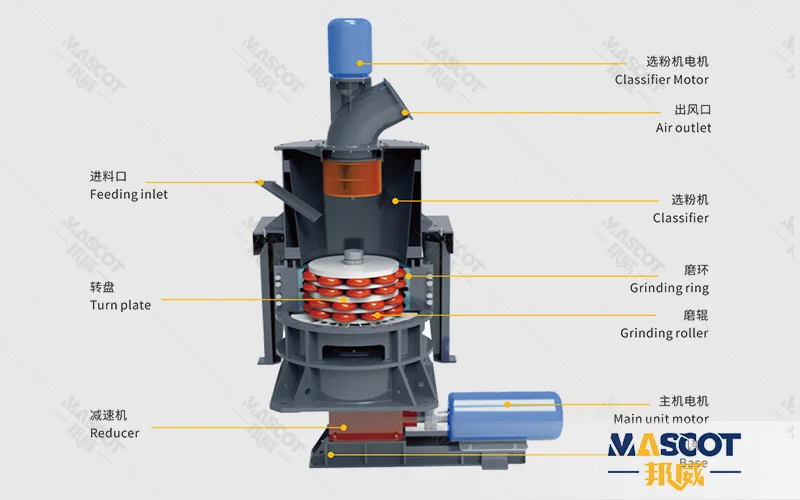
The HGM series is built so that the grade is a setting rather than a second plant. Multi-layer rollers press the material against the ring under centrifugal force while a variable-frequency turbo classifier cuts the product across the 325-2500 mesh band, so moving from a 1250 mesh coating grade to a paint-grade cut is a classifier change on the same machine, not a different mill. The series holds a D97 pass rate above 98% with fineness stability of about ±2%.
Changeover is fast enough to be commercial: one machine switches between minerals in 30-60 minutes, and the lined powder path in the grinding and conveying stages is what prevents a pigment grade from picking up colour or iron from the product that ran before it. Around the mill, the process is integrated — feed crushing, grinding, classification and collection with a cyclone and pulse-jet bag filter — and delivered as a complete line with feeder, bucket elevator, control panel, drawings and commissioning support. The module-by-module logic of that line is set out in how a complete HGM line is configured.
The commercial case for serving both grades is that they occupy different price bands on the same mineral. A producer selling bulk filler competes on tonnage; a producer holding a coating or premium paint grade is selling a specified product into a much smaller competitive set, and the buyer's alternative is a jet mill line whose cost per ton is on a different scale. Moving up the ladder from 325 mesh to 1250 mesh is what changes that, and the arithmetic of the move — cost per ton at the fine end against the bulk grades left behind — is worked through in the 325 to 1250 mesh ROI model.
Running both grades on one line spreads the investment across two markets instead of one. It also changes the sales conversation: a plant that can offer a 1250 mesh coating grade, a paint-grade cut and a treated filler grade from the same mill is negotiating three specifications rather than one commodity price.
Most failed grade trials trace back to a specification that was never written down precisely. Before quoting either grade, fix these six points:
The calcium carbonate grinding page sets out how calcite and limestone behave through this process, and Mascot's free project design returns a configuration sized on your mineral and your target grade rather than on a catalogue figure.
Q1: What fineness does paper coating calcium carbonate need compared with paint grade?
Coating grade sits at the fine end of the range — a cut such as 1250 mesh at D97 is the working reference — while paint and coating grade is bought across a wider band, roughly 600-2500 mesh, depending on whether the filler is there for gloss or for economy volume. The HGM series produces the whole 325-2500 mesh band on one machine, so the grade is set by the classifier.
Q2: Can one mill produce both grades?
Yes. Moving between them is a classifier change, and one machine switches between minerals in 30-60 minutes with a lined powder path so that colour is not carried from one product into the next.
Q3: Why does brightness matter more than fineness in some quotations?
Because brightness is what replaces expensive pigment in the formulation. Two powders at the same cut can price differently on tint strength alone, and no amount of grinding can correct a dark deposit.
Q4: How stable is the fineness in production?
The variable-frequency turbo classifier holds a D97 pass rate above 98% with stability of about ±2%, against the ±5% typical of conventional lines — the difference between a grade that survives a re-order and one that generates complaints.
Q5: What warranty applies?
Twelve months on the whole machine and on core components — rollers, rings and classifier — with 24/7 online support and engineers available for installation, commissioning and operator training.
Paper coating grade and paint grade calcium carbonate are the same mineral separated by a top cut and by the colour and handling discipline around it. The paper mill buys a fine cut and high brightness to protect a printed surface; the paint plant buys a cut matched to its film, with brightness that reduces its pigment bill. Both buy consistency in those numbers, and both reject a delivery when it moves. A single HGM Micro-Powder Grinding Mill covers the whole 325-2500 mesh band with a turbo classifier holding D97 above 98% at about ±2% stability, a lined powder path that protects brightness, sealed collection that keeps the fine fraction in the product, and changeover in 30-60 minutes — two price bands from one investment. Send your mineral, your target D97 and your brightness goal, and Mascot will confirm which of the two grades your deposit can support.

About of Mascot
Zhengzhou Mascot Industry is a high-tech mining equipment company integrating R&D, manufacturing, sales, and after-sales service. Focusing on crushing, grinding, and mineral processing equipment, we provide professional solutions to our customers. We are ISO9001:2015 certified, and our products include mobile crushing plants, crawler crushing plant, construction waste crushing plants, jaw crushers, sand making machines, cone crushers, fine crushers, grinding mills, ball mills, etc., all with reliable performance to meet diverse project needs.
• Professional pre-sales support: Free project design and comprehensive solutions to help you accurately select the right equipment;
• Comprehensive on-site service: Providing installation guidance and worker training to ensure smooth equipment commissioning;
• Reliable after-sales guarantee: A complete after-sales system, timely response to technical inquiries and equipment maintenance, ensuring long-term stable operation.
To protect your rights, please contact us through the following official channels for professional service:
WhatsApp: 0086-16650273865
Email: mascot@mascotenv.com
We are committed to providing high-quality equipment and full-cycle services to deliver comprehensive intelligent solutions for the global mining industry!

This production line utilizes a three-ring medium-speed micro-grinding mill as the central equipment, complemented by other auxiliary equipment like hammer crushers, bucket elevators, and storage silos to establish a comprehensive grinding operation system. It has demonstrated strong potential for application and market competitiveness in industries such as construction, chemical industry, and new materials.

The Raymond mill production line is a highly efficient system designed for grinding operations, with a focus on energy efficiency, durability, and productivity. It caters to the needs of users by offering fine powder products in non-metallic ores, coal powder, and slag processing, aiding enterprises in achieving sustainable growth.
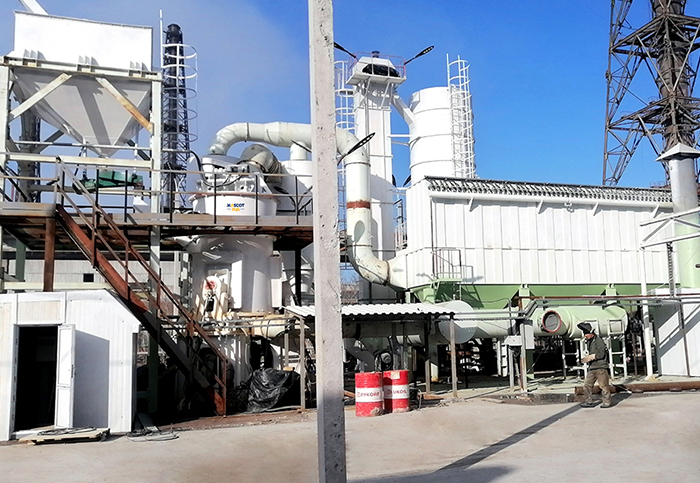
The production line of the vertical roller mill is a cost-effective and energy-efficient solution for processing powder, which is widely used in many industries, such as metallurgy, building materials, industrial solid waste treatment, thermal power plants, cement plants, and environmental protection fields. The primary purpose of this project is to finely grind raw materials through a vertical roller mill to meet the requirements of different industries for particle size, purity, and output of powder products.

YGMX Enhanced High-Pressure Mill is a new type of high-performance grinding equipment, and the biggest improvement of this milling equipment lies in the increase of the high-pressure spring system in the grinding roller part. Compared with the traditional high-pressure roller mill, it has a wider scope of application and excellent performance to meet the production needs of a variety of powder fineness. It is widely used in non-metallic minerals, chemicals, building materials, metallurgy, environmental protection, etc. Multiple areas.

The MTW series European grinding mill production line includes high-efficiency crushers, elevators, electromagnetic vibration feeders, milling machines, classifiers, and collectors. These pieces of equipment work together to achieve efficient crushing, grinding, and classification of various non-metallic ores, coal powder, slag, and other materials. It can meet the diverse needs of various industries for powder particle size, uniformity, shape, etc., and offer enterprises high-quality grinding products.
Green and Intelligent Mining Machinery
Manufacturing and Export Base
Based on high quality and perfect after-sales service, our products have been
exported to more than 120 countries and regions.
Copyright © 2023 Zhengzhou Mascot Environmental Technology Co., Ltd Record number: Yu ICP No. 13021523-4





 WhatsApp