
Most powder enquiries arrive with one number attached, and that number is usually a mesh count. The specification that actually decides whether a delivery is accepted is built from two: D50 and D97. They come off the same measurement report, they describe opposite ends of the same curve, and they pull a mill in different directions. This article covers which of the two belongs in the contract, which one belongs in the process discussion, and what happens to throughput when both are written in on an HGM Series Micro-powder Grinding Mill.
D50 is the median: half the powder is finer, half is coarser. It decides how a powder packs, how it discharges from a silo, what bulk density it travels at, and how much of it a compound will absorb before viscosity or stiffness runs away. None of those behaviours depends on a handful of coarse grains.
D97 is the top cut: the size that only 3% of the powder exceeds. It decides whether a 20-micron film shows a speck, whether a seal fails at one hard grain, whether a glaze fires smooth. The middle of the distribution cannot answer that question, and an average cannot either.
Both numbers describe one curve, and neither is complete alone. A median with no top cut says nothing about the tail. A top cut with no median says nothing about packing. Read together they give position and width — and width is where most supply disputes begin, because two powders can share a D50 to the decimal and still behave like different products.

The split is easier to see when the question comes from the plant floor rather than from a datasheet. These are the six questions that decide a powder purchase, and the number each one actually depends on.
| Question in the plant | Number that answers it | Why that number and not the other |
|---|---|---|
| How much filler can the compound take before flow changes? | D50 | Loading is a packing property of the bulk; the median and the spread set it, the tail does not |
| Will a speck show in a thin film or a gloss surface? | D97 | A single oversized grain creates the defect; the median never enters that decision |
| Will the powder discharge from a silo without rat-holing? | D50, plus the spread | Flow is set by the bulk, and a wide spread packs and segregates unevenly in storage |
| Will the lot pass the residue test at 325 mesh? | D97, or the measured top cut | Residue is a coarse-end measurement by definition |
| Which price band does the grade sell into? | D97 | Commercial grade ladders are written at the top cut, not at the middle |
| Can two suppliers' powders be blended without a surprise? | Both, from one method | Blending averages the medians but not the tails; a coarse tail survives the mix |
The pattern is consistent: process questions tend to be D50 questions, acceptance questions tend to be D97 questions. A quotation that names only one of them has answered only half the enquiry — which is why formulator spec sheets for polymer and rubber fillers carry both, alongside whiteness and moisture limits. The full set of clauses those sheets use is set out in the ultra-fine filler specifications for rubber and plastics.
Dividing D97 by D50 gives a rough width index that costs nothing to calculate. A powder with a 5-micron median and a 10-micron top cut has a ratio of 2.0 — a steep curve, most of the material packed into a narrow band. The same 5-micron median with a 16-micron top cut gives 3.2, a long coarse tail riding behind an identical median. On paper both read "D50 = 5 micron". In a coating line they behave like two different products, and the one that fails will be blamed on the supplier rather than on the specification.
The comparison only holds if both figures came from the same measurement. Laser diffraction, sieve analysis and sedimentation each report a different median for the same powder, and on laser instruments a wet dispersion usually pulls the fine end lower than a dry one. A D50 from one laboratory and a D97 from another is not a pair; it is two unrelated statements that happen to sit on the same page. When a customer sends a specification, the useful question is not only what the numbers are, but which method produced them — and a D97 clause with no method attached is difficult to enforce in either direction.

Specifying one number is not a simplification; it moves the risk to whoever receives the powder. Three versions of the same mistake are common.
The median-only order. The supplier meets the D50, ships a coarse tail, and the first delivery passes the datasheet while failing the customer's line. The saving negotiated on price is smaller than the cost of one rejected batch, and the dispute is unwinnable because the contract never named a top cut.
The top-cut-only order. Holding a tight D97 by grinding harder pushes the median down. Bulk density falls, dusting rises, and the compounder who bought a filler finds that more powder is needed to reach the same loading. The complaint arrives as "inconsistency" rather than as a fineness problem, which makes it harder to trace.
The mesh-only order. A mesh count is a trade band, not a measured limit: "800 mesh" can be satisfied with a top cut of 12 microns or 20 microns, and both suppliers will consider the order met. Two grades of the same mineral can diverge exactly here, as the comparison of paper coating and paint-grade calcium carbonate shows, and the difference is written in microns rather than in mesh.
The workable version of the clause is short: one acceptance number (D97 with its method), one behaviour number (D50 on the same report), and the material and feed condition the figures were produced from. That is also the shortest route to a quotation that can be compared with another one.
On a roller mill with an aerodynamic classifier, a tighter top cut is bought with throughput. Raising classifier speed sends more material back to the grinding chamber for another pass; the drive power stays where it was while tonnes per hour fall, so specific energy per tonne rises faster than the cut narrows. Wear cost per tonne follows the same curve, because more of the product is ground more than once before it leaves.
That has a commercial consequence. The right specification is the coarsest top cut the customer's process will actually accept — not the tightest number a competitor is willing to print. Every micron removed from the top cut is paid for in tonnage, and the payment is invisible on the datasheet: it shows up as capacity the plant cannot reach and as a cost per ton that never quite matches the business plan. The arithmetic of that trade between grade and cost per tonne is worked through in the 325 to 1250 mesh cost model.

On the HGM the cut is set by a variable-frequency turbo classifier, with airflow carrying the powder into it. Classifier speed positions the curve; air volume decides how much material is carried to the classifying zone at all. Together they move both numbers, which is the point worth understanding before a purchase: the operator can place the distribution where the contract needs it, but not reshape it. Width is a design outcome of the classifier type and the residence time in the chamber, not something a setting can invent.
The published performance at the cut is a D97 pass rate above 98%, with fineness stability of roughly ±2% against the ±5% typical of conventional lines, and a grade change completed in 30-60 minutes by classifier speed and airflow alone. The mechanism behind those figures — why an aerodynamic cut holds where a mechanical one drifts — is set out in the guide to how D97 is held on the HGM mill.
Two operating habits keep both numbers where the contract put them. The first is feed discipline: over-feeding coarsens the cut before any alarm sounds, because the classifier sees more tonnes than it can classify and passes coarse material with the fines. The second is wear inspection: worn rollers and rings change the shape of the curve gradually, so a mill can hold its D97 while its D50 drifts down and its bulk density quietly falls. Checking both numbers on every lot catches that drift while it is still an adjustment rather than a claim.
A model recommendation is one short exchange when the enquiry carries the numbers the mill will be judged against.
| Input | Why It Decides the Specification |
|---|---|
| D50 and D97 in micron, from one report, with the method named | Two numbers from one method describe a curve; two numbers from two methods describe nothing that can be guaranteed |
| The mineral and its Mohs hardness | The HGM band covers non-metallic minerals below Mohs 7; hardness also sets how fast the curve moves as parts wear |
| Tonnes per hour at that cut, not across the range | Capacity published for a model is an envelope over its whole range; the tonnage at a specific cut is what sizes the frame |
| The feed size the crushing stage will deliver | Published input limits run from 10 mm to 20 mm across the four models, so the crusher is chosen with the mill |
| Feed moisture and the drying arrangement | The series is published for feed below 6% moisture; above that the drying step belongs in the line design, not in the mill |
| Whiteness, iron or volatile limits, if the contract has them | These decide the wear-material grade and whether the powder path is ceramic-lined, rather than the model |
Mascot runs a grinding test on the customer's own material free of charge and reports a measured D50 and D97 with an output figure at that setting. For a project where the two numbers are the contract, that report is worth more than any catalogue table: it is the only document that ties a distribution to a specific mineral, a specific feed and a specific tonnage. The equipment list a finished line is built from — crusher, elevator, feeder, mill, classifier, collector and silos — is documented in the marble micro-powder line case.

Q1: Should D50 or D97 go into the purchase contract?
A: D97 is the usual acceptance clause, because it is the number that decides whether a delivery passes on the customer's line. D50 belongs in the same clause as the behaviour number, so that a supplier cannot meet the top cut by grinding the median away. Name one acceptance number and one behaviour number, and state the method for both.
Q2: Can I compare a D50 from one lab with a D97 from another?
A: No. Different methods report different values for the same powder, and wet and dry dispersion separate the fine end differently. Ask for both numbers on one report, with the instrument and the dispersion method named. A specification without a method is hard to enforce and easy to dispute.
Q3: Does a tighter top cut reduce output?
A: Yes, on any roller mill with an aerodynamic classifier. A higher classifier speed returns more material for a second pass, so tonnes per hour fall while drive power stays fixed, and specific energy per tonne rises. This is why the specification should sit at the coarsest top cut the application accepts rather than at the tightest one available.
Q4: Can one mill hold a D50 and a D97 at the same time?
A: It holds the pair that belongs to one classifier setting. Both numbers move together when speed and airflow change, so a second grade means a second setting — 30-60 minutes of changeover rather than a second machine. What the setting cannot do is narrow the distribution beyond what the classifier design produces; that would require a different machine class.

About of Mascot
Zhengzhou Mascot Industry is a high-tech mining equipment company integrating R&D, manufacturing, sales, and after-sales service. Focusing on crushing, grinding, and mineral processing equipment, we provide professional solutions to our customers. We are ISO9001:2015 certified, and our products include mobile crushing plants, crawler crushing plant, construction waste crushing plants, jaw crushers, sand making machines, cone crushers, fine crushers, grinding mills, ball mills, etc., all with reliable performance to meet diverse project needs.
• Professional pre-sales support: Free project design and comprehensive solutions to help you accurately select the right equipment;
• Comprehensive on-site service: Providing installation guidance and worker training to ensure smooth equipment commissioning;
• Reliable after-sales guarantee: A complete after-sales system, timely response to technical inquiries and equipment maintenance, ensuring long-term stable operation.
To protect your rights, please contact us through the following official channels for professional service:
WhatsApp: 0086-16650273865
Email: mascot@mascotenv.com
We are committed to providing high-quality equipment and full-cycle services to deliver comprehensive intelligent solutions for the global mining industry!

The MTW series European grinding mill production line includes high-efficiency crushers, elevators, electromagnetic vibration feeders, milling machines, classifiers, and collectors. These pieces of equipment work together to achieve efficient crushing, grinding, and classification of various non-metallic ores, coal powder, slag, and other materials. It can meet the diverse needs of various industries for powder particle size, uniformity, shape, etc., and offer enterprises high-quality grinding products.
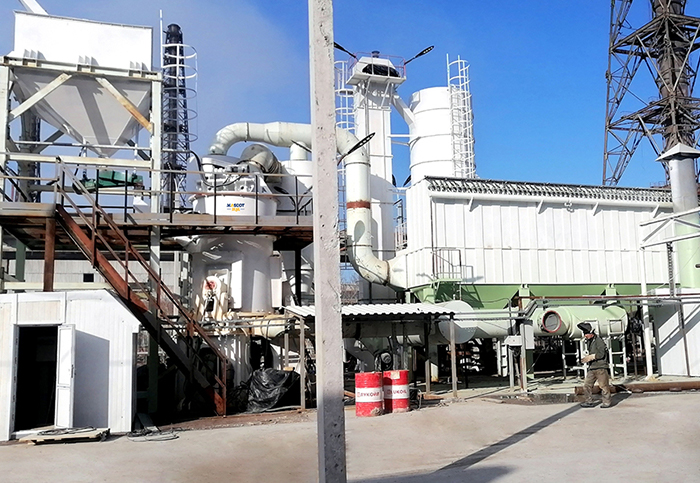
The production line of the vertical roller mill is a cost-effective and energy-efficient solution for processing powder, which is widely used in many industries, such as metallurgy, building materials, industrial solid waste treatment, thermal power plants, cement plants, and environmental protection fields. The primary purpose of this project is to finely grind raw materials through a vertical roller mill to meet the requirements of different industries for particle size, purity, and output of powder products.

YGMX Enhanced High-Pressure Mill is a new type of high-performance grinding equipment, and the biggest improvement of this milling equipment lies in the increase of the high-pressure spring system in the grinding roller part. Compared with the traditional high-pressure roller mill, it has a wider scope of application and excellent performance to meet the production needs of a variety of powder fineness. It is widely used in non-metallic minerals, chemicals, building materials, metallurgy, environmental protection, etc. Multiple areas.

The gypsum grinding production line is an efficient, stable, and environmentally friendly production solution, which is widely used in construction, decoration, the chemical industry, and other fields. In addition, the grinding process is particularly critical, which directly affects the quality and particle size of the final product. With the continuous development of science and technology, the technical level and production efficiency of gypsum grinding production lines will be further improved, providing strong support for the development of the gypsum processing industry.

This production line utilizes a three-ring medium-speed micro-grinding mill as the central equipment, complemented by other auxiliary equipment like hammer crushers, bucket elevators, and storage silos to establish a comprehensive grinding operation system. It has demonstrated strong potential for application and market competitiveness in industries such as construction, chemical industry, and new materials.
Green and Intelligent Mining Machinery
Manufacturing and Export Base
Based on high quality and perfect after-sales service, our products have been
exported to more than 120 countries and regions.
Copyright © 2023 Zhengzhou Mascot Environmental Technology Co., Ltd Record number: Yu ICP No. 13021523-4





 WhatsApp
