 25
 27
 25

Silica fume is sold as a specified ultra-fine powder, and the 800-3000 mesh band is where the specification does all the work: a buyer who measures a top cut in micron will not accept a mill setting that drifts above it. This guide covers the HGM Series Micro-powder Grinding Mill in that band — which models actually reach 3000 mesh, what tonnage to plan on at a fine cut, where the cost per ton sits against a ball mill circuit, and how the wear parts behave when the feed is a hard silica material.
The HGM series is published for non-metallic minerals with Mohs hardness below 7 and humidity under 6%, producing 150-3000 mesh (106-4 micron) powder. The working band of this article — 800 to 3000 mesh — sits inside that range, and the top of it is the finest the series reaches.
One point has to be stated before anything else, because it changes how the specification should be written. The published material list for this series is calcite, limestone, dolomite, talc, kaolin, barite, feldspar, gypsum, quartz and wollastonite. Silica fume is not one of the published material groups, and it should not be treated as interchangeable with the crystalline silica those pages describe: quartz is the hard-silica reference in this series at Mohs 7, and a hard feed at a fine cut is exactly where roller and ring wear starts to drive the cost per ton. The practical answer is the one the series' own literature recommends for any material — run a grinding test on your silica fume first, and fix the model and the wear grade from the measured result rather than from a catalogue figure. Mascot provides that test free of charge.
What can be said with confidence is how the band behaves. The cut is set by the built-in variable-speed turbo classifier, and at 2500-3000 mesh that classifier runs at its highest speed — the top cut is a classifier setting, not a change of grinding parts. Turning it down moves the same machine through every coarser grade in the 150-3000 mesh range. For a plant that sells more than one grade this is the commercial argument for the machine: 800 mesh and 3000 mesh are two settings of one mill, not two investments.

In this band the selection rule is the reverse of choosing at 325 mesh. At a coarse cut you pick the machine by tonnage and set the classifier afterwards; at 2500-3000 mesh you list the models that reach your top cut first, and only then choose between them on tonnage. The table below is the published specification, and the rated top cut column is the one that filters the list.
| Model | Average Diameter (mm) | Ringing Rollers (pcs) | Max. Input Size (mm) | Rated Top Cut | Capacity (t/h) | Main Grinder (kW) |
|---|---|---|---|---|---|---|
| HGM80 | 800 | 21 | ≤ 10 | 106-4 micron (150-3000 mesh) | 0.5-6 | 75 |
| HGM100 | 1000 | 28 | ≤ 15 | 106-4 micron (150-3000 mesh) | 1.2-10.2 | 110 |
| HGM100+ | 1000 | 34-36 | ≤ 15 | 106-4 micron (150-3000 mesh) | 1.2-11.5 | 132 |
| HGM125 | 1250 | 40-44 | ≤ 20 | 106-5 micron (150-2500 mesh) | 2.5-20.5 | 185 |
How to read this table: every figure is the published parameter for the series. The rated top cut is the finest finished-product size published for each model, and it is the column to read first: HGM80, HGM100 and HGM100+ are rated 150-3000 mesh, while HGM125 is rated 150-2500 mesh — so for a 3000 mesh top cut HGM125 is not on the list, however attractive its tonnage column looks. The HGM100+ row is highlighted because it is the model that combines a 3000 mesh top cut with the largest multi-grade flexibility in that group. The capacity column is the rated envelope across each model's full working range and is not the output at 5 micron; section 3 explains why that distinction decides the tonnage you can actually plan on.
The published capacity envelope across the four models is 0.5 to 20.5 t/h. Read at the fine end that number needs a second clause, because output and fineness trade against each other on any roller mill: at 2500-3000 mesh the classifier runs at its highest speed, the material stays in the grinding chamber longer than it would at a coarse grade, and the real output sits at the lower end of the envelope.
Two consequences follow for a project. First, sizing should be done at the grade you intend to sell, not at the range's headline figure — a plant quoting 3000 mesh on the strength of a model's upper capacity number is the most common way a fine-powder project disappoints in its first month. Second, the feed rate at a fine cut is deliberately lower than at a coarse grade; that is the trade for a 4-5 micron cut, and it is an operating decision, not a limitation to be worked around.
What the series does promise at the cut is repeatability. The variable-frequency turbo classifier holds a D97 pass rate above 98%, with fineness stability of roughly ±2% against the ±5% typical of conventional lines — and it is that figure, rather than the average particle size, that protects a fine grade against complaints when delivery ten is tested against the sample that won the trial. The mechanics behind the number are set out in the guide to how D97 is held on the HGM mill.

Two things separate a fine-powder line that runs at a predictable cost from one that does not: how fast the grinding parts wear, and whether the powder path introduces anything the customer did not order.

On wear, the published description is short and specific. The grinding rollers and rings are cast from a high-performance wear-resistant alloy and last 2-5 times longer than standard steel. The series' own cost comparison rates wear cost as low on the basis of high-chrome alloy (HRC 58-62) rated for Mohs 1-6.5 minerals, and it notes a second saving that a ball mill circuit cannot match: there is no grinding media to top up, so a whole category of scheduled work disappears from the maintenance calendar.
The honest limit is hardness. The series' published guidance is that hard minerals in the Mohs 6-7 range — feldspar and quartz are the examples given — can be ground in the finest band, but roller and ring wear rises sharply and the cost per ton rises with it. That is the point at which a wear estimate for your specific material should be obtained before an order rather than after, and it is why the free sample test is worth the freight on any silica-based feed.
On contamination, the mechanism matters more than a claim. The HGM grinds by pressure and shear rather than by impact, so heat generation is minimal and no iron is introduced by the grinding action itself. Where a specification is sensitive to colour, brightness or chemistry, the powder path can be specified with ceramic-lined classifier housings and piping so that it never contacts bare steel, and the product is collected in a pulse-jet bag filter under negative pressure so the finest fraction leaves the circuit as product rather than as dust. For a silica fume grade sold into a formulation where the chemistry is the product, that is a specification item rather than a maintenance preference.
At a 4-5 micron cut the cost per ton is decided by the whole circuit rather than by the mill alone, because a conventional ultra-fine line carries a second machine and a media bill that an integrated mill does not. The comparison below is the published one for this series.
| Cost Item | HGM Micro-Powder Mill | Conventional Ultra-Fine Circuit |
|---|---|---|
| Output at the same fineness | 30-40% higher than ball mill classification lines | Baseline |
| Energy consumption | 40%+ lower than ball mill classification lines at equal fineness | Baseline |
| Machines in the circuit | One — grinding, classifying and collecting in a single unit | Two — a mill plus a separate fine classifier |
| Wear cost | Alloy rollers and rings, 2-5 times standard steel; no grinding media to top up | Grinding media and liner replacement cycles |
| Floor space and civil works | Small | Large — two foundations and a larger dust system |
| Maintenance stops | Low — no ball reloading | High — scheduled stops for media top-up |
How to read this table: the output and energy rows are the same published figures this series quotes against ball mill classification lines at equal fineness, and they are relative comparisons rather than promises for a specific mineral. On the published costing basis — 2 t/h, 6,000 operating hours a year and an electricity price of $0.08/kWh — the mill cuts annual power cost by roughly 40% against a ball mill system. At 2500-3000 mesh every one of those figures has to be confirmed by a grinding test on your own material, because absolute kWh/t and cost per ton depend on hardness, feed size, electricity price and the D97 you are actually selling.
That last point is where the grade ladder becomes a commercial decision rather than a technical one. Moving from a bulk filler grade to a fine specified grade changes the competitive set the producer is quoting into, and the arithmetic of that move — cost per ton at the fine end against the bulk grades left behind — is worked through in the 325 to 1250 mesh cost model. The specification pattern that makes a fine grade sellable, including where two grades of the same mineral diverge, is set out in the comparison of paper coating and paint-grade calcium carbonate.

The machine is delivered as one integrated circuit rather than as a mill with accessories. Crushed raw material is elevated to the storage hopper and metered in by an electromagnetic vibrating feeder; multi-layer rollers press it against the ring; the airflow carries the powder to the turbo classifier, which passes the qualified cut and returns the oversize for regrinding; and the product is collected in the cyclone and pulse-jet bag filter. Where the top cut is 4-5 micron, the chamber residence time is longer than at a coarse grade, which is why minimal heat generation matters both for whiteness and for keeping crystal water where it belongs.
A standard ultra-fine line therefore lists: jaw crusher, bucket elevator, electromagnetic vibrating feeder, the HGM main unit with its turbo classifier, cyclone collector, pulse-jet bag filter and product silo, delivered with control panel, drawings and on-site commissioning guidance. The module-by-module logic of that arrangement is set out in how a complete HGM line is configured, and the equipment list of a delivered micro-powder plant — from hammer crusher and bucket elevator through to the storage silos — is documented in the marble micro-powder line case, which is the checklist any two quotations on a fine-powder line should be compared against.
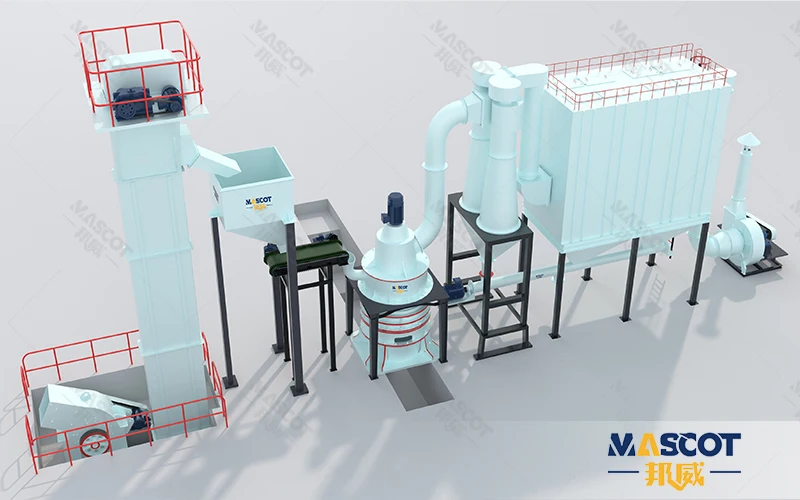
Two commercial details belong with the equipment list rather than after it. Changeover between minerals on this series takes 30-60 minutes, which is what makes a single mill viable for a plant selling several fine grades. And the mill carries a 12-month warranty on the whole machine with a further 12-month warranty on core components including rollers, rings and classifiers, alongside 24/7 online consultation and engineers available for on-site installation, commissioning and operator training.
A model recommendation is a short conversation when the enquiry carries the right six inputs, and in this band the first one — the material itself — carries more weight than it would for a soft mineral.
| Input | Why It Decides the Specification |
|---|---|
| A sample of the actual silica fume, with its measured hardness | It is not one of the published material groups for this series, so the model, the tonnage and the wear grade come from the test result rather than from a group table |
| The target stated as a D97 or D50 in micron | In the 800-3000 mesh band buyers state micron, not mesh; that number is what the classifier is set against |
| Tonnes per hour at that cut | Selects the frame among the models that reach the cut — and it must be quoted at the fine end of the envelope, not at the range maximum |
| The top cut you must never exceed | It filters the model list first: three models are rated to 3000 mesh, and the largest frame is rated to 2500 mesh |
| The feed size the crushing stage will deliver | The published input limits run from 10 mm to 20 mm across the four models, so the crusher is sized with the mill |
| Whether colour or chemistry is controlled in the product | Decides whether the powder path is specified with ceramic-lined classifier housings and piping |
Q1: Which HGM models actually reach 3000 mesh?
A: In the published parameters, HGM80, HGM100 and HGM100+ are rated 106-4 micron (150-3000 mesh), while HGM125 is rated 106-5 micron (150-2500 mesh). So for a 3000 mesh top cut the choice is between those three, and HGM125 is quoted only to 2500 mesh however large its tonnage column is.
Q2: What tonnage can I expect at 800-3000 mesh?
A: The published capacity envelope is 0.5-20.5 t/h across the four models, measured over each model's whole working range. At the finest end the classifier runs at its highest speed and the real output sits at the lower end of that envelope, so a firm tonnage at a 4-5 micron cut has to come from a grinding test on your material — the test is free of charge and reports a measured D97 with an output curve.
Q3: My feed is a hard silica material — will the wear parts make it uneconomic?
A: That is the right question to ask before ordering, because the published guidance is that hard minerals in the Mohs 6-7 range can be ground in the finest band but roller and ring wear rises sharply and the cost per ton rises with it. The rollers and rings are alloy, published at 2-5 times the life of standard steel, and a wear estimate for your specific material is provided before the order rather than after it.
Q4: Can grinding to 4 micron cost me whiteness or introduce iron?
A: The mill grinds by pressure and shear rather than impact, so heat generation is minimal and no iron is introduced by the grinding action. Where the specification is sensitive to colour or chemistry, ceramic-lined classifier housings and piping can be specified so the powder path never contacts bare steel, and collection takes place in a pulse-jet bag filter under negative pressure.

About of Mascot
Zhengzhou Mascot Industry is a high-tech mining equipment company integrating R&D, manufacturing, sales, and after-sales service. Focusing on crushing, grinding, and mineral processing equipment, we provide professional solutions to our customers. We are ISO9001:2015 certified, and our products include mobile crushing plants, crawler crushing plant, construction waste crushing plants, jaw crushers, sand making machines, cone crushers, fine crushers, grinding mills, ball mills, etc., all with reliable performance to meet diverse project needs.
• Professional pre-sales support: Free project design and comprehensive solutions to help you accurately select the right equipment;
• Comprehensive on-site service: Providing installation guidance and worker training to ensure smooth equipment commissioning;
• Reliable after-sales guarantee: A complete after-sales system, timely response to technical inquiries and equipment maintenance, ensuring long-term stable operation.
To protect your rights, please contact us through the following official channels for professional service:
WhatsApp: 0086-16650273865
Email: mascot@mascotenv.com
We are committed to providing high-quality equipment and full-cycle services to deliver comprehensive intelligent solutions for the global mining industry!
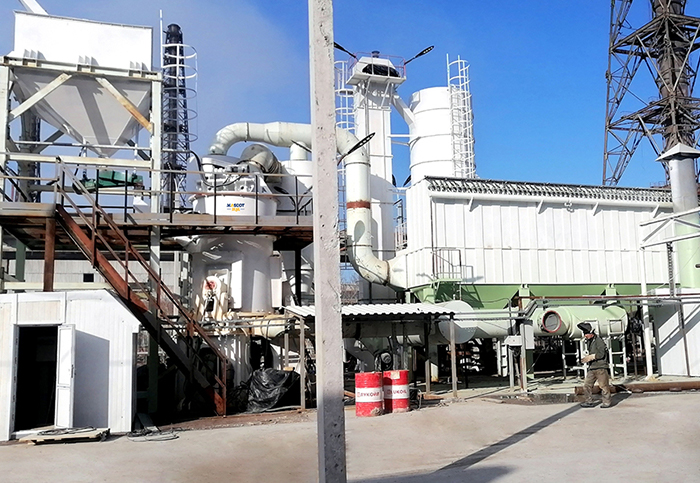
The production line of the vertical roller mill is a cost-effective and energy-efficient solution for processing powder, which is widely used in many industries, such as metallurgy, building materials, industrial solid waste treatment, thermal power plants, cement plants, and environmental protection fields. The primary purpose of this project is to finely grind raw materials through a vertical roller mill to meet the requirements of different industries for particle size, purity, and output of powder products.

The ball mill production line is a comprehensive production line that integrates material crushing, grinding, grading, and collection. This production line is mainly used to process various materials, including sand and gravel, cement, new building materials, silicates, refractory materials, fertilizers, ferrous metal beneficiation, non-ferrous metals, glass ceramics, etc.

This production line utilizes a three-ring medium-speed micro-grinding mill as the central equipment, complemented by other auxiliary equipment like hammer crushers, bucket elevators, and storage silos to establish a comprehensive grinding operation system. It has demonstrated strong potential for application and market competitiveness in industries such as construction, chemical industry, and new materials.

The high-pressure grinding mill production line is a project specially designed for efficient grinding operations. It is widely used in metallurgy, building materials, the chemical industry, highways, water conservancy hydropower, and other industries. It is a suspended roller mill that uses springs to increase pressure. It can achieve efficient grinding processing of various non-metallic raw materials. It has high efficiency, stability, and environmental protection characteristics.

The Raymond mill production line is a highly efficient system designed for grinding operations, with a focus on energy efficiency, durability, and productivity. It caters to the needs of users by offering fine powder products in non-metallic ores, coal powder, and slag processing, aiding enterprises in achieving sustainable growth.
Green and Intelligent Mining Machinery
Manufacturing and Export Base
Based on high quality and perfect after-sales service, our products have been
exported to more than 120 countries and regions.
Copyright © 2023 Zhengzhou Mascot Environmental Technology Co., Ltd Record number: Yu ICP No. 13021523-4





 WhatsApp
